New Hope joins hands with Fourier Intelligence to incubate an embodied intelligence company, which secures tens of millions of yuan in angel round financing.
Author | Qiao Yujie
Editor | Yuan Silai
Yingke learned that Shanghai Sunseed Intelligent Technology Co., Ltd. (SUNSEED, hereinafter referred to as "Sunseed Intelligent") recently completed an angel - round financing of tens of millions of yuan. We have summarized the information of this round of financing and several highlights of the company:

Financing Amount and Investment Institutions
Financing Round: Angel Round
Financing Amount: Tens of millions of yuan
Investment Institutions: Led by Ningbo Beilun Commercial and Logistics Investment Group, followed by Rongcheng Rongxin Fund and Shengjing Jiacheng.
Use of Funds: R & D investment, product iteration, and business promotion

Basic Company Information
Establishment Time: 2022
Company Headquarters: Minhang District, Shanghai
Technological Highlights: Sunseed Intelligent was jointly founded by New Hope Intelligent Equipment Manufacturing Co., Ltd., Feixi Technology, a leading unicorn enterprise in general intelligent robots, and a startup partner team.
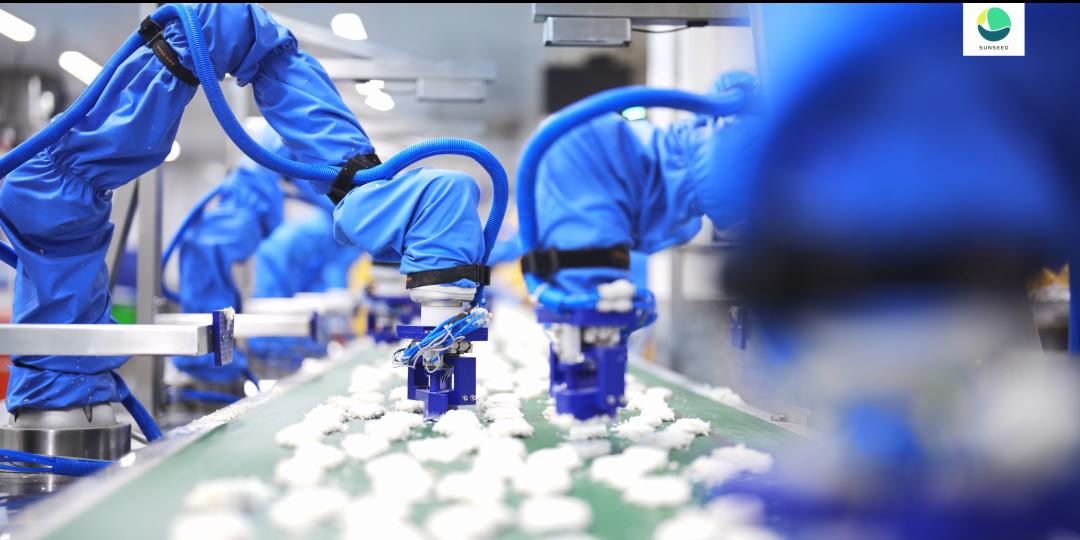
Sunseed Intelligent focuses on combining AI with flexible robot technology. It provides professional and flexible full - stack flexible food processing solutions for food production processes such as cutting, processing, and inner packaging. The company's core product, the general food processing single station, identifies and models incoming materials through the AI vision system, and generates personalized processing strategies through the inference of the intelligent decision - making system, maximizing the yield rate while ensuring efficiency. The execution layer is completed by a flexible robotic arm with high - precision real - time force control capabilities. Its "eye - brain - hand" collaborative architecture can independently complete complex tasks such as fine cutting, precise weighing, standard meal preparation, and in - line processing.

Market Analysis
Currently, China's embodied intelligence industry has entered the commercialization pilot stage from technology verification. The food processing field has a good automation foundation. However, in the fine - processing link, traditional automation equipment cannot solve the problems of randomness and variability of incoming materials in the food processing field, which has become a bottleneck restricting the increase of the proportion of automation equipment within individual enterprises.
With the maturity of AI technology and flexible robot capabilities, embodied intelligence is being deeply integrated with various fields and scenarios. The application of embodied intelligence in the food processing field will enter a growth period. Achieving automation in the fine - processing link through the combination of AI and flexible arms is considered to have broad market space. According to the calculation data provided by the enterprise, the market for labor replacement in the food processing field can reach the trillion - yuan level.
(Image Source/Enterprise)

Team Background
Mao Liang, the co - founder and CEO of the company, once served as the head of the product line at Geek+ Technology, the product director and the general head of product R & D at Minglue Group. He has more than 10 years of experience in continuous startup teams and rich experience in building products from scratch and assembling teams.
Dr. Liu Xu, the co - founder and chairman, graduated from the Department of Electronic Engineering at Tsinghua University with a bachelor's degree and obtained a doctorate in Electronic and Electrical Engineering from Imperial College London. He is the chairman of New Hope Intelligent Equipment Manufacturing Co., Ltd., a practical professor at the Shenzhen International Graduate School of Tsinghua University, and an advisor to the Airbus Group. He once served as the vice - president of Siemens China Co., Ltd.

Q&A with the Founding Team
Yingke: What are the technical difficulties in applying embodied intelligence in the food processing field? Where does the differential advantage of Sunseed's general flexible robot lie?
Mao Liang: The automation coverage in the food processing industry is actually not low, but the proportion of automated processing procedures in many categories of factories is not high, only about 20% - 30%. The main reason is that traditional automation equipment cannot solve the problems of randomness and variability of incoming materials in the food processing field. Therefore, the fine - processing and other links still highly rely on manual labor.
In terms of differential advantages, first, we adopt the "general intelligence + force - controlled arm" solution, realizing "eye - brain - hand" collaboration through AI, enabling the equipment to understand the characteristics of incoming materials like a human being, and judge which parts need to be processed and how to process them. We have accumulated a lot of industry know - how and data in the food processing industry, and our products have strong industry adaptability. Currently, only we are doing embodied intelligence specifically for the food processing industry.
Second, our equipment can be quickly deployed and used for multiple purposes. First, our equipment is a small standardized device, similar to a small food processing single station. When deploying, you only need to change camera - like components according to the user's needs, and it can be quickly deployed like building blocks. Second, at the software level, we support flexible switching between different processing modes. When the product line category or finished product requirements change, you can switch the control logic with one click to achieve rapid line change. There may be some simple parts that need to be replaced, but users can replace them by themselves.
Yingke: What is the company's current business model? Is it mainly equipment, or an overall delivery of "equipment + software + solutions"?
Mao Liang: We adopt the "equipment + software + solutions" model. For example, if a customer has already deployed a production line and needs to change the processing variety or processing method later, if it is a scenario that the system has learned, the customer can directly purchase a license for use. If it is a new scenario, with the overall logic remaining unchanged, the customer can also train the model on our operating platform by themselves, or we can provide customized services. Currently, we have covered many application scenarios, and most needs can be met through license upgrades, similar to the OTA updates of equipment.
Yingke: How is the current commercial delivery situation? Can it solve the customer's pain points?
Mao Liang: At the beginning of commercialization in 2024, indeed, many customers were on the sidelines, thinking that embodied intelligence equipment was relatively new. However, as more actual production lines were put into operation and more delivery cases were completed, more and more customers saw the actual effects of the equipment and began to be willing to introduce it.
For customers, the benefits are mainly reflected in two aspects: one is labor replacement. The problem of difficult recruitment in the food processing industry is very prominent. Some enterprises have orders but cannot recruit enough workers, and our equipment can directly solve the problem of insufficient production capacity. The other is reducing losses. Compared with manual operation, our system can achieve a higher pass rate and stability, and is more accurate and faster in cutting and meal preparation. Now, when many customers receive new orders, they will come to communicate with us first to see if the entire production line can be automated.
Yingke: What do you think of the future application of embodied intelligence in the food processing field and the possible industry competition?
Mao Liang: The trend of using embodied intelligence to solve food processing problems is becoming more and more clear. At the same time, there are high thresholds in this industry. We started exploring in 2021, founded the company in 2022, and only really achieved commercialization cases in 2024. A lot of traditional industrial automation experience is not applicable here, such as the corrosion problem caused by high - humidity environments and disinfectant spraying. Also, for the recognition, grasping, and processing logic of different ingredients, which parts are edible and which parts have higher value, all require long - term accumulation of a lot of industry know - how. These models, data, and experience in vertical fields are themselves barriers. In the future, more enterprises will definitely join this track, but we have an open attitude. Only when more participants work together can the industry truly develop.
Yingke: What are Sunseed Intelligent's future development plans after the financing?
Liu Xu: Sunseed Intelligent has completed the transition from 0 to 1. We hope to complete the transition from 1 to 10 as soon as possible starting from 2026, continue to accumulate and conduct forward - looking R & D internally, and achieve leap - forward growth in external business.
In terms of product detail control, our products will be more modular and standardized, with more standardized hardware components and application functions. We will also continue to strengthen investment in AI models to ensure the stability and continuous upgrade of the mass production of Sunseed Intelligent's "general food processing single station" and cover more scenarios.
In terms of commercialization, after fully expanding the domestic food processing commercial market, Sunseed Intelligent will focus on exploring more replicable commercial scenarios. In addition, we are also looking at the global market and have started to contact overseas food processing factories to test our products.