Li Feng: My Outlook and Predictions for 2026: Earning Money, AI, and the Logic of Competition
Standing in 2026, we will suddenly realize that the technological explosion in the past few years was merely the prologue of the era. The real social - level applications and industrial reshuffling have just begun. Facing the great changes and reconstructions in the next 5 to 20 years, where exactly are the new round of dividends and opportunities?
Li Feng, the founding partner of Peakview Capital, gave his key outlook on 2026 in a major annual sharing at Hundun Academy. This is not only a discussion about AI technology but also a deep review of money, technological innovation, and the competitive logic of the AI industry.
Regarding the second half of the AI era: All technological cycles have an upper half and a lower half. In the upper half, the United States leads in technology, but in the lower half, China has more advantages. And in the later stage of each technological wave, China often starts to catch up and overtake.
Regarding China's AI opportunities: AI + hardware will become China's strategic opportunity. When the combination of "software + hardware" becomes China's forte, we can leverage the supply - chain advantages developed through China's highly competitive manufacturing industry to achieve industrial transformation and upgrading.
Regarding the ultimate competition: In the Sino - US AI competition, China is holding another trump card: data. Ten years from now, the final outcome of the great - power competition will focus on two things: energy and data. Whoever has more certain and long - term advantages in these two aspects is more likely to win.
The following is a refined summary of the key points from Teacher Li Feng's opening - year course in 2026. It is recommended to save and read it carefully . This article only accounts for 50% of the full content. The complete content is available on the Hundun APP.
Thanks to Hundun for the invitation, which gives me a chance every year to share with you. I also take this opportunity every year to try to explore from our perspective: Why has the world and China, where we live, developed into what it is today? Why are the situations around you and your personal experiences the way they are now?
Today, let's first discuss a very hot topic recently, which is also the focus of the Sino - US competition. Its core mainly lies in: Is AI a productivity revolution?
Facing the next 5 years, 10 years, or even 15 to 20 years, your most important questions are: Should you participate in AI today? With how much enthusiasm should you participate? At what speed should you participate? All these depend on whether you think AI is a productivity revolution.
If you think AI is a productivity revolution, then looking back at all the productivity revolutions in history, from the time when obvious technological changes start to occur until they change our lives and productivity, it usually takes a long time.
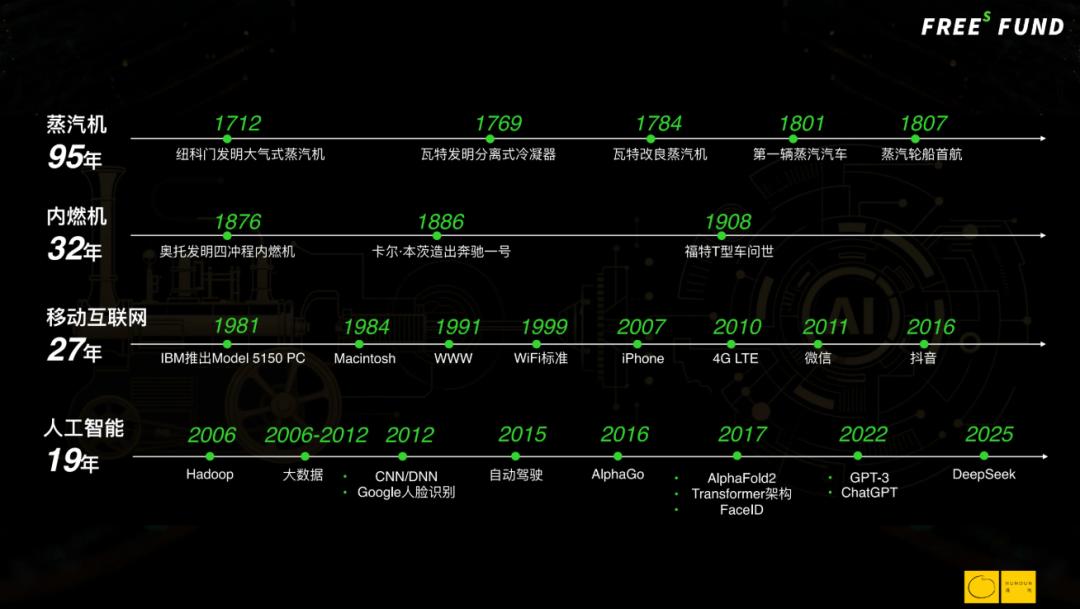
It took 95 years from the birth of the steam engine in 1712 to the actual implementation of steam cars and steamships; it also took about 30 years from the appearance of personal computers in 1981 to the time when iPhone and WeChat became national - level applications.
The same is true for AI. Initially, from 2006 - 2012, the "big data" stage was not strictly AI but rather the construction of AI infrastructure. It was not until 2012 that Google's facial recognition technology brought about the first wave of artificial intelligence, and it has only been 13 years since then, which means there is still a long way to go for the systematic transformation of AI into productivity.
So, if you haven't started with so - called AI yet, you don't have to be too anxious because you still have enough time.
01
Why is the current AI boom unprecedented?
In the above figure, we can see that the evolution of AI has encountered four booms in total.
The first time AI became popular was when Google recognized a cat from a bunch of chaotic and disordered pictures. This was the real starting point for neural networks to attract widespread attention. So, the first large - scale applications of AI fell into two directions: facial recognition and autonomous driving.
If you recall 2015, the most highly valued unlisted company globally was the ride - hailing app Uber. At the same time, Tesla launched the predecessor of the FSD beta version. So, people began to combine the imagination of autonomous driving and vehicle dispatching. The idea that all cars in the future could be autonomously driven and uniformly dispatched directly triggered the boom in autonomous driving.
The second time was when AlphaGo played Go, but this was still far from the lives of ordinary people.
The third time was when AI was used for protein structure prediction, which gave rise to a wave of AI - powered drug discovery. Why did AI - powered drug discovery become popular? Looking back with hindsight, the pattern is very clear. Protein structure prediction itself was just a technological breakthrough and would not immediately become an investment hotspot.
The real turning point was that the pandemic rapidly heated up the biopharmaceutical industry. Against this background, AI capabilities began to enter the biopharmaceutical field, and the intersection of the two gave rise to this investment focus .
Next, we come to the large - language models that we are familiar with today.
So, you will find a clear pattern: Every time there is a breakthrough in AI technology, it will form a real application wave and an "investment focus event" only when it coincides with an industry that is undergoing structural changes.
Since this is the fourth AI boom in history, why is this one particularly hot? It not only attracts everyone's attention but has also heated up to the point where China and the United States are engaging in all - round and fierce competition in chips, computing power, models, and applications. There is a crucial macro - perspective behind this.
We all know that there is a standard for measuring the bubble level of the capital market - the "Buffett Indicator", which refers to the proportional relationship between the GDP of an economy, a country, or a region and the total market value of its capital market.
Looking back at 2019 before the pandemic, if we consider the world as a whole, the global GDP was about 86 trillion US dollars, and the total market value of the global stock market was about 89 trillion US dollars. The ratio between the two was close to 1:1, which was in a relatively reasonable range. Among them, the US stock market accounted for slightly more than one - third.
Then, in 2020, the pandemic broke out. The direct consequence was that in the following year and a half, the world carried out an unprecedented "money - printing" on a scale unimaginable in history.
In 2020 alone, the combined expansion of the balance sheets of the Federal Reserve, the European Central Bank, and the Bank of Japan reached about 8 trillion US dollars.
Statistics from TradingView further show that around that year, the balance - sheet expansion of the world's major central banks reached about 12 trillion US dollars.
Balance - sheet expansion is not simply "printing money". When this base money starts to enter the real - economy cycle through channels such as bank credit, it will further generate a "multiplier effect" on money.
This 12 - trillion - dollar money injection brought nearly 50 trillion US dollars of global liquidity, which is extremely rare in the history of the global economy.
Against the background of extremely abundant capital, in February 2022, the Russia - Ukraine conflict broke out. This had a huge impact on Europe: at the bottom was energy security; there were even news reports at that time that German families had to cut wood for the winter. In the middle was supply - chain stability because there would be no production without energy. At the top was national security.
In the global capital - allocation pattern, the United States, Europe, and China are the three most important markets.
Facing this situation, imagine that if you are in charge of allocating 100 billion US dollars, you obviously would not want to allocate it to European assets. And in 2022, China was still in the process of pandemic prevention and control.
The result of the under - allocation of Europe and China was that the incremental funds were extremely concentrated in US - dollar assets.
Meanwhile, in 2022, the US - dollar interest rate rose, which also attracted the return of funds.
All these "historical special cases" coincided during this window period. As a result, so much money had to be extremely concentrated in US - dollar assets.
Since the third quarter of 2022, global funds have poured into US - dollar assets, and asset prices have naturally risen.
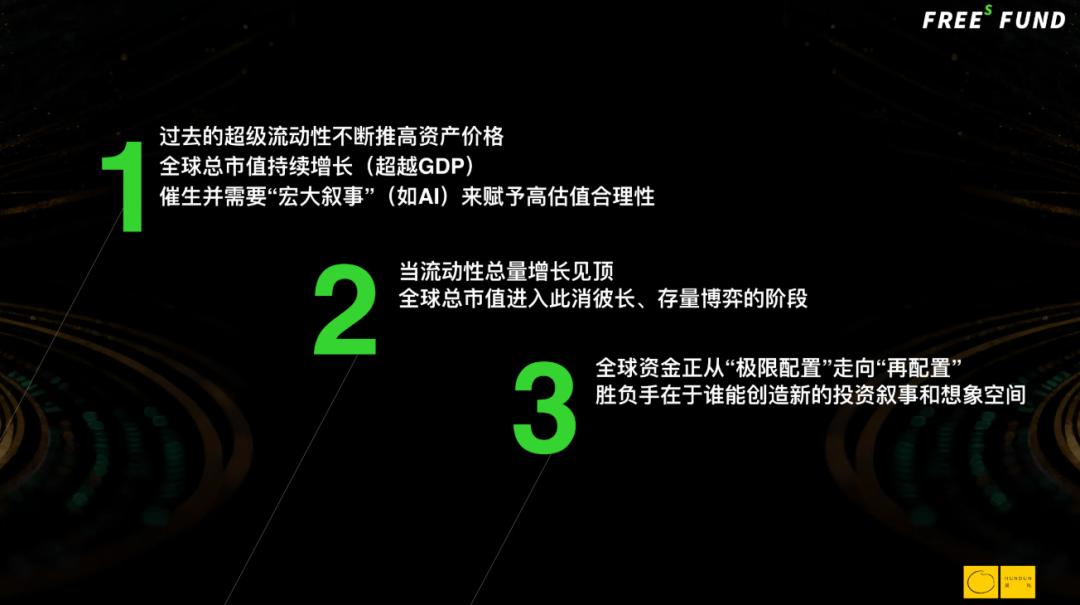
However, the problem is that the capital market cannot simply explain the price increase as being driven by liquidity (so much money has come to me). It has to find a grand "narrative" to explain the reason. So, the market urgently needs an "axis", a story and logic to support the continuous and large - scale increase in asset prices.
Coincidentally, in the fourth quarter of 2022, ChatGPT 3.5 emerged out of nowhere. The timing of this technological progress happened to be when the market was extremely eager for a "big story". This "narrative" was thus born.
So, the things that have happened in the next two years are unimaginable. We have witnessed companies with a market value of 4 trillion US dollars; we have witnessed that the combined market value of the "Magnificent Seven" in the US capital market (Google, Amazon, Apple, Meta, Microsoft, Nvidia, and Tesla) exceeds the GDP of any country in the world except China and the United States.
Why is this round of AI so hot? Simply put, it is because there is too much money, and the money has been "extremely allocated". As a result, phenomena unseen in history have emerged.
In 2026, if the world no longer prints money on a large scale as it did during the financial crisis or the pandemic, the capital - market value will remain at 130 trillion US dollars. Once the capital scale is balanced, the market becomes a "zero - sum game"; if A gets more, B has to get less.
The only difficult question today is: Can the US stock market still maintain its current level?
Let's set an extreme scenario - you are in charge of 100 billion US dollars but are forced to allocate more than 80% of your funds to US - dollar assets. This is an "extreme allocation". However, as long as there are factors that make you feel insecure and uncertain, this allocation cannot be sustained.
At the end of 2024, Trump took office, which in itself constituted a huge uncertainty. So, the funds shifted from "extreme allocation" back to "rational allocation", which is what we call re - balancing and re - allocation.
Assuming that the world no longer engages in aggressive money - printing and the liquidity level remains basically stable, funds will only look for relatively certain assets with medium - to - high growth and returns globally, while avoiding over - concentration in the US - dollar system.
This leads to a result: A huge amount of funds start to flow and look for a destination. The real competition lies in who can provide more sufficient and credible reasons to attract the funds. The United States needs it, China needs it, Europe needs it, and all economies need it.
The ultimate game is about who can accumulate more "positive factors".
02
Investment logic in the AI era
The investment logic in the AI era is directly related to our wallets.
The questions that people are most concerned about are: Will the enthusiasm for AI in the United States decline? If it does, will it affect China? How can China pick up the next baton?
In the simplest terms, all historical technological investment cycles can be roughly divided into an upper half and a lower half. This is the case from big data, facial recognition, and autonomous driving to AI - powered drug discovery.
In the upper half, people only care about technological innovation. Capital will generally invest in whoever has the technology. In the lower half, it mainly depends on who uses the technology for applications and, preferably, makes money. That's who will be in the spotlight.
If we look back at the history of technological development, in the upper half of the technological cycle, the United States often takes the lead. In the middle, China and the United States each have their own advantages. The United States has more advantages on the technology side, and China has more advantages on the application side. And in the later stage of each technological wave, China often starts to catch up and overtake.
Taking AI as an example, we can divide it into three stages.
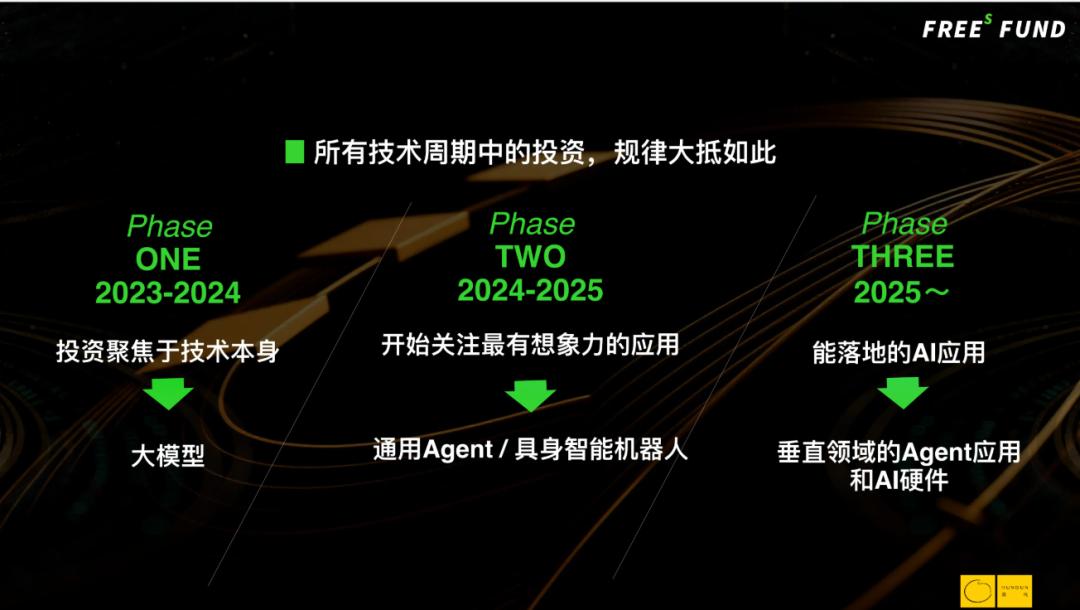
The first stage was from 2023 to the first half of 2024, when all people discussed was large - language models.
The second stage started in 2024, and AI applications became very popular in both China and the United States, especially in the two directions of general agents and embodied intelligent robots.
Why did the trend change?
Because all changes start with technological innovation, so people will first invest in technology. However, technological development will not always exceed expectations. After technology takes a small step forward and makes a leap, it will enter a relatively linear development stage. Once it enters the linear - development stage, people will start to think that since there has been a technological breakthrough, what is most likely to use the technology? It is applications.
In the field of AI, such applications are, first, general agents (intelligent agents), which can help you do all the things you need to do in the digital world, or at least help you with part of them. Second, there are embodied intelligence or humanoid robots, which can help you complete all tasks in the physical world.
One can help you do all things in the digital world, and the other can help you do all things in the physical world - these are obviously applications with the greatest imagination.
However, what is the flip side of this "greatest imagination"? It is that in the short term, they are the most difficult to implement. Otherwise, they wouldn't have so much imagination.
The third stage involves AI applications that can be implemented, typically vertical - domain agent applications and AI hardware. Invest in applications that can be truly implemented and make money. When the market enters this stage, technological applications become more down - to - earth, and the valuation logic for a project also shifts from "telling stories" to "doing calculations".
The current AI investment has started to move towards this stage. The core question is: Who can make money with AI today?