Insights into the automotive aftermarket: Differentiation and breakthroughs in the game between gasoline and electric vehicles
In 2025, China's automotive aftermarket entered a critical turning point.
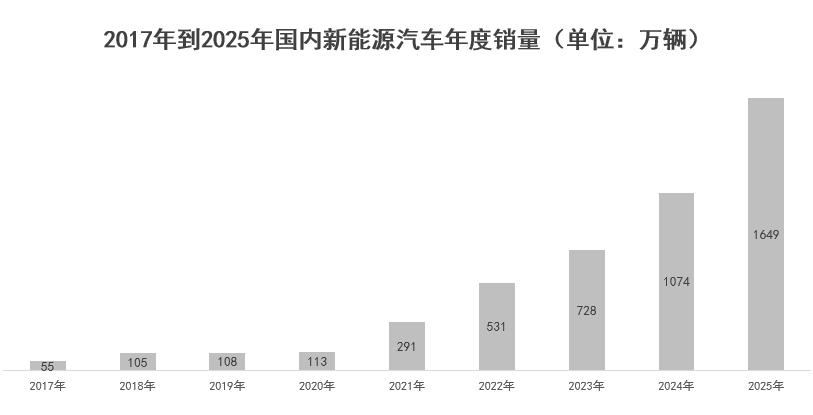
A vehicle ownership of 360 million solidified the stock base, a total vehicle sales volume of 34.4 million continued to inject vitality into the market, and the sales volume of 16.49 million new energy vehicles activated the incremental space. The superposition of these three potentials laid a solid foundation for the development of the aftermarket.
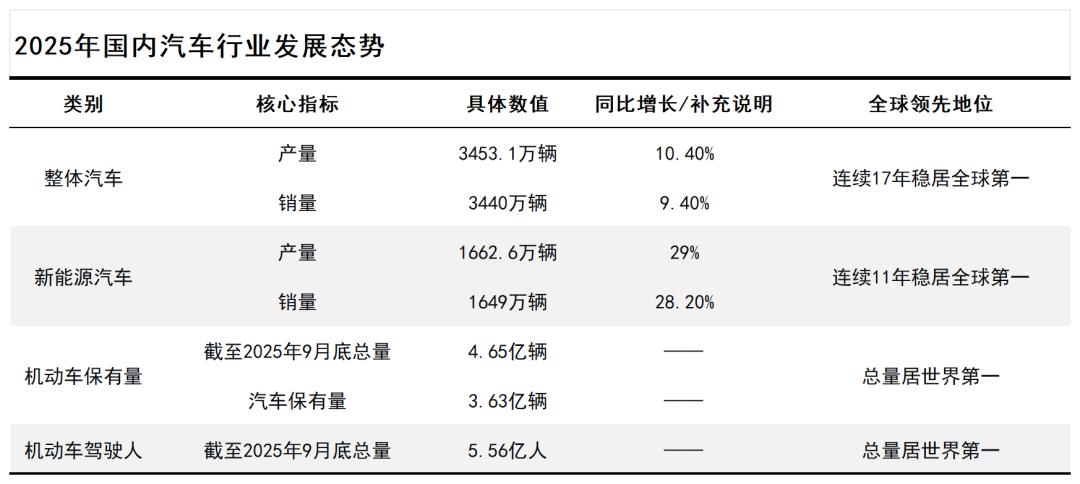
Source: Compiled based on public information. Chart by DoNews
However, not all parts of the huge industrial chain are moving in a positive direction. Instead, there is a distinct differentiation trend: the rationalization of consumption has pushed the sales volume of second - hand cars to exceed 20 million for the first time, but it has put pressure on the number of vehicles entering maintenance and repair shops. At the same time, the upgrading of personalized, intelligent, and digital demands has given rise to new growth poles such as specialized repairs, in - depth repairs of old cars, and personalized modifications.
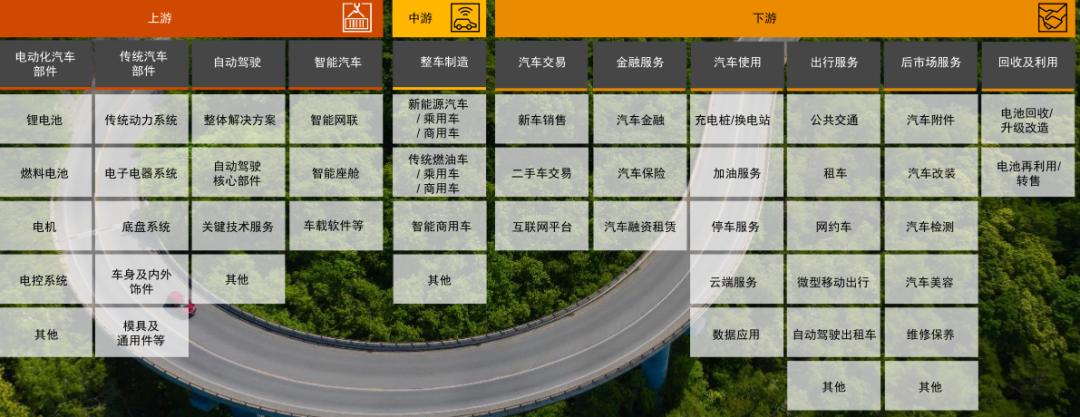
Source: PwC
The underlying logic of the competition between fuel - powered and electric vehicles has led to differentiated development trends in various sub - chains. The car washing and beauty business, with its adaptability across different vehicle models and power types, has become the focus of traffic competition in the market. The differentiation of product categories in the auto parts market has intensified, with significant differences in popularity. The maintenance and repair track has bid farewell to extensive growth and entered a new cycle of "stock competition + structural reshaping". The new energy vehicle insurance has achieved scale expansion and initial profitability, accelerating the reshaping of the ecosystem. The fields of power battery testing and recycling are also gradually moving towards standardization driven by both policy guidance and market demand.
Against this background, how to complete in - depth transformation in line with the new energy trend, strengthen the core competitiveness of enterprises, and accurately perceive changes in user needs have undoubtedly become the core issues that all participants in the automotive aftermarket in 2026 must face.
Keyword 1: Users - Rationality as the foundation, individuality as the wings
"Moving from the virtual to the real" has become the core tone of automobile consumption after 2025. The parallel development of rationality and individuality has profoundly rewritten the development path of the aftermarket.
On the one hand, the continuous "trading price for volume" in the new car market has impacted the vehicle's resale value, leading more users to turn their attention to more cost - effective new energy second - hand cars. The "Insight Report on Second - hand Car Consumption of Young Users" shows that young users make prudent and practical car - buying decisions. Meeting the daily commuting needs is the core requirement, and the vehicle condition and price are the primary considerations.
The advantages of "outstanding cost - effectiveness and immediate availability without waiting" have continuously driven the surge in second - hand car sales. In the first 10 months of 2025, the cumulative trading volume of new energy second - hand cars reached 1.284 million, a year - on - year increase of 44%. The annual domestic second - hand car trading volume reached 20.108 million, a year - on - year increase of 2.52%, officially entering the era of 20 million.
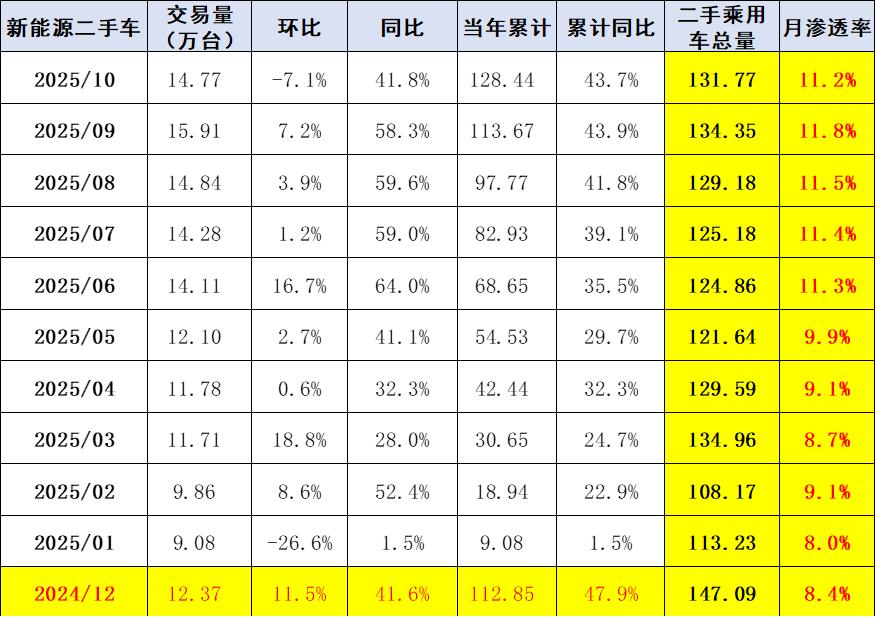
Source: Cui Dongshu's official account
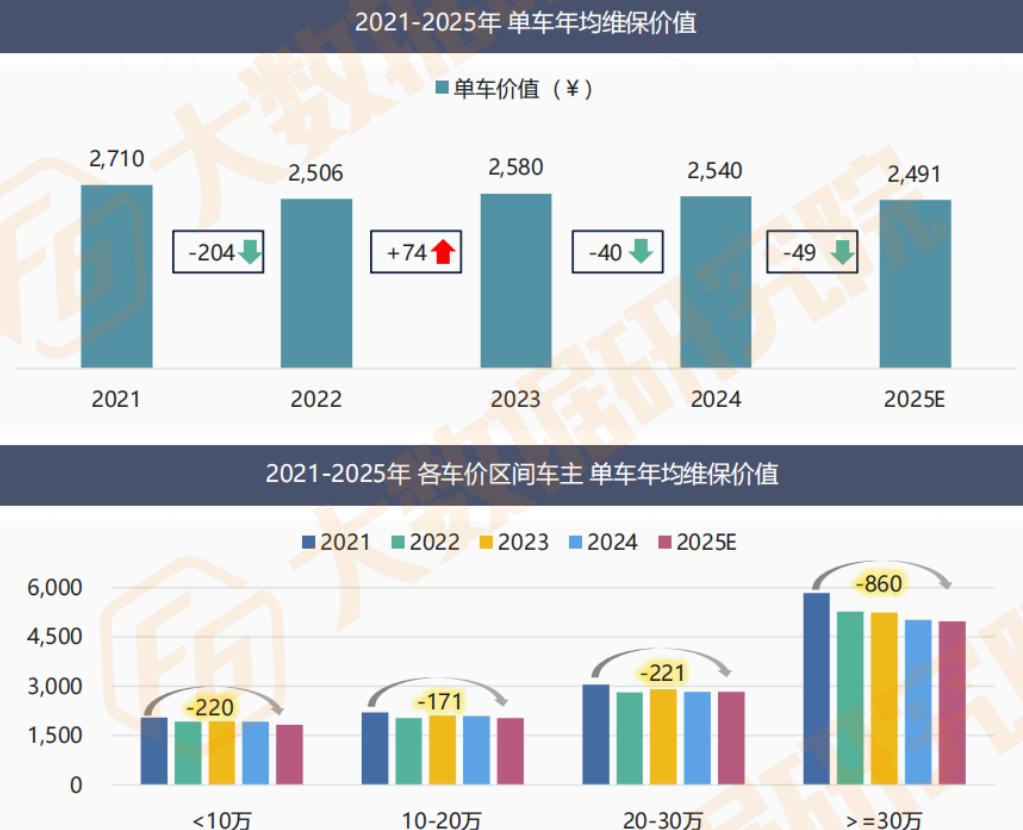
On the other hand, the decline in resale value has led car owners to continuously reduce their subsequent investment in vehicles, putting short - term pressure on the maintenance and repair industry. In 2025, the average annual maintenance and repair cost per vehicle for car owners has dropped below 2,500 yuan. The average annual maintenance and repair expenditure of owners of high - end models worth more than 300,000 yuan has shrunk by nearly 1,000 yuan compared with 2021.
At the same time, car owners' consumption behavior has become more "streamlined". The proportion of car owners who consume four or more items in a single visit to the repair shop has dropped to 8%. This means that the traditional model of "bundled marketing and project stacking" has completely failed. Promoting the refined operation of maintenance and repair services has become the key to breaking the deadlock in the industry.
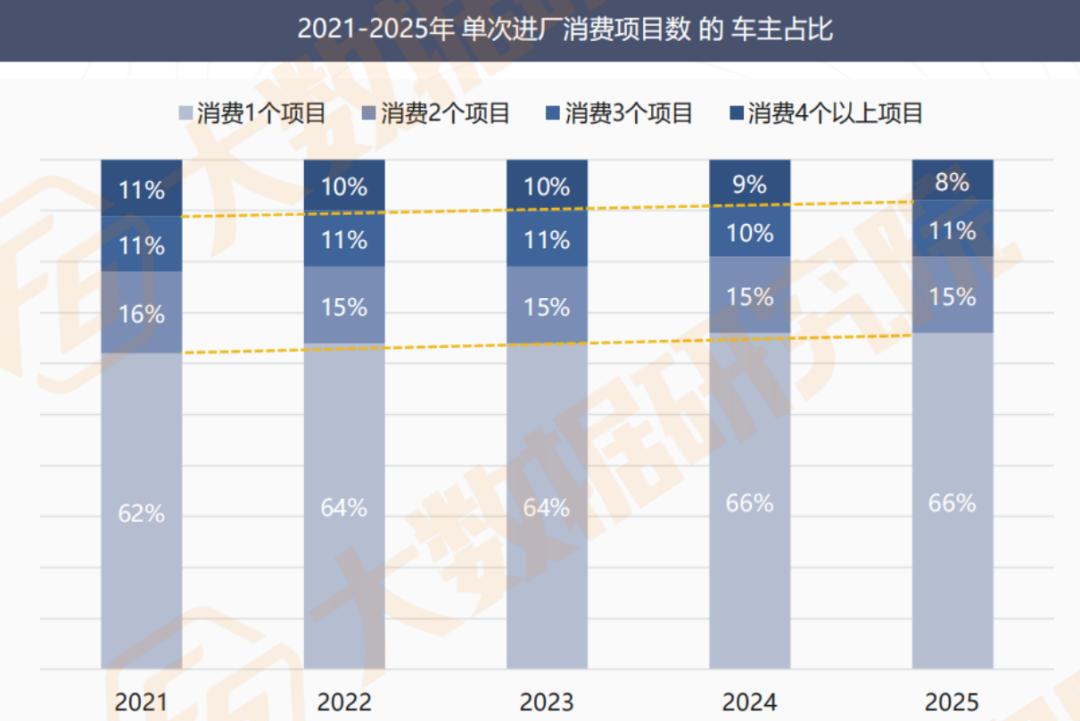
Source: F6 Big Data Research Institute
Source: F6 Big Data Research Institute
On the basis of rational consumption, the explosive growth of domestic new energy vehicle sales, combined with the trends of younger car owners and intelligent development, has made personalized needs a new growth pole in the aftermarket.
Source: Compiled based on public information. Chart by DoNews
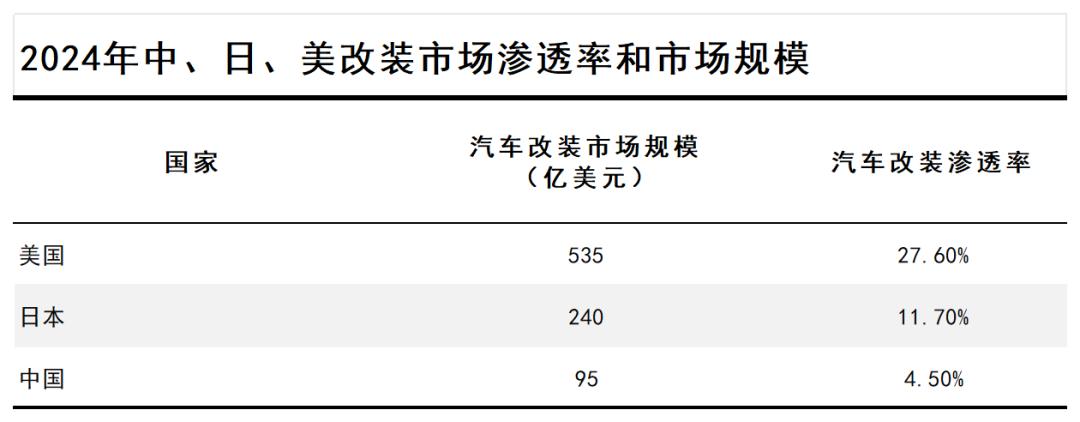
Taking the modification market as an example, in 2024, the penetration rate of the domestic modification market was far lower than that of the United States and Japan. However, for every 1 - percentage - point increase, it could bring tens of billions of yuan in new market scale. Especially in 2025, the implementation of new regulations such as the "Regulations for Motor Vehicle Safety Technical Inspection" (GA801 - 2025) and supporting policies provided solid policy support for the standardized development of the modification industry.
Source: MCR Jashi Consulting
From the perspective of the consumer group, the modification needs show obvious differentiation: male car owners focus on hardcore modification fields such as performance improvement, handling optimization, and competitive styles, and are the core consumer group for performance modification; young female car owners prefer body color changes, interior decoration details, delicate accessory matching, and intelligent function upgrades, and have become the core promoters of the "appearance economy" in the modification field.
Currently, the modification market has formed a hierarchical competition pattern and is accelerating its transformation towards branding, digitization, and standardization: leading professional brands (Cheyishang, Gaiba, XPEL China) focus on first - tier and new first - tier cities, building barriers with direct - operation/franchise models + unified image, standardized construction, and perfect after - sales guarantee; automobile manufacturers and 4S stores have set up "official modification points", relying on original parts and technicians to serve high - end users; small and medium - sized workshop - style stores in third - and fourth - tier and some second - tier cities, with flexible pricing and local resources as advantages, mainly offer cost - effective domestic parts. However, the lack of standardization and after - sales service leads to relatively high market risks. In addition, vertical platforms and comprehensive e - commerce platforms have built a closed - loop of "online product selection - offline construction", accurately reaching young consumer groups through short - video promotion and offline cooperation for conversion.
The upgrading of personalized needs has also driven the rapid growth of the automobile window tinting industry. According to data from Judongche, the current scale of the automobile window tinting and modification industry has exceeded 150 billion yuan, with an annual compound growth rate of 14%. However, the industry also faces multiple pain points in the short term: high user decision - making costs, fierce price competition, deviations between the expected experience and the actual effect, and the active entry of automobile manufacturers, making the competition in the track increasingly intense.
Against this background, the window tinting industry is accelerating its transformation towards high - end and intelligent development to seek breakthroughs: on the product side, high - end products made of TPU material account for more than 65%, and self - repairing coatings and nano - dispersion technology have become standard features of high - end products; on the digital side, brands such as Sharkshell have built a QR - code traceability system, enabling 100% traceability of materials, and the online certification rate of technicians has reached 92%, building an industry trust system; on the scenario side, innovative products such as intelligent dimming sunroofs and titanium nitride spectral films have promoted the transformation of car window films from traditional "protective products" to "intelligent cockpit components". The transformation has achieved remarkable results. The customer retention rate of agents adhering to brand - based operations is as high as 72%, 3.2 times that of price - oriented merchants.
The dual trends of rationality and individuality have not only broken the traditional supply - demand balance in the automotive aftermarket but also given rise to multiple new growth tracks, injecting new vitality into the industry's development. In 2026, how to accurately identify users' core pain points, establish in - depth resonance with users, and actively adapt to new consumption preferences has become the key to breaking the deadlock in the industry.
Keyword 2: Auto service/auto parts - Competition between fuel - powered and electric vehicles, pattern differentiation
The explosive growth of new energy vehicle sales has not only reshaped the competition pattern in the new car market but also rewritten the development logic of the auto service and auto parts industries at the fundamental level.
In this industrial transformation, the car washing and beauty business, with its unique advantage of being unrestricted by vehicle models and power types, has become the key to breaking the deadlock in the industry. Using car washing and beauty as a traffic entry point and extending to high - margin businesses such as sheet metal painting and maintenance packages has become the core strategy of 4S stores and independent maintenance shops.
Zhong Sheng Group pointed out that the entry of car washing and beauty customers is not only an important opportunity to discover sheet metal painting needs but also an accurate contact point for promoting value - added services. Leading new energy vehicle manufacturers such as BYD and Tesla have successively deployed car washing and window tinting services, confirming the core value of this track. Traditional gas stations have also accelerated their upgrading, providing both charging and refueling services to meet the diverse needs of car owners.
However, the essential differences between new energy vehicles and fuel - powered vehicles in terms of technical architecture and power form are promoting the accelerated differentiation of the industry's sub - fields, giving rise to a new ecosystem:
Firstly, the maintenance demand for high - age fuel - powered vehicles is continuously shrinking. In 2025, China IV fuel - powered vehicles were included in the trade - in subsidy for the first time. According to data from the Ministry of Commerce, the annual trade - in volume exceeded 11.5 million, driving the new car sales revenue to exceed 1.6 trillion yuan, and more than half of the passenger car retail sales were involved. The subsidy policy continued in 2026, accelerating the elimination of high - age fuel - powered vehicles, and the demand for supporting maintenance and parts replacement services also decreased synchronously.
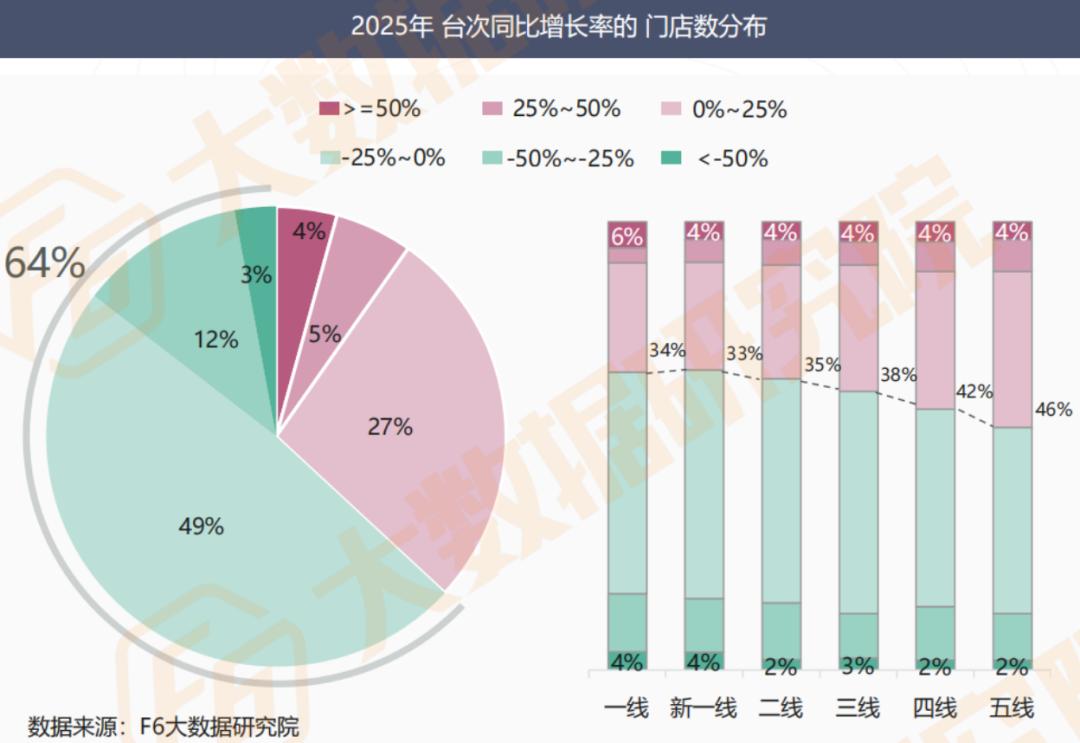
Secondly, maintenance shops in developed cities are facing growth bottlenecks. New energy vehicles have a higher penetration rate in developed cities, but their maintenance frequency and the number of maintenance items are both lower than those of fuel - powered vehicles. Coupled with the popularization of technologies such as die - casting integration and the three - electric system, many traditional shops are in a dilemma of "not knowing how to repair and not daring to repair", with limited growth in the number of vehicles entering the shop, forcing shops to accelerate their technological and business - model transformation.
Source: F6 Big Data Research Institute
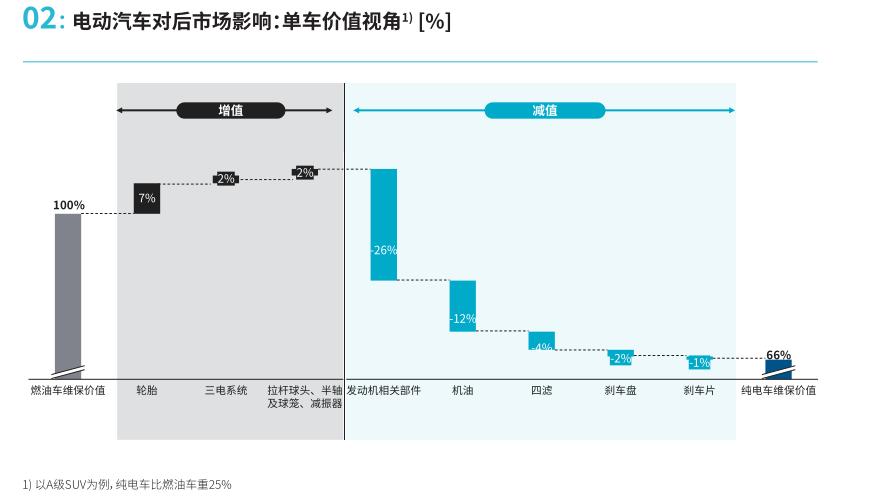
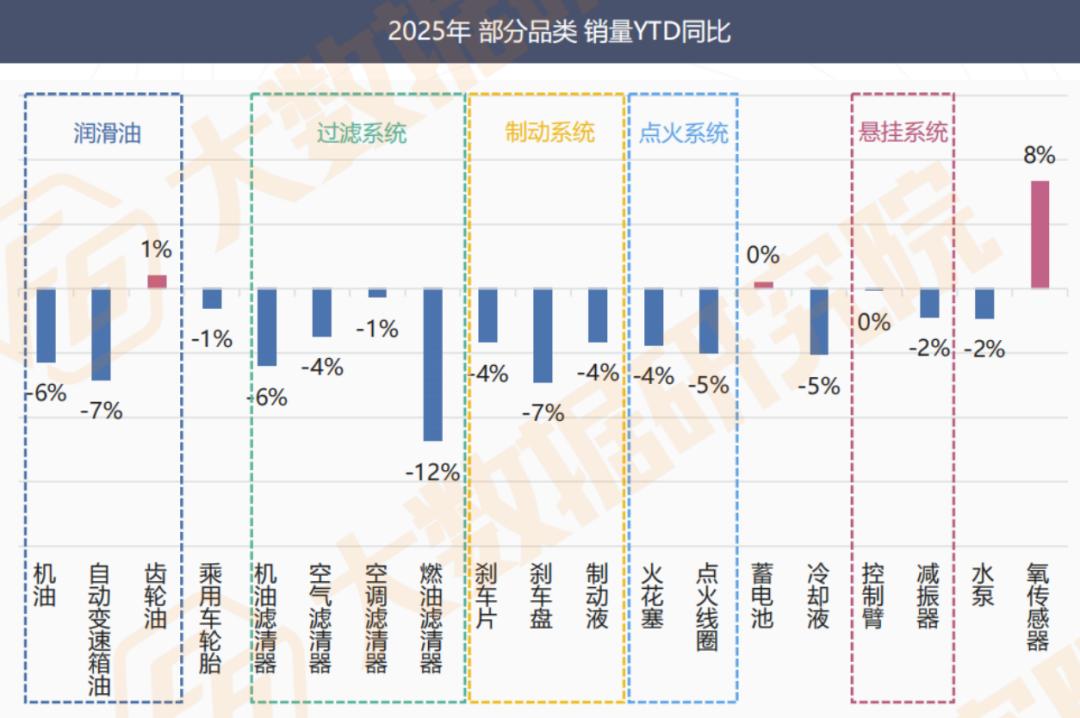
Thirdly, the maintenance demand for electric vehicles shows structural characteristics. Taking Class A pure - electric SUVs as an example, the detection and maintenance of the three - electric system bring incremental value. Moreover, the self - weight of pure - electric vehicles is 25% higher than that of fuel - powered vehicles, increasing the replacement frequency of vulnerable parts such as tires and shock absorbers. However, this incremental value is difficult to offset the shrinkage of maintenance value caused by the disappearance of the engine system. The demand for parts such as engine oil and four filters has declined significantly. In 2025, the sales volume of gear oil only increased by 1% due to its adaptation to hybrid systems, while the sales volume of engine oil and automatic transmission oil decreased by 6% and 7% respectively.
Source: Roland Berger
Source: F6 Big Data Research Institute
Jiang Yongxing, the founder and CEO of Kaisi Times Technology Co., Ltd., said that the parts demand is shifting from general mechanical parts to new - energy - specific categories and personalized modification parts. This requires auto parts enterprises to iterate their product lines and strengthen the technical certification and rapid response capabilities of the supply chain to meet the challenges of rapid vehicle model iteration and large demand fluctuations.
In the long run, with the growth of new energy vehicle ownership and driving mileage, combined with the expansion of the "mobile space" scenario, the exclusive maintenance needs such