The top three in high-level intelligent driving have emerged, and DeepRoute.ai has become the dark horse.
The AI wave is sweeping across global industries. End-to-end and VLA model technologies have successively driven a paradigm shift in the intelligent assisted driving industry. In the past, rule-based algorithm operations that relied on a large amount of human labor allowed leading companies to maintain their dominant positions, while many innovative teams at a relative disadvantage in terms of resources, data, or scale could only hold back.
However, with technologies such as end-to-end and VLA, startup companies can quickly enter the market with precise technological breakthroughs and become core players in the industry. There is a case like DeppSeek in the field of large models, and in the field of intelligent assisted driving, DeepRoute.ai is such a dark horse.
The "White Paper on the Trends of China's Intelligent Driving Industry (2025)" released by Jingguan Automobile shows that currently, the leading enterprises in the urban intelligent driving market mainly include Huawei, DeepRoute.ai, and Momenta.
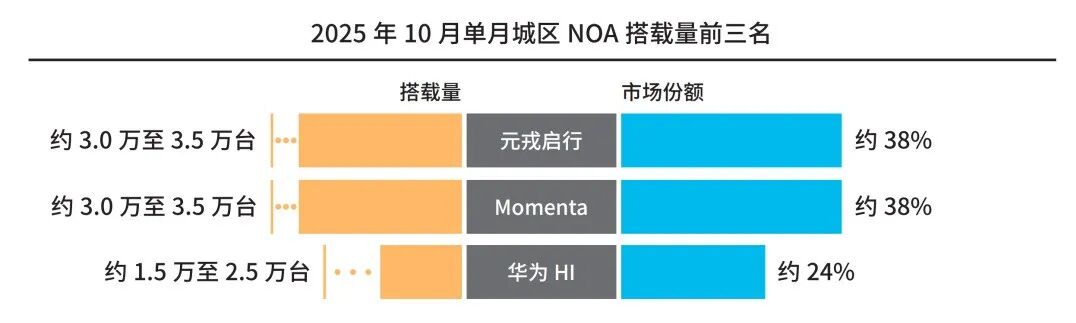
Among them, the market data of the third-party urban NOA market in China from January to October 2025 shows that DeepRoute.ai's market share has increased rapidly. Especially in October 2025, DeepRoute.ai's market share reached 38%, ranking first in the market and showing excellent performance. More notably, its growth multiple was as high as 2.7 times.
Extracted from the "White Paper on the Trends of China's Intelligent Driving Industry (2025)"
On the surface, DeepRoute.ai's rapid growth is mainly due to the company's installation of its solutions on the mainstream mass-produced models of brands such as Great Wall, Geely, and smart. However, looking deeper, this is a verification of the systematic capabilities from technological breakthroughs to product experience and even mass production and delivery efficiency.
In the highly competitive automobile industry, technical solutions need to ensure a good user experience while also providing reasonable costs and efficient delivery capabilities. DeepRoute.ai's breakthroughs in installation volume and market performance are precisely the embodiment of this comprehensive ability.
Meanwhile, in the field of high-order intelligent driving, although Huawei and Momenta still occupy important positions and maintain stable market shares, DeepRoute.ai's capability system has been well-polished and will undoubtedly become one of the variables affecting the future market pattern.
Advancement of Urban Intelligent Driving and Rapid Changes in the Industry Pattern
In the past two years, the market scale of NOA technology has expanded rapidly. The high-speed NOA technology has entered the mature stage, and the focus of the industry's differentiated competition and strategic layout has shifted to urban NOA. As a crucial year for the commercial implementation of urban NOA in China in 2025, the market scale has grown rapidly.
Data shows that the popularization of urban NOA is accelerating. According to the "Research Report on Urban NOA Automotive Assisted Driving in 2025", in the first three quarters of 2025, the sales volume of new passenger cars with combined driving assistance functions (Level L2) in China increased by 21.2% year-on-year, with a penetration rate of 64%. It is expected to rise to 66.1% by the end of 2025, and about two-thirds of new models will be equipped with Level L2 assisted driving functions.
In this popularization process, third-party technology suppliers have played a core role. The "Chinese solutions" provided by Chinese enterprises such as Huawei, Momenta, and DeepRoute.ai not only serve domestic automobile enterprises but also attract cooperation from international brands such as Mercedes-Benz, BMW, and Toyota, promoting Chinese intelligent driving technology to the world.
According to the "White Paper on the Trends of China's Intelligent Driving Industry (2025)", in October 2025, the top three in terms of urban NOA installation volume were DeepRoute.ai, Momenta, and Huawei HI, with installation volumes of approximately 30,000 to 35,000 units, 30,000 to 35,000 units, and 15,000 to 25,000 units respectively; and their market shares were approximately 38%, 38%, and 24% respectively.
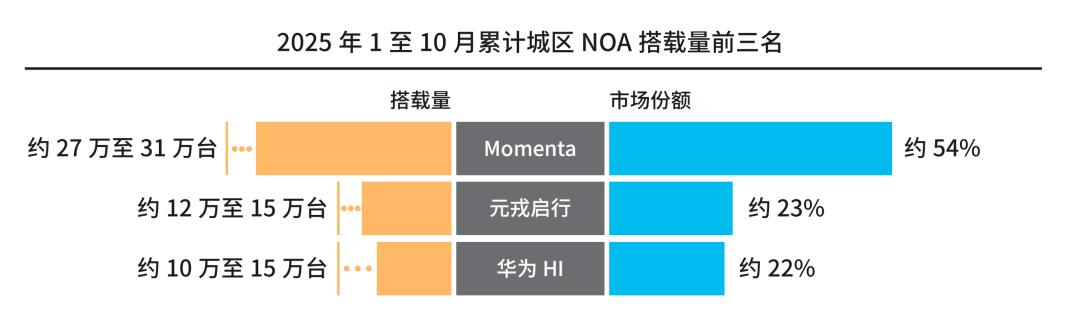
Looking at the cumulative data from January to October 2025, the market still presents a situation of three major players standing side by side. Among them, Momenta's cumulative installation volume was approximately 270,000 to 310,000 units, with a cumulative market share of approximately 54%, ranking first; DeepRoute.ai's cumulative installation volume was approximately 120,000 to 150,000 units, with a cumulative market share of approximately 23%; and Huawei HI's cumulative installation volume was approximately 100,000 to 150,000 units, with a cumulative market share of approximately 22%.
Extracted from the "White Paper on the Trends of China's Intelligent Driving Industry (2025)"
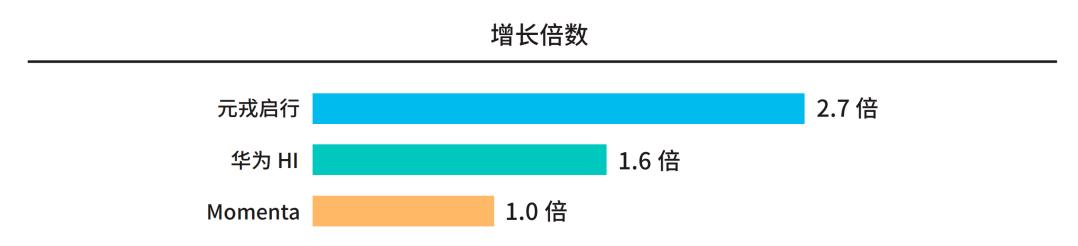
In terms of growth multiples, DeepRoute.ai, Momenta, and Huawei Hi were 2.7 times, 1.0 times, and 1.6 times respectively, with DeepRoute.ai showing the most significant growth momentum.
Extracted from the "White Paper on the Trends of China's Intelligent Driving Industry (2025)"
By the end of 2025, the delivery of mass-produced vehicles equipped with DeepRoute.ai's assisted driving system exceeded 200,000 units, covering more than 15 models. In just over a year, DeepRoute.ai's market share rapidly climbed from zero, reaching nearly 40% in October 2025 and firmly ranking among the first echelon of the industry.
Breakout of Technology-based Companies under the AI Paradigm
Driven by the AI paradigm, intelligent driving is undergoing a transformation from "rule-driven" to "data-driven". This change has significantly lowered the threshold of traditional human-written rules and instead relies on algorithms and data to define products and experiences, thus creating significant breakout opportunities for technology-based companies. Technology-based companies represented by DeepRoute.ai have also emerged rapidly in recent years.
Of course, the evolution of intelligent driving highly depends on the "data closed-loop". Therefore, scale has become the key support for enterprises to break out. As Zhou Guang, the founder of DeepRoute.ai, revealed: "The competition in the assisted driving industry will be more intense in 2026. Reaching the scale of one million vehicles is a safe zone, and DeepRoute.ai will cross this threshold in 2026."
The reason why scale has become a moat is that it can ensure the positive cycle of both capital flow and data flow. In terms of capital, the R & D investment in intelligent driving is high and the cycle is long. Reaching the scale of one million vehicle installations can bring stable revenue to support annual R & D investments of billions of yuan and avoid being left behind due to insufficient funds. In terms of data, one million vehicles can generate billions of kilometers of real road condition data every day, forming a high-quality data closed-loop. This enables enterprises to be far more efficient than their smaller-scale competitors in algorithm iteration and solving rare scenario problems.
Currently, the end-to-end large model is becoming the core engine for the iteration of NOA technology, promoting the industry's transformation from a modular architecture to an integrated perception and planning system and enhancing the safety experience of intelligent driving.
Facing this trend, various enterprises are accelerating their layout through different paths. New car-making forces are building technological barriers through full-stack self-research. For example, Tesla, Li Auto, etc. have achieved one-stage end-to-end mass production and continuously optimize the anthropomorphic level of their systems with real road data.
Traditional automobile enterprises mostly cooperate with third-party technology suppliers to quickly introduce advanced capabilities. For example, DeepRoute.ai has bound itself with the popular models of brands such as Great Wall and Geely, such as the Wei brand Gaoshan and Lanshan, and the Geely Galaxy M9. Relying on the market sales of these models, it has provided strong support for its large-scale expansion. Momenta adheres to the main line of "reinforcement learning + end-to-end architecture" and cooperates with brands such as SAIC and GAC, relying on the data closed-loop system to continuously promote the iterative evolution of algorithms.
It can be seen that in the process of the AI paradigm reshaping the industry, technology-based companies rely on algorithm innovation to build large-scale data closed-loops and commercial implementation capabilities, thus establishing long-term advantages in the increasingly fierce competition.
Changing the Competition Pattern and Running Differently from Huawei
Currently, the competition pattern in the domestic high-order intelligent driving market is undergoing significant changes. In addition to the self-research route of automobile enterprises, third-party leading suppliers represented by Huawei, DeepRoute.ai, and Momenta have jointly formed an important pole in the market.
In terms of customer selection, different suppliers have different strategic focuses. Some enterprises prefer to cooperate with multiple brands to establish technological benchmarks, while companies like DeepRoute.ai focus on in-depth cooperation with core automobile enterprises to create "blockbuster models", believing that large-scale data accumulation is of more long-term value than short-term brand premium.
Through large-scale delivery, DeepRoute.ai expects that the cumulative mass production and delivery of vehicles equipped with its assisted driving solutions will exceed one million in 2026.
However, this is not the end. Regarding future customer expansion, Zhou Guang, the CEO of DeepRoute.ai, said: "We definitely need to enter the joint-venture brand market and are also actively expanding customers among central state-owned enterprises and local state-owned enterprises." He emphasized that mass production scale is the foundation for the company's development, and Robotaxi is the company's next-stage plan. However, without sufficient mass production customers and data accumulation, the goal of "fully driverless" driving cannot be truly achieved.
According to industry data, in the first three quarters of 2025, the pre-installed standard penetration rate of the urban NOA function in the Chinese passenger car market had reached approximately 7.01%, and it is expected to exceed the key threshold of 10% by the end of the year and enter a period of rapid popularization.
Meanwhile, according to the "Research Report on Urban NOA Automotive Assisted Driving in 2025", from January to November 2025, the cumulative sales volume of passenger cars equipped with urban NOA reached 3.129 million, accounting for 15.1% of the insured passenger cars. More than 68.9% of the sales came from mainstream models priced below 300,000 yuan.
Currently, the urban NOA market is rapidly penetrating into the mainstream passenger car price range of 100,000 to 200,000 yuan, which is the key to realizing the popularization of intelligent assisted driving. Forecasts show that the annual shipment volume of high-order intelligent driving models is expected to reach the level of five million units in 2026.
In the future, the competition in the assisted driving industry will continue. As for who can truly have the last laugh, it may depend on which enterprise can truly implement technology, products, and mass production and delivery and maintain the ability to make stable progress in the constantly changing market.