The landscape of multinational automakers in China is changing: who is in decline, and who is growing?
The "law of conservation of energy" in the automotive circle was particularly evident in 2025.
On one hand, the sales of domestic car - makers such as Leapmotor, AITO, XPeng, and Xiaomi soared. On the other hand, the sales of multinational car - makers like Mercedes - Benz, BMW, and Porsche were sluggish.
Recently, there were reports that Mercedes - Benz and BMW had given preliminary demand forecasts for 2026 to domestic supply chains, both less than 500,000 units. This figure is almost the same as their sales level in China in 2016.
A decade ago, Mercedes - Benz sold 470,000 vehicles in China, a year - on - year increase of 26.6%; BMW sold 516,000 vehicles, a year - on - year increase of 11.3%. They were at the peak of their glory.
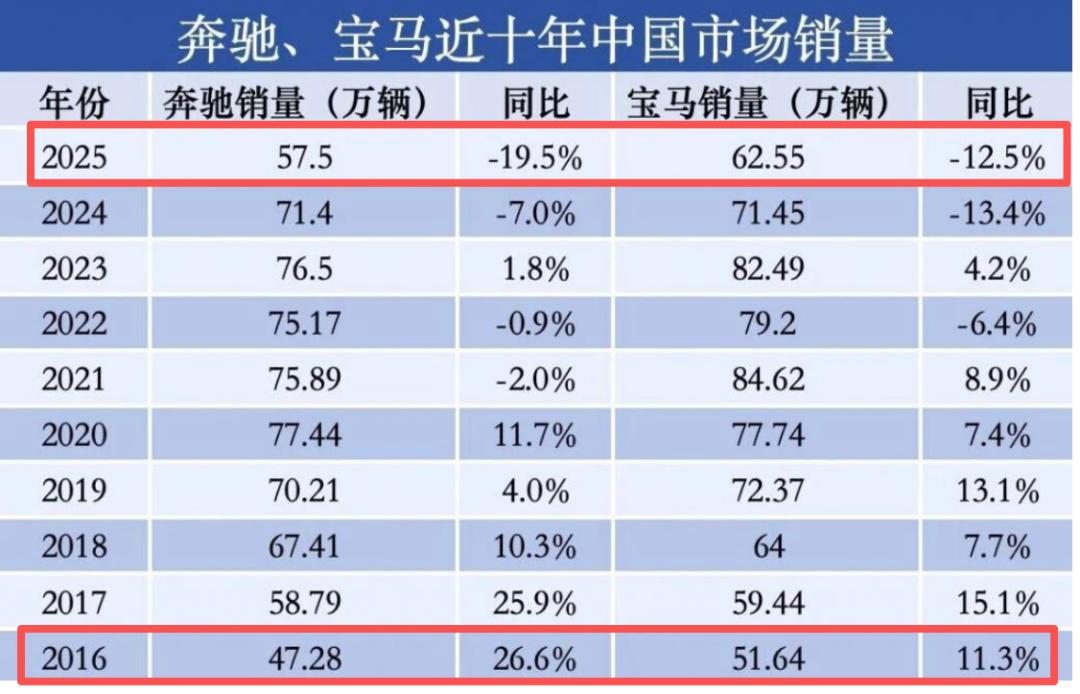
Picture/Sales of Mercedes - Benz and BMW in the Chinese market in the past decade. Source/Screenshot from Internet and New Energy Outlook
After a decade, the numbers seem to have come full circle, and the market has changed dramatically.
The market share of multinational car - makers is indeed shrinking, but the rate of decline varies. Looking closely at the 2025 performance, there are already gaps within this camp. Some can still hold their ground and even achieve slight growth; some are hovering in the middle, barely maintaining; while the once - leading luxury brands are seeing their sales and brand influence decline together.
What exactly is going on behind this differentiation?
1. Toyota and General Motors are steadily rising
Among multinational car - makers, Toyota and General Motors had relatively stable sales in 2025.
Among them, Toyota sold more than 1.78 million vehicles in China, a year - on - year increase of 0.23%. Although this increase is not large, it is crucial - this is the first time Toyota's sales have turned positive since the negative growth in 2022. SAIC General Motors showed a more obvious performance, with annual sales of 535,000 vehicles, a year - on - year increase of 22.99%, finally ending the "seven - year consecutive decline" that started in 2018.
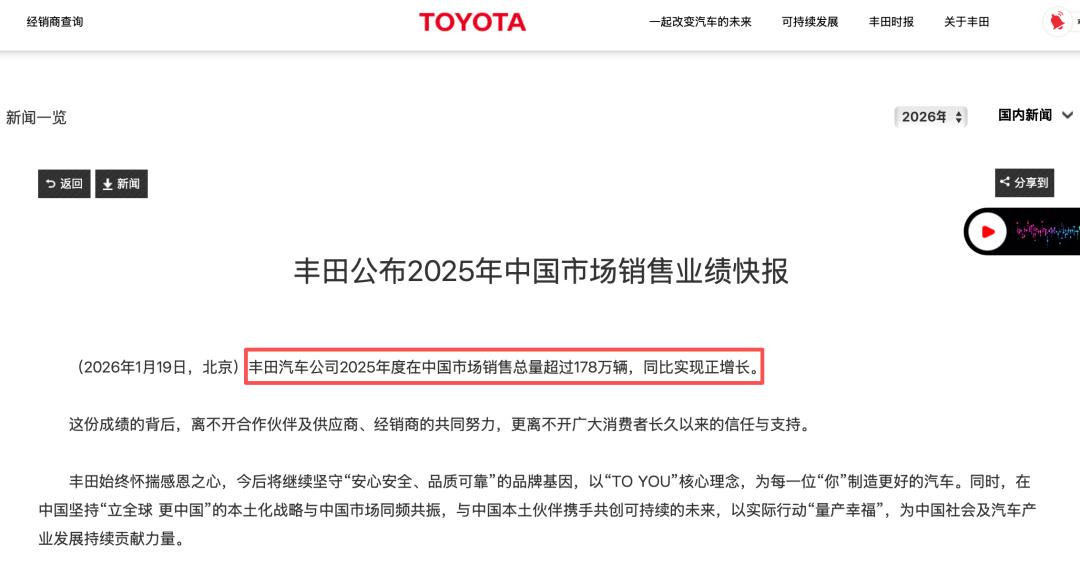
Picture/Toyota's sales in the Chinese market in 2025. Source/Screenshot from Internet and New Energy Outlook
It is no accident that they can hold steady in the general environment where joint - venture and luxury brands are under pressure.
A large part of Toyota's confidence comes from its hybrid vehicle base. Although the penetration rate of new energy vehicles is continuously increasing and the charging infrastructure is rapidly expanding, there are still many users with charging anxiety. Toyota's hybrid technology, which has undergone years of technological precipitation and market verification, provides a "worry - free" solution for these users - hybrid models can enjoy the convenience of fuel vehicles and significantly reduce fuel consumption costs.
Data shows that FAW Toyota's intelligent electric hybrid dual - engine models sold more than 380,000 units throughout the year, a year - on - year increase of 14%. GAC Toyota's intelligent electric hybrid dual - engine models sold more than 390,000 units throughout the year, accounting for more than half of GAC Toyota's total sales.
Mr. Li bought a Corolla Cross intelligent electric hybrid version some time ago. He said frankly, "I commute 80 kilometers every day, and charging is not convenient. Toyota's hybrid technology allows me to enjoy the smoothness and low fuel consumption of electric drive without any range anxiety. I just need to refuel and go. For me, this is the most realistic and reliable technological choice at present."
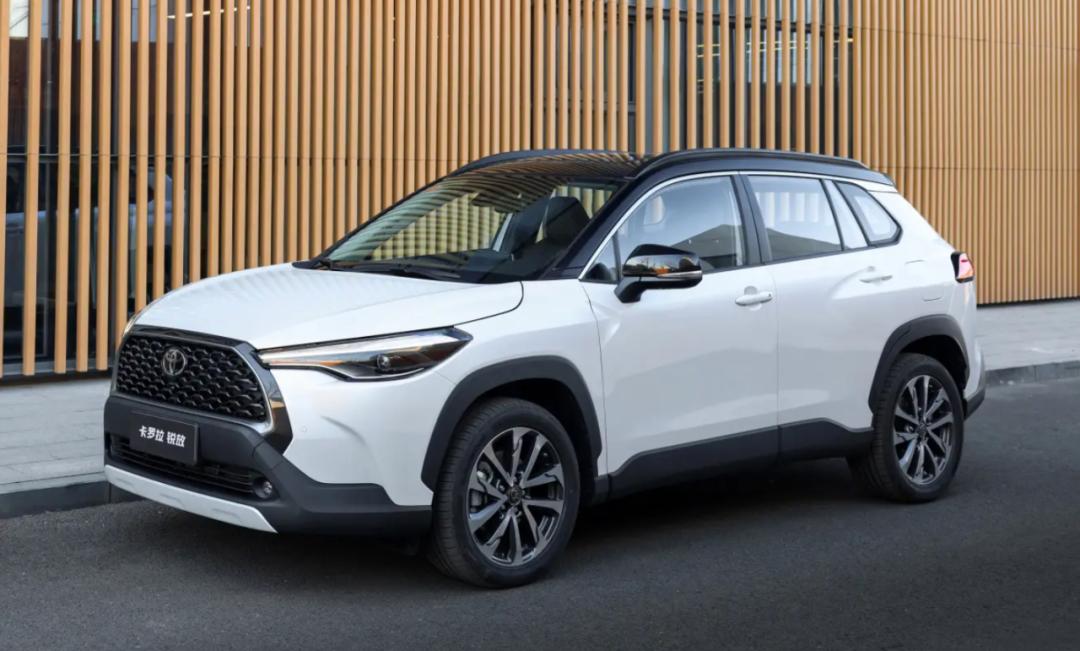
Picture/Toyota Corolla Cross. Source/Screenshot from Internet and New Energy Outlook
However, Toyota is not sticking to the status quo. In the first half of 2025, Toyota gave more decision - making power to its Chinese team, implemented the "ONE R&D R & D system" and the "Chinese Chief Engineer System", allowing the local team to decide how to develop China - exclusive models. At the same time, it cooperated with Chinese technology giants such as Huawei, Xiaomi, and Momenta.
The recovery of SAIC General Motors is more like a complete self - adjustment. In the second half of 2024, SAIC General Motors announced that it would hand over the product definition and business decision - making power to the Chinese team.
The effect of the adjustment was immediate. The Buick brand became the main growth driver, with the annual sales of its GL8 family reaching 112,000 units; the new electric sub - brand "Zhijing", and its first model, the Zhijing L7, also made a splash in the market, with more than 6,000 units delivered in two months. The delivery volume of Cadillac's pure - electric Lyriq increased by 90% year - on - year.
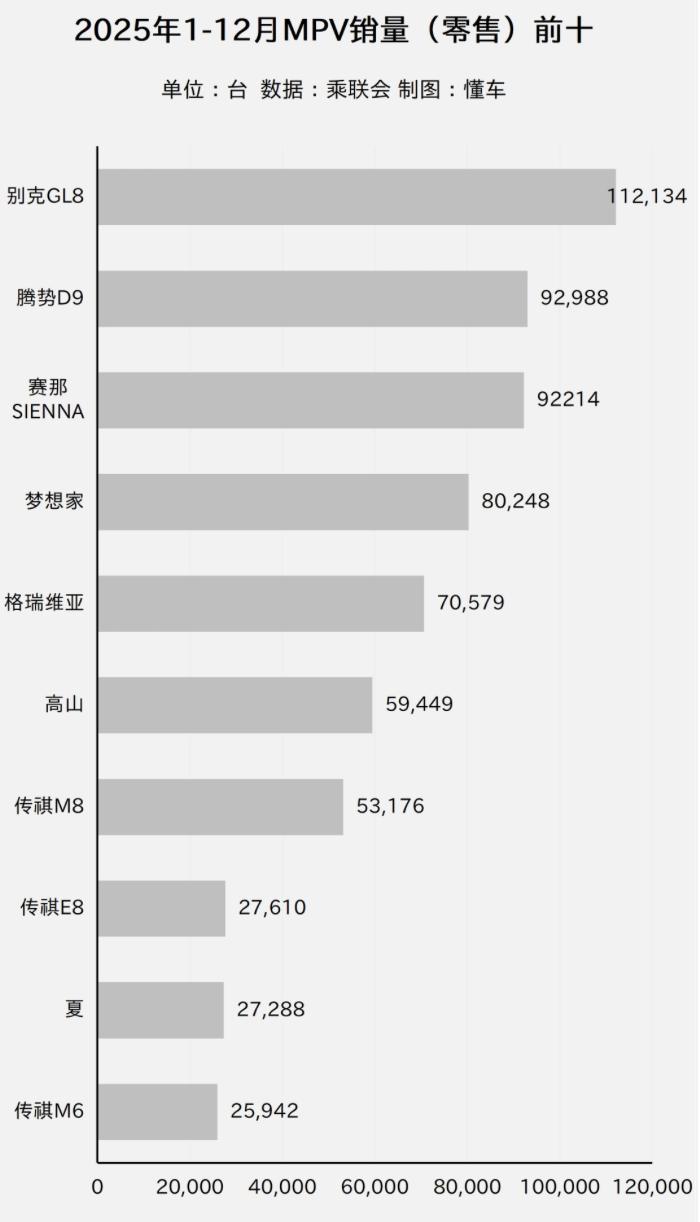
Picture/Top 10 MPV sales in 2025. Source/Screenshot from Internet and New Energy Outlook
"I used to think that American cars were fuel - consuming and had rough designs. But the new models are completely different. The interior refinement and intelligent configuration are comparable to those of new - force brands. The 2.0T variable - cylinder engine paired with a 48V mild - hybrid system is very fuel - efficient. The most important thing is that I can feel that the Buick Envision Plus is optimized for Chinese road conditions and family needs. The chassis filter vibration is very delicate, and the local applications in the car - machine system are also very comprehensive."
"The Cadillac Lyriq doesn't simply stack screens. Instead, it creates a sense of luxury and technology with its excellent chassis texture, quiet cabin, and the stunning 9K curved screen. This experience is very unique. I also heard that the latest car - machine system was upgraded under the leadership of the Chinese team, and the localization service is getting better and better." Many consumers who bought SAIC General Motors' new - energy models said frankly.
2. Korean brands are lukewarm
Compared with the counter - trend stabilization of Toyota and General Motors, Korean brands represented by Hyundai and Kia seem to have gradually fallen into a delicate "middle state" in the Chinese market in the past two years. Their market share has been stagnant for a long time, their presence has been continuously diluted, and they have gradually become a niche choice in the multinational car - maker camp.
According to data from the Passenger Car Association, the market share of Korean brands shrank from 3.8% in 2020 to 0.9% in 2025. In sharp contrast, although also under pressure, the market shares of Japanese and German brands remained at around 12.2% and 15.4% respectively during the same period.
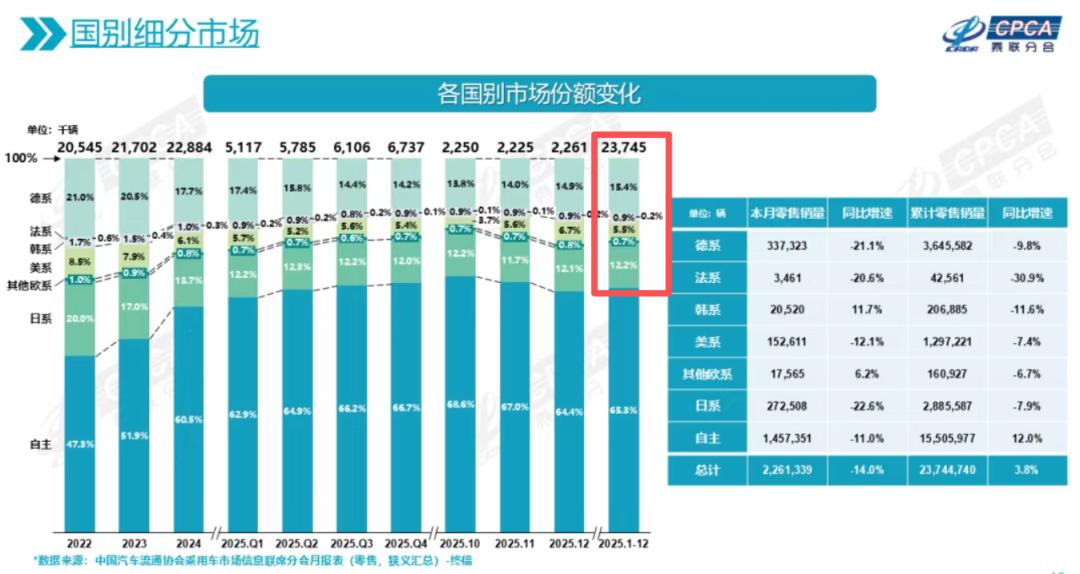
Picture/Changes in the market share of different countries in recent years. Source/Screenshot from Internet and New Energy Outlook
Take Beijing Hyundai as an example. Its annual sales in 2025 were 210,000 units, a year - on - year increase of 14.8%. It seems to be recovering, but in fact, it lacks confidence. Since its sales fell below one million in 2017, Beijing Hyundai has been on a downward trend. In 2024, its sales were only 154,000 units, a decline of more than 30%. In the eyes of many consumers, Beijing Hyundai has long been out of the mainstream brand competition echelon.
Specifically for models, the once - popular SUV, the ix35, used to have monthly sales of over 10,000 units, but now its monthly sales have been stuck in the three - digit range for a long time. Now, the Elantra, which has the best sales performance, is under the dual pressure of the downgrading attacks from independent new - energy models such as BYD Qin and Leapmotor B01, and the price - cut encirclement of joint - venture fuel vehicles such as Sylphy and Lavida. Its living space has been continuously squeezed, and it only sold 63,000 units in 2025, a year - on - year decline of 18.1%.
Kia, also in the Korean camp, has not been able to reverse the downward trend. In 2025, Kia's sales in China were about 254,000 units, a slight year - on - year increase of 2.3%, but still far from its peak of 650,000 units in 2016.
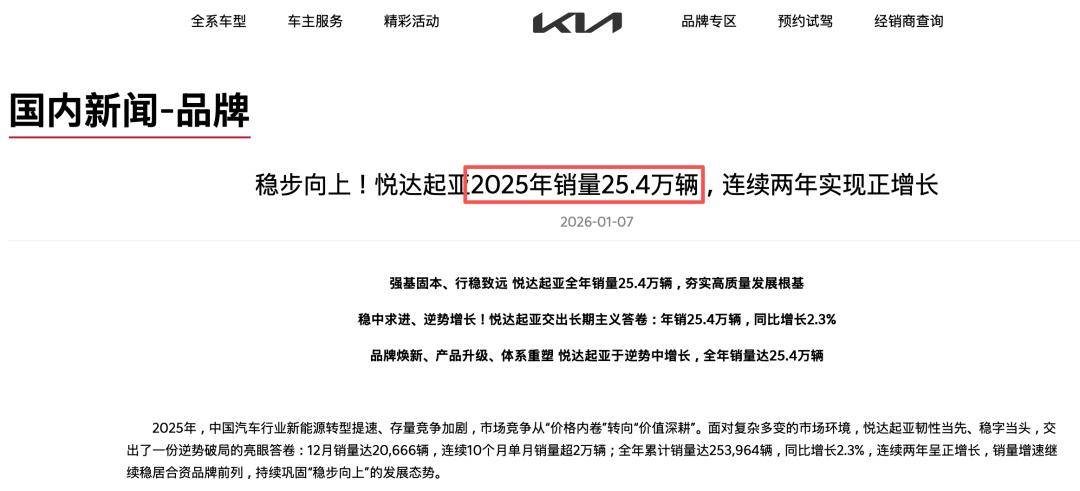
Picture/Kia's sales in 2025. Source/Screenshot from Kia's official website and New Energy Outlook
Why are they in this situation? Through contacts with many consumers, we gradually found that the lukewarm situation of Korean cars is the result of multiple factors.
The slow progress of electrification is the key reason for the setbacks of Korean brands. While multinational competitors such as Volkswagen and Toyota had already launched multiple electric models in the Chinese market, Kia, which had launched multiple pure - electric models in Europe and America, only began to launch pure - electric models such as the EV6 in the Chinese market in 2023; Beijing Hyundai's first mass - produced pure - electric model, the EO Yiou, based on the Hyundai E - GMP pure - electric dedicated platform, was launched in October 2025.
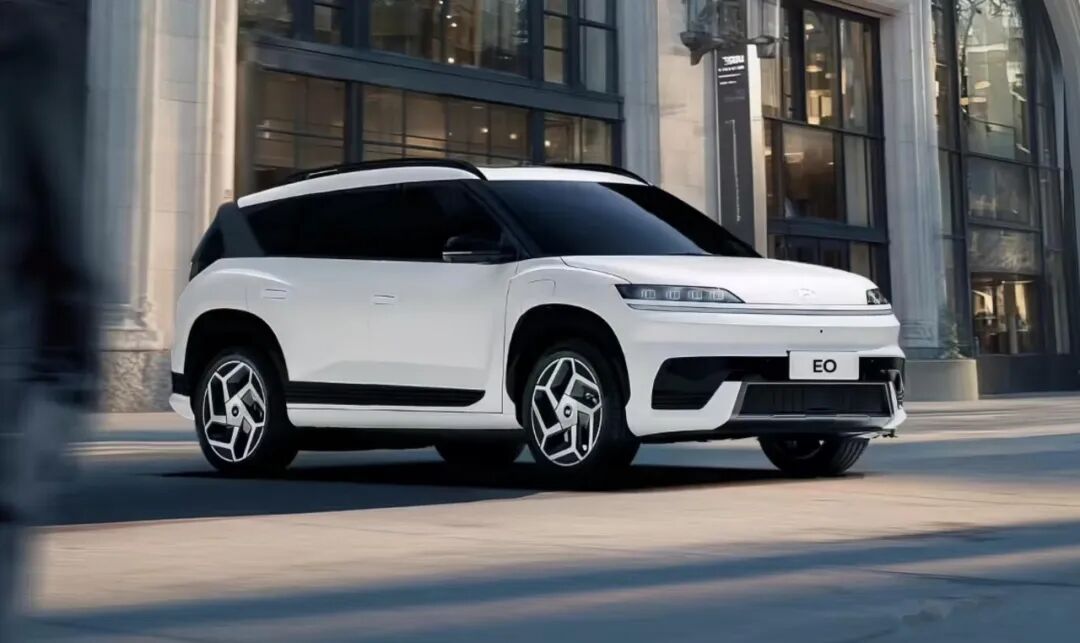
Picture/Beijing Hyundai EO Yiou. Source/Screenshot from Internet and New Energy Outlook
This time difference not only means missing out on the early - stage market dividends but also strengthens consumers' perception of their slow transformation.
Meanwhile, the position of Korean brands in consumers' perception has also changed. In the fierce market competition, the original "high - cost - performance" positioning advantage of Korean cars is weakening.
In the past, Korean cars won their market space by having a precise positioning between Japanese and German cars. They had more fashionable designs and richer configurations than Japanese cars and were more price - friendly than German cars.
However, this space is now being squeezed from both ends. At the upper end, their brand premium has always been difficult to compete directly with mainstream German and Japanese brands; at the lower end, Chinese brands are not only rapidly catching up in design and quality but also have established obvious experience advantages and cost - control capabilities in the fields of electrification and intelligence.
"I've driven this Hyundai ix35 for six years, and it has never had any major problems. It's very worry - free to use. The car itself is good, but I won't recommend it to my friends. After all, there are too many choices with the same budget now. If my friends value technology and vehicle - using costs, domestic new - energy vehicles have obvious advantages; if they insist on choosing a joint - venture brand, there are also many other options with better reputations."
"I chose Hyundai at that time because of its good - looking appearance and large discounts. I could buy the face of a joint - venture car with a small amount of money. But now, compared with Chinese brand products at the same price, it feels like it belongs to a different era." Many consumers who have paid attention to Korean cars for many years said frankly.
3. Among the laggards, BBA has returned to the level of 10 years ago
In the differentiation of the market pattern, the group with the most significant downward trend is represented by German brands such as BBA, Porsche, and Volkswagen, and also includes brands such as Nissan and Honda. Ford among American brands has not been spared either.
Data shows that Mercedes - Benz's sales in China were 470,000 units in 2016, reached a peak of 774,000 units in 2020, and then continued to decline. In 2025, it was only 575,000 units, a year - on - year decline of 19%, with a loss of more than 300,000 units in sales over five years.
BMW's sales were still at a high of 825,000 units in 2023, but dropped to 625,500 units in 2025, a year - on - year decline of 12.5%, losing about 200,000 units of market share in China in just two years.
Audi's decline has been more gradual but continuous. Its sales were 589,000 units in 2016, remained at 729,000 units in 2023, and dropped to 617,500 units in 2025, a year - on - year decrease of 5%.
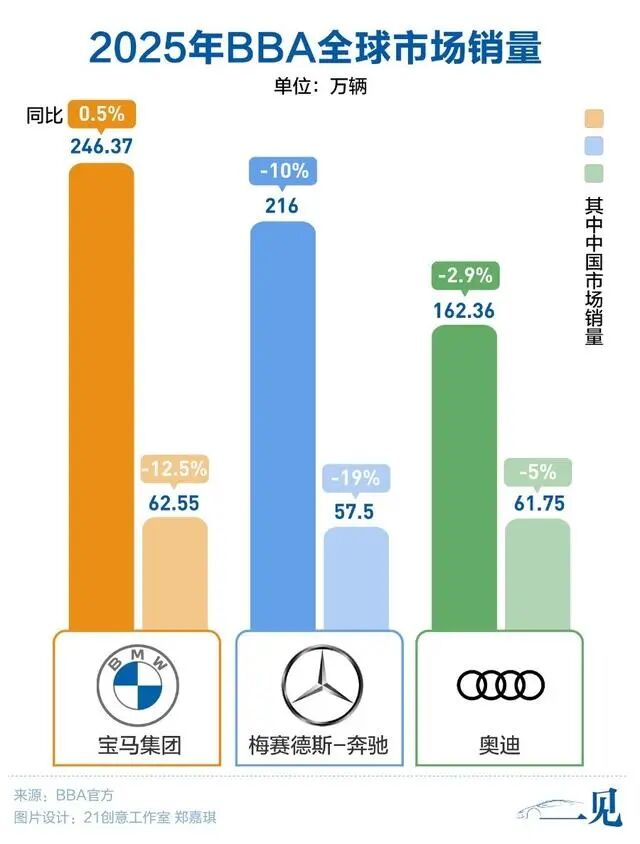
Picture/BBA's global/Chinese market sales in 2025. Source/Screenshot from Internet and