The AI hardware market is booming.
Inside the temple of a pair of AI glasses, there hides a flattened smartphone. This is an apt metaphor for today's AI hardware in the industry. At the CES 2026 in Las Vegas, new smart glasses products from over 50 manufacturers were unveiled collectively, among which Chinese brands occupied a prominent position. Less than two weeks after the conclusion of CES 2026, the enthusiasm from the exhibition had spread throughout the entire industry chain. Smart glasses were included in the national subsidy catalog for large - scale equipment replacement and trade - in for the first time, ranking alongside mobile phones, tablets, etc., as one of the four subsidized categories.
Data from market research firm IDC shows that in the third quarter of 2025, the shipment volume of the Chinese smart glasses market increased by 62.3% year - on - year. Global tech giants and Chinese Internet companies are flocking to the AI hardware track at an unprecedented speed. Products such as Alibaba's Quark AI glasses, ByteDance's Doubao Mobile Assistant, and Baidu's Wenxin Yiyan glasses have been released intensively.
Meanwhile, information from the investment community shows that OpenAI is poaching hardware engineers from Apple like crazy and plans to launch its own AI hardware products, which is interpreted by the outside world as an attempt to create an "AI - version iPhone".
The Panorama of AI Hardware
When talking about AI hardware, our vision should not be limited to the eye - catching glasses form. In fact, it is a complete ecosystem from the underlying infrastructure to the front - end interactive terminals. We can clearly divide it into three levels: the "basic layer" that provides core computing power, the "terminal layer" that serves as the carrier of capabilities, and the "integration layer" that caters to specific scenarios.
At the basic layer, AI chips (such as NVIDIA GPUs and Google TPUs) are like the invisible engines of the entire intelligent era, providing powerful computing power for training and running large models. At the terminal layer, there is a wide variety. Besides AI glasses that are on the verge of explosion, the AI PCs and AI mobile phones that we are already familiar with are undergoing profound self - revolutions, evolving from tools to intelligent agents that can actively understand and execute tasks. Smart speakers and headphones are also connecting to more powerful models. And AI Pins, smart rings, and even humanoid robots, which represent frontier explorations, point to a more seamless and embodied future interaction.
At the integration layer, AI turns into solutions for professional scenarios, from the intelligent driving computing platform of cars to the AI quality inspection cameras in factories. However, among all terminal forms, AI glasses are moving from a geeky gadget to the center of the mass consumer electronics stage at an amazing speed. Especially at this year's CES, they are not just products but have become a symbol for tech companies to compete for the right to speak in the next - generation computing platform. This concentrated explosion is not accidental but an inevitable outcome of the evolution of technology, the market, and the ecosystem reaching a critical point.
AI Glasses: On the Verge of Explosion
At this year's CES, there were 942 Chinese exhibitors, accounting for about 22% of the total number of exhibitors. The clearest signal conveyed by the exhibition is that AI is moving from the digital world to the physical world. Huang Renxun, the founder of NVIDIA, systematically explained the concept of "Physical AI" for the first time at the conference, emphasizing that AI technology will be deeply integrated with hardware to achieve understanding and interaction with the physical world. This shift provides a strategic direction for the development of AI hardware.
China's AI glasses industry is experiencing unprecedented dual - drive from policies and the market. At the end of December 2025, the National Development and Reform Commission and the Ministry of Finance jointly issued the "Notice on Implementing the Policy of Large - Scale Equipment Replacement and Trade - in of Consumer Goods in 2026", clearly including smart glasses in the subsidy scope for purchasing new digital and smart products. This is the first time that smart glasses have received direct support at the national level.
Globally, data from Counterpoint shows that in the first half of 2025, the global shipment volume of smart glasses increased by about 110% year - on - year. Market forecasts are even more optimistic: Morgan Stanley predicts that the global shipment volume of AI glasses is expected to reach 35 million units by 2028, and Citigroup predicts that the global shipment volume of smart glasses will grow to 112 million pairs at a compound annual growth rate of 105% by 2030.
Major manufacturers demonstrated diverse technical routes at CES 2026: Thunderbird Innovation launched the X3 Pro Project that supports eSIM functionality, enabling AI glasses to have the ability to connect to the Internet and make calls independently of mobile phones for the first time. Rokid Technology released the screenless AI glasses Rokid Style, which weighs only about 38.59 grams, targeting daily wearing comfort. XGIMI Technology, a company well - known for its smart projectors, also announced its entry into the AI glasses track and launched the "MemoMind" brand. With the influx of more enterprises, the smart glasses market is showing an unprecedentedly active situation, marking that this industry is moving from the concept verification stage to large - scale application.
Alibaba joined hands with Qualcomm, Luxshare Precision, Dr. Glasses and other enterprises to establish the Quark AI Glasses Industry Ecosystem Alliance. Smart glasses manufacturer XREAL signed strategic cooperation agreements on the AI/AR industrial chain with Longcheer Technology, Jingsheng M&E Co., Ltd., etc. Companies such as Goertek, AAC Technologies, and Sunny Optical have also made significant progress in core technologies such as micro - display and optical waveguide.
Looking at regional markets, the differentiation is significant. In the overseas market, especially in North America, Meta dominates with its Ray - Ban series, holding a market share of up to 73% in the first half of 2025. In contrast, although China's overall market share is still lagging behind, its growth momentum is extremely strong - the shipment volume in the first half of 2025 has exceeded one million units, accounting for 26.6% of the global market, and domestic brands are active, becoming a force that cannot be ignored.
The competitive landscape shows a distinct pattern of "one super - power and multiple strong - powers". Meta temporarily holds the position of the "one super - power" globally, while numerous Chinese brands form the "multiple strong - powers" camp. These Chinese participants can be mainly divided into three categories: first, consumer electronics giants such as Xiaomi and Huawei. The former focuses on high cost - performance, and the latter builds a full - stack ecosystem; second, vertical brands represented by Thunderbird Innovation and Rokid, which have advantages in self - developed optics and dual - line layout of consumer and enterprise markets respectively; third, cross - border entrants represented by Li Auto, Alibaba, Baidu, and ByteDance, whose strategies focus on vehicle - machine linkage or ecological service extension.
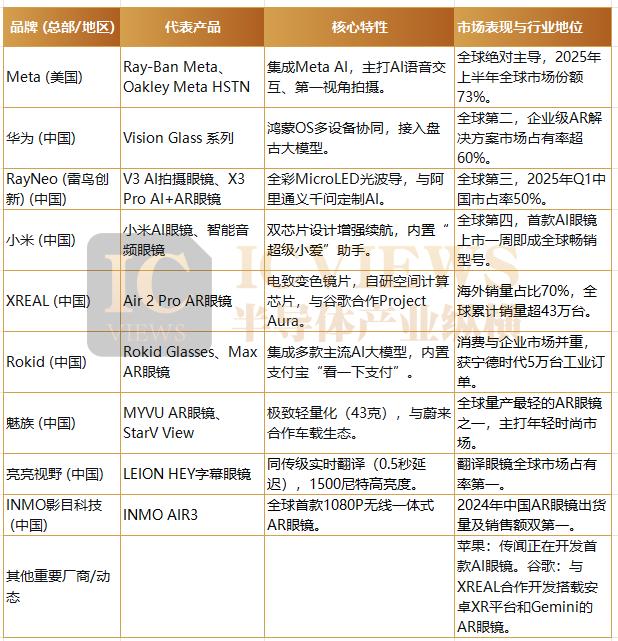
On the product strategy front, mainstream manufacturers generally adopt a "dual - track" approach. On the one hand, they launch smart glasses with functions focused on AI shooting and audio interaction (such as Ray - Ban Meta) to lower the price threshold and promote market penetration. On the other hand, they actively layout AI+AR glasses with integrated display functions (such as Ray - Ban Display) for higher - level productivity, entertainment, and interaction scenarios, paving the way for future forms.
This evolution of technology and the market is also directly reflected in the wide price stratification. Currently, the market price ranges from basic - function products costing dozens of dollars to high - end AR glasses costing nearly a thousand dollars, forming a three - dimensional pattern. In the Chinese market in 2025, two major trends emerged: the price of AI audio - shooting glasses has moved up to the mid - to - high - end range above 1,500 yuan; while AI+AR glasses maintain their high - end share, and their internal product structure is also being adjusted. Through rapid product iteration (such as the generational upgrade of Meta's Ray - Ban series) and a systematic hierarchical pricing strategy (such as Thunderbird Innovation covering the range from a thousand yuan to nearly ten thousand yuan), the industry path of technological advancement and value enhancement is clearly mapped.
Well - Received but Poorly Sold
The AI glasses market presents a picture full of contradictions: on one side, there is an explosive growth in shipment volume and enthusiastic capital pursuit; on the other side, the products are facing multiple real - world bottlenecks in user experience, ecological construction, and mass - production capabilities. This interweaving of apparent prosperity and inherent challenges outlines the real pain of the industry as it tries to cross the gap between early adopters and the mass market.
At the hardware performance level, the industry is generally caught in the "impossible triangle" dilemma of "lightweight, long battery life, and high performance". Pursuing an extremely thin and light appearance inevitably requires squeezing the battery space, thus sacrificing battery life. Meanwhile, powerful edge - side AI computing power and real - time interaction functions bring significant power consumption and heat - generation problems. For example, when Meta's Ray - Ban Meta smart glasses are in continuous AI conversation mode, the battery life is sharply reduced to only about 30 minutes, which is a direct manifestation of this contradiction. This fundamental contradiction further translates into specific pain points in user experience (such as uncomfortable wearing, poor shooting effects, and unstable connection) and a high - cost structure. Among them, optical display (accounting for about 43% of the cost) and the main control chip (accounting for about 31% of the cost) are the two major cost centers. Currently, the relatively cost - effective Birdbath optical solution occupies more than 90% of the market share due to its mature technology. However, the optical waveguide and full - color Micro - LED technologies, which are regarded as the future direction and offer a better experience, have high costs, which are the key factors restricting the popularization of high - end products. The technological progress demonstrated at exhibitions such as CES 2026 provides the possibility for future cost reduction.
In addition to the contradictions within the hardware itself, the fragmented ecosystem and privacy concerns form another soft barrier. Compared with Meta overseas, which can integrate its own social platforms, in the domestic market, each brand relies on different large models (such as Alibaba's Qianwen and Huawei's Pangu) and systems, forming "data islands". This leads to high adaptation costs for developers, and users also have difficulty in having a coherent experience. A deeper - seated challenge is that the first - person, seamless shooting feature of AI glasses makes the privacy and security issue extremely prominent, and the industry still lacks unified behavioral norms and technical standards.
Secondly, the maturity of the supply chain is another major bottleneck restricting the scale and stability of industrialization. Although AI glasses can rely on the mature supply chains of some consumer electronics, under the strict requirements of low power consumption, miniaturization, and high performance, the manufacturing yield rates of multiple key links (such as special optical components, micro - batteries, and highly integrated chip packaging) are still low. This directly leads to difficulties in ramping up production capacity and unstable market supply. A typical example is that after Flash Technology high - profilely launched the first mass - produced AI shooting glasses in China at the end of 2024, it quickly fell into a dilemma where its production capacity could not meet the order demand, highlighting the huge gap between "launch" and "stable delivery".
Internet Giants Enter the Arena Collectively
The influx of Internet giants into the AI hardware track is driven by the competition for the next - generation human - machine interaction entrance.
ByteDance cooperated with ZTE to launch the Doubao mobile phone. The built - in system - level AI assistant, "Doubao Mobile Assistant", can obtain global control across applications and complete various operations under the user's voice command. Two days ago, Anker Innovations and Feishu under ByteDance jointly released the latest AI hardware - Anker AI Recording Bean. Anker Innovations is responsible for the hardware - end R & D, and Feishu provides software AI adaptation and services, focusing more on software, AI capabilities support, and open interfaces, enabling the device's recordings to be directly connected to the Feishu system, automatically importing the recording files into the Feishu ecosystem and being stored as Feishu documents. Currently, the underlying large - model technology of the Anker AI Recording Bean is still supported by Doubao. The Anker AI Recording Bean looks like a round button and supports both Bluetooth and Wi - Fi transmission modes. Users can wear it directly on the collar or cuffs, or fix it on the back of the mobile phone through a magnetic accessory.
Alibaba adopts a "both hardware and software" strategy. On the one hand, it penetrates through software products such as the Quark browser; on the other hand, it launches hardware products such as Quark AI glasses and DingTalk A1, forming a two - step layout of cross - device ecological collaboration and vertical and segmented hardware ecosystem. Baidu relies on its Xiaodu smart hardware matrix and focuses on the home AI scenario, creating a "whole - house proactive AI system" that can actively judge user needs based on sound, image, location, and behavior data.
Yue Yang, the co - chief analyst of the electronics group at Huachuang Securities, pointed out that the innovation at the system level of AI mobile phone assistants is expected to become a new revolutionary wave similar to the upgrade of the computer system from DOS to Windows and the upgrade of the mobile phone system from Symbian to Android. This system - level innovation is reshaping the basic mode of human - machine interaction.
The need for commercial monetization is also an important factor driving Internet companies to layout hardware. Luo Yiyang, a senior analyst in the electronics industry at Tianfeng Securities, analyzed that for various large - model enterprises, hardware is one of the key paths to achieve commercial monetization of technology. In the current situation where large - model companies are generally facing commercialization difficulties, hardware provides a clear monetization channel.
Therefore, when giants like Alibaba, ByteDance, and Baidu, which have traffic and models at their disposal, enter the arena and start manufacturing glasses, mobile phones, and even recording beans, they are no longer competing for the sales volume of a single piece of hardware. This is a "land - grabbing movement" for the next - generation interaction entrance - whoever defines the standard for the combination of hardware and software and controls users' all - day attention and data may become the inevitable "ecological hub". At this moment, hardware is just a tangible shell to carry this ambition.
This article is from the WeChat public account "Semiconductor Industry Insights" (ID: ICViews), author: Fang Yuan. It is published by 36Kr with authorization.