B-shares, the last gold mine?
Author | Wang Hanyu
Editor | Zhang Fan
Continuing the "924" market trend in 2024, the A-share market has been fluctuating and rising for more than two years. As of now, the Shanghai Composite Index has risen from over 2,700 points to over 4,100 points. Many institutions have predicted that the A-share market is entering a "slow bull" pattern, while the B-share market seems to be a forgotten "value depression".
On January 14th, Jinjiang Hotels issued an announcement stating that the company had completed its plan to increase its holdings of some B-shares, with a cumulative increase of $26.0668 million. This round of share - increasing has once again drawn the market's attention to the B - share market. Against the backdrop of the A - share market's volatile upward movement and a rise in the valuation center, there is still a significant valuation difference between Jinjiang Hotels' A - shares and B - shares.
Wind data shows that as of mid - January this year, the average PE of Jinjiang Hotels' A - shares in the past year was about 50 times, while that of B - shares was only about 18 times. The discount rate of B - share prices compared to A - shares has long remained at about 60%.
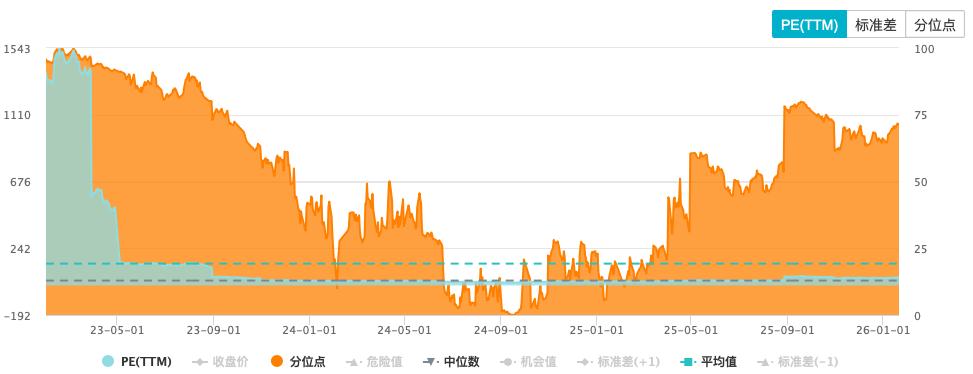
Valuation changes of Jinjiang Hotels' A - shares in the past three years. Source: Wind
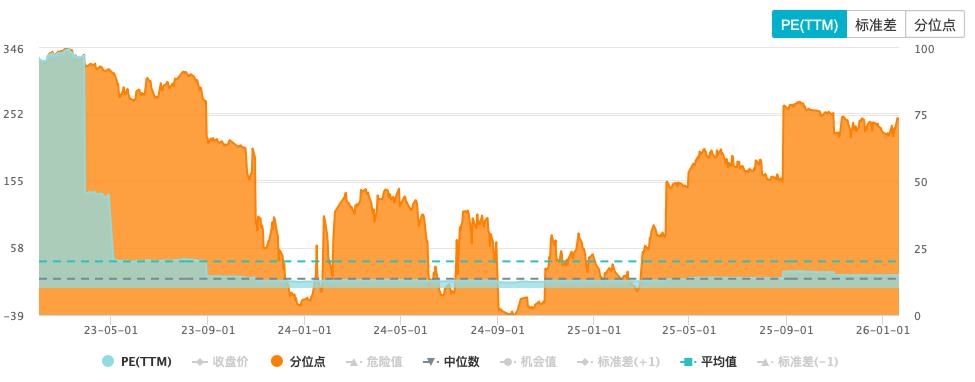
The valuation changes of Jinjiang B - shares in the past three years show that their median and average values are significantly lower than those of A - shares. Source: Wind
This significant price difference is not unique to Jinjiang Hotels but has long existed in the special sector of the Chinese capital market - the B - share market.
Looking beyond individual stocks, in the past two years, the return of the B - share index has long hovered around 0% and has even often been negative, while the performance of major A - share and H - share indices has been better than that of the B - share index. This divergence has become even more obvious especially after April 2025.
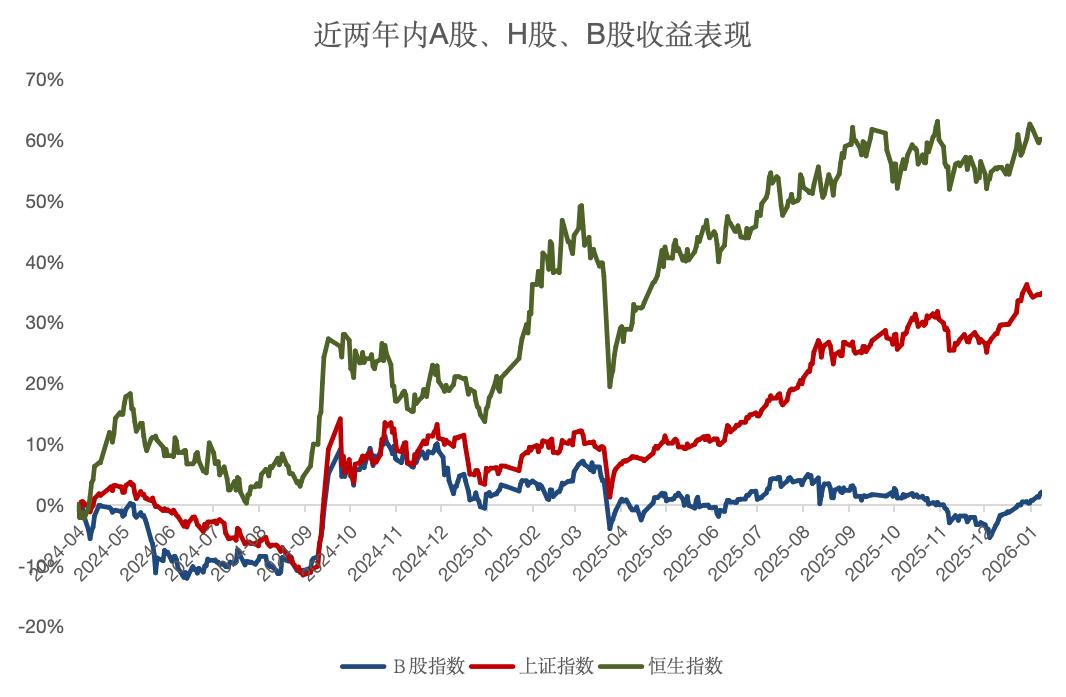
Data source: Wind Charting: 36Kr
So why did Jinjiang Hotels choose to increase its holdings of B - shares at this time? Why has the B - share market been in a long - term low - valuation state? Can investors find opportunities in it?
Why did Jinjiang Hotels increase its holdings of B - shares?
Generally, listed companies' share repurchases or increases in their own shares are mostly due to considerations such as optimizing the capital structure, enhancing control and equity stability, and improving the efficiency of capital use.
When a company believes that its stock price is undervalued, especially significantly lower than its intrinsic value, share repurchases can reduce the share capital, increase earnings per share, thereby boosting market confidence and safeguarding shareholders' interests. For Jinjiang Hotels, the B - shares have long been below the net asset value and have a price - earnings ratio of only about 18 times. The cost of increasing holdings is relatively low, which is obviously attractive from a financial perspective.
At the same time, a company's self - increase in shares, especially in the relatively illiquid B - share market, can consolidate its controlling position and prevent potential equity takeover risks without affecting the A - share price. Although Jinjiang Hotels' current share - increasing did not reach the controlling line, it sent a clear signal that the management is optimistic about the company's long - term development.
Moreover, in terms of trading volume, the B - share market has long had light trading volume and insufficient liquidity. A listed company's active share - increasing can not only inject some vitality into the market but also demonstrate its recognition of the company's value during the period of low stock prices, indirectly promoting the restoration of valuation.
Considering Jinjiang Hotels' own fundamentals, measured by the number of rooms, it is already the leader in the domestic hotel industry. After going through the performance fluctuations after the impact of the pandemic, the industry is gradually recovering. Increasing its holdings of B - shares at a low cost at this time reflects prudence in financial strategy and can also convey confidence in future development to the outside world.
Why has the B - share market been in a long - term low - valuation state?
The share - increasing behavior itself does not change the company's actual business operations, but it highlights the significant valuation gap between B - shares and A - shares - the same company with the same fundamentals, but a price "dual - track system" is formed due to different trading markets. So what are the reasons for this situation?
To understand the low - valuation phenomenon of B - shares, we need to first review its historical context.
In 1992, RMB special stocks, namely B - shares, were officially launched. The original intention was to open up a channel for domestic enterprises to attract foreign investment when the RMB capital account was not yet open. B - shares are denominated in RMB but are traded in foreign currencies - US dollars for Shanghai B - shares and Hong Kong dollars for Shenzhen B - shares. Initially, they were only available for purchase by overseas investors.
After 2001, the B - share market was opened to domestic individual investors. However, due to factors such as foreign exchange control, inconvenient trading, and differences in information disclosure compared with A - shares, investor participation has always been low. The small market capacity, light trading volume, and lack of institutional investors have led to much lower liquidity in the B - share market than in the A - share market, and the valuation has been under long - term pressure.
Early B - share investors were mainly overseas institutions and individuals. However, with the implementation of the QFII (Qualified Foreign Institutional Investor) system in 2003 and the launch of the Shanghai - Hong Kong Stock Connect in 2014, the channels for foreign capital to enter the A - share market have become increasingly rich and convenient. The institutional advantages of B - shares have disappeared, and foreign investors have gradually reduced their holdings due to poor liquidity and imperfect information disclosure.
In recent years, the regulatory authorities have mentioned "studying B - share reform" several times, but no clear plan has been implemented. The financing function of the B - share market has almost stagnated, and refinancing is difficult. Some companies have chosen methods such as "B - to - A conversion" and "B - to - H conversion" to find a way out, but the process is complex and the cost is high. This policy uncertainty has further suppressed the valuation and activity of the B - share market.
In addition, B - shares are denominated and traded in foreign currencies. Domestic investors need to bear the risk of exchange - rate fluctuations, and the procedures for currency exchange and settlement are more cumbersome, with higher frictional costs than those of A - shares. Against the backdrop of the normalization of two - way fluctuations in the RMB exchange rate, this has also become one of the factors restricting the liquidity of the B - share market.
Overall, the low valuation of the B - share market is the result of the superposition of multiple historical and real - world factors such as lack of liquidity, marginalization of policies, imbalance in the investor structure, and high trading costs. With the continuous opening of the capital market in both directions and the enhanced linkage between the A - share market and the global market, the original "window for foreign investment" function of the B - share market has basically completed its historical mission, and the phenomenon of valuation discount has therefore persisted for a long time.
A neglected value depression?
The share - repurchase behavior of listed companies in the B - share market has made the market re - examine the investment value of the B - share market.
Currently, there are about 70 companies that issue both A - shares and B - shares. The vast majority of B - shares have a significant discount compared to A - shares. For some companies such as Jinjiang Inn, the discount rate even exceeds 50%.
This means that investors can buy the same equity of the same company at a lower price. From an investment perspective, this is obviously an arbitrage opportunity worthy of attention. However, due to factors such as liquidity, it is difficult to realize the arbitrage.
On the other hand, due to the low stock price, the dividend yields of many B - shares are significantly higher than those of A - shares. The dividend yields of some individual stocks have long remained above 5%, and can even reach 8% - 10%. For long - term investors who focus on cash returns and can tolerate lower liquidity, the high - dividend feature of B - shares is quite attractive.
However, it is worth noting that the low liquidity of B - shares may cause investors to be able to buy but not sell, resulting in a different form of "being trapped". In addition, exchange - rate fluctuations may also erode investment returns.
Looking at the current situation, Jinjiang Hotels' share - increasing in the B - share market seems to be an ordinary share - repurchase on the surface, but it actually reflects the long - standing valuation dilemma and potential opportunities in the B - share market.
As a product of the historical "dual - track system", the lack of liquidity and marginalization of policies in the B - share market have led to its long - term lower valuation than the A - share market. However, it is precisely this deviation that provides the possibility for calm value investors to buy the equity of high - quality companies at a discounted price.
However, the existence of a value depression does not mean that the price will immediately return - the market can be irrational for longer than expected. The share - increasing behavior of industrial capital is often more significant as a signal than market sentiment. For investors, on the basis of fully understanding the risks of the B - share market, they may look for opportunities in stocks with stable fundamentals, high dividend yields, and significant price differences between A - shares and B - shares.
*Disclaimer:
The content of this article only represents the author's views.
The market is risky, and investment should be cautious. In any case, the information in this article or the opinions expressed do not constitute investment advice for anyone. Before making an investment decision, if necessary, investors must consult professionals and make careful decisions. We have no intention of providing underwriting services or any services that require specific qualifications or licenses for all parties in the transaction.

Follow to get more information