Unitree doesn't want to be second. The humanoid robot market is surging with undercurrents.
As expected, robots are going to be on the Spring Festival Gala again.
On January 17th, China Media Group officially announced that the 2026 Spring Festival Gala will be a further advancement of "technology + art", and clearly stated that robots will take the stage again.
Last year, robots just did the yangge dance among the crowd. This year, they might show off their kicking skills and high - difficulty backflips.
As early as a month ago, the news about robots on the Spring Festival Gala spread. 36Kr reported that in order to compete for the sponsorship of the Spring Festival Gala, Zhipu Robotics bid 60 million yuan, and Unitree pushed the price up to 100 million yuan.
Zhipu denied participating in the bidding, and Unitree didn't make a public response.
Judging from various leaked information, the humanoid robots taking the stage at the main venue this year seem to still be from Unitree.
One is eager to distance itself, and the other is secretive. Behind this Rashomon - like situation is the competition for the right to speak between two leading domestic embodied intelligence companies.
The smell of gunpowder from the open and covert struggles continues to permeate
On January 8th, the international institution Omdia released the list of global humanoid robot shipments in 2025. The data shows that Zhipu ranked first with 5,168 units, and Unitree ranked second with 4,200 units.
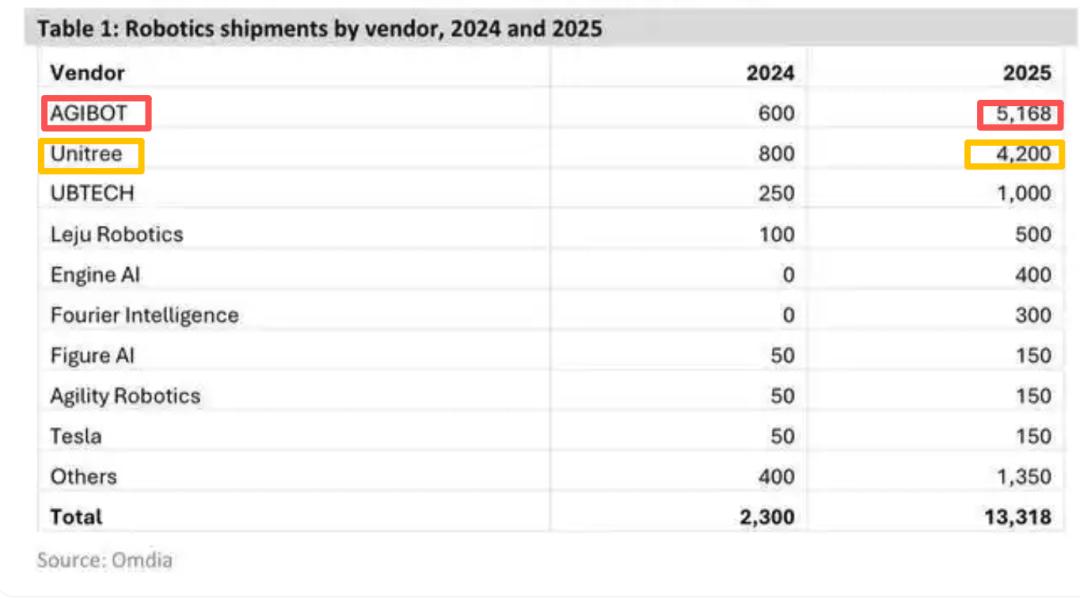
Immediately afterwards, on January 15th, the global market research company Counterpoint Research released a research report on humanoid robots. Zhipu ranked first in the humanoid robot market in 2025 with a 30.4% market share in terms of installed capacity, and Unitree ranked second again with a 26.4% share.
On January 19th, an interesting thing happened.
The media reported collectively that Unitree's actual shipments in 2025 exceeded 5,500 units. If calculated by mass - production offline, it exceeded 6,000 units. It's almost like saying directly that Unitree is the number one.
I carefully checked the news source. They wrote like this: It was learned from Unitree's agents and suppliers.
This kind of indirect information release is very sophisticated. The official doesn't want to say certain things, so it relies on the media to "actively" inquire.
However, on the evening of January 22nd, Unitree couldn't hold back anymore and took the initiative to show its strength. It posted on its official WeChat account, saying, "In the past month, there have been many false rumors about our company's shipment volume in 2025 on the Internet."
According to Unitree's post on its official WeChat account, in 2025, the actual shipments of its humanoid robots exceeded 5,500 units, and the mass - production offline of the main bodies exceeded 6,500 units.

Unitree also kindly reminded everyone that robots come in many forms. Don't combine the numbers of different types of robots for comparison. In other words, I, Unitree, am the number one in humanoid robot shipments.
From the competition for the title of the "top dog" in the industry, we can see that in the current humanoid robot track, even before the commercial closed - loop starts, it's already extremely competitive and in all - dimensional confrontation.
It's not just domestic companies. Global players are also making high - profile statements to support their valuations. In a recent in - depth interview, Elon Musk claimed that after the mass - production of the Optimus humanoid robot, in just three years, there might be more robots capable of performing high - level surgeries than surgeons in the world. In five years, their surgical skills will surpass humans.
You know, the mass - production node of Optimus V3 is set for the end of this year. According to Musk's rhythm, surgeons can retire in 2030.
Why are they all making high - profile statements?
Because in 2026, investors' patience has reached a critical point. After multiple rounds of financing in the early stage, companies need to prove their value as soon as possible to support the next round of financing or IPO.
There are many ways to prove value, and performing in front of the whole nation is the most direct and the loudest way of "showing strength". That's why companies are scrambling to be on the Spring Festival Gala.
Behind the competition for status and popularity, the industry will face a major test in 2026.
The reason for this major test at this node is essentially that the "narrative dividend" of embodied intelligence has been overdrawn to the limit in 2025.
Take the primary - market financing as an example. In the humanoid robot segment, the total financing amount in 2021 and 2022 was about 4.5 billion yuan, and the total in 2023 and 2024 was about 10 billion yuan.
In the just - concluded 2025, there were 173 rounds of financing, and the amount soared directly to 24 billion yuan.
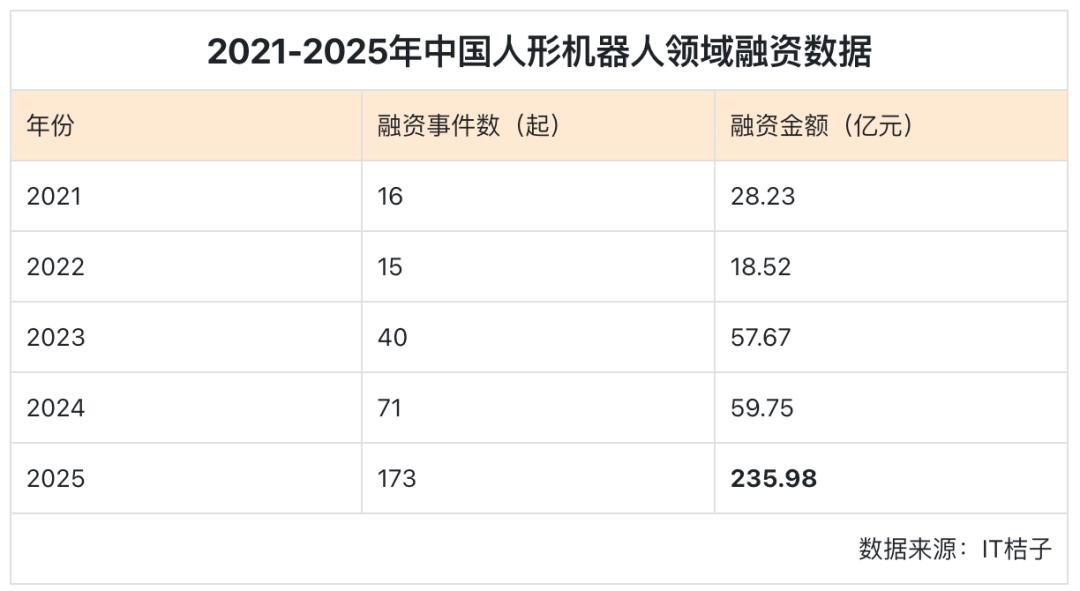
The amount of money invested in one year is more than the total of the previous three or four years. This is just public data, and strategic investments that haven't been announced are not included.
In the United States across the ocean, it's also booming. Figure AI, founded in 2022, saw its valuation soar to 39 billion US dollars after completing its Series C financing in September 2025, a 15 - fold increase in 18 months! NVIDIA continued to invest in its Series C after participating in its Series B.
At the same time, a large number of entrepreneurs have emerged in the industry.
As of the beginning of this year, there are already more than 140 domestic humanoid robot complete machine companies in China.
Currently, there are about 300 global humanoid robot complete machine companies in the world. That is to say, we account for half of the market.
These companies are mainly concentrated in the Yangtze River Delta (about 30%), the Pearl River Delta (about 24%), and the Beijing - Tianjin - Hebei region (about 18%).
Just last year, domestic companies released more than 330 humanoid robot products.
What does it mean to have 140 companies and 330 products?
Last year, the global humanoid robot shipments were only 13,300 units. The top three are all domestic companies, accounting for 10,300 units in total. That is to say, about 99% of the remaining companies have almost no substantial sales.
An even more cruel truth is that even those leading companies that have advanced to mass - production and even gone public are not having a good time. Ubtech, the "first humanoid robot stock", shipped 1,000 units in 2025, ranking third in the world in terms of shipments. However, since its listing at the end of 2023, this company has not achieved annual or quarterly profitability.
It is like a microcosm of this industry: even if it becomes the leader, it is still in the survival stage of "burning money for development and making losses for the future".
Behind the false prosperity of a large number of companies flocking in is the extreme homogenization of products. They are becoming more and more like humans and even have genders, but they lack self - developed "brains" and "cerebellums".
The algorithms mainly rely on open - source frameworks and fine - tuning of large models. Many underlying architectures are pieced together from general solutions. There has been no substantial breakthrough in force control, tactile sense, and flexible delivery.
To put it bluntly, many manufacturers are focusing on improving performance - type abilities, such as walking, dancing, and backflips. So most of the products sold can only go to research institutions, schools, or accompany dancers at concerts.
This logic of "emphasizing performance and neglecting delivery" is the biggest false boom in the current industry.
According to the statistics of Caixin Securities, in 2025, the highest single - order amount for humanoid robots was Ubtech's 250 million yuan, and most of the other orders were in the tens of millions of yuan level.
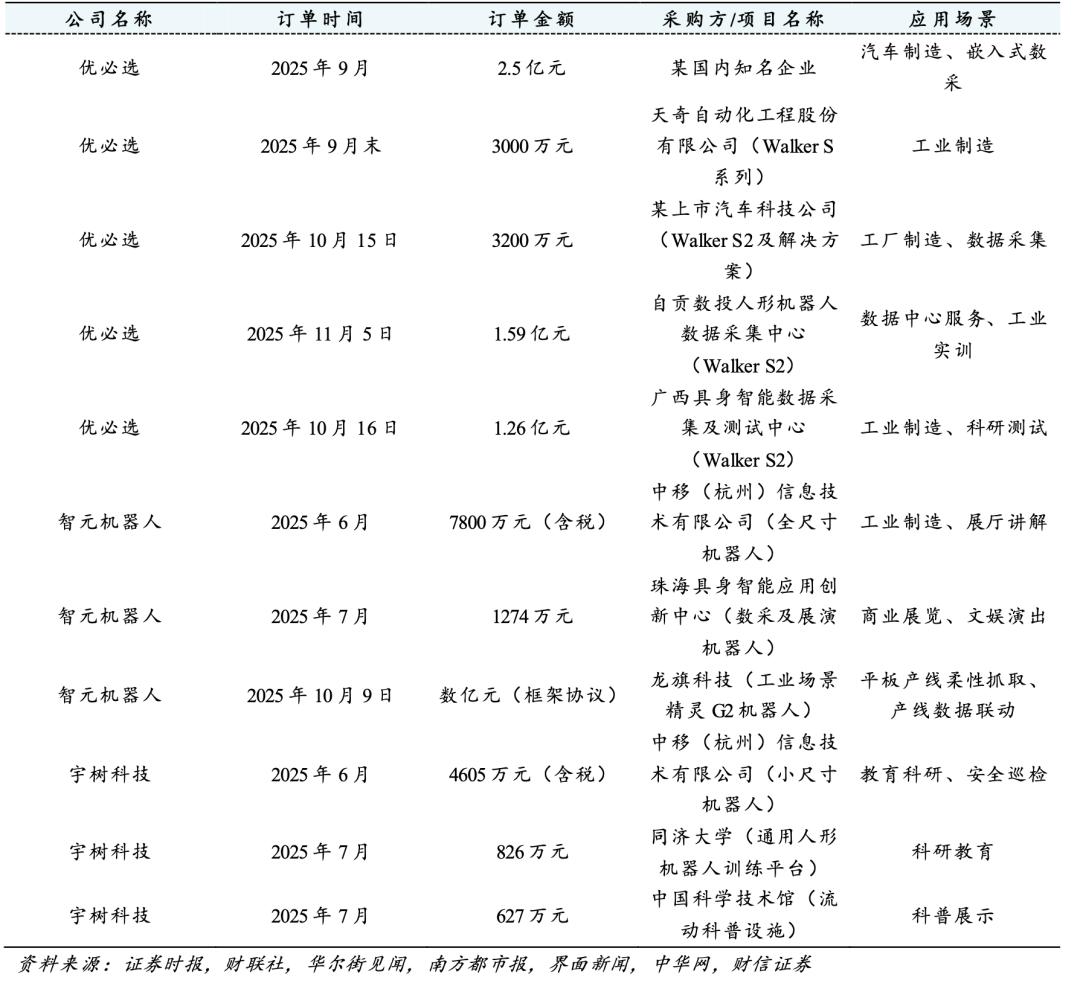
This embarrassing situation of "lack of large - scale orders" is the comprehensive result of narrow implementation scenarios, unproven ROI (return on investment), and immature technology.
Being obsessed with improving performance abilities is to grab short - term popularity and orders. However, long - term neglect of the underlying logic of industrial scenarios will result in technological hollowness.
Once the industry window period closes, these companies will be left with nothing but a pile of dancing scrap iron.
So, when the expectations are overdrawn in advance and the valuation deviates from the fundamentals, those unfulfilled performance commitments will have to be settled in the industry's major test in 2026.
To extinguish the false boom and squeeze out the bubbles, the industry must achieve key breakthroughs in mass - production and commercial implementation.
Currently, the BOM cost of most products in the world's first - tier humanoid robot market is stuck between 40,000 and 50,000 US dollars. For a factory owner, it doesn't make economic sense to spend hundreds of thousands of yuan to buy an incompetent employee that still needs long - term maintenance and often has bugs.
Only when Tesla and domestic leading companies achieve mass - production and turn humanoid robots into industrial standard products does it mean that the supply chain will tend to be stable. Only then is it possible to reduce the cost.
And when the cost drops to a critical point and the ROI of humanoid robots can exceed that of human labor in some industries, the industry inflection point will arrive.
In the coming year, the key to the industry lies with Tesla. Currently, the domestic independent supply chain is booming in many areas. The IPO process of Unitree will be a key signal. If it goes smoothly and the fundraising exceeds expectations, the domestic industrial chain can get a boost.
And one month later, when the lights on the Spring Festival Gala stage go out, those robots will ultimately have to enter the factory to prove that they can do more than just backflips.
This article is from the WeChat official account "Feng Sheng Sheng" (ID: fangshi488). Author: Feng Sheng Sheng. Republished by 36Kr with permission.