Breaking through the "gacha" dilemma of text-to-3D generation, Mugen3D opens the door to the ToC application of the world model.
In the field of AI-generated 3D, there have long been "pain points" such as insufficient generation accuracy that fails to meet commercial standards, and discrepancies between the generated results and the input images. SumeruAI, a Shenzhen-based startup team, recently launched the Mugen3D platform and completed a ten-million-yuan angel round of financing. Through the in-depth combination of its self-developed image-to-3D algorithm and 3D Gaussian Splatting (3DGS), it has achieved the generation of high-precision 3D assets of all categories from a single photo. This not only eliminates the "randomness" in the modeling process, making the AI-generated models "ready-to-use" and eliminating the need for manual model refinement. Moreover, the training and inference costs of its algorithm have been reduced to less than one-thousandth of those of industry competitors, making it expected to become the cornerstone for the consumer-side application of spatial intelligence and world models. This breakthrough has attracted wide attention from international authoritative media. Recently, media such as AP News, USA Today, and Yahoo Finance have conducted in-depth reports on it.

Ending the "Lottery Draw" Era: From a Single Photo to a 1:1 Realistic Model
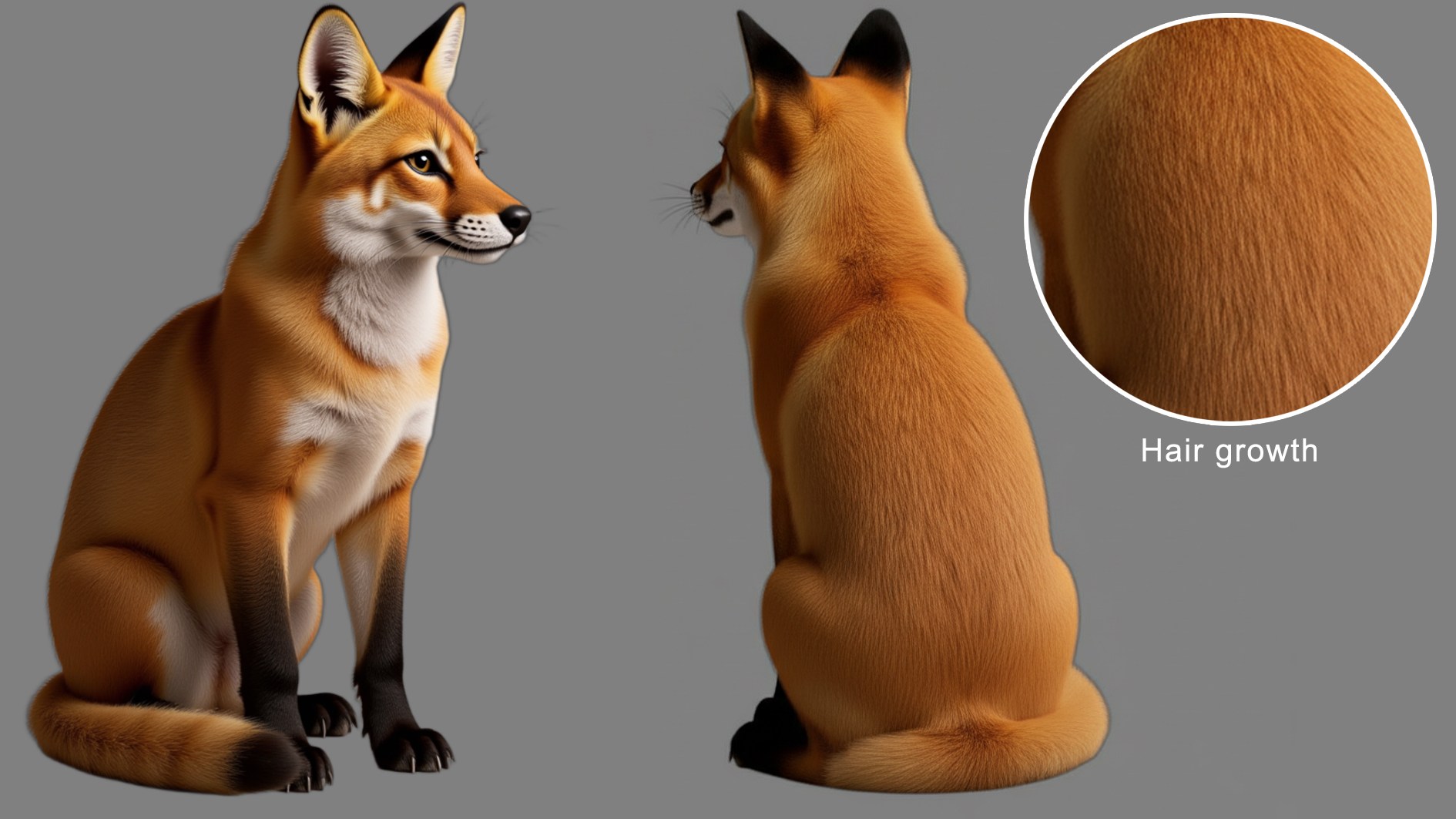
In the field of 3D content production, although AIGC technology has penetrated to some extent, creators have long been in a "gambling" state. Existing mainstream 3D generation solutions often face great uncertainties. In high-precision fields such as human figures and animals, the generated models often suffer from facial feature distortion, blurred textures, or "clipping errors" where geometric surfaces intersect abnormally.
This uncontrollability means that the semi-finished products generated by AI still require professional modelers to spend hours on manual repair, making it difficult to truly enter the industrial production pipeline.
The Mugen3D platform launched by SumeruAI aims to completely reverse this situation. Its core ability is defined as "Single-Shot Perfection". Users don't need to set up complex multi-camera arrays or scanning devices. They only need to upload an ordinary 2D photo - whether it's a complex character, a lively pet, or a precise industrial part - and Mugen3D can restore a 1:1 corresponding 3D model with no loss of details within minutes.
"The core logic of Mugen3D is not to 'quickly create a shape', but to accurately capture and restore the information features of the physical world through a single photo in a very short time, and let AI drive it to generate animations and interactions," said Feng Cheng, the CEO of SumeruAI.
Reconstructing the Technical Foundation: The Trinity of Graphics Algorithms, Generative AI, and 3DGS
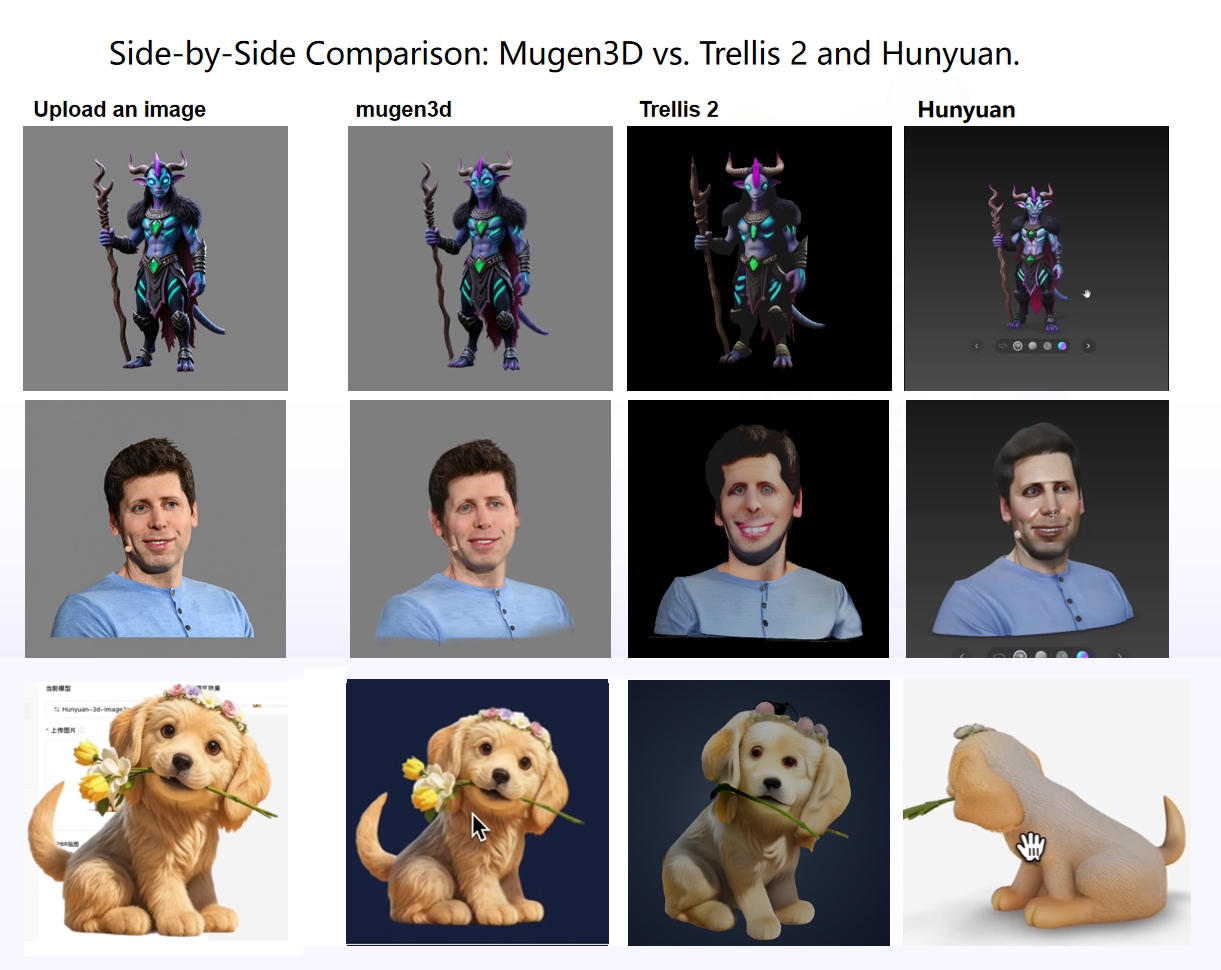
Mugen3D has a unique underlying workflow. The platform is built on three pillars: generative AI, SumeruAI's self-developed geometric algorithm, and the cutting-edge 3D Gaussian Splatting (3DGS) technology.
Different from many tools on the market that rely on "black-box generation", Mugen3D introduces a rigorous geometric backbone. This algorithm is based on camera geometry, projection principles, and multi-view consistency, and lays a "foundation" for the generation process through deterministic mathematical logic. This approach fundamentally reduces common failure modes such as facial structure distortion and texture drift, ensuring extremely high stability of the output results. This makes Mugen3D the only tool on the market that can currently enable users to generate the desired 3D model with "one photo" and "one attempt", avoiding the cost increase caused by multiple generation attempts or post - production manual model refinement.
At the rendering performance layer, Mugen3D uses 3DGS technology. Compared with traditional rigid polygon meshes, 3DGS represents the scene as millions of 3D Gaussian points. This non - continuous representation allows Mugen3D to capture extremely subtle texture hints and material reflection effects, and is perfectly compatible with content pipelines that require real - time interaction, such as VR and spatial computing.
Game - Changing: Reinventing the 3D Asset Supply Chain at One - Thousandth of the Cost
The emergence of Mugen3D marks that high - precision 3D modeling is evolving from an expensive manual craft to an accessible standardized commodity.
Mugen3D proposes a revolutionary architecture for algorithm training. It doesn't rely on expensive and scarce 3D model asset libraries, but mainly uses a large amount of image and video data for training. It is understood that the underlying algorithm of Mugen3D was trained with only 8 RTX5090 graphics cards and hundreds of thousands of image/video data. In contrast, Microsoft Trellis used 64 A100 graphics cards and hundreds of thousands of 3D models for training. The inference process of Mugen3D is also fully implemented on consumer - grade graphics cards, truly enabling efficient inference on consumer - grade GPUs. Combined with Mugen3D's feature of "one - shot" and unbiased generation, it can be said that the emergence of Mugen3D makes the large - scale application of the world model at the consumer end possible.
This "game - changing" combination of quality and cost is triggering a chain reaction in multiple vertical fields:
3D Printing and DIY: Enthusiasts can generate a 3D model exactly the same as the picture with just one photo, completely lowering the threshold for the DIY market, such as the entry of 3D printing, especially color 3D printing, into households.
Games and Social Media: The industry is moving towards an era of fully AI - generated assets. Personalized gaming experiences will explode on a large scale. Not only will "one - person game studios" emerge at an accelerated pace, but the boundaries between games and social products will further blur. Real - time and multi - dimensional interactions between users and Internet products will become a reality, and the generation and distribution of Internet visual content will become more personalized and gamified.
Digital Marketing and Advertising: Video ads are evolving into interactive media. Products in ads are no longer static stickers but 3D entities that users can interact with in real - time and observe from multiple dimensions. And according to the user's natural language input, personalized product recommendations can be provided, significantly shortening the distance from intention to transaction.
Towards the "World Model": A Bridge Connecting AI and the Physical World
SumeruAI has been deeply involved in the field of generative 3D for over three years. Previously, the team completed a closed - loop verification in the education and e - commerce fields with its hyper - realistic 3D digital human products, providing 24/7 uninterrupted intelligent labor for global enterprises.

For the team, launching Mugen3D is just the first step in building the underlying infrastructure of the "world model". SumeruAI's ultimate goal is to create a fully AI - driven 3D engine that can directly bridge the gap from natural language to free 3D animations.
"3D is a high - quality data compression of the physical world. Therefore, AI - generated 3D models and animations are the only path to the real 'world model'," summarized the CTO of SumeruAI. "The world model is a bridge connecting the virtual space and the real physical world."
Currently, Mugen3D has officially launched a global beta test.
About SumeruAI: SumeruAI is an AI technology company focusing on generative 3D content and spatial intelligence. It is committed to lowering the threshold of 3D content creation through underlying algorithm innovation and providing a core digital asset engine for the future spatial computing ecosystem.