After surpassing Tesla, BYD faces global competition head-on.
Two years ago, it might have been premature to discuss the global competitiveness of domestic Chinese automobiles.
At that time, technological breakthroughs in products and domestic production capacity expansion were the only two priorities. Among domestic new energy vehicle enterprises, none had truly reached the top of global sales.
However, a 2025 global new energy vehicle market segmentation list has completely changed the situation: BYD, with an annual sales volume of 2.25 million pure - electric vehicles, has surpassed Tesla for the first time to top the global rankings.
This reversal has broken Tesla's pattern of topping the list for many consecutive years and also brought a historic turning point for Chinese automakers in terms of their voice in the global new energy vehicle race.
New challenges follow. After dominating the pure - electric vehicle market, what awaits BYD is the test of sustainable global profitability and the all - around competition with rivals in terms of vehicle models.
Reap the Scale Dividends from the Rising Penetration Rate
The rise of any industry cannot be separated from the nurturing of the era. BYD's breakthrough in the pure - electric vehicle market first benefits from the dividends brought by the increasing penetration rate of the Chinese new energy vehicle market.
Multiple public sources indicate that in 2025, the penetration rate of new energy vehicles in China exceeded the 50% mark, with an annual sales volume of 12.852 million vehicles, marking that the market has fully entered the era dominated by new energy vehicles.
In a sense, the continuous increase in per - capita vehicle ownership and the upgrading of the consumption structure have resonated, providing broad growth space for pure - electric vehicles. The maturity of pure - electric technology has just met this demand leap.
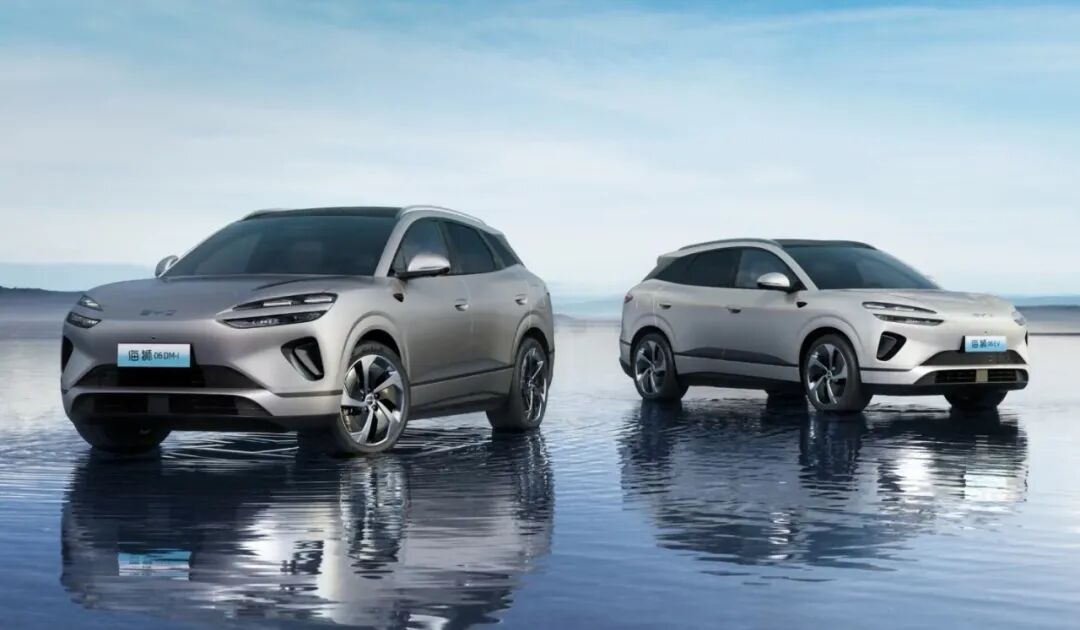
Under this trend, the structural adjustment of the market's technological route has become a key driving force. Hybrid vehicles, which used to be on par with pure - electric vehicles, now present a pattern of "simultaneous rise of pure - electric and plug - in hybrid vehicles, and the ebb of range - extended vehicles". According to data from the Passenger Car Association, in 2025, the wholesale proportion of pure - electric vehicles reached 60.2%, plug - in hybrid vehicles accounted for 30.4%, while range - extended vehicles only accounted for 9.4%. Meanwhile, the industry has entered a new stage of "electricity being cheaper than gasoline" from "equal price for gasoline and electric vehicles", which not only squeezes the market share of fuel vehicles but also highlights the cost - effectiveness advantage of pure - electric vehicles, further accelerating the increase in penetration rate.
Specifically for BYD, two points are worth noting. Firstly, thanks to the popularization of fast - charging technology and the improvement of the charging network, the range anxiety of pure - electric vehicles has been greatly alleviated. Technologies such as BYD's Blade Battery have given its products double advantages in safety and range, which exactly meet the core demands of family users for high - quality travel. Secondly, BYD has a first - mover scale advantage. It has long been the leader in the domestic industry, making it easier to overtake Tesla.
The slowdown of Tesla's growth has also created external conditions for BYD's overtaking.
In the past year, due to some controversial stances of Elon Musk, Tesla has faced a trust crisis in some markets. The slowdown of model iteration has reduced the freshness of its products, and some resources have been transferred to the self - driving taxi business. Coupled with the tightening of the US electric vehicle subsidy policy, Tesla's global sales volume declined by 8.6% in 2025.
With the interweaving of internal and external factors, the competitive balance in the global pure - electric vehicle market has been completely broken.
Move from Being the Sales Champion to the Comprehensive Strength Leader
If the scale dividends are the favorable timing for BYD's overtaking, then cost control and profitability are the favorable geographical conditions. Against the backdrop of the continuous decline in the average price of global new energy vehicles, the average price of domestic passenger vehicles in China dropped from 184,000 yuan in 2024 to 178,000 yuan in the first 11 months of 2025. The overall profit margin of the industry declined from 6.2% in 2020 to 4.3% in 2024. Cost management ability has become the core competitiveness for enterprises to survive.
This is also a key challenge for BYD to compete with Tesla globally. Fortunately, BYD has made some progress in this area.
Looking back at Tesla, it has long occupied the high ground in terms of cost advantage with its minimalist production process and global supply - chain integration ability. However, BYD has achieved a breakthrough by adopting the model of "full - stack self - research and self - production of more than 90% of components". Whether it is the three platforms (A, B, C) of BYD's assisted - driving system or the R & D of the three - electric system, BYD has indeed built a complete independent industrial - chain system. The benefit is that it can quickly respond to market demand changes and achieve rapid product iteration.
Data from the third quarter of 2025 shows that after excluding the gross - profit contribution of BYD Electronics, the gross - profit margin of its automobile - related business reached 20.6%, while Tesla's automobile - business gross - profit margin was only 15.4% in the same period. The 5.2 - percentage - point gap in gross profit means that BYD has more room for maneuver in price wars and also provides financial support for its continuous R & D investment.
However, there is still pressure behind the cost advantage.
Especially in the global high - end market, overseas brands still lead in terms of brand recognition and premium ability. Models such as Tesla's Model S and Model X still dominate the market above 300,000 - 400,000 yuan. Although the sales volume of BYD's high - end models has been steadily increasing, there is still a gap in terms of brand and premium ability. In the overseas market, BYD's best - selling models are mostly concentrated in the mid - and low - end segments, and there is still room for improvement in its competitiveness with Tesla in the mid - and high - end market.
Even though BYD's sales volume in Germany increased eight - fold in a year, a research report from UBS shows that a survey in the German market indicates that only 12% of consumers are willing to pay the same premium for BYD as they would for BBA (Mercedes - Benz, BMW, Audi). Most consumers still position BYD as "high - configuration and affordable models". The outside world believes that there is still a long way to catch up with traditional luxury brands in terms of soft power such as exclusive service systems and cultural values.
This means that BYD's current global leadership in pure - electric vehicles is more of a victory in scale. In the future, how to maintain the cost advantage while enhancing the brand influence in the high - end market will be the key for it to continuously consolidate its global leading position.
It is worth noting that the average price of domestic passenger vehicles in China was 184,000 yuan in 2024 and dropped to 178,000 yuan in the first 11 months of 2025. The decline in the cost per vehicle reflects that some automakers are still adopting the market strategy of sacrificing price for volume. However, since profit will be the core consideration for most manufacturers next year, it is expected that many automakers will continue to consolidate the sales advantage of models in the 100,000 - 200,000 - yuan range and shift the focus of competition to the price range above 200,000 yuan.
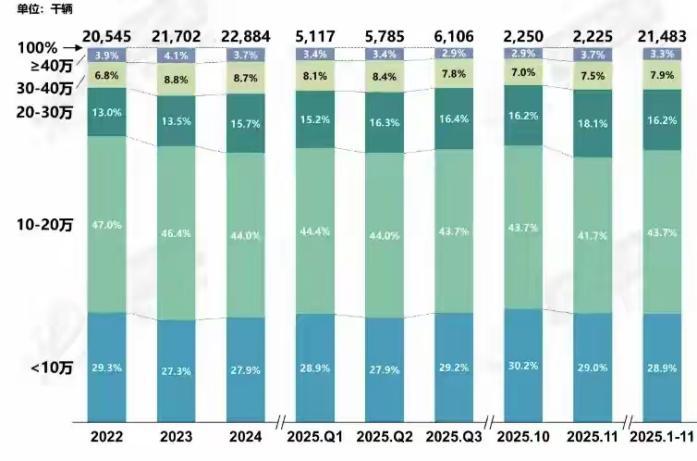
In addition, the progress of L3 autonomous driving in the domestic market is accelerating. Once models in this price range are equipped with intelligent driving functions, it may narrow the competitive gap with models in the 300,000 - 500,000 - yuan range, posing a strong impact on the domestic high - end market and its profit margin. Therefore, continuously strengthening the high - end market overseas has become a new adjustment point.
Whether it is the profit pressure from the industry's per - vehicle cost or the competitive challenge to high - end models after the arrival of L3, this general trend also exists for BYD. Therefore, the refinement of global high - end vehicles and the control of global costs are even more important.
Two Declines after the Pure - Electric Vehicle Success
Mean Intensified Competition with Tesla in 2026
Winning the global sales championship is just the starting point. In the global new energy vehicle market in 2026, there will be a full - scale confrontation between BYD and Tesla. Two sets of data are worth noting.
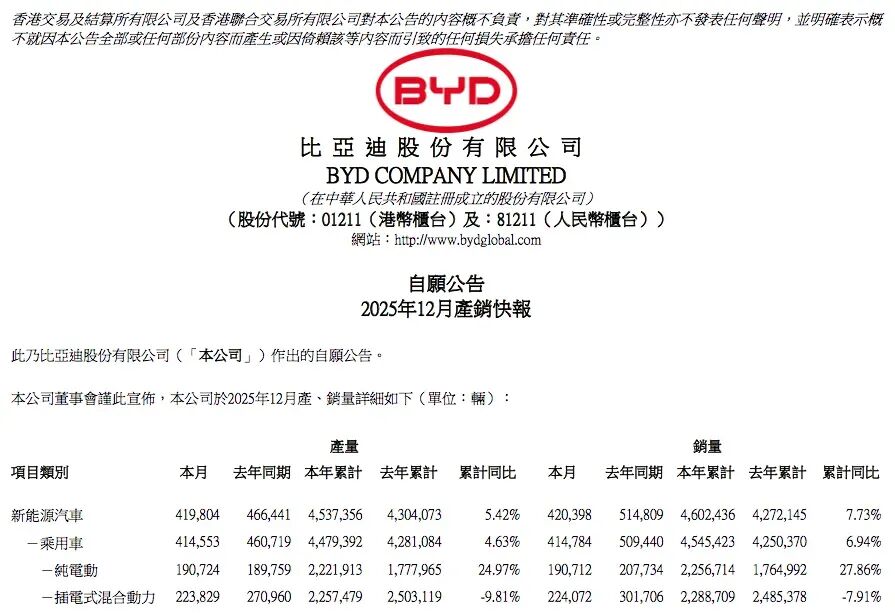
Firstly, since the second half of last year, the growth rate of the new energy vehicle market has been visibly declining. It is expected that the growth rate of the domestic new energy market will slow down to about 10% this year, and the subsidy policy will be less generous. Secondly, from September to December 2025, BYD's sales volume declined year - on - year for four consecutive months. In December, the sales volume declined by 12.45% month - on - month and about 18% year - on - year, the largest single - month decline in two years.
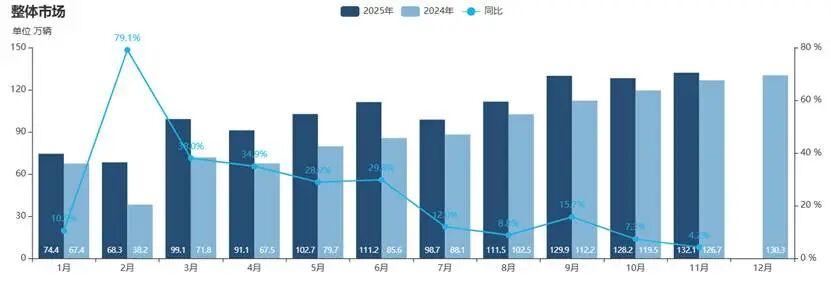
This may further accelerate BYD's globalization process.
Dialectically, BYD's globalization strategy is being implemented at an accelerated pace. Currently, BYD's overseas business covers more than 110 countries and regions. It is not just a simple product export but also an export of the industrial chain, which can further reduce logistics and tariff costs. After its overseas sales volume exceeded one million vehicles for the first time in 2025, BYD plans to strengthen the layout of its entire industrial chain overseas in 2026 and further deepen local development in Europe, Southeast Asia, South America, Japan and other places.
The company has announced the establishment of overseas factories in Thailand, Uzbekistan and Brazil, with a total designed production capacity of more than 300,000 vehicles per year. Factories in Hungary, Malaysia, Cambodia and other places are under planning.
However, the "counter - attack" from competitors, especially Tesla, is also fierce.
As Elon Musk refocuses on the automobile business, Tesla is accelerating model iteration and launching multiple new models to cover a wider price range. For example, the cheaper version of the Model Y Standard launched by Tesla in October may help the company regain some lost ground in the next few quarters.
Considering Tesla's previous advantages in per - vehicle cost and gross profit, it is not afraid of price - war competition. However, in the context of declining scale and the anti - involution trend in some core markets, the consideration of restarting this strategy will become more cautious.
A new approach may be more effective. It is reported that in 2026, Tesla is fully promoting the approval of its Full Self - Driving (FSD) system in Europe, trying to enhance the product's attractiveness again. Tesla also plans to further expand the production capacity of its super - factories in Berlin, Texas and other places and increase its layout in India, Southeast Asia and other regions, forming direct supply - chain and production - capacity competition with Chinese automakers such as BYD.
As a born - global enterprise, Tesla has ranked first in electric vehicle sales in many countries around the world over the years. Its super - factory layout and super - charging network still have a first - mover advantage. In recent years, Elon Musk has also focused on artificial intelligence, self - driving cars and humanoid robots. Tesla's stock price does not seem to have been greatly affected by its sales volume.
For BYD, there is competition with competitors in terms of global supply - chain ability, market expansion ability and sales volume. It is also possible that competitors may gain an advantage in future competition by taking the lead in cutting - edge technologies such as artificial intelligence. In other words, the future competition between the two sides may not be limited to the automobile business.
Referring to Toyota, which has more than 75 production bases on five continents and a distribution network covering 190 countries and regions, there is still huge room for growth in the globalization of Chinese automakers such as BYD. Of course, this heavy - asset model of "self - built bases + independent channels" will also test their financial strength and local operation ability.
Therefore, for BYD, the key to continuous leadership is how to replicate its domestic success overseas and make progress in local R & D, supply - chain management and high - end brand building. The global competition between Chinese automakers and Tesla has just begun.
This article is from the WeChat official account "Yidu Pro", written by Fengcheche, and is published by 36Kr with authorization.