Terence Tao was amazed. The mathematical singularity has initially emerged, and AI has presented an original proof beyond human reach for the first time.
The mathematical singularity is emerging! Gemini has solved a new mathematical theorem. A top Stanford scholar exclaimed, "Coming up with this would be something to brag about for a lifetime." Terence Tao predicted a symbiotic future for mathematicians and AI. Grok has discovered a new hidden path in the Riemann Hypothesis...
Chinese is one of the human languages.
Bits are the language of computers.
And mathematics is the language of the universe.
As Galileo, the "father of modern physics," said, "To understand the universe, you must understand the language in which it is written - the language of mathematics."
To test whether humanity has achieved Artificial Superintelligence (ASI), what else can we use other than mathematics?
The original ability of AI in mathematics is the inevitable path to ASI (and even understanding the essence of physics), and it is the core of the core.
If you hear that an AI has won a gold medal in the International Mathematical Olympiad (IMO), you may still have doubts about ASI -
After all, the knowledge involved in the IMO is still high - school mathematics;
After all, humans must have answers to such problems;
After all, one might be able to win an IMO gold medal just by relying on memory...
But now, things are different.
This is not an exaggeration. It has been confirmed by Fields Medalist Terence Tao and Stanford professor Ravi Vakil himself.
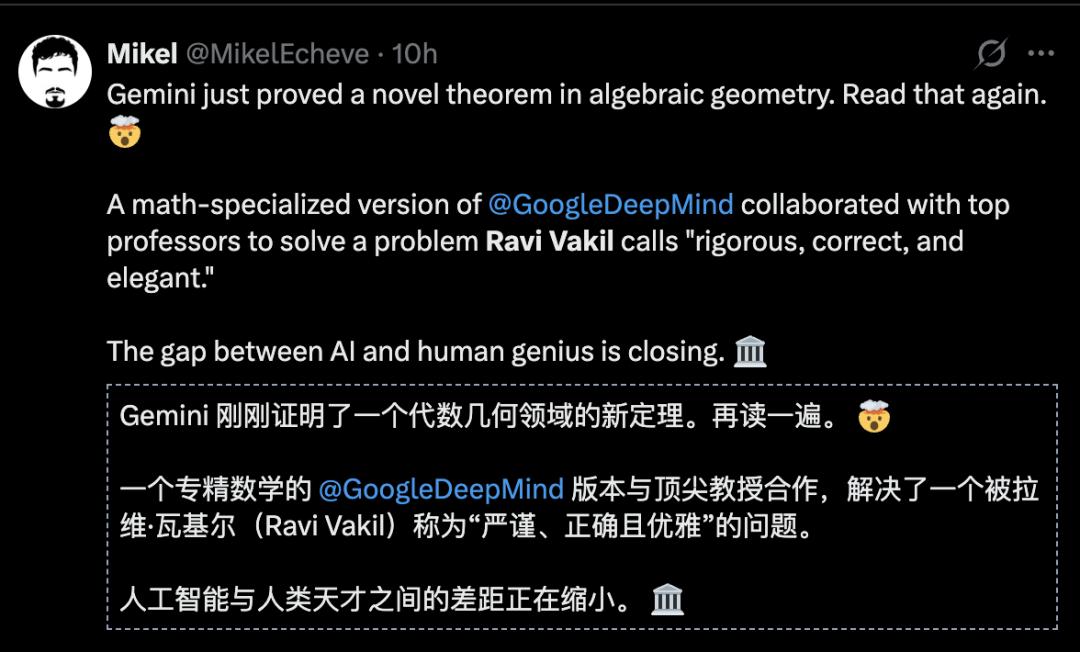
A team from Google DeepMind used Gemini to prove a new theorem in the field of algebraic geometry -
Note, it's brand - new!
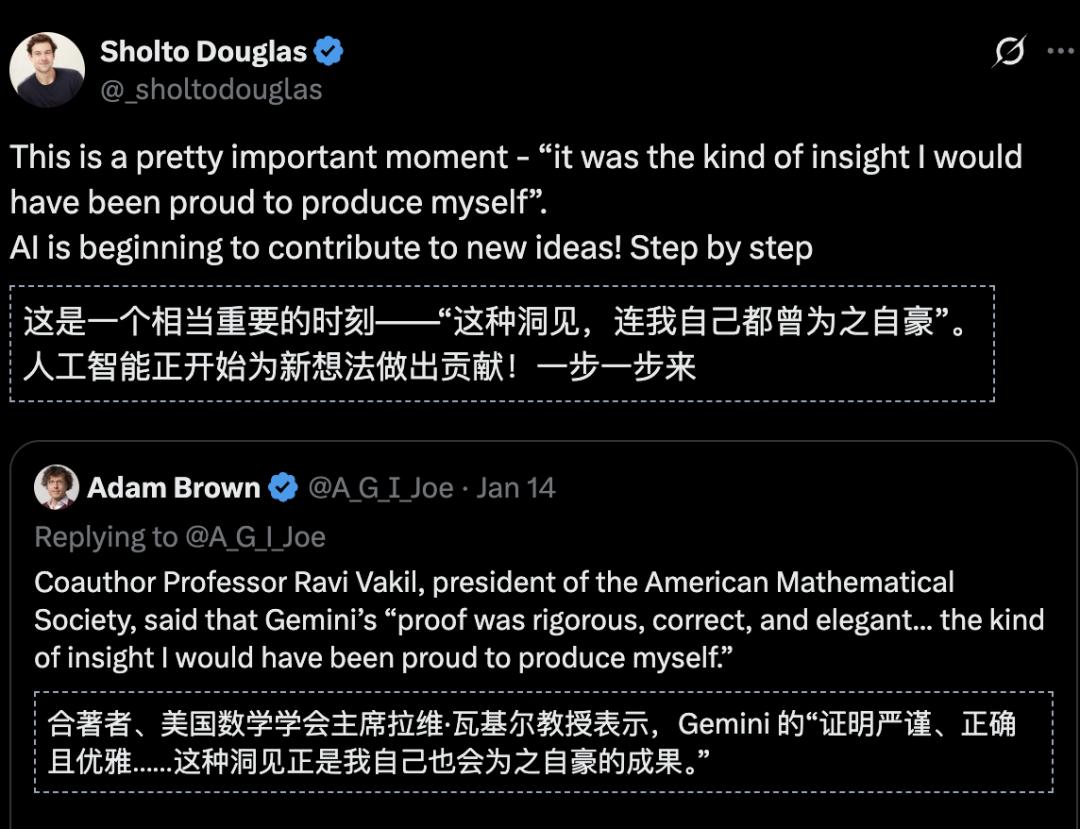
It's not like rewriting what humans already know as before. Even Stanford's top scholar, Professor Ravi Vakil, exclaimed:
If I had come up with such elegant insights myself, I'd brag about it for a lifetime.
For those who still doubt the intelligence of AI, such results are undoubtedly shocking.
And this is not the only breakthrough.
AI tools have blossomed in the field of mathematics. AI has officially knocked on the door of creative thinking!
The grand journey has begun.
Terence Tao predicted that AI may independently solve 1% - 2% of Erdős problems.
Meanwhile, Musk's Grok 4.20 isn't holding back either. It was reported that it "crushed" the Bellman function problem that had puzzled professors for a long time in just 5 minutes.
What does this mean?
Let's make a bold prediction: 2026 will be the "Year of ASI." Humans will define problems, and AI will fill in the gaps in proofs.
Alarm: Is the "Oppenheimer Moment" in the mathematical world here?
Just now, Gemini has proven a new theorem in the field of algebraic geometry.
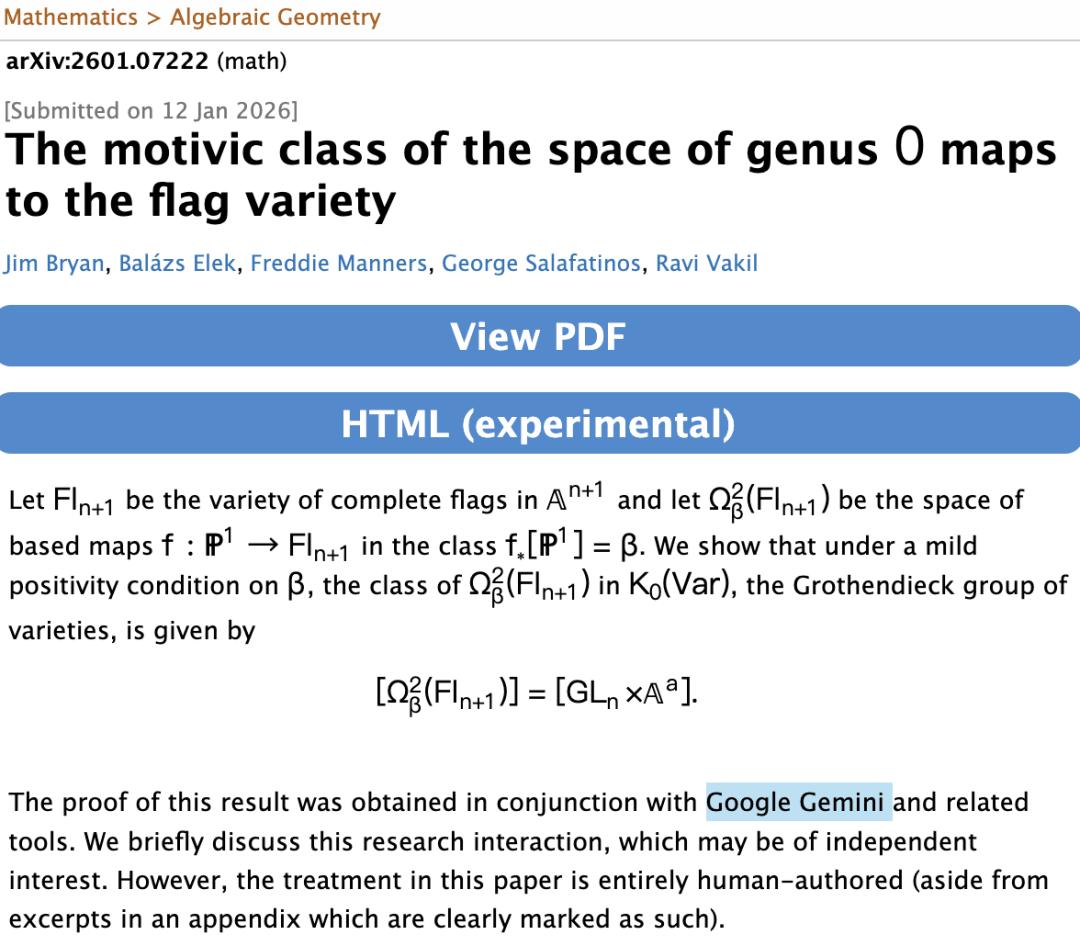
Link: https://arxiv.org/abs/2601.07222
Mathematicians Ravi Vakil and three others published a paper titled: THE MOTIVIC CLASS OF THE SPACE OF GENUS 0 MAPS TO THE FLAG VARIETY.
This problem has been difficult to tackle for a long time, and part of the proof in the new paper generalizes the relevant argument methods in the existing framework.
In a sufficiently powerful and computable framework (Grothendieck ring/motivic class), it gives a very clean closed - form answer and can also derive a formula for the number of points in a finite field that can be directly verified.
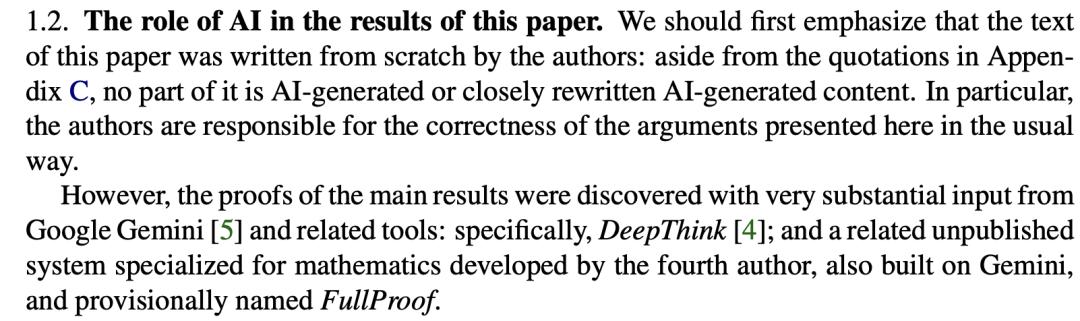
But the paper clearly states:
The proof process of the core result of this paper was realized with the strong promotion of Google's Gemini model and its related tools - specifically including the DeepThink system and a mathematical proof system (tentatively named FullProof) specially developed by the fourth author based on the Gemini framework.
You should know that the author Ravi Vakil, who signed at the end of the paper, is an expert in this field. This paper also references his article published in the top - tier journal "Duke Mathematical Journal" in 2025.
Ordinary readers may not even understand the title, but AI can already assist mathematicians in finding new proof methods.
We can't help but sigh: The gap between AI and human genius is narrowing.
Stanford University professor and President of the American Mathematical Society, Ravi Vakil, personally verified that Gemini provided key and original insights, and the proof it gave was "rigorous, correct, and elegant":
As someone familiar with the relevant literature, I believe that Gemini's argument is not a simple rewrite of existing proofs but brings real insights.
I would be proud of such insights even if they were my own.
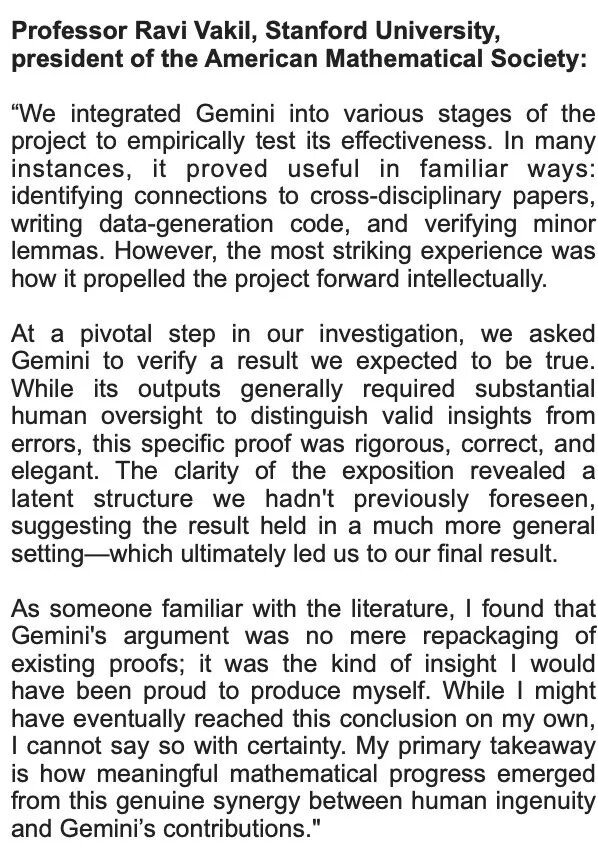
He even said that he wasn't sure if he could have reached this conclusion on his own in the end.
And his biggest gain this time is: Important mathematical progress comes from the real collaboration between human wisdom and Gemini's contributions.
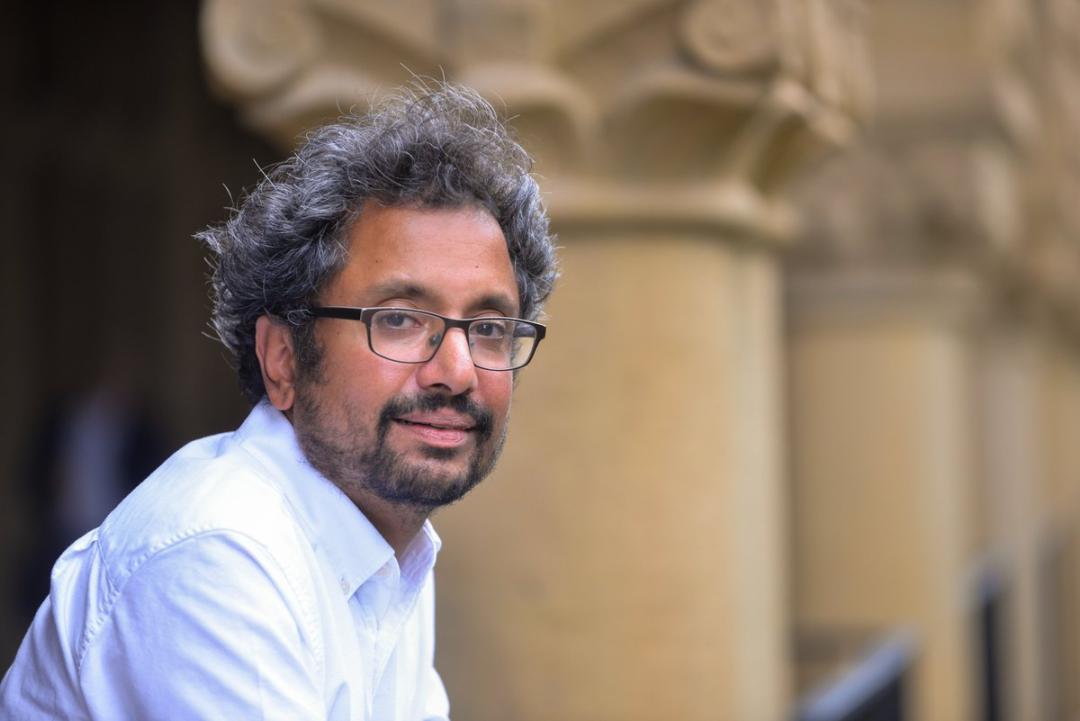
Ravi Vakil's research has made fundamental contributions to many topics in algebraic geometry, including Gromov - Witten theory, enumerative geometry, and Schubert calculus.
Last year, Epoch AI reported on Professor Ravi Vakil's prediction about AI: The impact of AI on mathematics is a phase transition, not a slow climb.
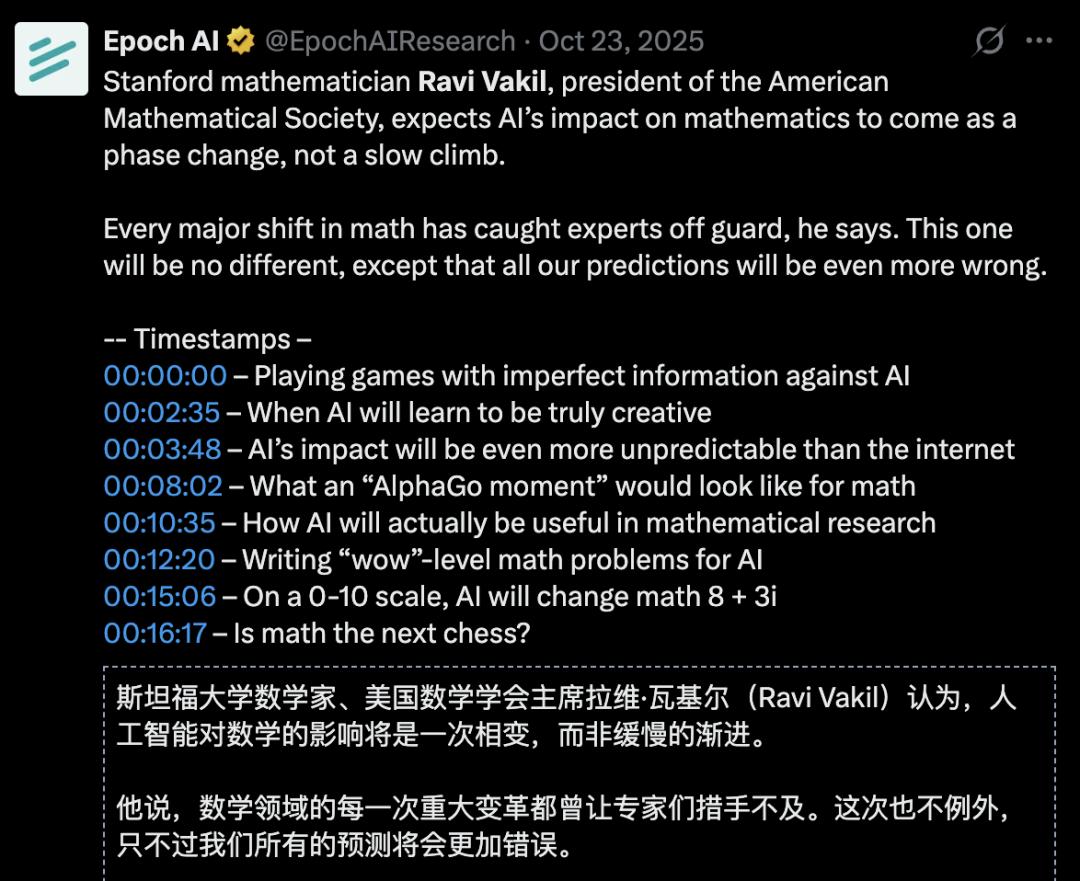
In the history of mathematics, every major change has caught experts off guard, and this time will be no exception - the only difference is that all our predictions will be even more wrong.
A Mathematical Fantastic Voyage
Grok 4.20 Discovers a Squared - Level Leap
Coincidentally, Paata Ivanisvili, a professor in the Department of Mathematics at the University of California, Irvine, also got early access to the internal test version of Grok 4.20.
The amazing mathematical ability shown by this version of Grok made the professor exclaim, "Wow!"
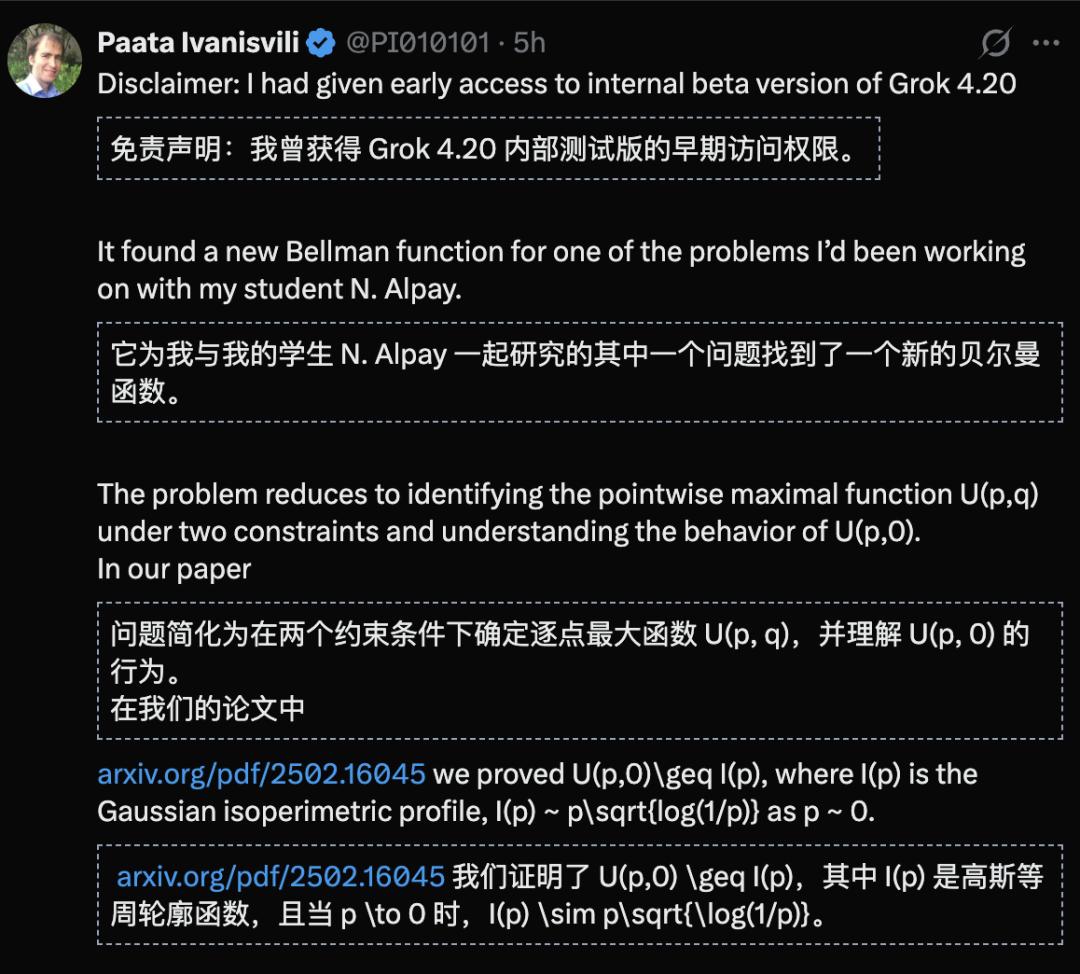
Here's what happened:
Professor Ivanisvili and his student N. Alpay were looking for a new Bellman function.
To put it simply, they needed to determine the point - wise maximum function U(p,q) under two constraints and figure out what U(p,0) looks like.
After a tough battle using "human brains," they derived a good lower bound in their latest paper: U(p,0) \geq I(p).
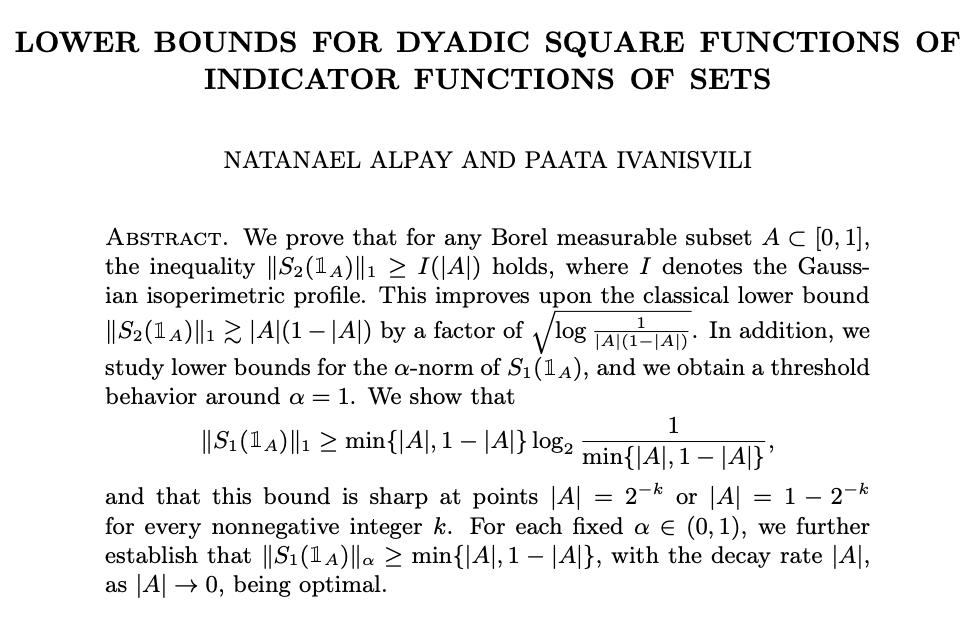
Link: https://arxiv.org/pdf/2502.16045
Here, I(p) is the Gaussian isoperimetric profile.
When p approaches 0, its accuracy is about at the level of p\sqrt{\log(1/p)}.
Then, the highlight moment came.
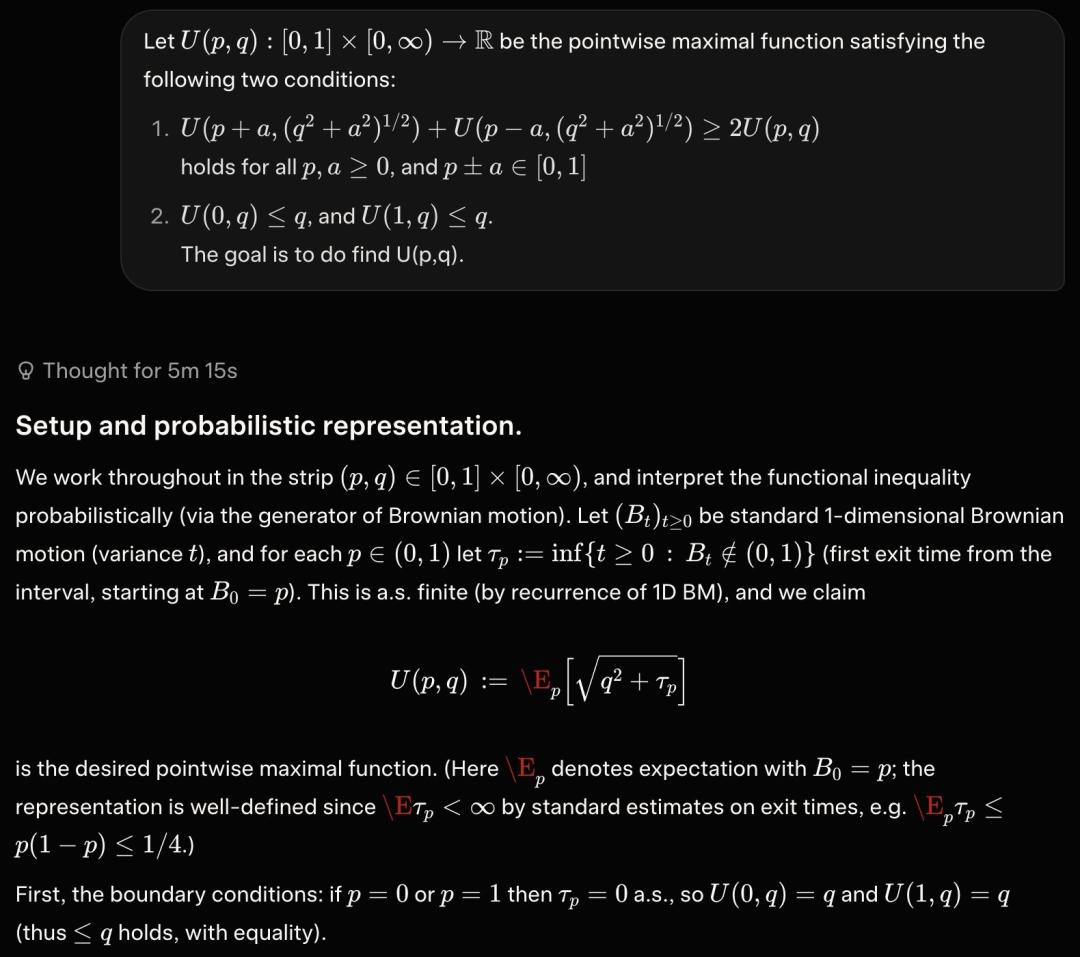
The professor fed the problem to Grok 4.20.
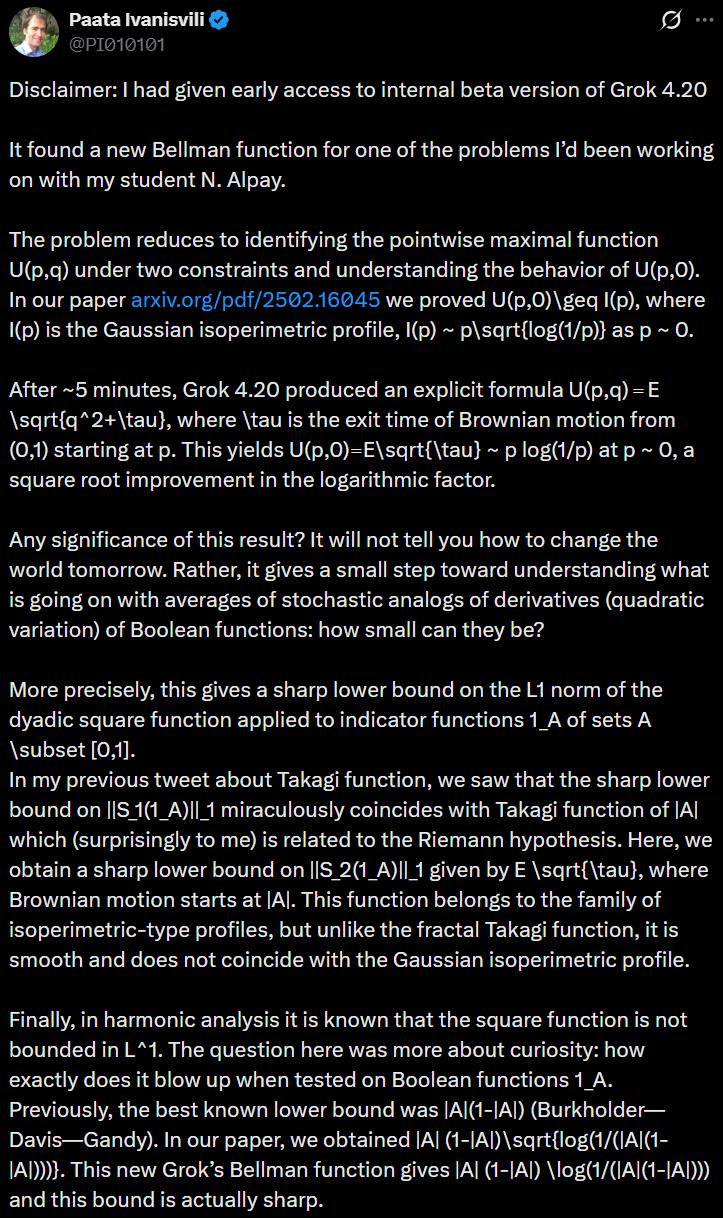
Just 5 minutes later, Grok threw a beautiful explicit formula on the table:
U(p,q) = E \sqrt{q^2+\tau}
In other words, Grok introduced the exit time (tau) of a Brownian motion starting from point p leaving the interval (0,1).
Calculated using this formula, the result becomes U(p,0) \sim p \log(1/p).
Those in the know may have already noticed: Grok helped humans get rid of that annoying "square root"!
This is a real square - root - level leap in the logarithmic factor.
This formula is invaluable in satisfying mathematical curiosity. It takes us a big step forward in understanding "how small the random simulation of the derivative of a Boolean function can be."
More precisely, Grok gave a sharp lower bound for the L^1 norm of the dyadic square function.
Professor Ivanisvili had experienced a similar mathematical fantastic voyage before: He once found that certain lower bounds were mysteriously related to the Takagi function and even the famous Riemann Hypothesis, like a quantum entanglement.
The new function discovered by Grok this time is not a fractal like the Takagi function, but a smooth and perfect isoperimetric - type profile that completely breaks away from the pattern of the Gaussian isoperimetric profile.
In the field of harmonic analysis, the question of how the square function "blows up" has always been fascinating. Let's take a look at this leaderboard:
🥉Bronze (Previous Record): The lower bound given by Burkholder - Davis - Gandy is |A|(1 - |A|).
🥈Silver (Professor's Team): The Ivanisvili team worked hard to push it to the level of |A| (1 - |A|)\sqrt{\log(\dots)}.
🥇Gold (Grok 4.20): AI gave |A| (1 - |A|) \log(\dots).
Grok not only removed the square root, but more impressively, this bound was proven to be sharp.
Terence Tao: AI Takes on 1% - 2% of Erdős Problems Alone
Last weekend, Neel Somani - a software engineer, former quantitative researcher, and startup founder - accidentally discovered something shocking while testing the mathematical ability of OpenAI's latest model.
He pasted a math problem into ChatGPT. When he came back 15 minutes later, he was surprised to find that the model had written a complete proof. He used a tool called Harmonic to formalize this reasoning, and the result was flawless.