1.6 billion is just the minimum guarantee. What Elon Musk wants to give Zhu Xiaotong is 10 billion.
A key document recently submitted by Tesla to the U.S. Securities and Exchange Commission (SEC) shows that the company has granted 520,021 stock options to Tom Zhu, the senior vice president of the automotive business. The exercise price is set at $435.80, and the grant date is January 8, 2026.
Calculated based on the market price at the time of the grant, the theoretical face value of this option is as high as $226 million, approximately 1.6 billion RMB. If Tesla's market value reaches the promised $8 trillion by Elon Musk within 10 years, the value of this option will soar to about 10 billion RMB.
Those familiar with Elon Musk will easily notice that this is not his style at all. Musk is well - known for his toughness.
After acquiring Twitter in October 2022, he laid off more than 50% of the employees in just a few weeks. About 3,700 people were fired by a single email. Four core executives, including CEO Parag Agrawal, were dismissed on the day the deal was completed, with no room for negotiation.
At Tesla, he is equally uncompromising. In April 2024, to cut costs and cope with profit pressure, Musk suddenly announced a global layoff of more than 10%, involving about 14,000 employees, even including Rebecca Tinucci, the head of Tesla's Supercharger team and the soul of the entire Tesla charging network.
Musk's management philosophy is simple and straightforward: those who cannot create immediate value have no place in the company. However, he acts in the opposite way towards Tom Zhu. This long - term lock - in is extremely rare in Musk's management style, and the signal it sends is crystal clear.
In fact, Tom Zhu is irreplaceable for Tesla and the company's future.
1
According to the SEC filing, this option plan will be vested over a long - term period. One forty - eighth of the shares covered by the options will vest and become exercisable on April 5, 2027, and thereafter, one forty - eighth of the shares will vest and become exercisable each month.
This means that the entire plan is actually a five - year retention plan, and all the options will be fully vested by March 2031.
Tesla submitted a list of senior executives to the SEC, which includes only three people: CEO Elon Musk, CFO Vaibhav Taneja, and Global Vice President Tom Zhu. This shows Musk's high regard for him.
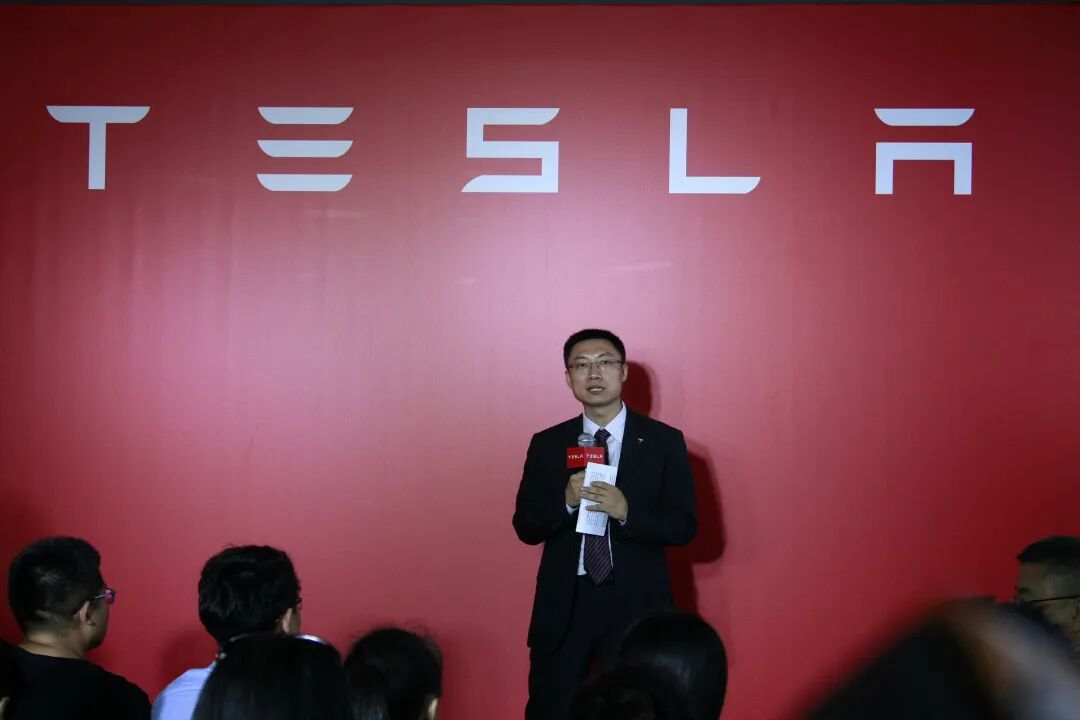
Tom Zhu, born in Shenyang, Liaoning, holds a bachelor's degree from Auckland University of Technology in New Zealand and an MBA from Duke University. He is a model of Tesla's internal promotion system.
In April 2014, Tom Zhu joined Tesla as the head of the charging project in China. Later that year, he was promoted to the general manager of Tesla China, leading the sales and charging network construction in the Chinese market.
In 2019, after the commissioning of Tesla's Shanghai Gigafactory, his responsibilities expanded to the Asia - Pacific region, and he officially received the title of global vice president.
The construction speed of the Shanghai Gigafactory led by Tom Zhu is a miracle.
He set a record of "starting construction, commencing production, and delivering products all in the same year." It took only 10 months to transform a muddy field into Tesla's most efficient and cost - effective production base globally.
To be on standby 24/7 during the initial construction of the Shanghai Gigafactory, Tom Zhu moved his residence to a public rental housing near the construction site. He dealt with emails in the early morning and monitored the production line during the day.
In December 2019, the factory started production, and in January 2020, the first batch of Model 3 was delivered to Chinese customers. As of December 2025, the Shanghai Gigafactory had produced its 4 millionth vehicle, with an annual production capacity of over 750,000 vehicles, making it Tesla's largest production base globally.
Tom Zhu doesn't have an independent office. His workstation is located in a corner of the factory's open - plan area, and he requires himself to reply to work messages within 5 minutes.
In this regard, he is very similar to Musk. The latter also slept in the factory during the "production hell" of Model 3 and required himself to reply to emails within 15 minutes.
Not only is the factory construction fast, but Tesla's financial reports also specifically mention the production efficiency of the Shanghai Gigafactory, describing it as "impressive."
Specifically, each worker in the Shanghai Gigafactory produces 48 - 50 vehicles per year, while each worker in the Fremont factory only produces 25 - 28 vehicles per year.
Considering the salary difference, Chinese workers have an annual salary of $14,000 - $15,000, while American workers have an annual salary of $82,500. The comprehensive cost - effectiveness advantage of the labor force in the Shanghai Gigafactory is 8 - 14 times. The localization rate of the Shanghai Gigafactory reaches 96%, and the cost per vehicle is 65% lower than that in the United States.
This efficiency is not only reflected in numbers but also in the factory layout and logistics system. Different from traditional automobile factories, the Shanghai Gigafactory adopts a "linear design," which significantly reduces the internal logistics distance.
Tesla didn't build a traditional warehouse in the Shanghai Gigafactory. Instead, it uses a "warehouse on wheels" system. Trucks transporting parts and materials directly unload the goods to the corresponding workshops. More than 2,000 logistics vehicles shuttle within the factory area every day, all scheduled by a precise electronic management system.
This makes the internal logistics distance almost zero, and a new car rolls off the production line every 30 seconds.
In 2022, due to special circumstances, to ensure the production efficiency of the Shanghai Gigafactory, Tom Zhu chose to live and work in the factory with thousands of employees for about two months. During this period, he slept in the factory dormitory or temporary beds in the workshop, ate boxed meals with the workers, and had the same work and rest schedule.
At the end of the same year, when the production capacity ramp - up of the Texas factory was blocked, Musk directly dispatched Tom Zhu to the United States to solve the problem.
During the critical period when Musk was deeply involved in the Twitter acquisition and couldn't spare enough time, it was Tom Zhu who took on the daily operation of the global automotive business, acting as the de facto "shadow CEO."
In April 2023, Tom Zhu was officially promoted to the senior vice president of the automotive business, taking over global production and sales. His name also appeared in the list of Tesla's senior management for the first time.
Musk's trust in Tom Zhu stems from his absolute execution ability shown in times of crisis. Promoted from the head of the Chinese charging network to the second - in - command of the global automotive business, Tom Zhu is the most determined executor of Musk's will.
As Musk's energy is increasingly scattered among multiple companies such as SpaceX, xAI, and Neuralink, Tesla urgently needs a steward who can focus on business execution around the clock.
Especially since Tesla has ambitious goals such as conquering the Robotaxi market and increasing the production capacity of Cybertruck in 2026, Musk must retain Tom Zhu.
2
Tom Zhu owes his current achievements to a person, Ren Yuxiang.
In 2018, Tesla entered its darkest hour.
In the United States, the severe production capacity crisis and low yield rate gave Musk a huge headache every day. Almost everyone on Wall Street wanted to short Tesla.
At that time, nearly half of the global new - energy vehicle sales were in the Chinese market. However, Tesla's average monthly sales in China were only 120 vehicles. Musk once publicly said that he had considered disbanding the entire Chinese team because of this.
There were reasons why the Chinese market was difficult to penetrate. At that time, all Teslas sold in China were imported cars. The starting price of Model 3 at 499,000 RMB deterred many Chinese consumers.
To reduce the price, local production had to be achieved. But at that time, foreign - funded enterprises had to establish joint - ventures to produce cars in China. Naturally, the maverick Musk was reluctant to do so.
So Musk began to look for a "China hand" to open up the Chinese market and naturally thought of his old classmate Ren Yuxiang.
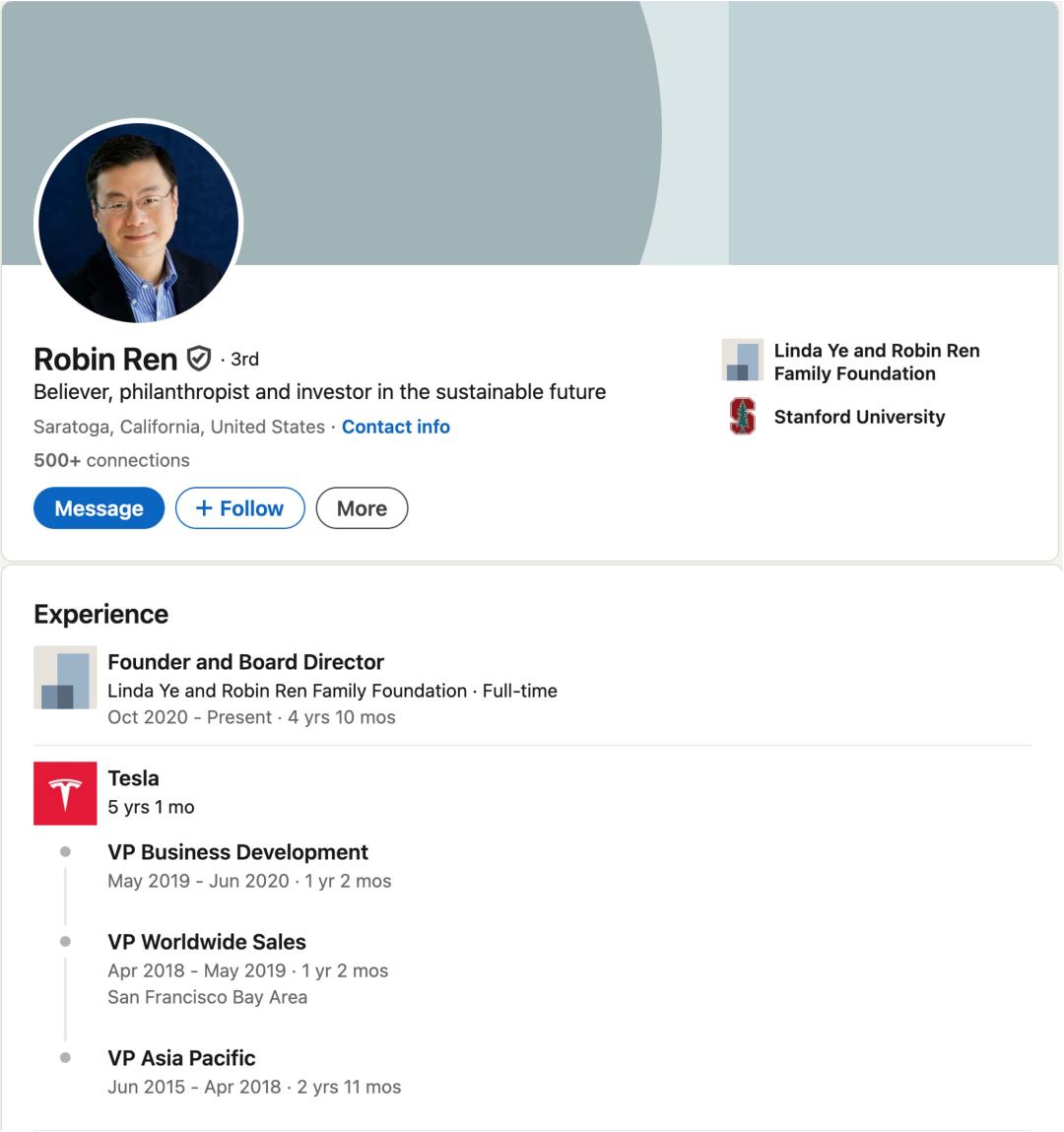
Ren Yuxiang, an alumnus of Musk at the University of Pennsylvania and the 22nd International Physics Olympiad champion, was evaluated by Musk as "better at physics than me."
Since 2012, Musk has repeatedly invited Ren Yuxiang to join Tesla. At first, Ren Yuxiang was very surprised by Musk's offer and bluntly said, "Musk knows almost nothing about the automotive industry." He added, "It's hard to imagine that Musk would suddenly invite me to lunch 20 years after graduation."
But Musk was reluctant to give up his old friend easily. After multiple invitations, Ren Yuxiang finally joined Tesla in May 2015 as the vice president of the Asia - Pacific region.
Another reason why Musk valued Ren Yuxiang might be that he was a native of Shanghai and had certain resources at his disposal, but that's another story.
With Ren Yuxiang's mediation, Musk began to frequently meet with Chinese senior officials.
In April 2017, when Ren Yuxiang and Musk met with Chinese senior officials, Ren Yuxiang first put forward the argument that 'a wholly - owned factory is beneficial to the upgrading of the Chinese automotive industry.' In simple terms, introducing Tesla's technology could promote the upgrading of the local supply chain.
With the theories of "technological independence" and "industrial chain driving effect," Ren Yuxiang gradually loosened the established joint - venture model of the domestic automotive manufacturing industry.
In February 2018, Ren Yuxiang flew to the United States to report the detailed plan of the Shanghai Gigafactory to Musk, including the location map, financing commitment, and transaction terms. Unfortunately, Musk was busy with the "production hell" stage of mass - producing the Nevada battery factory, and Ren Yuxiang couldn't even meet him.
Finally, Musk didn't look at the slides Ren Yuxiang prepared for him. He just stared at Ren Yuxiang and asked, "Did we do the right thing?" This question surprised Ren Yuxiang.
He retorted, "Boss, are you joking? The work is almost done, and you're asking me now if it's okay?" However, Ren Yuxiang then said that building a factory in China was the right thing to do, and Musk then approved the continuation of the Shanghai Gigafactory project.
In April 2018, the Chinese government lifted the restrictions on foreign ownership of new - energy vehicles, and the opportunity finally came for Ren Yuxiang and Tesla. In July 2018, the Shanghai Municipal Government signed a cooperation memorandum with Tesla.
The unveiling ceremony of Tesla Shanghai Co., Ltd. and the Tesla Shanghai Electric Vehicle R & D Innovation Center was carried out by Shanghai Mayor Ying Yong and Elon Musk, but the agreement was signed on behalf of both parties by Ren Yuxiang, the vice president of Tesla. This fully demonstrates Ren Yuxiang's key role.
Ren Yuxiang also secured three extremely favorable conditions for Tesla. The first was a land concession. Tesla obtained 860,000 square meters of land in Lingang for 980 million RMB, which was only about 10% of the market price.
The second was a low - interest loan. Tesla received credit support totaling more than 16 billion RMB with an interest rate of only 3.9%. The third was rapid approval. It only took half a year from signing the contract to starting construction, allowing Tesla to experience the "China speed" for the first time.
Driven strongly by Ren Yuxiang, Tesla broke the established joint - venture model for foreign - funded automakers and facilitated the first wholly - foreign - owned automotive manufacturer project in China.
Although Ren Yuxiang left the company in 2020, he rewrote the rules of the game and laid the legal and financial foundation for the Shanghai Gigafactory.
After Ren Yuxiang paved the way, Tom Zhu took over the baton and created a miracle in this arena.
After signing the contract, Tesla started to build the factory rapidly.
Through the Gigafactory, Tesla solved the production and profitability problems at once.
In October 2021, Tesla's market value exceeded $1 trillion. All these achievements are inseparable from the Gigafactory, and the contributions of Ren Yuxiang and Tom Zhu are indispensable.
Ren Yuxiang was responsible for breaking the deadlock from scratch, and Tom Zhu was responsible for taking it from one to infinity. The relay of these two Chinese people contributed to Tesla's success in China and even globally.
However, production alone is not enough. To promote Robotaxi, Musk also needs actual data for training, so he modified the payment model of FSD.
Musk has announced that starting from February 14, Tesla will stop selling the full - self - driving software in a one - time purchase mode, which was originally priced at $8,000. Instead, it will fully implement a monthly subscription system at $99 per month.
This strategy aims to lower the user threshold, establish a continuous cash flow through subscriptions, and rapidly expand the user base to collect a large amount of driving data to support AI training.
Currently, FSD has been pushed in North America. Tesla also plans to obtain regulatory approval for FSD in Europe in 2025, possibly as early as February 2026. At the beginning of 2026, FSD completed the remarkable feat of crossing the United States without any human intervention in a test drive, covering a total distance of 4,397 kilometers across various complex road conditions.
3
In the technology industry with a very high turnover rate of senior executives, locking in core operational talents through a five - year long - term plan ensures that Tesla won't falter when Musk is stretched thin.
What Tom Zhu can bring to Tesla is to replicate the model of the Shanghai Gigafactory in Berlin, Texas, and even the future Mexican factory.
However, reality is far more brutal than ideal.
Tesla has a total of six Gigafactories globally. Except for the smooth expansion of the Shanghai Gigafactory, the expansion of factories in Berlin, Fremont, etc. has encountered challenges.
Tesla plans to expand the Berlin factory to increase its annual production capacity to 1 million vehicles. Currently, the factory's production capacity is only 500,000 vehicles.
The situation at the Texas factory is also not optimistic. In December 2022, Tom Zhu led the Shanghai team to the United States and visited two factories in California and Texas respectively for production optimization.
At that time, Tesla posted a photo on Twitter to celebrate that the Austin factory reached a new production milestone of 3,000 Model Y vehicles in a week. However, this was still less than one - third of the weekly production of the Shanghai Gigafactory in that quarter.
Musk promised that the Cybercab for the Robotaxi fleet would start mass - production at the Texas Gigafactory in April 2026, with a target annual production capacity of 2 million vehicles, which will be "the highest - volume model in Tesla's history."
Musk's initial goal is to set the production cycle time for each Cybercab at 10 seconds, which will be shortened to 5 seconds in the future.
At this speed, once the production line is mature, Tesla plans to produce at least 2 million Cybercabs per year, a figure that will exceed the annual production of any single Tesla model at present.
But in reality, Musk