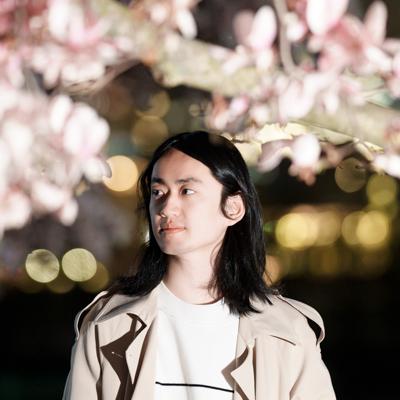
Chen Lijie, a legend from Yao Class, joins OpenAI. He was admitted to Tsinghua University at 16 and became an assistant professor at UC Berkeley at 30.
Latest news: Chen Lijie, a genius from Yao Class, has joined OpenAI.
According to "Top Chinese Community News", OpenAI has internally confirmed that Chen Lijie, a genius from Tsinghua University's Yao Class and an assistant professor in the Department of Electrical Engineering and Computer Sciences (EECS) at UC Berkeley, has joined OpenAI and is responsible for mathematical reasoning!
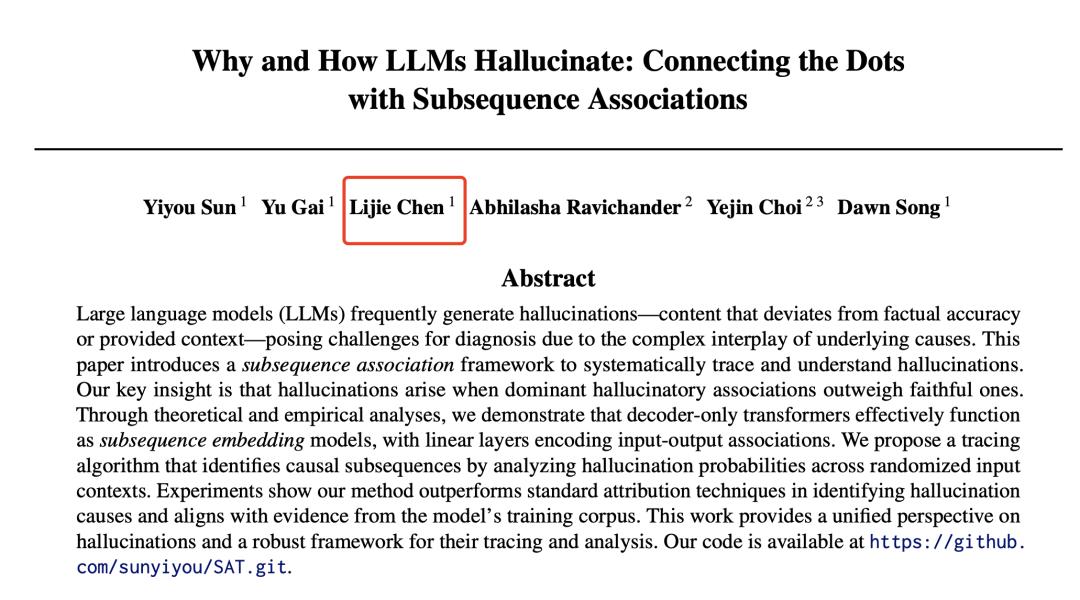
It's worth mentioning that OpenAI also cited another research paper titled "Why and How LLMs Hallucinate: Connecting the Dots with Subsequence Associations" in which Chen Lijie participated in its popular paper "Why Language Models Hallucinate" published in September last year.
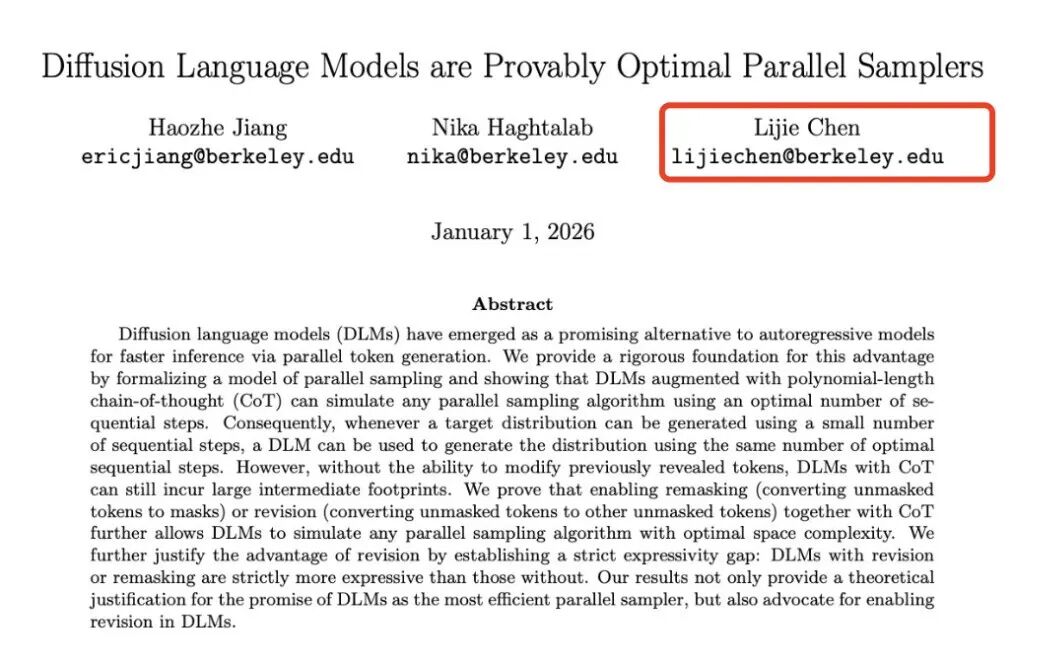
Meanwhile, Chen Lijie's latest research direction he's recently involved in is also very "trendy", focusing on Diffusion Language Models, closely following the important evolution path of current generative models.
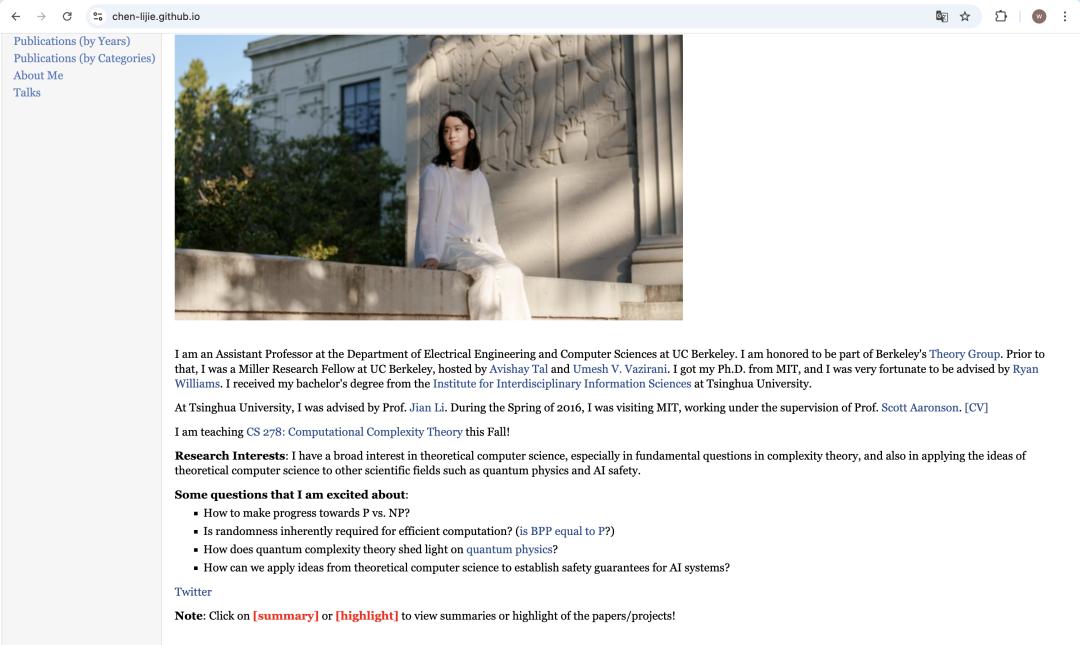
As of now, there has been no update on Chen Lijie's homepage.
Who is Chen Lijie?
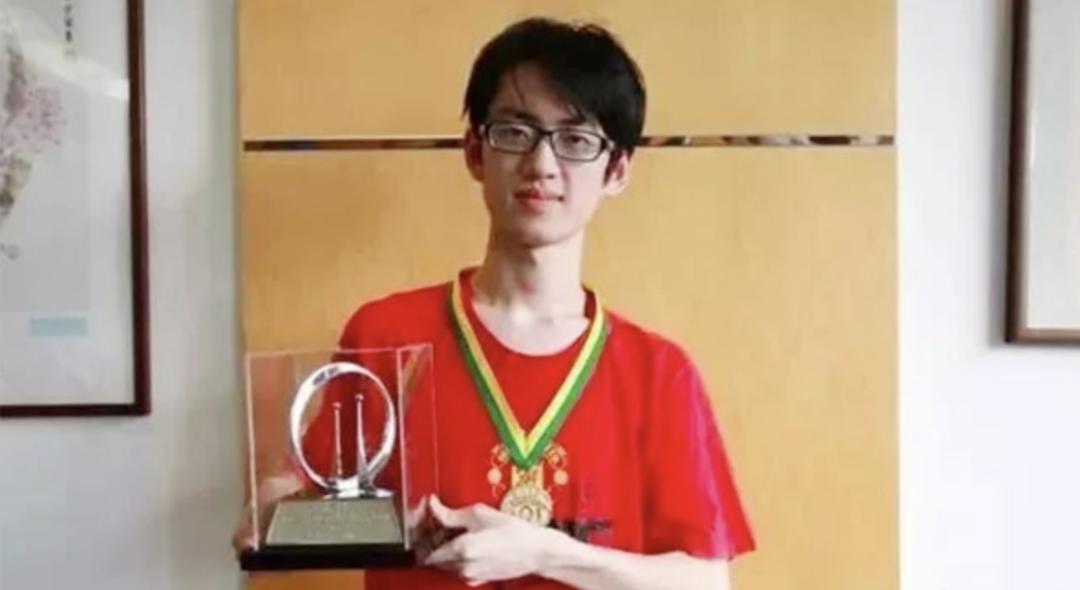
Chen Lijie was born in 1995. At the age of 16, he won the gold medal in the National Olympiad in Informatics (NOI) and was admitted to Tsinghua University without taking the college entrance examination. He is a well - known alumnus of Tsinghua University's "Yao Class" and has long been engaged in theoretical computer science research.
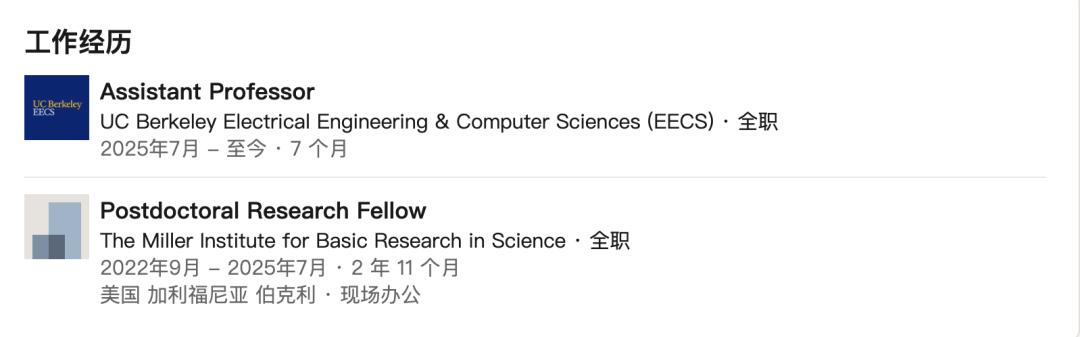
In 2025, Chen Lijie officially joined the Department of Electrical Engineering and Computer Sciences (EECS) at the University of California, Berkeley (UC Berkeley) as an assistant professor and became a member of the Berkeley Theory Group, mainly engaged in research related to Computational Complexity Theory.
Looking back on Chen Lijie's educational and career experiences, it can be described as a miraculously smooth and outstanding experience.
He started participating in informatics competitions since junior high school and is one of the legendary players in the Informatics Olympiad (OI) circle:
November 2011: First place in the Zhejiang Division of the National Informatics Olympiad in Provinces (NOIP 2011)
February 2012: First place in the National Informatics Winter Camp (WC 2012)
February 2013: First place in the National Informatics Winter Camp (WC 2013)
April 2013: First place in the Chinese Team Selection Contest (CTSC 2013)
July 2013: First place (gold medal) in the International Olympiad in Informatics (IOI 2013)
……
△
In 2013, Chen Lijie graduated from Hangzhou Foreign Languages School. In his senior year of high school, he refused an internship invitation from Google, citing the need to focus on his studies. In the same year, he was admitted to Tsinghua University without taking the college entrance examination based on his competition results.
After entering Tsinghua University's Yao Class, Chen Lijie gradually shifted his focus from competitions to scientific research.
During his undergraduate studies, he published several papers in important computer science conferences such as AAAI, AAMAS, COLT, and CCC, and began to systematically engage in research on Computational Complexity Theory.
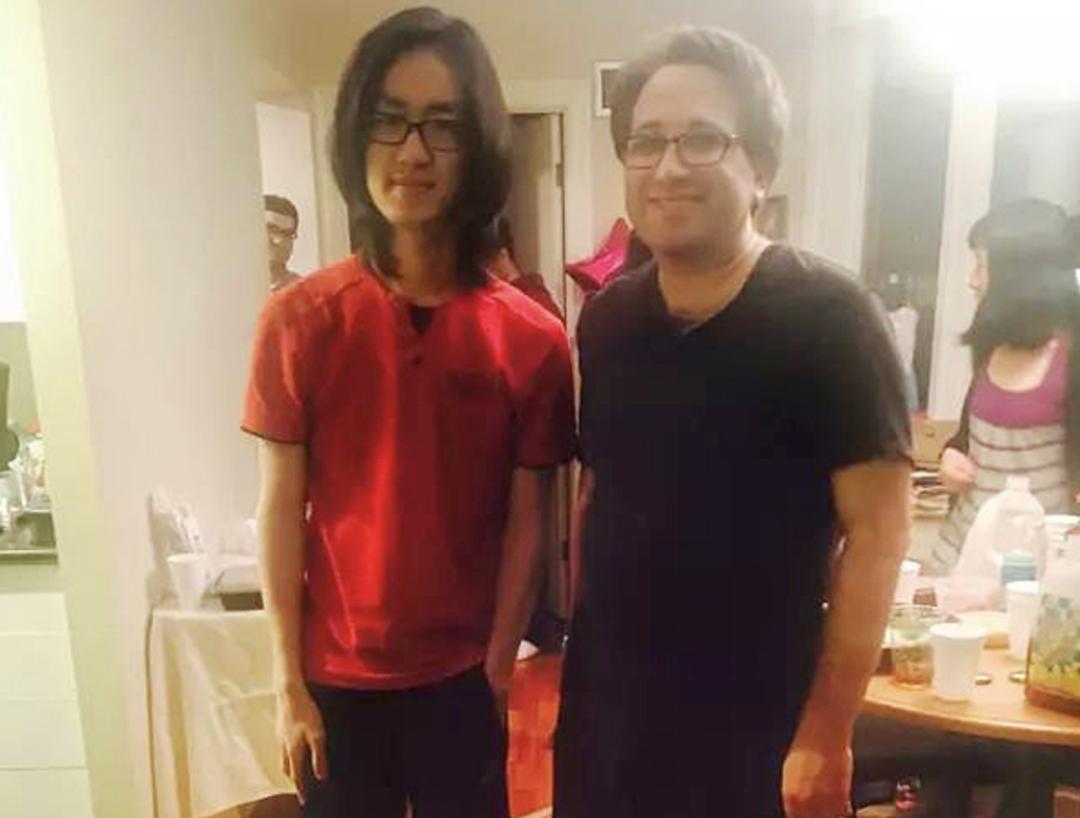
In the second semester of his junior year, he went to MIT for an exchange program, studying under the famous theoretical computer and quantum information scholar Scott Aaronson, researching quantum complexity.
△
During his visit to MIT, he solved an open problem proposed by quantum information scholar John Watrous in 2002.
It's worth mentioning that Professor Scott Aaronson later joined OpenAI in 2022, engaging in theoretical basic research on AI safety.
In 2017, Chen Lijie published a paper at the Annual Symposium on Foundations of Computer Science (FOCS), solving an important problem in the field of computational complexity. He became the first Chinese undergraduate student to publish a paper at FOCS.
In the same year, he graduated from Tsinghua University's Yao Class and went to MIT to pursue a doctoral degree in computer science.
During his doctoral studies, Chen Lijie studied under Ryan Williams, and his research focused on Computational Complexity Theory and Fine - grained Complexity Theory.
During this period, he published papers in top theoretical computer science conferences such as FOCS and STOC multiple times and won important academic honors such as the Best Student Paper Award at FOCS, including:
Best Student Paper at STOC in 2019
Best Student Paper at FOCS in 2019
In 2022, Chen Lijie obtained his doctoral degree from MIT and then joined the Miller Institute at UC Berkeley as a Miller Postdoctoral Fellow.
The Miller Fellowship is awarded to only a few outstanding young scholars each year. His collaborating mentors at Berkeley include Avishay Tal and Umesh V. Vazirani, the founder of quantum computing.
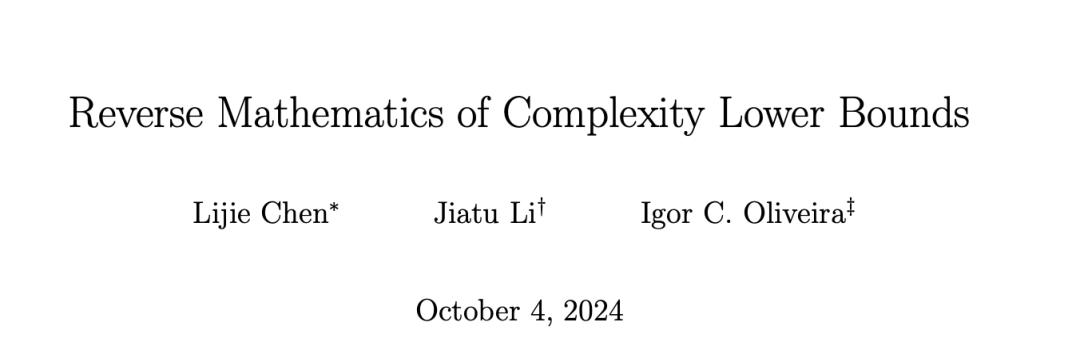
In 2024, Chen Lijie's paper titled "Reverse Mathematics of Complexity Lower Bounds" brought new ideas to a class of computational complexity problems that have troubled the academic community for nearly 50 years.
In 2025, he officially joined UC Berkeley as an assistant professor in EECS and began to teach the graduate course "Computational Complexity Theory".
Currently, Chen Lijie's main research directions include core problems in theoretical computer science such as P vs NP, circuit complexity, fine - grained complexity, derandomization, and algorithmic lower bounds.
He has made systematic contributions in the fields of the connection between derandomization and complexity lower bounds and hardness magnification.
In addition, he has also begun to introduce the methods of complexity theory into cutting - edge fields such as quantum physics and AI safety.
Now, after OpenAI clearly set the exploration direction of AI4S, Chen Lijie has become a member of OpenAI.
However, Chen Lijie remains as low - key as ever. On all his personal platforms, the latest news is still about his paper achievements.
References:
[1]https://www.tsinghua.org.cn/info/1953/13913.htm
[2]https://chen-lijie.github.io/documents/CV.pdf
[3]https://chen-lijie.github.io/
This article is from the WeChat official account "QbitAI", author: henry. It is published by 36Kr with permission.