Can a piece of cloth choke NVIDIA?
San Jose, California, USA.
When Jensen Huang boldly claimed that AI computing power will increase by a million times in the next decade, few noticed that what supports this computing power revolution is not only chips, but also:
A mysterious electronic fabric.
01 Japanese Enterprises' Hegemony
If an AI server is compared to a super sports car, the chip is the engine, and the electronic fabric is the chassis.
Without a chassis, the most powerful engine is just a pile of scrap metal. Similarly, without electronic fabric, NVIDIA's Rubin architecture, however advanced, is just a castle in the air.
Although called electronic fabric, it is not ordinary cloth, but an electronic - grade glass fiber used for manufacturing PCB boards.
High - end electronic fabric, especially those with ultra - thin, low - dielectric (Low - Dk) properties, integrates various cutting - edge materials science and can be regarded as an assemblage of black technology.
To date, in this field, the ones truly controlling the industrial lifeline are still little - known Japanese manufacturers such as Nittobo, Asahi Kasei, and Asahi Glass. These three companies alone occupy nearly 70% of the global high - end electronic fabric market, almost forming an oligopoly.
They don't produce AI chips, but they hold the key to AI computing power.
They control the most difficult and fundamental parts of electronic fabric production and can achieve mass production without fail year after year.
Although Chinese enterprises can also produce electronic fabric and have a relatively large global share, they mainly compete in the mid - to - low - end markets.
Why do Japanese manufacturers almost monopolize the high - end electronic fabric market?
The answer is the insurmountable moat they built with decades of patience.
Electronic fabric is woven from glass fibers, and its performance depends on the chemical formula of the fibers. Japanese manufacturers have mastered two glass materials with golden formulas in the industry - NE - glass and T - glass, whose dielectric constants are far superior to ordinary glass.
Don't underestimate these formulas. They are like Mount Everest in the field of materials science.
Developing a qualified electronic glass formula requires tens of thousands of experiments, continuous adjustment, and control of various process parameters.
Take the NE - glass technology as an example. Nittobo started researching it in the 1990s and painstakingly worked on it for more than 30 years before the industry boomed.
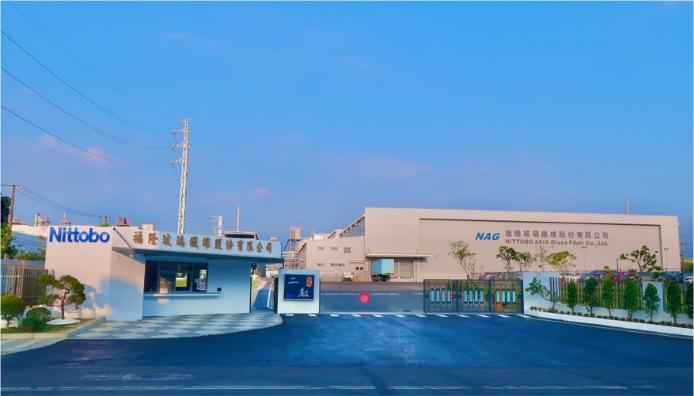
▲Source: Nittobo
Domestic enterprises didn't start getting involved until after 2010, lagging behind by nearly 20 years right from the start.
Japanese manufacturers with first - mover advantages have woven an airtight patent network for latecomers. They have applied for patents not only for core formulas but also for the entire industrial chain, from raw material purification, wire - drawing technology to equipment manufacturing.
At the same time, they have also deeply bound themselves to chip giants.
In the past few years, Nittobo has carried out extensive cooperation with chip giants such as NVIDIA and AMD.
NVIDIA's latest Rubin architecture puts almost extreme requirements on electronic fabric, and globally, almost only Nittobo can meet these requirements.
Moreover, Japanese enterprises have formed a strong deterrent to competitors through huge irreversible investments.
Building an electronic yarn kiln costs at least 500 million yuan, and high - end kilns can cost over 1.5 billion yuan. The expansion cycle of high - end electronic fabric production is more than 2 years, and the equipment investment for a single standard production line exceeds 500 million yuan. Ordinary enterprises simply don't have the ability or courage to enter the market.
Once a trial fails, they will lose everything.
Through these three steps, Japanese manufacturers have completed the implicit control of the global high - end electronic fabric market, and China's related industries have been held back. However, with China's overall breakthrough in science and technology, this situation is changing.
02 Breaking the Deadlock from Multiple Points
In 2019, a domestic PCB enterprise wanted to purchase a batch of ultra - thin electronic fabric. When they inquired about the price from the Japanese side, they were quoted a price ten times that of ordinary electronic fabric, with an additional condition:
Prohibited from supplying to Huawei and ZTE!
This is the overbearing logic of Japanese manufacturers: high - end electronic fabric is their private territory. Chinese enterprises can either be taken advantage of or be excluded from the high - end industrial chain.
This kind of situation has further stimulated the innovation and struggle of Chinese enterprises.
Facing the monopoly wall woven by the Japanese over decades in high - end fields such as ultra - thin and low - dielectric, Chinese enterprises launched a collective charge.
Leading the charge is Honghe Technology.
In the past, the supply of ultra - thin electronic fabric was long dominated by Japanese and American enterprises, and China almost completely relied on imports.
In 2017, Honghe established a R & D team and an experimental factory in Shanghai with only one goal: to develop ultra - fine yarns and conquer the technology of 9 - micron ultra - thin electronic fabric.
But at the very beginning, the R & D personnel hit the first major obstacle - the wire - drawing technology.
According to Li Jinlong, one of the team leaders, "For several months, the experimental machines couldn't draw ultra - fine yarns, and the wire - breaking rate was extremely high."
To solve the wire - breaking problem, the R & D personnel repeatedly innovated the existing spinneret technology, tried hundreds of solutions, and optimized the glass formula at the same time, and finally achieved a technological breakthrough.
In 2021, Honghe successfully mass - produced 9 - micron ultra - thin electronic fabric, breaking the foreign monopoly at one stroke.
If the core of ultra - thin fabric is precision, the core of low - dielectric fabric is the formula.
The lower the dielectric constant, the faster the signal transmission speed and the smaller the loss. This is crucial for the rapidly developing AI.
For a long time, the low - dielectric fabric market has been monopolized by Japanese enterprises such as Nittobo and Asahi Kasei.
To break the blockade, Li Zhiwei, the founder of Henan Linzhou Guangyuan, led the R & D team to start a second entrepreneurial journey in the place where the Red Flag Canal was dug.
The biggest technical challenge for low - dielectric fabric lies in the coordinated breakthrough of material formula optimization and manufacturing process.