Behind the explosion of virtual pets: Can AI robots accompany people until old age?
In the past two years, electronic pets have become popular again.
Electronic pets like Moflin, LOVOT, and Ropet have no practical functions, yet they are pursued by many young people.
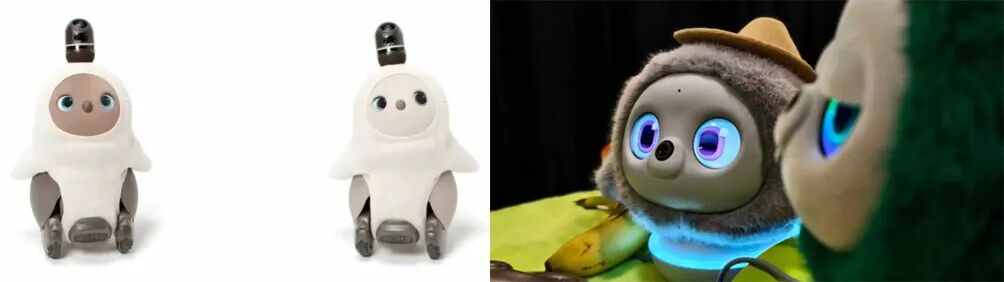
LOVOT, Ropet
Since the digital age, people have never stopped seeking virtual companionship. From the virtual world to reality, it continuously meets people's needs for emotional companionship.
Electronic pets are also evolving. In the future, will robots accompany you as you grow old?
The Evolution History of Electronic Pets
Each generation has its own electronic pets.
The world's earliest electronic pet was Tamagotchi, launched by Bandai in Japan in 1996.
It had an egg-shaped shell, only three buttons, and a black-and-white screen. Once launched, it quickly became popular worldwide and became the childhood memory of many people born in the 1980s and 1990s.
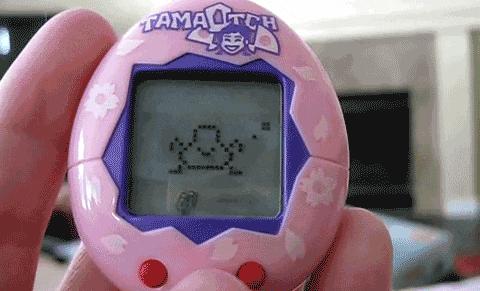
Tamagotchi
Later, Japan also produced virtual pets that became popular worldwide, such as the Digimon device, Nintendo Nintendogs, and Travel Frog.
Influenced by the virtual culture, Japan has always been at the forefront of the world in exploring electronic virtual companionship products.

Travel Frog
QQ Pet, launched by Tencent in 2005, was the "first electronic pet in life" for many Chinese people born in the 1990s.
Users could complete personalized tasks such as feeding, bathing, seeing a doctor, and working in the pet community.

QQ Pet
These pets only existed within the screen and had no actual intersection with the real world where people lived.
With the development of AI technology and hardware devices, electronic pets have branched out into the field of pet robots and integrated into people's daily lives.
They not only have physical hardware but also a smarter "brain".
The AIBO robotic dog launched by Sony in Japan in 1999 is considered the pioneer of pet robots.
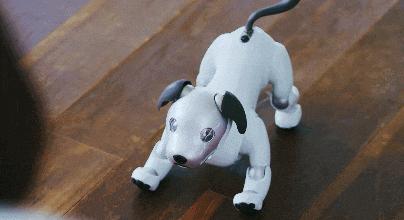
Sony AIBO Robotic Dog
The AIBO was designed to resemble a puppy. It was equipped with an advanced motion control system and intelligent technology, enabling it to sense the surrounding environment, interact with users, and had the ability to learn autonomously. For example, it could wag its tail and bark, and adjust its behavior according to the user's reactions and habits.
The initial price of the AIBO was around $2,500. Later, it was discontinued due to Sony's change in business strategy, but it proved the commercial viability of high - end pet robots.
Compared with traditional pet robots, most of the electronic pets on the market in recent years are "AI + plush toys".
Products like Moflin, Ropet, Cupboo, and Mirumi have bionic fur, big round eyes, cute and dainty appearances, and various emotions, making people want to hug them at first sight.

Moflin
For example, Moflin is like a combination of a hamster and a rabbit. When you gently stroke it, it will happily make a "squeaking" sound. If you ignore it for a long time, it will get angry and let out a low sigh, making you can't help but care more about it.
LOVOT is known as a toy for the rich, with a price as high as 60,000 yuan.
The reason for its high price is that its fur is made of a material softer than real hair, and the eye interaction is so detailed that it can even simulate pupil dilation, achieving the ultimate in realism.
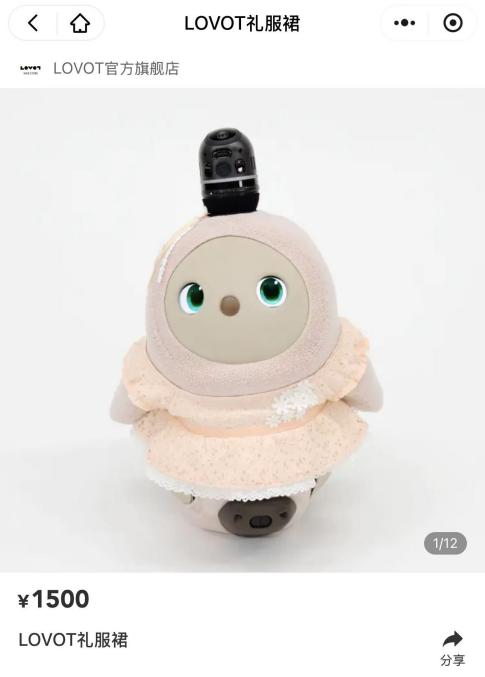
LOVOT Clothing
That's not all. The price of LOVOT's clothes ranges from 700 to 1,500 yuan. Each piece of clothing has a built - in chip. As long as you change its clothes, it will be very happy.
This also attracts users to continuously spend on their pets.
With the increasing demand for pet robots, the market is constantly being segmented.
Different from the realism of plush toys, abstract pet robots like Xiaomi's CyberDog 2 and Unitree's Unitree Go2 usually have a metallic appearance, are derived from biological features, and have a stronger sense of technology.
For example, CyberDog 2 can not only run, jump, and turn as flexibly as a real dog but also do the moonwalk and backflip. It can recognize the owner's movement trajectory and voice, actively greet and play with you, just like your considerate little follower.
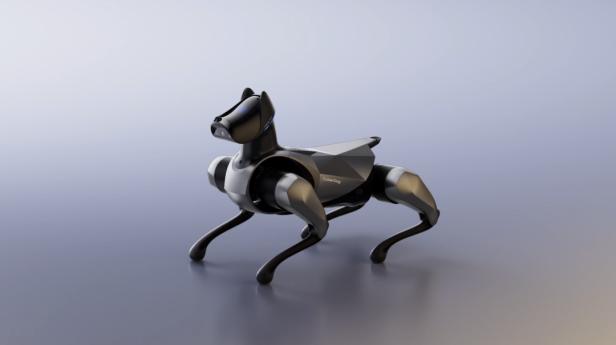
CyberDog 2
From simple interactions with pets on the screen in the early days, to personalized game interactions, and then to having a realistic appearance and emotional expressions.
Electronic pets are still evolving.
Electronic Pets "Understand Me So Well"
The internal logic behind the popularity of electronic pets is basically the same as that of the pet economy.
The development of urbanization and aging has given rise to the loneliness economy.
According to data from the National Bureau of Statistics, the number of single - person households in China increased from 67.09 million in 2010 to 125 million in 2020, a 1.15 - fold increase in 10 years. The proportion of single - person households in all households increased by 10.86 percentage points over the 10 - year period.
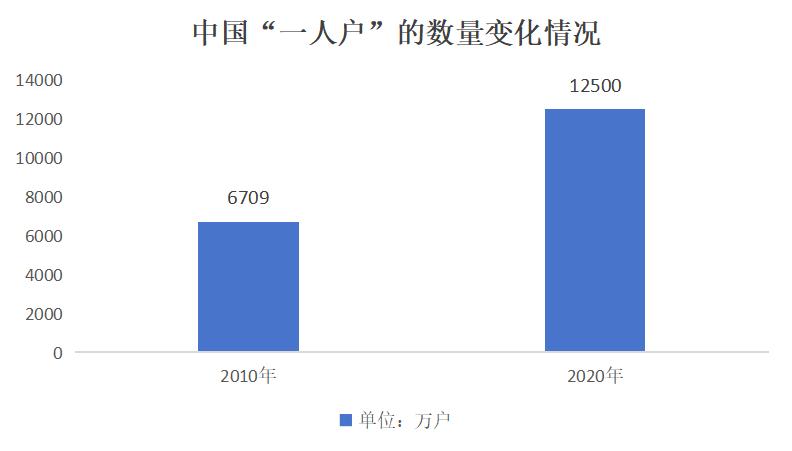
Changes in the Number of Single - Person Households in China
Reasons such as leaving hometown, long - term solitude, lack of intimate companionship, and multiple pressures can all exacerbate people's sense of loneliness.
In recent years, the search volume for topics related to "healing" and "healing - style" on the Chinese Internet has increased by 256%.
The empty - nest population is more willing to entrust their emotions to pets to obtain spiritual and psychological comfort.
Scientific research has proven that "companionship" can make the brain release hormones such as endorphins and oxytocin, which can reduce stress, relieve anxiety and loneliness, and make people feel happy.
Therefore, the pet industry has been growing against the trend and has become an "anti - cyclical" industry.
Data shows that from 2015 to 2024, the scale of China's urban pet consumption market soared from 97.8 billion yuan to over 300 billion yuan, with an annual compound growth rate of 12.98%.
Keeping a pet requires certain conditions, including space, as well as necessary time and money.
For people who do not have the conditions to keep a pet, electronic pets have become an ideal alternative.
On the one hand, they are easier to "keep alive".
Keeping an electronic pet does not require daily care such as feeding, bathing, and walking. Even if you accidentally "kill" it, you can restart and "resurrect" it, without experiencing the emotional trauma of life and death. It's simply painless pet - keeping.
It is both worry - free and labor - saving, and allows you to experience the fun of pet - keeping and long - term companionship.
On the other hand, they "understand" the owner better than real pets.
Compared with real pets, AI - enabled electronic pets not only provide a realistic emotional experience with the assistance of touch and vision but also offer customized emotional support through algorithms. Users get a "custom - made pet" that belongs only to them.
Like real pets, it can heal people's hearts without speaking.
AI technology provides the most core "life - form simulation" for electronic pets, including the most basic realistic appearance, body temperature, and breathing.
In addition, there are also expressions of body movements and facial expressions, as well as the expression of emotions.
For example, LOVOT can move freely. When it is picked up, it will retract its wheels below and snuggle in your arms like a cute little baby.
For example, when Moflin is stroked or hugged by its owner, it will show happiness and a sense of security. If it is not paid attention to for a long time, it may appear anxious and sad, thus stimulating people's desire to care.
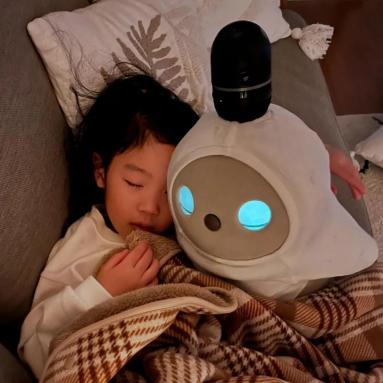
LOVOT Accompanying a Child
The smartest part of electronic pets is the customized emotional interaction, active emotional feedback, and autonomous learning.
Take Ropet as an example.
It will actively care about the owner.
The emotion recognition engine can analyze the user's emotions, including capturing the owner's facial expressions through the camera and analyzing the owner's intonation changes with the sound sensor. When it finds that the owner is unhappy, it will wave and actively offer comfort and a hug.
It can also automatically adapt to the owner.
The adaptive learning algorithm gives Ropet memory. It will record the owner's habits, such as preferred interaction methods and daily schedules, and then adjust and optimize its own behavior patterns. It can also conduct in - depth conversations by connecting to ChatGPT via Wi - Fi.
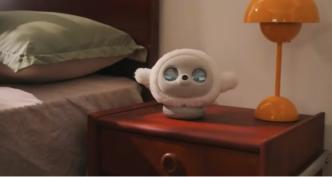
Ropet
This kind of emotional connection generated by algorithm simulation makes people can't help but sigh, "It understands me so well."
When interacting with real pets, the more emotions people invest, the deeper the relationship between them will be, and the more they give, the happier they will feel.
Similarly, electronic pets will "evolve" in real - time with technological iterations, and their cognitive ability and emotional interaction ability will continue to be upgraded.
The more you interact with an electronic pet, the better it will understand the owner and the more personalized services it can provide, thus forming a repeated interaction cycle.
The Future of AI Companionship
In 2023, the electronic pet market showed explosive growth.
Data from MarketsandMarkets shows that the global AI pet market size was $1.19 billion in