Prospects and Warnings of Embodied Intelligence in 2026
When summarizing the development of embodied intelligence in 2025, we tried to find keywords other than "prosperity", or more "down - to - earth" descriptions.
Unfortunately, it's quite difficult to sum up the development of embodied intelligence in 2025 with a single word.
People who have been actively involved in the venture capital or technology industry for a long time must share the same feeling. It's hard to find any industry in the past that can be compared with the development of embodied intelligence in 2025. This was a year filled with extreme expectations and disappointments; a year when capital raced to enter the market; and also an important year that rewrote history.
Amidst the intertwined emotions today, some worry that the "embodied intelligence bubble" might mislead, while others fear that the long - term development of embodied intelligence might leave only "shallow hoof marks".
Therefore, we can no longer make lazy judgments by relying on "cognitive dependence" to compare with other industries, nor can we talk vaguely about an unrealistic future without respecting technological development.
This article attempts to make predictions from a non - emotional perspective, looking beyond the surface fluctuations of the technological cycle. We have no intention of making a distant imagination of "the world 5000 days later". Instead, we choose to focus on the next approximately 300 - day time window: based on the real changes in the industry's behavior, the migration of enterprise resource allocation, and the actual orientation of capital and policies in the past year, we extrapolate the possible key trends of embodied intelligence in 2026 based on past experience.
Based on the above logic, we believe that in 2026, the embodied intelligence industry will witness several clear and prudent change paths: resource allocation will significantly tilt towards the data side, and data will start to be regarded as long - term infrastructure rather than short - term projects; consumer - grade products will enter the real - market testing period, and enterprises will face the first round of close - range competition centered on "usability and sense of value"; the industry's supply chain will gradually mature, with more obvious professional division of labor, and "small workshops" will evolve into "intensive production lines"; meanwhile, the mass production and commercialization of embodied intelligence will begin to take on a large - scale outline, and they will interact with the evolution of the supply chain. For the first time, the industry will truly face the systematic examination of cost, delivery, and ROI.
There is also an opinion that must be mentioned: embodied intelligence won't leave much time for the third - tier players.
01 Warnings
Gartner, a globally leading technology research and consulting firm, proposed the Hype Cycle for Emerging Technologies, which is also worth referring to in the robotics field. This curve includes five stages: the technology trigger stage, where the concept attracts attention; the peak of inflated expectations stage, where media hype drives up expectations; the trough of disillusionment stage, where the actual results fall short of expectations; the slope of enlightenment stage, where practical applications gradually mature; and the plateau of productivity stage, where the value of the technology is widely recognized.
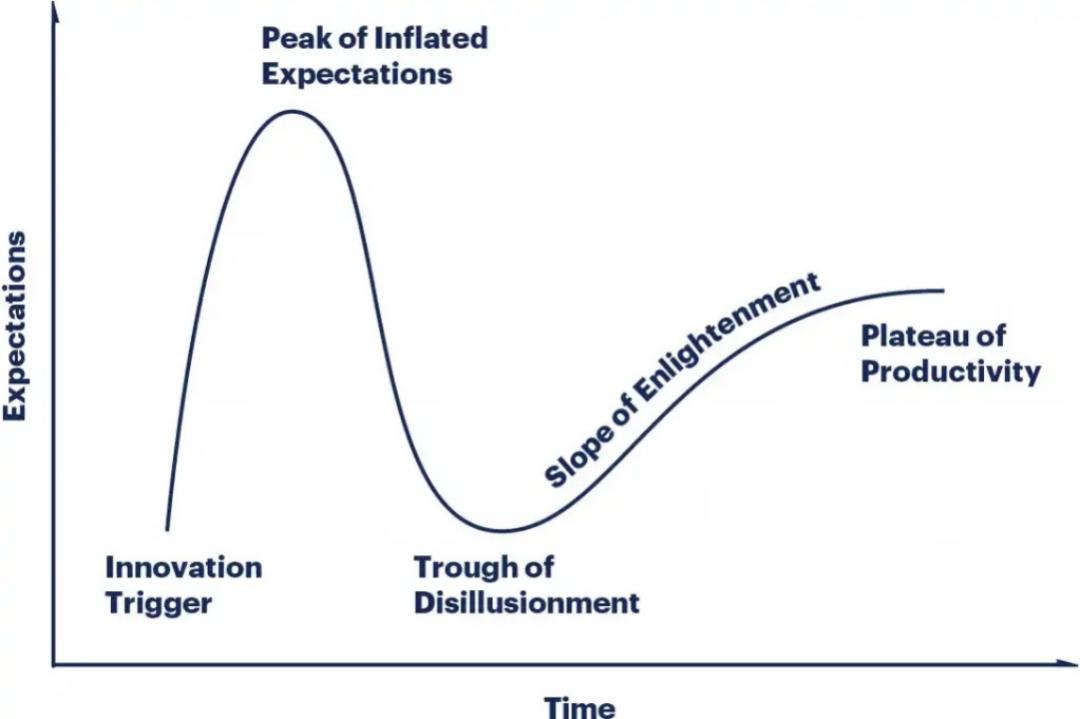
Currently, embodied intelligence is in a complex state where multiple cycles overlap and stages are misaligned. If we consider embodied intelligence as a continuation of robotics, this cycle, after decades of silence, has started to move from the mature stage to a new recovery phase with the explosion of AI. From the perspective of AI derivatives, embodied intelligence has just entered the technology trigger stage and has attracted wide attention.
On one hand, some leading enterprises have passed the concept - validation stage and are starting to touch the real boundaries of mass production, delivery, and commercial returns. On the other hand, a larger number of enterprises are still stuck between the technology trigger and the peak of inflated expectations, constantly vacillating between financing, demos, and narratives.
This means that the industry neither experiences a complete "cleansing" after a full - scale bubble burst nor has it reached the golden stage of stable expansion. Instead, it has entered a critical window period where the cost of trial - and - error rises sharply and path choices become irreversible. Under such realistic conditions, any strategic misjudgment or resource misallocation will be quickly magnified into a survival risk. The following warnings are put forward based on this "less - forgiving" industry situation.
Redundant development will converge
In the past year, driven by the rapid influx of capital and attention, combined with the periodic bottlenecks of technology, a large number of enterprises have chosen almost the same technological paths, product forms, hardware architectures, demonstration capabilities, and even public - relations narratives. This homogenization was not seriously examined in the early stage because the industry was still in the stage of "can it be developed" rather than "who can sustain long - term development".
However, a deeper and more hidden form of redundancy is erupting in the foundation models and data systems. Currently, some enterprises, without advantages in technological foundation, talent density, or capital reserves, still choose to develop their own general - purpose foundation models, trying to "start from scratch" at the model level. Meanwhile, each enterprise is repeatedly investing human resources and capital in highly similar scenarios to build their own data - collection systems: remote - operation platforms, simulation environments, sensor solutions, and annotation processes are almost identical but fragmented, and there is even no unified standard for data reuse, let alone the formation of economies of scale.
This state of "each developing its own model and collecting its own data" is essentially an inefficient internal consumption of resources.
The top - level relevant statements clearly indicate that there are currently more than 150 enterprises related to humanoid robots in China, more than half of which are startups or cross - industry entrants. The number itself is not the problem, but when highly similar products, models, and data pipelines appear densely, the R & D space is rapidly compressed, and the marginal innovation cost increases sharply. The industry will inevitably undergo convergence and screening.
In 2025, this problem was not fully exposed because robots were mainly confined to laboratories and the scientific research and education market. This market has relatively loose requirements for performance boundaries, cost structures, and long - term stability, allowing multiple players to coexist and weakening the intensity of direct competition. However, in 2026, as leading enterprises achieve real - world implementation in industrial, service, and consumer scenarios, the market will no longer tolerate "redundant paths".
Especially in the consumer (C - end) market, the competition will quickly turn into a typical buyer's market. Enterprises not only need to answer "is the technology advanced", but also "is it worth choosing and can it be delivered in the long term". This requires enterprises to form a clear division of labor and make trade - offs among technology, products, supply chains, and services, rather than covering all aspects comprehensively and developing everything in - house.
It can be predicted that in the future, the truly competitive enterprises may not be those with the most in - house development, but those that make trade - offs earliest and avoid ineffective redundancy earliest. Choosing cooperation rather than confrontation at the foundation - model level and promoting data sharing, reuse, and standardization will be the prerequisite for the industry to move from fragmentation to scale.
Convergence does not mean the disappearance of opportunities. On the contrary, when the stage of redundant development ends, real differentiation will emerge, manifested in engineering capabilities, product understanding, delivery efficiency, and user trust. The more brutal the screening, the larger the remaining space. In *The Innovator's Dilemma*, the author described a dilemma where "technology supply may not equal market demand". In the context of the narrowing of embodied - intelligence products in this round, it means that perhaps some differentiated products that directly address user pain points can detonate the market?
Maintain a healthy cash flow
In 2025, we witnessed the bankruptcy of several robotics companies. The Silicon Valley star company K - Scale Labs raised funds three times in a year but still faced a broken capital chain; Aldebaran, a well - known humanoid - robot company established for 20 years, also announced liquidation.

Image source: K - Scale Labs
Although the experiences of predecessors cannot be simply applied, they do provide a perspective for the industry to think about. In this field where both software and hardware are capital - intensive, "maintaining a healthy cash flow" is of utmost importance. While everyone is indulging in the hustle and bustle and enthusiasm of the industry, such as the rising shipment volume, prices reaching the "sweet spot", and record - high salary levels, enterprises should always be aware of the financial reefs hidden beneath this wave that can swallow startups. All entrepreneurs entering this field must engrave the principle of maintaining a healthy cash flow into their company's survival creed.
In the financing market of 2026, it is very likely not to be a fertile ground for all but a siphon field concentrating on the top players. Capital has become more cautious, and resources will accelerate the tilt towards leading enterprises with high technological barriers and clear commercialization paths. For most startups, the difficulty of financing may become a major constraint. When the financing cycle lengthens and the terms become more demanding, the cash flow on the balance sheet is the lifeline of the enterprise, determining whether you can survive the darkness before dawn and wait for the day of technological breakthrough and market explosion.
An even more fatal trap is the scale - up curse of "losing money upon implementation". Many enterprises happily launched their robots into the market but fell into the strange circle of "losing money on each unit sold". On one hand, some did it deliberately. According to the Embodied Intelligence Research Society, some enterprises are in a stage of "losing money" or having "very low profits" when shipping products. This is due to the common low - profit nature of the manufacturing industry and the enterprises' choice to preemptively capture users' minds. On the other hand, many teams only focus on the hardware BOM cost when pricing products but underestimate the hidden costs of making embodied - intelligence products from "usable" to "user - friendly".
As a result, a cruel phenomenon may occur in 2026: an enterprise's order volume is rising steadily, seemingly with a bright future, but in fact, each additional robot sold adds to the burden of losses. The pressure of after - sales maintenance increases exponentially, and the investment in scenario customization is endless. Eventually, the enterprise falls into the scale - up trap of "the more you sell, the more you lose".
When the growth of revenue cannot keep up with the expansion of costs and the cash flow on the balance sheet is continuously eroded by losses, no matter how impressive the order data may seem, it will only be the last straw that breaks the enterprise. There are many such cases in various fields.
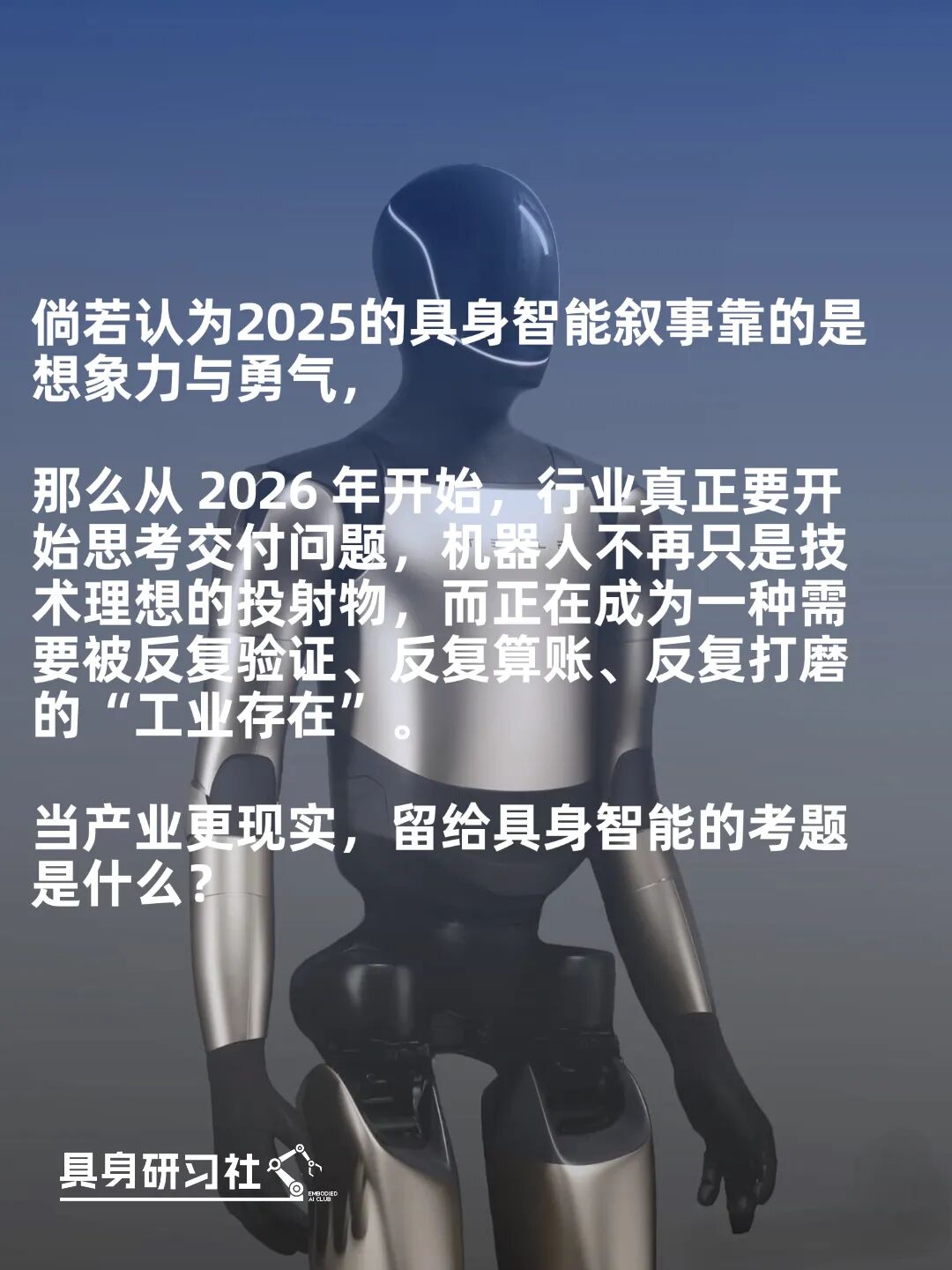
If the narrative of embodied intelligence in 2025 relied on imagination and courage, then from 2026 onwards, the industry really needs to start thinking about the issue of delivery. Robots are no longer just projections of technological ideals but are becoming an "industrial existence" that needs to be repeatedly verified, calculated, and refined. In the new year's journey, some may continue to indulge in the grandeur of the wave, while others may start to repair their boats and adjust their courses. In the end, it is never the loudest shouters who reach the other shore, but the pragmatic ones who are the first to recognize and avoid the traps.
02 Outlook
In 2025, embodied intelligence seemed to be completing a whole set of "experiments", from model architecture to the whole - machine manufacturing, from scenario exploration to the commercialization closed - loop, and has been initially verified.
In 2026, enterprises in the embodied - intelligence field will no longer make small - scale attempts, and large - scale applications and real - world commercial battles may unfold.
Data bottlenecks will be addressed comprehensively
There is a view in the industry that the competition in the second half of the industry will revolve around the cycle of "data collection - model training - large - scale expansion - model iteration". That is to say, the model is no longer the only "decisive factor", and data is not something to be discussed separately but the cornerstone of the cornerstone. (Some people did not think so in the first half of the year.)
In the data - collection stage, the article "#Embodied Intelligence: No Consensus is the Best Consensus#" by the Embodied Intelligence Research Society once stated that there is no unified answer in the industry about "what data to use". Due to the advantages and disadvantages of different data types, the current mainstream solutions are: remote - operation real - machine data collection and simulation data.
Essentially, these two data - collection methods are balancing an "impossible triangle" of "authenticity, scale, and low cost" based on their own technological routes and scenario requirements. However, it cannot be denied that both methods have certain limitations. For example, simulation data can be generated in large quantities, but there is a Sim2Real gap, and whether the data - generation cost is low is also questionable. The authenticity of real data needs no further elaboration. In the field of fine - grained operations, models prefer this type of data, but the problem is that the cost is high and it is difficult to scale up.
This was the biggest point of contention in 2025, and even formed the only consensus that "the impossible triangle of data is becoming an important factor restricting the industry's development". Fortunately, by the end of the year, the industry no longer got stuck in a binary opposition but started to think about a "third way".
On one hand, with the iteration of data - collection technologies, the "radar chart" area of the "impossible triangle" is constantly shrinking in all dimensions. For example, data - collection paradigms such as the UMI data paradigm represented by Luming Robotics, Generalist AI, and Sunday, and efficient data - collection methods like the exoskeletons of Daimeng DE - EXton2 and Qiongche Intelligence AirExo - 2 can collect relatively real data. In addition, there is a "human - centered" data - collection paradigm represented by Tashizhihang, which can continuously record real and high - quality operation behaviors (improving collection quality) without changing human operation methods or additionally building collection environments (reducing collection costs).

Image source: Sunday
In addition to finding new solutions, data has become a problem that the whole industry is working together to solve. Since the second half of last year, various large - scale real or simulated datasets have been intensively open - sourced. AgiBot World of Zhiyuan Robotics, RoboMIND of the Beijing Humanoid Robot Innovation Center, WIYH of Tashizhihang, and even just a few days ago, the startup team of GenRobot.AI (Jianzhi Robotics) also publicly released over - ten - thousand - hour data and a dataset of one - million - task clips and distributed them in batches.
Moreover, the top - level design has also planned the infrastructure construction in the field of embodied - intelligence data. In the past year, local governments have actively intervened, established regional data - collection centers, and purchased data - collection equipment. According to incomplete statistics, the cumulative order amount of local governments' purchases of data - collection robots in 2025 has approached one billion yuan. This data infrastructure may reduce enterprise costs and promote the formation of a data - sharing ecosystem. In 2026, with technological iteration, the open - source ecosystem, and policy support, the problem of data scarcity will gradually be alleviated, injecting new vitality into model training.
The first - round potential of consumer - grade robots
Since embodied intelligence entered the public eye in early 2025, the most concerned question from the outside world must be when robots will "enter thousands of households". However, the reality in the middle of the year was that the