He Xiaopeng: In the future, the best AI companies will all develop their own chips.
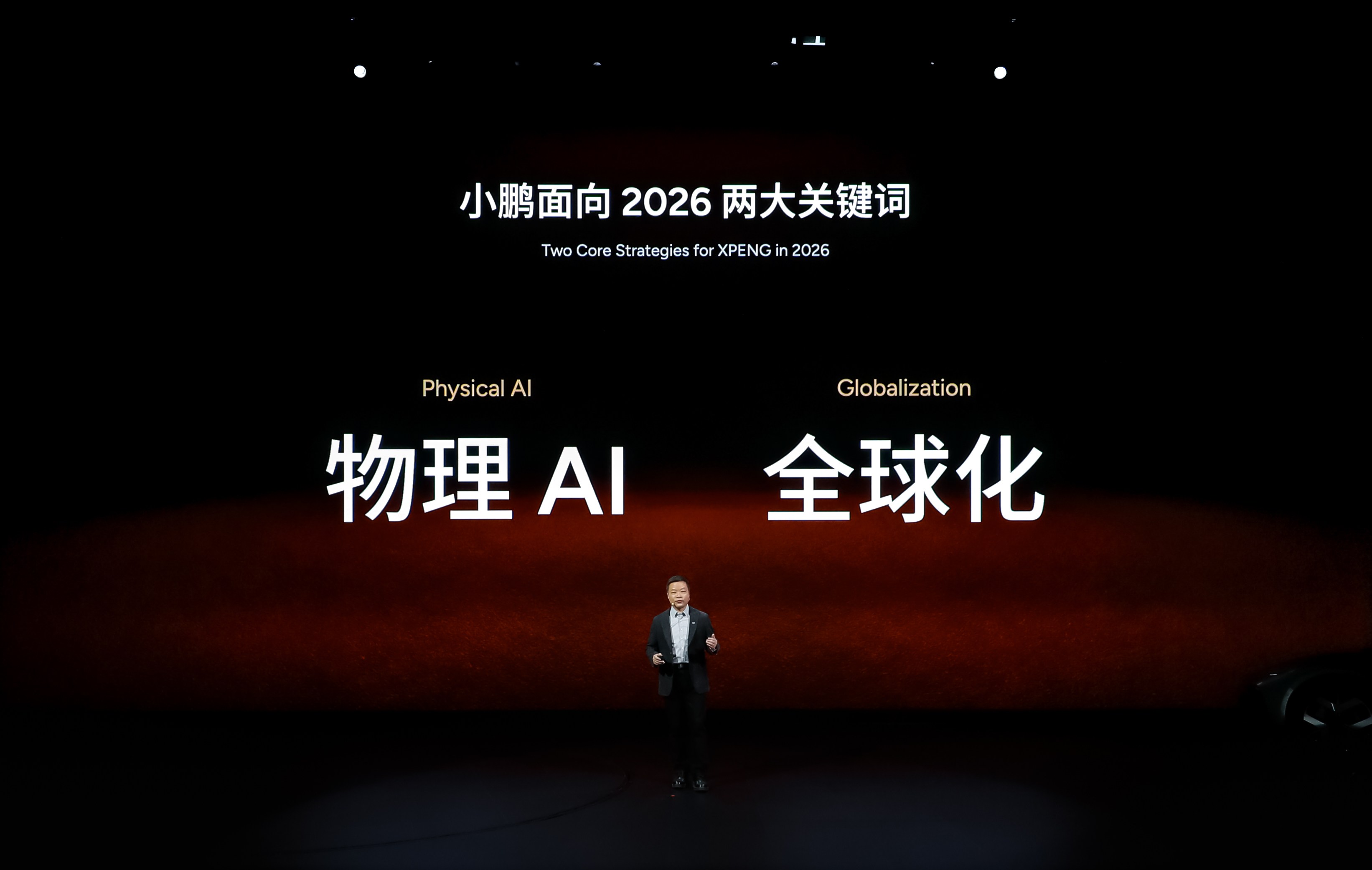
He Xiaopeng, Chairman and CEO of XPeng Motors
Text | Xiao Man
Editor | Li Qin
In addition to repeatedly emphasizing at press conferences that it is an AI company, XPeng is also becoming more and more like an AI company in terms of new business development.
On January 8, 2026, XPeng launched four new models: the XPeng P7+, the extended-range version of the XPeng G7, the 2026 XPeng G6, and the 2026 XPeng G9. However, the most important technological updates for these models are not the hardware configurations, but the chips and AI. All four new models will use XPeng's self-developed Turing AI chips. The Ultra SE and Ultra versions will be equipped with XPeng's second-generation VLA model, which can achieve basic L4-level assisted driving capabilities.
XPeng's approach is very similar to that of Tesla in recent years. Elon Musk has transformed Tesla from an automobile company into an AI company. Although the majority of Tesla's revenue still comes from selling cars, Tesla no longer makes significant changes to the hardware configurations of its models and has not launched a brand-new model for many years. Instead, it focuses on improving the AI capabilities of its cars.
They have both seen the next stage of changes that will occur in the automotive industry. He Xiaopeng said that in the past 10 years, automotive hardware accounted for more than 90% of the total value of a vehicle. However, in the next decade, the value of hardware will shrink to 50%, while the value of software will soar from 10% to 50%.
Therefore, XPeng not only wants to develop models and operating systems but also the software on the chips. He Xiaopeng believes that in the future, the world's best AI companies will choose to customize their own chips, which will determine the performance ceiling of each company's AI products.
Among the four new models launched by XPeng, the MAX version is equipped with one Turing chip (with an effective computing power of 750 TOPS). The newly added Ultra SE version is equipped with two Turing chips for intelligent driving. The Ultra version is the top-of-the-line model, using three Turing chips, two for intelligent driving and one for the cockpit. 36Kr Auto learned that XPeng's Turing chip for the cockpit only serves the large model, and the cockpit chip still mainly uses the Qualcomm 8650.
Both Tesla and XPeng are still in the early stages of business transformation. Especially in the Chinese automotive market, where competition is intensifying, XPeng's bet on AI has a higher degree of uncertainty. "The core is that 10% of the main users must think this idea is correct. Many people still haven't reached a consensus today," He Xiaopeng said directly.
Facing the uncertainty, He Xiaopeng wants to continue to increase his investment. He repeatedly mentioned "paradigm shift" and "emergence of strong intelligence" during the communication, emphasizing that the value of AI will be far higher than traditional performance upgrades.
It should be noted that currently, XPeng is still an automobile company whose core revenue comes from selling cars. 2026 is a big year for XPeng's product launches. In addition to launching multiple extended-range products, XPeng will also launch four brand-new SUVs. The product portfolio will expand significantly, and supply chain and channel management are equally important. Although this is not the most concerned topic in the capital market, it is related to XPeng's core business development.
The following is an edited conversation between 36Kr Auto and He Xiaopeng, Chairman and CEO of XPeng Motors:
Question: This time, a new Ultra SE configuration was added. This is also the first time XPeng has set up a separate model based on the cockpit. Why did you make such a setting?
He Xiaopeng: You can think of the SE as having a driver, and the Ultra as having an additional butler. As AI develops, the capabilities of these two parts will become more and more obvious.
Question: This year is a big year for XPeng's product launches. What new plans does XPeng have for its sales channels? With so many new models being launched and more SKUs added, the difficulty of supply chain management has also increased. What measures will XPeng take in supply chain management this year?
He Xiaopeng: The most important thing this year is to expand the global sales channels and the global supply chain. XPeng already has three factories outside China, and actually, more will be added this year. Regarding the Chinese market, the sales channels will start to penetrate into lower-tier cities. Previously, most of the channels were in the eastern, southern, and central regions. Now, they will expand more to the northwest and northern regions.
Question: XPeng's sales exceeded 400,000 units last year, showing a significant year-on-year increase. After the launch of multiple models with "dual capabilities" this year, what are your expectations for the annual sales volume and the overseas market?
He Xiaopeng: 2025 was the third year of "steady and far-reaching development" for XPeng. From 2026 to 2028 are three crucial years for physical AI. It is the period of transformation from software to the AI paradigm and building a good infrastructure. This is what we need to continuously do well during this period.
In terms of globalization, XPeng entered 60 countries and regions in 2025, and this year it will enter more countries and regions to conduct in-depth local R & D and local manufacturing. In the second half of this year, we will bring our autonomous driving capabilities to the world.
I hope that in the next 3 - 10 years, XPeng's sales, cooperation, and empowerment overseas can reach a 1:1 ratio with the Chinese market, or even a higher ratio.
Question: What are XPeng's plans for launching NGP in Europe? In the European market, L2, L2+, and L3 are not very popular. How does XPeng view this, and what solutions does it have?
He Xiaopeng: The VLA 2.0 will enter the European market in 2026, and road testing has already started.
The cockpit VLM will fundamentally change a vehicle. Currently, everyone thinks that the qualitative change lies in full autonomous driving. However, after a car has a good driver, it still needs a better butler. We need a localization language to describe things and a local computing large model. This is what our VLM does, although it incurs additional high costs.
XPeng is developing the base model for the physical world. Each model implemented in the physical world is different, such as those for cars and robots. Therefore, we must develop it ourselves. From the underlying base model to training, computing power, quantization, and deployment, it is all based on a self-developed logic. Only by doing this well can we achieve both high efficiency and effectiveness.
Question: XPeng is one of the few domestic car companies whose sedans sell better than SUVs. How will you strengthen the development of SUVs in the next step of product planning?
He Xiaopeng: Feng Ying has rich experience in SUV development. After she joined XPeng in 2023, she started planning XPeng's SUVs. This year, we will launch four brand-new global SUV models.
Question: You mentioned at the press conference that 2026 and 2030 are very crucial for the industry. Why do you have such a judgment?
He Xiaopeng: In the previous decade, the proportion of intelligence in a vehicle was only 10%. The most important market variables still came from factors such as the vehicle itself, the brand, and the comprehensive capabilities of the vehicle.
In the past, relying on integration methods and hardware methods, the scope of software's impact on the automotive industry was limited. However, the combination of AI and the automotive industry will change many logics. The proportion of software capabilities will gradually increase from 10% in the previous decade to 50%, while the proportion of hardware will shrink from 90% to 50%.
The changes in AI are too drastic. In the past three years, XPeng both explored AI and had doubts about it for a long time because it cost a lot of money but didn't yield much value. This was a very difficult process. XPeng has made many organizational transformations in the past. The algorithm logic was re - evaluated and changed even before the full delivery of VLA 1.0, which wasted a lot of money and time. However, at the end of last year, we had a remarkable achievement. Once the infrastructure is well - established, the speed of change will exceed our imagination.
Many hardware companies have differences in scale and scale advantages, while software companies often rely on network advantages. These two paradigms will be deeply integrated in the next five years.
Question: Is the revolution in new energy vehicles still an independent industrial revolution, or has it gradually evolved into a derivative of the AI and artificial intelligence revolution?
He Xiaopeng: Whether it is electric or extended - range vehicles, and whether it is the quality or the hardware experience, these are all very important aspects of the automotive industry in the next ten or twenty years. However, the proportion of software or AI is increasing, and this is a change.
Actually, when full autonomous driving truly arrives, it will be like the difference between buying a feature phone and a smart phone. Just as no one wants to buy a feature phone, the core is that 10% of the main users must think this idea is correct. Many people still haven't reached a consensus today. If 10% of the main users agree, it will influence the other 90% of potential buyers.
Question: All of XPeng's 2026 models are using the self - developed Turing chips. Other OEMs are also developing their own chips. What does XPeng think about this?
He Xiaopeng: At first, I thought that only a small number of enterprises should develop their own chips at the edge side, and most enterprises should use publicly available chips. However, after we successfully launched the edge - side chip last year, I gradually realized that, in a sense, chip companies are also software companies.
To do a good job in software, we not only need to develop operating systems but also the software on the chips. Personally, I think that in the future, the world's best AI companies are very likely to choose to customize their own chips. Because self - developed or customized chips can achieve the performance improvement of the next - generation technology with the current - generation technology. This is not just a cost issue but also a matter of capabilities.
Many Chinese companies are already developing chips. I believe that the value of customized private chips will be truly recognized by more entrepreneurs and users in the next decade. Even though this is not a common consensus today, it is something I firmly believe in.
Question: Recently, a person named David Moss drove a car with FSD for more than 10,000 kilometers in the United States without any intervention. How do you compare XPeng's VLA 2.0 with FSD?
He Xiaopeng: I firmly believe that in the AI paradigm, full autonomous driving will come faster.
In the past, I thought that in the era of rules, it might not be possible to achieve good autonomous driving even next year, and L5 was even more out of reach. However, now I really think that the time to enter the L4 level may be accelerated, and even entering the L5 level is already within sight, especially considering the changes in AGI, Coding AGI, and the field of autonomous driving.
Question: XPeng recently obtained permission for L3 - level road testing. However, you predict that China and the United States will directly jump from L2 to L4 in 2026. Why do you think L3 will be skipped in the development of autonomous driving?
He Xiaopeng: In the past few years, I always thought that L4 was out of reach because it is really very difficult. At the same time, I also always thought that L3 was a stage that was very difficult to truly achieve. On the one hand, it is difficult to define liability for L3. On the other hand, L3 is more of a technical logic rather than a logic that can be implemented in engineering.
Technological changes sometimes happen faster than expected. What was originally a linear development process may suddenly "burst forth with accumulated strength" after the linear speed gradually slows down, forming a new inflection point.
Question: Is XPeng's strategy for Robotaxi the same as Tesla's?
He Xiaopeng: Not exactly the same. We think that Robotaxis may still need a steering wheel and brakes, but they will become safer and more user - friendly. At the same time, they also need to have the ability to be controlled and regulated. We are using the same VLA to develop the Ultra (representing L4 software capabilities) and the Robotaxi (representing the integrated hardware and software capabilities).
Question: Some people think that car companies cannot do a better and more mature job in L4 and Robotaxi than L4 - specialized companies. How do you view this competition?
He Xiaopeng: I think it is not possible to directly compare them. They are purely in the software dimension, while we combine hardware and software and also have an AI dimension. So this comparison is not entirely correct.
Once XPeng's Robotaxi is launched in China, we will enter the global market and open up the SDK. The goal is to sell the Robotaxi with an open SDK to more countries. Our vehicles are not restricted by roads or rules, and the vehicle price is reasonable without the need for additional programming adaptation.
This is a competition between two paradigms. In the past, upgrading an L2 system by one version might only increase its performance by 10% - 20%, and the annual improvement was 50% - 60%. However, our goal this year is to achieve a ten - fold improvement, and another ten - fold improvement next year. Therefore, this is a different logic and way of perception from the past.
Question: Recently, the entire automotive industry has been under pressure, and many car companies are feeling the pressure on sales. XPeng had a relatively smooth year last year. Do you think it was difficult and tiring in the past year?
He Xiaopeng: I advised my colleagues not to enter the automotive industry a few years ago because every year is difficult for car companies. Many people didn't anticipate the changes in 2025, and there are a lot of contingencies in many things.
XPeng's judgment about the end of 2025 and 2026 was relatively accurate. We don't have inventory, which is different from many car companies that use the wholesale model. The wholesale model was under great pressure in the fourth quarter of last year, and the pressure may be even greater this year.
The current market change is just a passing phase. Although the new energy vehicle market is currently under pressure, I believe it will gradually recover over time. The worst time is often also the best time.