Zhipu and MiniMax's IPOs in the Hong Kong Stock Exchange: Those Who Endured Solitude and the $50 Billion Reward | Shenke Lite
Text by | Zhou Xinyu
Edited by | Su Jianxun
The wave is coming, and everyone has stood up
As investors in Zhipu AI's Series B round, Zhou Zhifeng, the managing partner of Qiming Venture Partners, and Hu Qi, the executive director, still remember what this large model company looked like in its infancy.
It was June 2021. At the press conference of the Beijing Academy of Artificial Intelligence, they saw the pre - trained model with a trillion - parameter count, "Wudao 2.0", for the first time in China.
After a series of introductions, Zhou Zhifeng and Hu Qi learned that the leader of "Wudao 2.0" was Tang Jie from the Knowledge Engineering Laboratory of Tsinghua University, and the company behind him was called "Zhipu AI".
Different from the current spotlight on large models, AI was a dormant field back then.
In 2021, the hottest investment themes were carbon neutrality and the metaverse. OpenAI was still a niche company in China, and large models and the Scaling Law were just experiments quietly carried out in a few large enterprises and research institutes.
Qiming Venture Partners still made the investment. The so - called "generalization ability" mentioned by several founding members of Zhipu AI and the already - promoted model API services made them realize that large models could step out of the laboratory and be a "big story" that could transform all industries. In the earliest internal discussions at Qiming Venture Partners, Hu Qi specifically noted the judgment on the Foundation Model by AI team members from Stanford University, including Fei - Fei Li.
At the end of 2021, when Qiming Venture Partners quietly invested in Zhipu AI, Huang Mingming, the founding partner of Mingshi Venture Capital, Xia Ling, the partner, and Xu Zhihao, the managing director, met Yan Junjie, the founder of MiniMax, who was planning to start a business.
There was no BP (business plan) or PPT in this meeting, nor was there a product demo. There was only Yan Junjie's nearly three - hour presentation.
"My goal is to achieve AGI (Artificial General Intelligence)." From Yan Junjie's mouth, several investors from Mingshi heard this strange yet grand vision for the first time. "I wasn't sure about the exact definition of AGI at that time, so I even searched for it on the spot," Xia Ling remembered.
However, Yan Junjie's methodology of "using end - to - end data - driven approach for NLP (Natural Language Processing)" caught Mingshi's attention. In 2015, Mingshi invested in Li Auto and understood the revolutionary significance of "end - to - end data - driven" for autonomous driving. Similarly, they were optimistic about the potential of this technology in AI dialogue systems.
Three months after meeting Yan Junjie, Huang Mingming decided to invest. In mid - 2022, he also introduced Wang Xing and Li Xiang respectively, aiming to let Yan Junjie "communicate and collide with top - notch entrepreneurs and product managers". In MiniMax's subsequent financing rounds, Mingshi ultimately invested in six consecutive rounds.
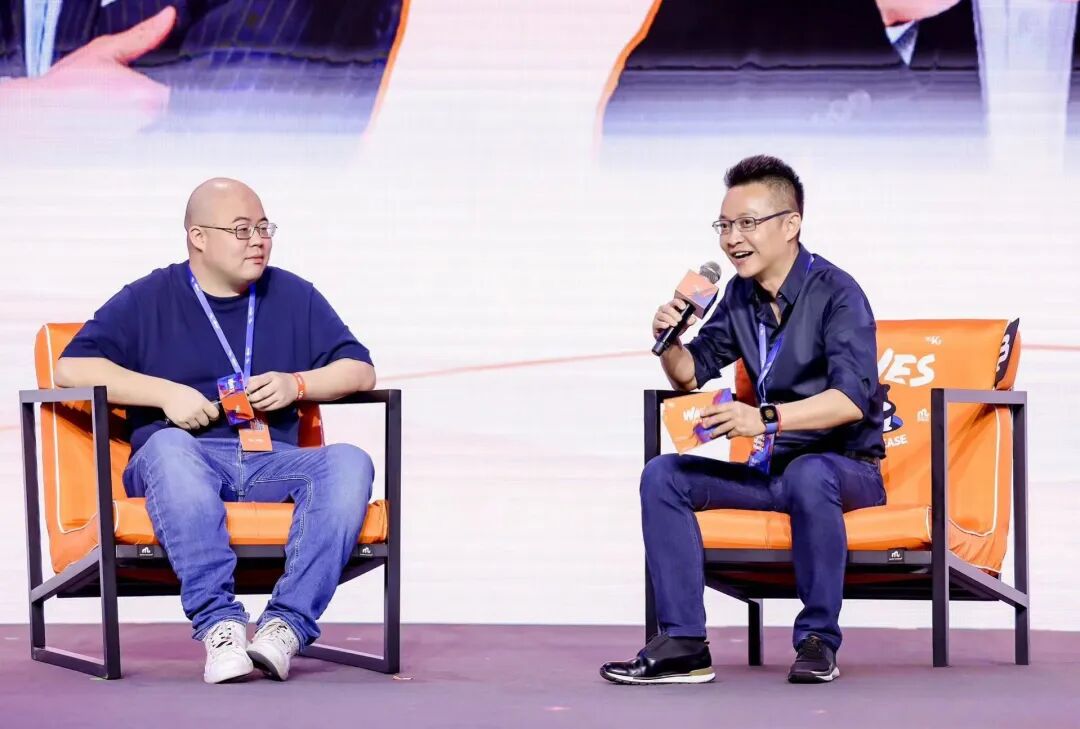
△ Yan Junjie (left) and Huang Mingming (right). Image source: 36Kr
The scarcity was the reason why the two funds invested in Zhipu AI and MiniMax respectively. However, the other side of "scarcity" was the loneliness of the minority's belief — at that time, it was still more than a year before ChatGPT quickly made large models a common consensus.
No one knew if they had made the right decision. Xia Ling described that Mingshi was "taking a bet" at that time. Zhou Zhifeng called the investment in Zhipu AI "half a step ahead": "No matter how good our investment methodology sounds, when we invested before the market consensus was formed, a sense of loneliness and self - doubt always lingered in the team."
The darkness before dawn is always long. Whether it was Zhipu AI, MiniMax, or Qiming Venture Partners and Mingshi Venture Capital, who chose them early on, they all explored and made mistakes in silence in the year after the end of 2021. One year later, ChatGPT emerged out of nowhere, and everyone knows what happened next.
In 2026, Zhipu AI and MiniMax, the earliest established among the "Six Little Tigers of Large Models", harvested an extremely important fruit since their founding:
On January 8th, Zhang Peng, the CEO of Zhipu AI, rang the gong at the Hong Kong Stock Exchange, announcing its listing. Its market value once exceeded HK$57 billion. On January 9th, MiniMax followed suit and was about to enter the secondary market with an estimated market value of over HK$50 billion.
On the hottest track in the past five years, the two hottest companies listed on the Hong Kong Stock Exchange almost at the same time — the market sentiment was instantly ignited.
During the short seven - day share - offering period, the public offering part of Zhipu AI was subscribed 1,159.46 times. The market's enthusiasm triggered the claw - back mechanism, and the proportion of Zhipu AI's public offering in Hong Kong increased from the initial 5% to 20%. As of the time of writing, Zhipu AI's stock price once exceeded HK$130, up about 12% from the issue price.
MiniMax was equally popular. Even though the public offering part was only HK$220 million, MiniMax attracted over HK$253.3 billion in margin funds. As many as 420,000 people subscribed, which was equivalent to 1,209 people competing for every HK$1 worth of stocks.
A new - share subscriber sighed to us: The lottery odds of these two companies were as low as getting tickets for a Mayday concert.
In the days when the IPOs came to an end, Zhou Zhifeng felt that whether it was Zhipu AI, MiniMax, or the early - stage investors, everything had come naturally, and everyone had always been holding a surfboard.
At the beginning of 2026, the wave came. "Everyone has stood up," Zhou Zhifeng sighed.
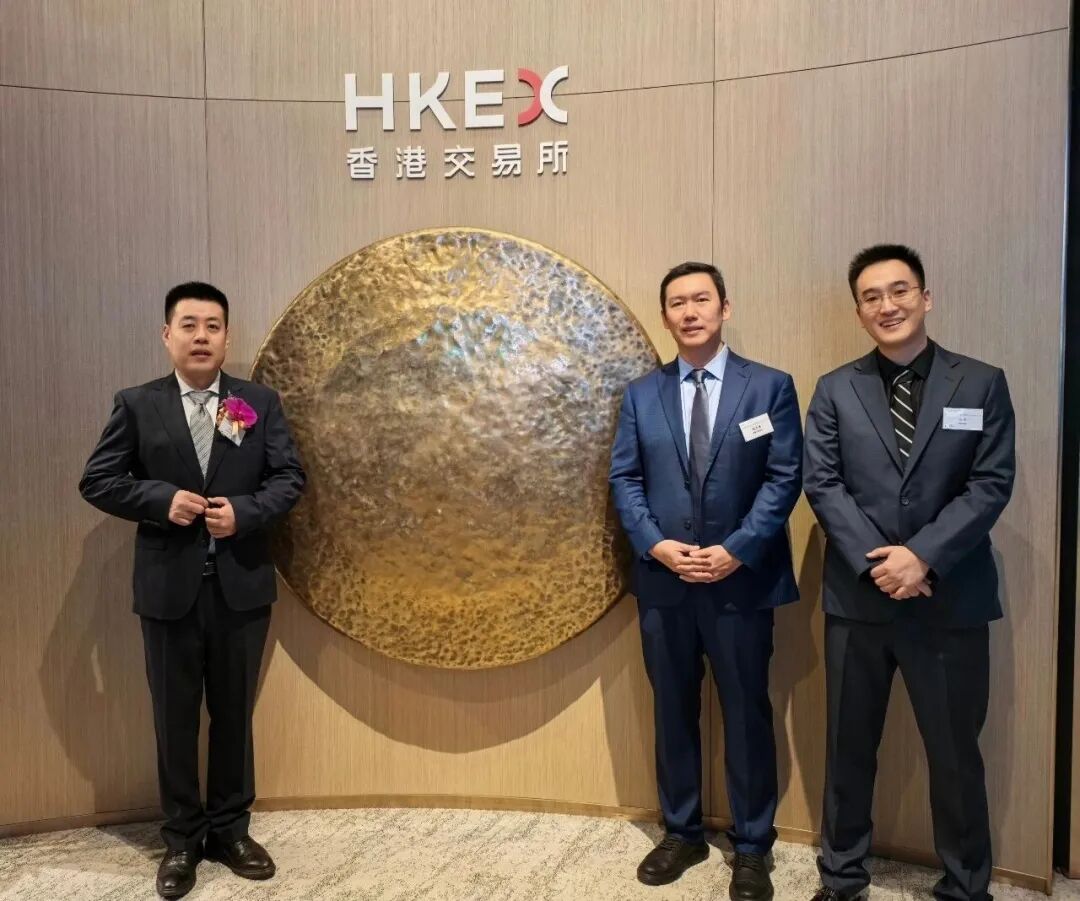
△ Wang Shaolan, the president of Zhipu AI (left), Zhou Zhifeng, the managing partner of Qiming Venture Partners (middle), and Hu Qi, the executive director of Qiming Venture Partners (right). Image source: Official website of Qiming Venture Partners
The door of the Hong Kong Stock Exchange is always open
The listings of Zhipu AI and MiniMax brought the Hong Kong stock market to a climax at the turn of the new year from 2025 to 2026.
Two or three years ago, the investment bank where analyst He Hui worked laid off employees several times due to declining performance. Now, he feels that the situation seems to have returned to 2018 when Xiaomi and Meituan queued up to list on the Hong Kong Stock Exchange. "There is work to do, and even overtime is sweet."
"Since 2025, the Hong Kong stock market has completely outshined the A - share market in terms of the recognition among technology companies. Firstly, the listed companies are hot enough, including many popular companies in the consumer, AI, and semiconductor fields. Secondly, the listing process is fast enough." He Hui told "Intelligent Emergence".
This is also a vivid microcosm of the capital spectacle in the Hong Kong stock market since the second half of 2025.
Macro data confirms the popularity of the Hong Kong stock market. According to the data of the Hong Kong Stock Exchange, 119 companies were newly listed in the Hong Kong stock market in 2025, the highest in the past five years. Wind data shows that as of October 13th, 2025, a total of 269 companies submitted IPO prospectuses to the Hong Kong Stock Exchange in 2025, more than the total number in the previous three years.
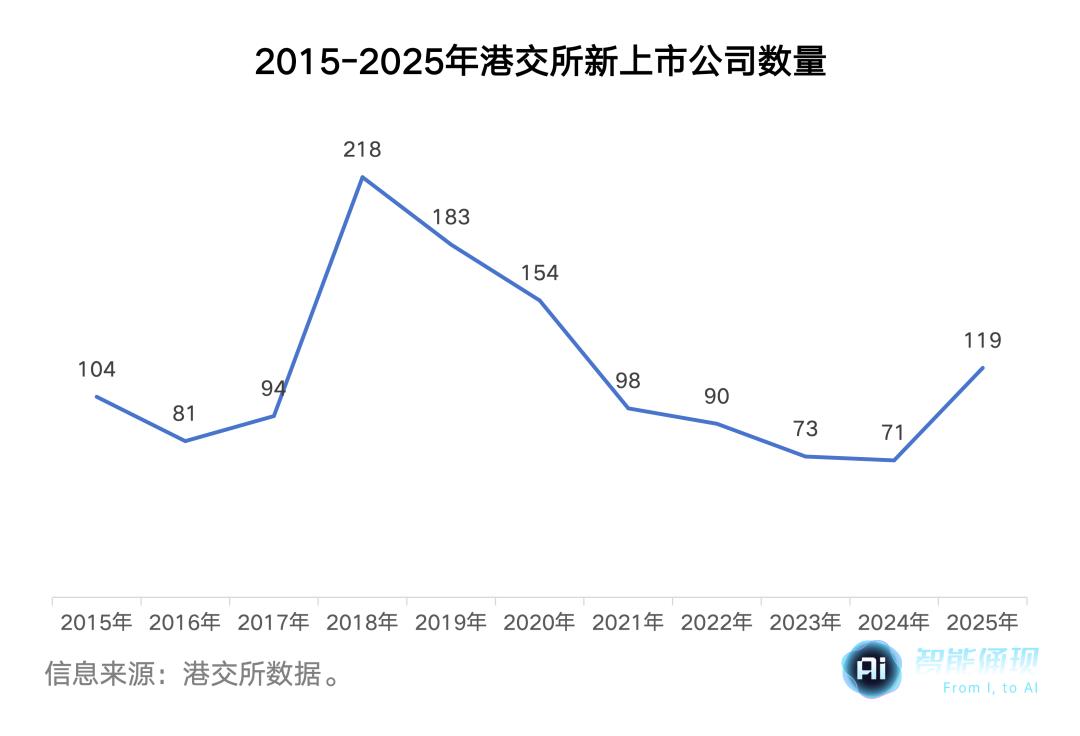
△ The number of newly - listed companies on the Hong Kong Stock Exchange from 2015 to 2025. Image source: Chart by "Intelligent Emergence"
Two obvious forces are crucial for the current prosperity of the Hong Kong stock market.
On one hand, there is the accelerating south - flowing capital and the proactive Hong Kong stock market. In order to attract investment and activate the liquidity of funds, the Hong Kong Stock Exchange began to frequently extend an olive branch to mainland enterprises.
Since 2025, the Hong Kong Stock Exchange has been more active in promoting itself in the mainland. In November 2025, members of the Hong Kong Stock Exchange appeared at the AGM (Annual General Meeting) of Mingshi Capital and introduced the IPO process and policies to the invested companies.
They emphasized an example of the recovery of the Hong Kong stock market in their presentation, which was the consumer sector that was booming at the beginning of 2025. At that time, due to the retail subscription multiple exceeding 5,000 times, the IPO of Mixue triggered the claw - back mechanism of the Hong Kong stock market, and the share of public offering increased from the original plan of 10% to 50%.
"The stereotype that stocks 'break their issue prices on the first day of listing' in the Hong Kong stock market has been reversed," Xia Ling told "Intelligent Emergence".
Among various friendly gestures, the provisions of Chapter "18C" of the "Listing Rules" of the Hong Kong Stock Exchange are of great significance to many technology companies. This listing system, which was launched in 2023 for "specialized and technological companies", allows technology companies that are unprofitable or have low revenues to list on the main board of the Hong Kong Stock Exchange.
The "Technology Company Express Lane" launched on May 6th, 2025, further sent out a friendly signal. This system allows eligible technology companies to receive listing guidance during the preparation stage and choose to submit IPO applications confidentially.
The new - generation large - model AI companies are in a good time. This is a situation that the previous generation of the "Four Little Dragons of AI" (SenseTime, Megvii, CloudWalk, and Yitu) did not experience.
Since August 2019, Megvii Technology has made several attempts at IPO but failed. For Yin Qi, the CEO of Megvii Technology, the recovery of the Hong Kong stock market in 2025 brought an opportunity to realize his dream. In October 2025, Qianli Technology, an intelligent driving company where he serves as the chairman, announced that it had submitted an IPO application to the main board of the Hong Kong Stock Exchange.
Of course, the "fast" pace of AI companies going to the Hong Kong Stock Exchange for IPO this year is also the result of the efforts of all parties. With MiniMax and Zhipu AI, two companies from the north and the south, listing on the Hong Kong stock market, there is now a representative of Chinese foundation models in the global capital market.
A former executive of one of the Six Little Tigers told "Intelligent Emergence" that in any strategic and cutting - edge field, there must be domestic counterparts to overseas companies in China. "The absence of any counterpart will lead to the global secondary - market funds flowing to overseas companies." In this sense, "Since there are OpenAI and Anthropic overseas, there must be Zhipu AI and MiniMax in China."
On the other hand, there is the accelerating development of the AI track.
"The iteration speed of the AI track in three months is equivalent to that of many traditional industries in a year," Xia Ling commented.
The unimaginable speed of technological iteration and resource consumption has led to higher financing needs. From 2023 to mid - 2024, the Six Little Tigers all stepped from being unicorns into the club of companies valued at over 20 billion yuan. Just one year later, the valuation quickly increased from 20 billion yuan to 30 billion yuan.
"At least by the end of 2024, the Six Little Tigers realized that the primary market could no longer support their valuations," a former executive of one of the Six Little Tigers remembered. At the end of 2024, almost all of the Six Little Tigers put IPOs on their agendas.
For example, according to "Intelligent Emergence", according to the plan of one of the Six Little Tigers, in March 2025, the company would raise another 3 - 4 billion yuan. As long as it achieved a revenue of 1 billion yuan that year, it was expected to list. However, due to the strategic adjustment of the founder, the company cut off its most profitable business, and the listing plan came to nothing.
"(If not listed), large - model companies can only conduct small - scale financing in the primary market at a valuation of 4 billion US dollars, which is very inefficient," Xia Ling told us. "The fastest way to raise funds is to list."
On one hand, AI companies are in urgent need of long - term ammunition. On the other hand, the Hong Kong stock market is opening its arms to AI and technology - themed investments. Multiple waves have finally formed a joint force to promote Chinese large - model companies to flock to the Hong Kong Stock Exchange for listing.
There are about six invested companies of Mingshi Venture Capital where Xia Ling works that are expected to list on the Hong Kong stock market in 2026. Coupled with MiniMax, which is about to ring the listing bell, "It's truly a year of harvest," he summarized.
Those who endured the loneliness
Among the "Six Little Tigers of Large Models", the uniqueness of Zhipu AI and MiniMax lies in that they are two Chinese large - model companies founded in the "pre - ChatGPT era" — Zhipu AI was founded in 2019, and MiniMax was born in 2022.
This was an unpromising time point.
"Many people thought that AI was just about the 'Four Little Dragons' at that time and were not willing to take a look," an investor who missed out on Zhipu AI and MiniMax told us. In 2022, someone also recommended MiniMax to him, saying that Yan Junjie was going to work on multi - modality. His first reaction was: Multi - modality? Who still does CV (Computer Vision) these days?
Even in the first half of 2023, there was still no consensus in the primary market on whether to invest in large - model startups and which one to choose.
Guanghe Venture Capital invested in Zhipu AI in May 2023. Cai Wei, a partner of Guanghe Venture Capital, admitted that before the investment, there were internal discussions: If large enterprises enter the market, will startups have a chance to survive? Is the business model of large models ToB or ToC?
The collective silence in the primary market was like a kind of judgment. When we asked the early investors of Zhipu AI and MiniMax why they were willing to invest during the silent period, the answers all pointed to the founders behind the two companies: Tang Jie and Yan Junjie.
Cai Wei remembered that when he first met the Zhipu AI team in August 2022, they didn't show a PPT but directly opened the dialogue box of the model GLM - 130B. This move increased Cai Wei's favorability towards the team. "This is a very geeky team, not just for show."
In his eyes,