An 84% decline in five years: The “lost era” of US dollar funds in China's primary market
The primary market in China, once a prosperous ecosystem driven by both RMB and US dollar funds, is clearly sliding towards a unipolar era dominated by the RMB.
Data from IT Juzi shows that US dollar funds have experienced a cliff - like contraction in both the number of investments and the investment amount.
Over the past five years, their total investment has shrunk by more than 84%, and their market share has dropped from one - third to just 10%.
As state - owned capital and industrial capital become the absolute main forces at the table, and the traditional VC financing path is subverted, a fundamental question is placed in front of all market participants: Is there still a place for US dollar funds in the "home court" of RMB funds?
Cliff - like Retreat: The "Lost Five Years" of US Dollar Funds
The data intuitively shows the retreat path of US dollar funds.
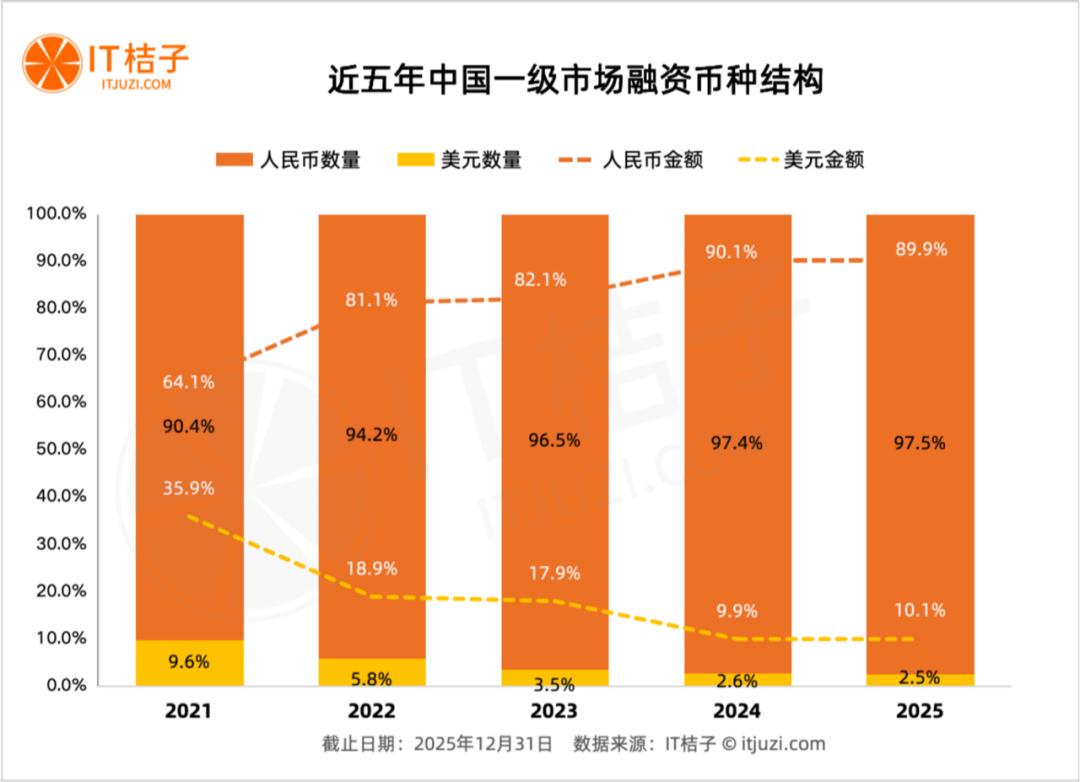
In terms of the number of transactions, the market has completely tilted towards the RMB.
In 2021, there were still 871 US dollar investment events, accounting for 9.6% of the total market; by 2025, this number had plummeted to 225, accounting for only 2.5%.
Meanwhile, the proportion of RMB investment events has climbed from 90.4% to 97.5%, almost achieving full coverage of the market.
The change in the investment amount is even more shocking.
In 2021, with an investment of 532.9 billion yuan, US dollar capital accounted for 35.9% of the market, competing with RMB funds. However, by 2025, the annual financing amount of US dollar funds was only 82.7 billion yuan, a shrinkage of more than 84%, and the market share also dropped to 10.1%.
On the contrary, the proportion of RMB funds has strongly increased from 64.1% to 89.9%, firmly grasping the absolute dominance of capital supply.
This is not a simple cyclical fluctuation but a profound structural change. Behind it is a comprehensive reconstruction of the nature of capital, investment logic, and exit paths.
Triple Factors Overlapping: Why Are US Dollar Funds No Longer Popular?
The retreat of US dollar funds is the result of the combined action of internal and external factors.
First is the switch of internal driving force: the strong rise of state - owned capital and industrial capital.
As revealed in the 2025 annual report, investment institutions with state - owned backgrounds have become the most powerful force in the market, with a direct investment penetration rate as high as 45% and dominating most large - scale strategic investments. These "national teams" and industrial giants use the RMB as ammunition, and their investment goals are more to serve national strategies, strengthen and supplement industrial chains, and integrate industries, rather than the short - term high - multiple financial returns pursued by traditional US dollar VCs.
When the core buyers in the market become RMB players, US dollar funds are naturally marginalized.
Second is the subversion of the investment path: the collapse of the traditional VC "growth ladder".
What US dollar funds are best at is to support enterprises to complete the "daring leap" from Series B/C to overseas listing. However, the current "dumbbell - shaped" market structure - active early - stage transactions, dominant strategic investments, and a financing gap in the growth stage - precisely hits the "weak point" of US dollar funds.
The shrinkage of growth - stage financing makes it impossible for VCs to pass on the baton; and after enterprises reach a certain stage of development, their demand for industrial resources (orders, scenarios) exceeds the demand for pure financial investment, and they are more inclined to accept strategic investments from RMB industrial capital.
Finally is the drastic change in the external environment: blocked exit channels and geopolitical risks.
In the past, the "VIE structure + overseas listing" was the most classic exit model for US dollar funds. However, in recent years, with the improvement of regulatory policies such as data security and anti - monopoly and the tense geopolitical situation, the uncertainty of this path has increased sharply.
The pessimistic exit expectation directly suppresses the investment willingness of US dollar funds at the front end. When the most familiar arbitrage game can no longer continue, the model of US dollar funds becomes unsustainable.
From the Leading Role to a Supporting Role: Where Is the Future of US Dollar Funds?
Facing the absolute home court of RMB funds, will US dollar funds completely disappear?
The answer may be no, but their role must change from the "leading role" at the table to a "supporting role" that provides special value.
In the future, the survival space of US dollar funds may exist in the following highly specialized niche markets:
· True Global Enablers: For Chinese enterprises aiming to become global companies, US dollar funds can still provide "going global" services that RMB funds can hardly match with their global network, overseas market knowledge, and cross - cultural management experience. This value must go beyond simple capital connection and penetrate into the actual implementation of overseas business.
· "Catalysts" in Top - Tier Hard - Tech Fields: In a few cutting - edge technology fields such as life sciences and high - end semiconductors, some top - tier US dollar funds still hold the world's most advanced technology resources, talent networks, and industry standards. They can play the role of "technology catalysts" in these fields, helping Chinese enterprises connect with the global innovation sources.
· Small but Beautiful Early - Stage "Value Discoverers": Avoid direct competition with RMB funds in the mid - and late - stages, return to the origin of VC, focus on the earlier stage, use a sharp global perspective to discover new models and new species with disruptive potential, and provide support in the startup period.
IT Juzi's observation found that well - known companies in the popular artificial intelligence and embodied intelligence tracks in the market in 2025, such as Dark Side of the Moon, Unitree Robotics, Galaxy Universal, and FeiXi Intelligence, still received initial financing from market - oriented US dollar funds.
In general, the era when US dollar funds could dominate the Chinese market by relying on capital advantages and exit - channel dividends is gone forever. In the new pattern dominated by the RMB, they must abandon the illusion of scale, re - polish their professional value, and transform from a capital provider to an irreplaceable resource connector and value enabler. This may be their only remaining position in the Chinese venture capital market.
This article is from the WeChat public account "IT Juzi" (ID: itjuzi521), author: IT Juzi, published by 36Kr with authorization.