ByteDance Enters the AI Glasses Market. Can Longcheer Technology Make a Comeback with Doubao?
While the outside world is still debating whether AI glasses with a return rate as high as 40% can be considered a good business, major Internet companies and even back - end ODM giants have placed their bets and are accelerating their entry into the market.
Tianyancha shows that on January 5th, Thunderbird Innovation, a leading AI glasses company, completed a Series D financing of over 1 billion yuan. The investment was led by China Mobile's Chain - Leader Fund and CITIC Jingshi, with participation from institutions such as Unicom's Lianchuang Innovation Fund. This is the first time that China's two major telecom operators have entered the smart glasses market through strategic investment. Li Hongwei, the founder of Thunderbird Innovation, even revealed that in the future, they may cooperate with telecom operators to offer "get glasses when you recharge your phone bill" to lower the purchase threshold for users.
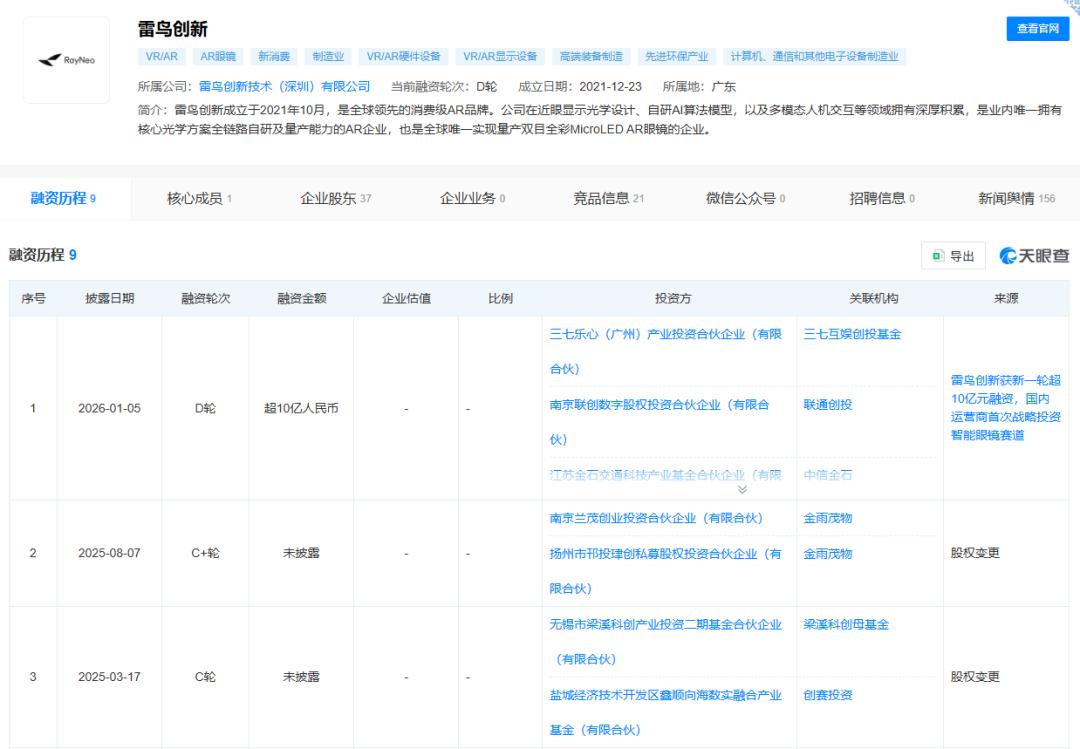
Image source: Tianyancha
Almost at the same time, some media reported that "Doubao" AI glasses under ByteDance are about to enter the shipping stage. It is reported that this product was jointly developed by ByteDance and Longcheer Technology. Longcheer is responsible for the development of the underlying UI, while ByteDance leads the development of the upper - layer apps. The R & D was carried out at Longcheer's Huizhou factory, and mass production will be handled by its Nanchang factory. After the news spread, ByteDance quickly responded, saying, "The rumor is untrue. There is currently no clear sales plan."
In the technology industry, an official "denial" is sometimes not the end of the story but may be part of business negotiations or strategic planning.
Previously, with the high - profile entry of Internet giants such as Xiaomi, Alibaba, and Baidu, rumors about ByteDance's entry into the AI glasses market had already spread widely. Therefore, rather than when ByteDance's product will be released, the outside world is more concerned about whether Longcheer Technology has really won the AI glasses order from ByteDance.
According to media reports, Longcheer Technology currently requires a minimum order quantity of 1 million units for AI glasses. This means that against the backdrop of slowing growth in its main business, Longcheer has the potential to stage a comeback with its AI glasses business.
01 A Partner Leaked "Business Secrets"
Longcheer Technology is becoming an important player in the AI glasses market. The financial reports of this consumer electronics ODM company for the first three quarters of 2025 reveal obvious changes in its business structure.
Data shows that in the first three quarters of 2025, Longcheer Technology achieved revenues of 31.332 billion yuan, a year - on - year decline of 10.28%. Its net profit attributable to the parent company increased by 17.74% year - on - year, reaching 507 million yuan. Among them, revenues in the third quarter decreased by 9.62% year - on - year, recording 11.424 billion yuan.
Looking at different business segments, in the third quarter, the smartphone business declined by 21.96% year - on - year, with revenues dropping to 7.682 billion yuan. The tablet business increased by 23.30% year - on - year, reaching 1.09 billion yuan. The AIoT product business increased by 47.17% year - on - year, achieving 2.282 billion yuan.
Obviously, the decline of the smartphone business, which is the revenue pillar, dragged down the overall performance, while the AIoT product business has become the growth engine. The rapid growth of AI glasses has been the main driving force for the revenue growth of this segment.
In addition to the slowdown in revenue growth, the gross profit margin of the main business has also been under continuous pressure.
From 2023 to 2024, the gross profit margin of Longcheer Technology's smartphone business was 8.68% and 4.92% respectively, showing a downward trend. Although the gross profit margins of tablets and AIoT products also declined, they were still significantly higher than that of the smartphone business. In 2024, the gross profit margins of these two businesses were 8.62% and 11.28% respectively.
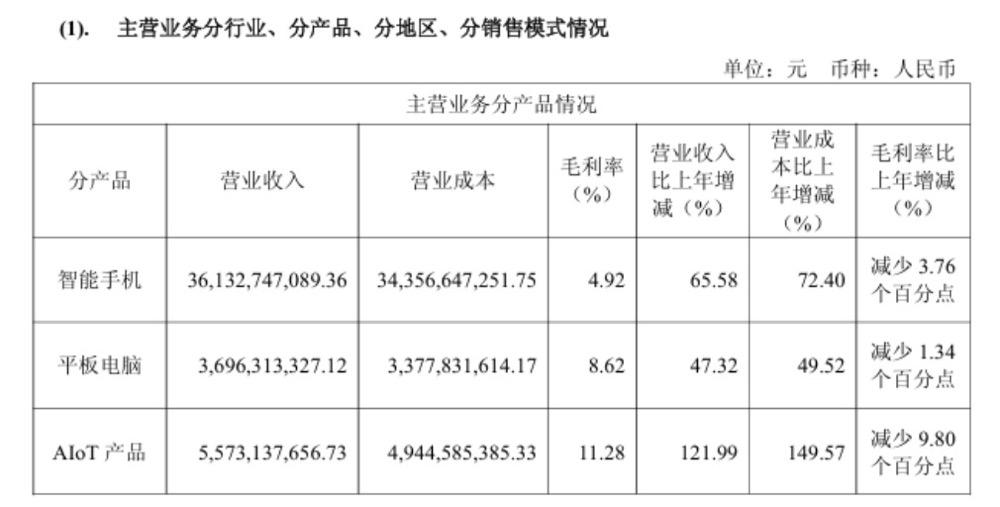
Image source: Longcheer Technology's 2024 Annual Report
Against this background, it is not difficult to understand why Longcheer Technology has turned its attention to the currently booming smart glasses market. In fact, the market has witnessed explosive growth in the past year.
Data from iiMedia Research shows that in 2025, the global sales volume and market size of smart glasses increased by 350.82% and 110.72% year - on - year respectively, reaching 13.448 million pairs and $12.58 billion. It is expected to grow to 130 million pairs and $138.73 billion by 2029. Among them, the Chinese market has shown particularly rapid growth.
In 2025, the sales volume and market size of smart glasses in China increased by 159.76% and 139.02% year - on - year respectively, reaching 3.286 million pairs and 11.21 billion yuan. It is expected to increase to 41.533 million pairs and 119.11 billion yuan by 2029.
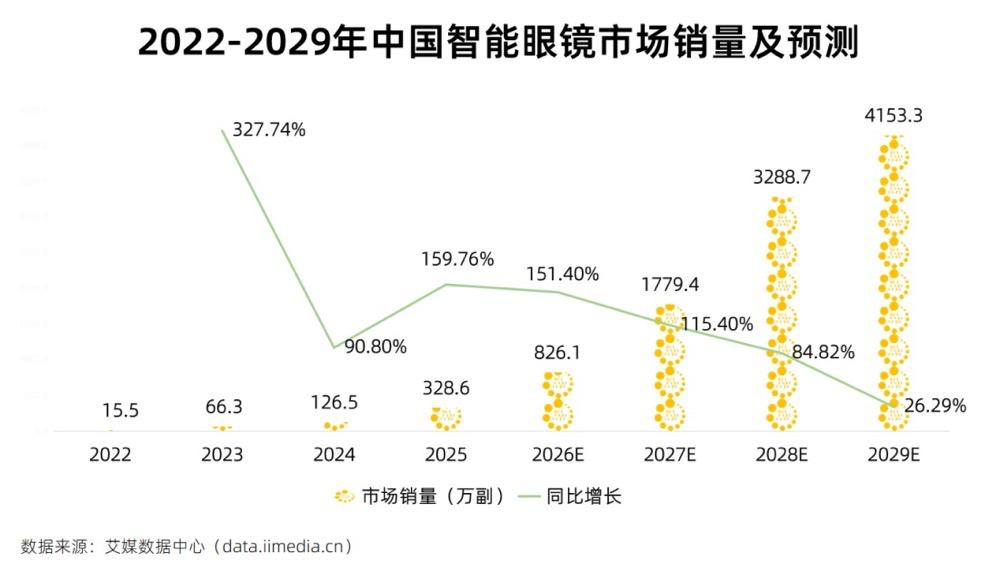
Image source: iiMedia Research
The shift in market trends has attracted many major Internet companies. In 2025, Xiaomi, Baidu, Alibaba (Quark), and even the new car - making force Li Auto successively launched their own AI glasses products, competing for the new entrance to the future smart terminal.
As an ODM giant, Longcheer Technology naturally doesn't want to miss out on this opportunity. The company has formed a clear strategy for its layout in the smart glasses field: deeply penetrate the supply chain of international leading customers, implement businesses such as charging cases and charging bases, and add a new category of children's glasses.
At the same time, the company is carrying out technological breakthroughs around the core areas of AI glasses, focusing on key technologies such as human - factors engineering, battery life, lightweight design, miniaturization of imaging hardware, and algorithms, and is also promoting the pre - research of N + 1 generation products. This forward - looking technological reserve has laid the foundation for it to undertake high - end AI glasses projects.
Therefore, it is not surprising that Longcheer Technology can undertake ByteDance's AI glasses business. It also mentioned in its semi - annual report in 2025 that "the company has newly undertaken the mass - production project of AI glasses for a leading domestic Internet customer and is gradually building the manufacturing capacity for smart glasses."
Is ByteDance the "leading domestic Internet customer" mentioned above? Yuanmeihui once asked Longcheer Technology for verification but received no response. Although there is no direct evidence, another company suspected to be a supplier of ByteDance's AI glasses, Huilun Crystal, may indirectly confirm their cooperation relationship.
On January 6th, regarding the Doubao AI glasses, Huilun Crystal issued a statement saying, "The crystal oscillators used in ByteDance's AI glasses come from Huilun Crystal. As the exclusive domestic supplier of crystal oscillators, we have formed a close ecological cooperation with ByteDance and Longcheer."
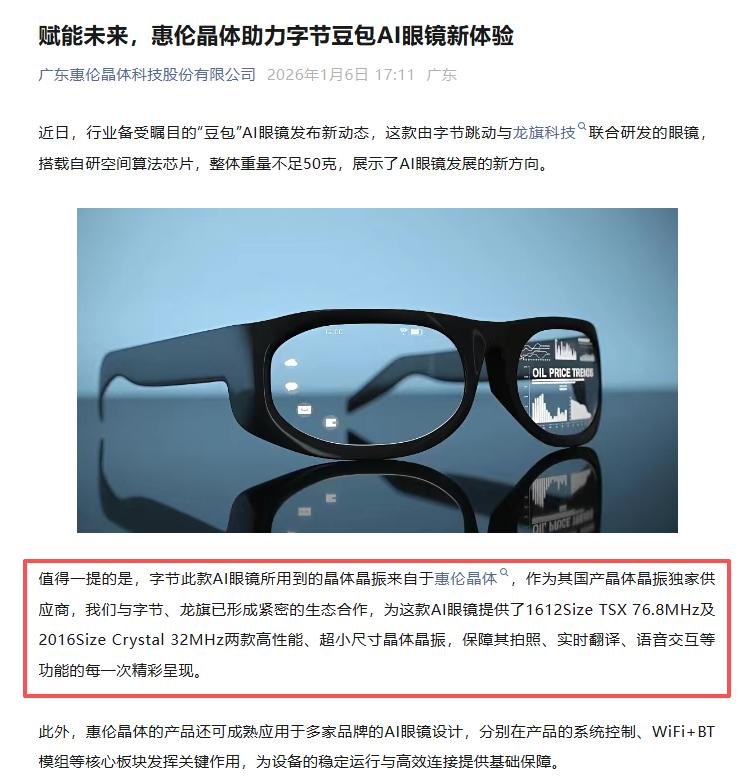
Image source: Huilun Crystal's official tweet
After the news that Longcheer Technology will manufacture ByteDance's AI glasses spread, its stock price hit the daily limit on January 5th and continued to rise in the following two trading days. As of the close on January 8th, it closed at 48.66 yuan per share, with a daily increase of 1.38% and a market value of 22.886 billion yuan.
02 A Contract Manufacturing Giant Turns to the "Next iPhone"
Longcheer Technology is not the only manufacturing giant betting on AI glasses. A full - scale competition among contract manufacturing companies has quietly begun in this new market.
Apple supply chain giants are flocking to the AI glasses market, and each has a signature cooperation partner. For example, Luxshare Precision provides in - depth ODM R & D and manufacturing support for Alibaba's Quark AI Glasses S1 series. After the product was launched, it was "sold out as soon as it was put on the shelves," and Luxshare led the production capacity ramp - up.
In addition, Luxshare Precision has set up dedicated optical factories in Wuxi and Kunshan to support the mass production of lightweight waveguide lenses with fully automated production lines and provides core component manufacturing for the Project Aura of XREAL's cooperation with Google.
Lens Technology, leveraging its accumulation in glass, ceramics, metals, composite materials and other fields, has transformed from a "structural component supplier" to an "AI edge - side hardware co - creator" and has become a core promoter of the lightweight design and overall assembly of AI glasses.
Different from Luxshare Precision, Lens Technology adopts the "equity + industrial fund" model and has a deep cooperation with AI glasses company Rokid. They jointly launched the Rokid AI glasses with a total weight of only 49 grams, achieving a wearing experience close to that of ordinary glasses. Based on the excellent past sales performance of the glasses products, Rokid has set a shipment target of 1 million units in 2026. As the exclusive supplier, Lens Technology will naturally benefit from it.
At the same time, Lens Technology is also cooperating with several leading domestic and international customers to develop multiple AI edge - side hardware products such as AI glasses, smart watches, and smart rings, covering the full - chain capabilities from structural components, modules to overall assembly.
Goertek Inc. has established a systematic advantage relying on its full - link closed - loop capabilities in "optics - acoustics - structure - manufacturing". It provides exclusive contract manufacturing for Li Auto's Livis AI glasses, participates in the production and manufacturing of Xiaomi's AI glasses, and provides one - stop solutions from optical components to the whole machine. It also provides contract manufacturing services for Meta's first AI glasses with a display screen and multiple AR glasses of XREAL.
It is worth noting that Longcheer Technology's old rival, Huaqin Technology, is also actively deploying in the smart wearables field. It is reported that Huaqin Technology has become the contract manufacturer for Meta's "AR watch". This device uses electromyography technology to achieve precise control of AR glasses by monitoring the electrical signal changes of the wrist muscle group, representing the cutting - edge exploration of the next - generation interaction method.
Behind the collective shift of these contract manufacturing giants is the pursuit of the "next iPhone". Against the backdrop of the slowdown in smartphone growth, AI glasses are regarded as the next trillion - level market in the consumer electronics industry.
03 When Will the "Impossible Triangle" Be Overcome?
Although the AI glasses industry is growing rapidly, it still faces many challenges. The core problem in the development of current smart glasses is the "impossible triangle" - it is difficult to balance performance, weight, and battery life at the same time.
Currently, although waveguide and micro - display technologies are relatively mature, the image quality they can provide still falls short of users' ultimate expectations. In terms of display technology, the industry has not fully solved the problem of dizziness caused by wearing smart glasses. Since 3D images rely on binocular parallax, and the depth of optical imaging is fixed, the mismatch between parallax and depth will cause dizziness.
Industry experts generally believe that the smart glasses industry is still in the early stage of development. Some even point out that for smart glasses to truly become the mainstream entrance, they need to go through at least one round of in - depth technological and industrial iterations, which is expected to take 5 to 10 years of development and accumulation.
This pessimistic expectation is not unfounded. User data can best reflect the problem. According to data cited by industry media, the return rate of AI glasses on JD.com and Tmall platforms is about 30%, and it is as high as 40% - 50% on the Douyin platform, far higher than that of ordinary consumer electronics products, exposing the fundamental defects in product experience.
User feedback mainly focuses on several core pain points: uncomfortable wearing - it presses on the nose bridge, and the discomfort becomes obvious after wearing for more than an hour; strong functional substitutability - taking pictures is not as good as using a mobile phone, and the sound quality is not as good as that of professional headphones; difficult after - sales maintenance - the lenses and temples are easily damaged, and the repair is complicated.
The root cause of these pain points is the aforementioned "impossible triangle". Manufacturers often have to make trade - offs among the three: pursuing lightweight design may sacrifice battery capacity, resulting in shorter battery life; enhancing display functions, such as using full - color display, will increase the weight.
Despite this, the market still has high expectations for the future of AI glasses.
Whether Longcheer Technology can recreate the glory of its smartphone business with its AI glasses business depends on whether it can help its cooperation partners cross the gap from "technological novelty" to "daily necessity". This is also the core of whether smart glasses can fulfill the promise of the "next - generation super terminal".
This article is from the WeChat public account "Yuanmeihui", author: Xie Chunsheng, editor: Su Huai. Republished by 36Kr with authorization.