Is there a trend of "state advancement and private retreat" in the primary market? The direct investment penetration rate of state-owned investment entities has reached 45%.
In the past five years, China's primary market has undergone profound structural changes.
The latest data from IT Juzi shows that the penetration rate of state-owned institutions in the primary market has steadily climbed from 35.46% in 2021 to 44.55% in 2025, an increase of 9.09 percentage points.
This means that for every 10 primary market investment transactions in China today, more than 4 have the involvement of state-owned institutions.
This figure marks that China's venture capital market has officially entered the "national team era" - state-owned capital is no longer a supplementary force in the market, but a dominant participant.
What are "state-owned institutions"?
Before discussing the penetration rate of state-owned capital, it is necessary to clarify the definition and scope of "state-owned institutions" by IT Juzi.
In terms of definition, state-owned institutions refer to investment institutions directly or indirectly controlled by government departments, state-owned enterprises, public institutions, or other state-owned capital.
In terms of scope, the state-owned institutions counted in this article mainly include two major categories:
The first category is government-guided funds. This is the most typical state-owned investment entity, including national industrial funds and local government-guided funds. For example, the National Integrated Circuit Industry Investment Fund, Beijing Guanguan, Shenzhen Capital Group, Guangzhou Fund, etc.
The second category is the investment platforms of state-owned enterprises/central enterprises. Industrial investment funds or corporate venture capital (CVC) established by central enterprises and local state-owned enterprises, such as China Mobile Innovation Fund, Shangqi Capital, China Merchants Capital, CITIC Capital, etc.
It should be noted specifically that there is another type of institution in the market - they are managed by private teams, but state-owned capital participates as LPs (limited partners) in the funds they manage. There are quite a number of such leading market-oriented institutions. In the statistics of this article, these institutions are still regarded as market-oriented institutions and are not within the statistical scope of "state-owned institutions" in this article.
The 44.55% penetration rate of state-owned capital mentioned in this article only includes the above first and second categories - that is, the investment entities directly controlled or actually controlled by state-owned capital.
These two types of institutions together form a huge "national team" lineup in the primary market. Currently, in the IT Juzi database (itjuzi.com), there are 1,609 state-owned institutions in China.
Breaking through 40%: The critical point from quantitative to qualitative change
In terms of absolute numbers, the number of investment events by state-owned institutions has shown unique resilience in the past five years.
In 2021, state-owned institutions participated in 3,211 transactions; during the market downturn from 2022 to 2023, although the absolute number declined (3,021 and 2,852 respectively), the decline was significantly smaller than that of the overall market.
In 2024, it slightly rebounded to 3,068 transactions, and in 2025, it increased significantly to 4,035 transactions, reaching a five-year high.
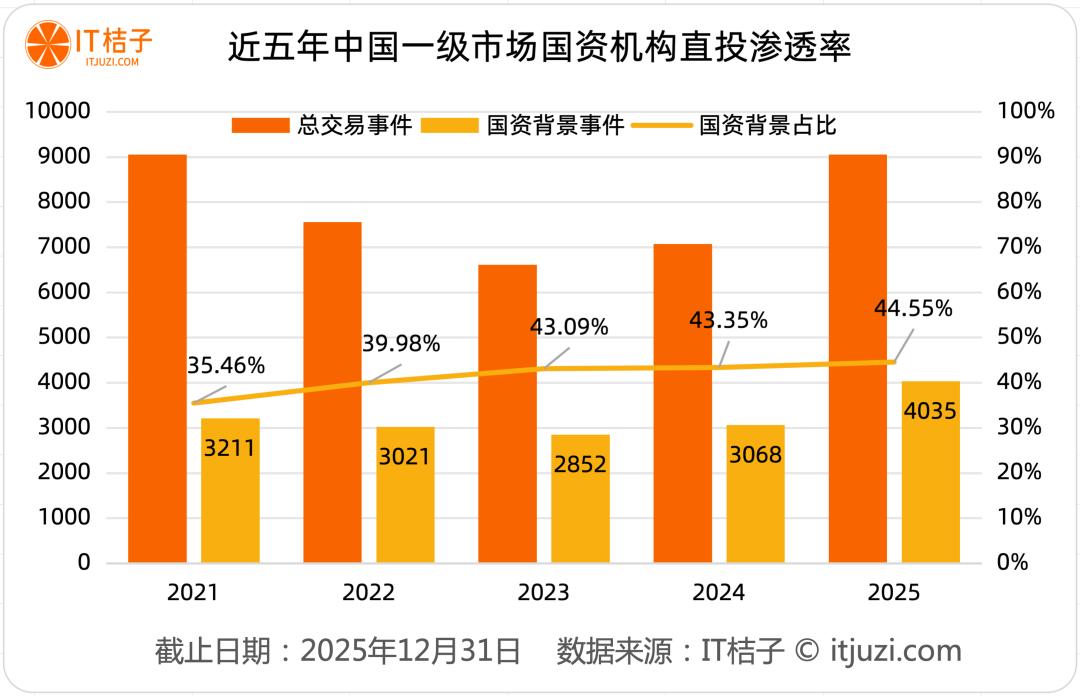
What is even more noteworthy is the changing curve of the penetration rate.
Even during the "winter period" from 2022 to 2023 when the total market trading volume declined significantly, the penetration rate of state-owned capital increased instead of decreasing, jumping from 35.46% in 2021 to 39.98% in 2022 and further reaching 43.09% in 2023.
When private capital retreated due to market uncertainties, state-owned institutions increased their investment efforts instead, playing the role of a "ballast stone".
From 2023 to 2025, the penetration rate of state-owned capital remained steadily above 43%, and in 2025, it reached a record high of 44.55%.
In the investment market, 40% is usually regarded as the critical line for the transformation from an "important participant" to a "dominant force".
When the market share of a certain type of investment entity exceeds this proportion, its decision-making logic will profoundly affect the pricing mechanism, transaction structure, and resource allocation mode of the entire market.
This indicates that the dominant position of state-owned capital in the market is a structural and long-term trend.
Market structure reshaping: Three major transformations are taking place
Transformation of investment decision-making logic
The investment decisions of state-owned institutions pay more attention to strategic orientation, the matching degree of industrial policies, and long-term value creation. When the penetration rate of state-owned capital approaches half, the market's valuation system, transaction terms, and exit paths are quietly changing.
In fields such as hard technology, advanced manufacturing, and new energy that conform to the national strategic direction, the valuation support is more solid; while for pure consumer Internet and model innovation projects, they face greater financing pressure. The "baton" of the market is shifting from "traffic" and "number of users" to "technological barriers" and "industrial value".
Transformation of entrepreneurs' financing strategies
For entrepreneurs, the increase in the penetration rate of state-owned capital means that financing strategies must be adjusted. Whether it conforms to the orientation of industrial policies and whether it can be recognized by state-owned institutions are becoming the key factors for the success of financing.
More and more startups are actively connecting with state-owned investment institutions during early-stage financing, and even considering how to align with local industrial policies and national strategic directions when planning their businesses.
Transformation of the market competition pattern
Private VC/PE institutions are facing a new competitive environment. State-owned institutions have natural advantages in terms of capital scale, risk tolerance, and resource integration ability; private institutions still have unique value in terms of decision-making efficiency, market sensitivity, and professional ability.
The future market pattern is likely to be a dual-track model of "state-owned capital leading + private capital supplementing": state-owned institutions will lead large-scale investments, strategic investments, and industrial integration, while private institutions will give full play to their expertise in early-stage investments, niche fields, and exploration of innovative models.
According to the current growth trend, it is not impossible for the penetration rate of state-owned capital to exceed 50% in the next 2 - 3 years. By then, China's primary market will truly enter a new stage of "state-owned capital as the mainstay and private capital as the supplement".
This transformation brings both opportunities and challenges.
The opportunity lies in that the stability and long-term nature of state-owned capital can provide more solid financial support for innovation and entrepreneurship and reduce the volatility of the market; the challenge lies in how to maintain market vitality, stimulate the innovation drive of private capital, and balance strategic orientation and market efficiency.
The data clearly tells us:
State-owned capital is no longer a "supporting role" in the primary market, but a well-deserved "leading role". Understanding this trend and adapting to this change will be a reality that all market participants - whether entrepreneurs, investors, or policy-makers - must face in the future.
This article is from the WeChat public account "IT Juzi" (ID: itjuzi521), author: IT Juzi, published by 36Kr with authorization.