The new era of AI is the integration with the physical world, A review of the year 2025
Today's AI products are all "trapped" within the screens. AI devices that interact with the physical world, such as smart glasses, headphones, and other wearables, are all trying to overcome the difficulties in human - AI interaction, aiming to free people from the constraints of inputting and reading information on the screen.
AI is for humans, and the era when humans accommodate AI will surely become history.
This is especially true in the field of embodied intelligence. After solving the problems related to slow and clumsy movements, embodied intelligence still seems confused and fails to understand the physical world of humans.
By following the clues and conducting a review of the most actively - financed physical AI companies in the United States in 2025, and comprehensively considering the progress of investment and startup projects, we have identified three major deficiencies: AI operating systems that empower smart hardware, embodied intelligence data that restricts the development of world models, and the well - known "world model".
Hardware serves as the carrier, data is the raw material, and the model is the soul. With the combination of hardware and software and the wide - ranging empowerment of operating systems, AI - native hardware has great potential to impact the physical world.
Our view is that the industrial revolution spurred by AI has just begun.
Review of Investments: A Year of Rapid Growth
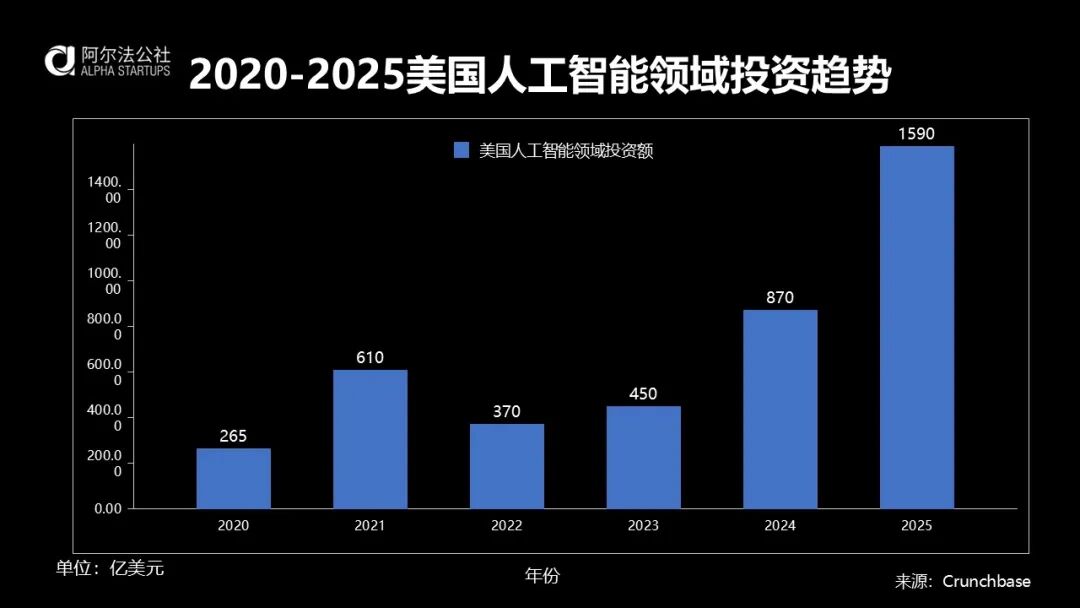
Investment trends in the AI field in the United States from 2020 to 2025. The data for 2025 is up to December 15th.
According to Crunchbase statistics, the cumulative venture capital investment in the AI field in the United States in 2024 was $87 billion. As of December 15th, 2025, the venture capital investment in the AI field in the United States was $159 billion.
The "physical AI" represented by embodied intelligence is a highlight. Crunchbase statistics show that in the first 11 months of 2024, robot - related startups raised $6.4 billion in financing. In the first 11 months of 2025, the cumulative financing in this sector exceeded $10.3 billion, $3.9 billion higher than the same period last year, with a year - on - year growth rate of 60.9%.
In the "physical AI" field, several landmark large - scale financings occurred in 2025: Figure completed a $1 billion Series C financing, and its post - investment valuation rose to $39 billion. FieldAI raised $314 million in financing, and its valuation increased to $2 billion. Oura Ring received over $900 million in Series E financing, and its valuation reached $11 billion.
According to World Bank data, the digital economy only accounts for 15% of the global GDP, and the remaining 85% of the GDP contribution comes from real - world industries that directly interact with the physical world. The share of AI in this field is still very low.
We have sorted out the companies with relatively large financing amounts and representative products in 2025 and classified them into categories such as embodied intelligence, AI wearables, industrial AI, and computing power infrastructure.
Embodied Intelligence
In the field of embodied intelligence, overseas startups have formed a first - tier group consisting of Physical Intelligence, FieldAI, Skild AI, Figure, etc. Several companies have received several rounds of financing with a single - round financing amount of over $100 million within a year.
Most of them are exploring general embodied intelligence models and looking for the Scaling Law of embodied intelligence, and they have achieved initial results. However, the paradigm of general embodied intelligence models has not yet converged. Some companies focus their models on complex operations, some on cross - hardware generalization ability, and others on adapting to unstructured environments.
Figure
Financing situation: In 2025, it received a $1 billion Series C financing led by Parkway Venture Capital, with participation from NVIDIA, Intel Capital, Qualcomm Ventures, LG Technology Ventures, etc. Its post - investment valuation reached $39 billion.
Official website: www.figure.ai
It was founded by serial entrepreneur Brett Adcock and brings together experts from top - tier institutions such as Boston Dynamics, Tesla, and Google DeepMind.
Figure adopts a vertical integration strategy of hardware and software to build high barriers: it independently develops and iterates the robot body and the general VLA model system Helix (using the "System 1 + System 2" architecture and end - to - end training). The company has also established the BotQ factory, hoping to achieve a self - replicating production model of "robots manufacturing robots".
Physical Intelligence
Financing situation: It received a $600 million Series B financing led by CapitalG. Existing investors Lux Capital, Thrive Capital, and Jeff Bezos all increased their investments, and new investors Index Ventures and T. Rowe Price participated in this round of financing. Its post - investment valuation is $5.6 billion.
In 2025, Physical Intelligence released the embodied intelligence foundation model π 0.5, which enables robots to directly perform tasks in a brand - new environment without prior training in that environment. It also allows robots to perform complex operations with low latency and high precision.
Generalist
Financing situation: Early investors include institutions such as Spark Capital, NVIDIA, Boldstart Ventures, Bezos Expeditions, and NFDG. The specific financing amount is not disclosed.
Official website: https://generalistai.com/
It was founded by former Google DeepMind senior research scientist Pete Florence (who led the development of PaLM - E and RT - 2). In 2025, it released the new embodied foundation model GEN - 0, which is trained based on 270,000 hours of real - world physical interaction data. This model uses a "harmonious reasoning" architecture to achieve real - time responses and has preliminarily verified the Scaling Law of embodied intelligence during training, that is, the intelligence of the model undergoes a qualitative leap as the scale of data and parameters increases.
Skild AI
Financing situation: In June 2025, it received a $135 million Series B financing with participation from NVIDIA, SoftBank, and Samsung. Its post - investment valuation is $4.4 billion. The latest report indicates that it is in talks with SoftBank and NVIDIA for an investment of over $1 billion, and its post - investment valuation may reach $14 billion.
Official website: www.skild.ai
It was founded by former CMU professor and Meta/FAIR researcher Deepak Pathak and Abhinav Gupta and is committed to building a general foundation model for robots. This model is trained with a massive amount of data that is 1000 times more than that of its competitors, has strong cross - hardware generalization ability, can be adapted to various forms of robots such as quadruped and humanoid robots, and can migrate between different tasks while showing "emergent behaviors".
Apptronik
Financing situation: The total financing amount within a year exceeded $1 billion. In February 2025, it received a $350 million Series A financing jointly led by B Capital and Capital Factory, with participation from Google. In March, it received additional financing with participation from Mercedes - Benz and ARK Invest, and the total amount of Series A financing reached $403 million. It is reported that it recently received a Series B financing of $560 million to $660 million led by B Capital, and its post - investment valuation is approximately $5.47 billion.
Official website: https://apptronik.com/
Apptronik was founded by a team spun off from the Human - Centered Robotics Lab at UT Austin and focuses on the research and development of high - performance general - purpose robot bodies. Its ninth - generation model, Apollo, uses a modular design (can be adapted to bipedal, wheeled, etc.) and aims to reduce the price to below $50,000. The "brain" of this robot is supported by models provided by Google DeepMind and NVIDIA, and the core computing is equipped with the NVIDIA Jetson module. It aims to achieve commercial production in 2026 through a low - cost general - purpose platform model (similar to smartphones) or the RaaS model.
FieldAI
Financing situation: In 2025, it completed two rounds of financing totaling $405 million. The list of investors is impressive, including Bezos Expeditions, BHP Ventures, Canaan Partners, Emerson Collective, Intel Capital, Khosla Ventures, NVIDIA, Prysm, and Temasek, etc. Early investors also include Gates Frontier and Samsung.
Official website: www.fieldai.com
It was founded by former NASA JPL senior expert Ali Agha (the team brings together experts from institutions such as DeepMind, Google Brain, Tesla Autopilot, and SpaceX) and is committed to developing a general - purpose robot "brain".
Its core is the "physics - first" Field Foundation Models (FFMs). Different from traditional language or vision models, this model is specifically designed to deal with the risks and uncertainties in the physical world. It can be adapted to various forms such as quadruped, humanoid, wheeled, and manned vehicles, and supports robots to perform real - time and safe autonomous operations in unstructured environments without pre - mapped maps. It has been actually deployed in hundreds of complex industrial scenarios.
The Bot Company
Financing situation: In 2025, it received a $150 million financing led by Greenoaks. The latest report shows that it is planning to raise a new round of financing of $250 million, and its post - investment valuation is expected to exceed $4 billion.
Official website: www.bot.co
It was founded by former Cruise co - founder and CEO Kyle Vogt, former Tesla AI technology leader Paril Jain, etc. and is committed to developing general - purpose robots for household scenarios. It aims to solve the trivial matters that consume human time and energy through automation and create "useful robots" that can truly enter every household, thus completely changing people's lifestyles.
Dyna Robotics
Financing situation: In March 2025, it received a $23.5 million seed - round financing jointly led by CRV and First Round Capital. Recently, it completed a $120 million Series A financing led by Robostrategy, CRV, and First Round Capital, with participation from Salesforce Ventures, NVentures, Amazon Industrial Innovation Fund, Samsung Next, and LG Technology Ventures, etc.
Official website: www.dyna.co
It was founded by serial entrepreneurs Lindon Gao and York Yang together with former DeepMind research scientist Jason Ma. It is committed to building a commercially viable general embodied AI. Its first commercial foundation model, DYNA - 1, has been deployed in real - world scenarios such as hotels and restaurants. This model uses fixed robotic arms to perform delicate tasks such as folding napkins and food packaging, and achieves a success rate of over 99% and 24 - hour unattended operation with a unique engineering reward model.
Tacta Systems
Financing situation: Recently, it received a $75 million financing, including an undisclosed $11 million seed - round financing led by Matter Venture Partners and a $64 million Series A financing jointly led by America’s Frontier Fund and SBVA, with participation from Matter Venture Partners, B Capital, Singapore Economic Development Board Investments, Woven Capital, etc.
Official website: www.tactasystems.com
It was founded by former Apple hardware team leader Andreas Bibl and is committed to solving the problem of "lack of tactile sense" in industrial robots. The company adopts a full - stack self - research and vertical integration strategy to develop a "dexterous intelligence" platform that includes cloud models, customized edge AI chips, and tactile sensor arrays. By building a unique "tactile intelligence layer", it upgrades the hardware and software of existing robotic arms, enabling them to have precise perception and manipulation capabilities comparable to humans, thus being able to handle delicate tasks such as electronic assembly and food processing that traditional robots cannot complete.
Smart Wearables
Smart wearables are still in the early stages, but they have great potential. The fact that startups are still exploring their hardware forms, interaction interfaces, and interaction methods, and there is no convergence in these aspects, proves their early - stage status.
Their great potential is manifested in the fact that even without a converged form and general - purpose device (such as a mobile phone), there is still a huge market just based on vertical - market applications (Oura Ring has sold 5.5 million units, and its valuation is $11 billion).
Oura
Financing situation: In the second half of 2025, it completed a $900 million financing led by Fidelity Management, with participation from new investor ICONIQ and existing investors Whale Rock and Atreides. Its post - investment valuation is approximately $11 billion.
Official website: https://ouraring.com/
Oura has obtained over 80% of the global smart ring market share, and its sales have exceeded 5.5 million units. The latest product, Oura Ring 4, is equipped with upgraded Smart Sensing technology, which significantly improves the accuracy of data such as blood oxygen and heart rate. The monitoring scope covers sleep, activity level, readiness, heart health, stress, female health, and metabolism.
The core of its software is the AI function Oura Advisor, which can deeply interpret data trends, provide proactive health advice, and formulate action plans. At the same time, it explores cutting - edge functions such as the "symptom radar" through Oura Labs, aiming to shift from passive monitoring to proactive health management.
Sesame
Financing situation: In February 2025, it received early - stage financing from Andreessen Horowitz, Spark Capital, and Matrix Partners. In October, it completed a $250 million Series B financing jointly led by Sequoia Capital and Spark Capital.
Official website: www.sesame.com
It was founded by Oculus co - founder Brendan Iribe and former Ubiquity6 co - founder Ankit Kumar. Sesame is committed to creating the next - generation smart hardware interaction method. Its core technology is the Conversational Speech Model (CSM), an end - to - end multimodal model that can understand both text and voice emotions simultaneously. Sesame has used it to create AI voice assistants Maya and Miles with "voice presence". To support this interaction interface, Sesame is developing a pair of AI smart glasses designed for all - day wear, hoping to provide a natural conversation experience like communicating with a real person through the combination of hardware and software.
Sandbar
Financing situation: It received a $13 million financing from True Ventures, Upfront Ventures, Betaworks, etc.
Official website: www.sandbar.com
It was founded by Mina Fahmi and Kirak Hong, who have engaged in the research and development of neural interfaces and smart hardware at institutions such as CTRL - Labs (acquired by Meta), Kernel, Magic Leap, and Google.
Sandbar has created a smart ring called Stream Ring, aiming to become the user's "second brain". Different from the health - focused Oura Ring, Stream Ring is an instant inspiration capture and creative assistance tool that uses a low - friction interaction method of "voice mouse" (voice + touch), allowing users to record ideas, manage notes, and control media through soft whispers in an unobtrusive way.
Industrial AI
Physical AI has also deeply penetrated into the industrial field. The core keyword in this field is autonomy. For example, Bedrock enables construction machinery to operate autonomously around the clock by installing a low - cost hardware - software combination kit, and Point One Navigation provides centimeter - level positioning capabilities for physical AI. Jeff Bezos has even personally entered the game, raising $6.2 billion to build the industrial AI startup Project Prometheus.
Bedrock Robotics
Financing situation: In July 2025, it received an $80 million Series A financing led by 8VC, with participation from institutions such as Eclipse, Two Sigma Ventures, Valor Equity Partners, NVentures, Crossbeam Venture Partners, Al Rajhi Partners