Behind Elon Musk's mass production of brain-computer interfaces: A misinterpreted "Industrial Internet of Things" human-machine interaction revolution
At the beginning of the new year, the tech circle was once again set ablaze by a statement from Elon Musk: Neuralink announced the official launch of the mass - production process for "fully automated puncture" surgeries and promised to bring the surgical cost down to an extremely low price range.
Those robotic arms that could only be seen in science - fiction movies may soon start implanting electrodes into the human brain with micron - level precision in a standardized manner. It seems that overnight, we've taken one more step closer to that cyberpunk world.
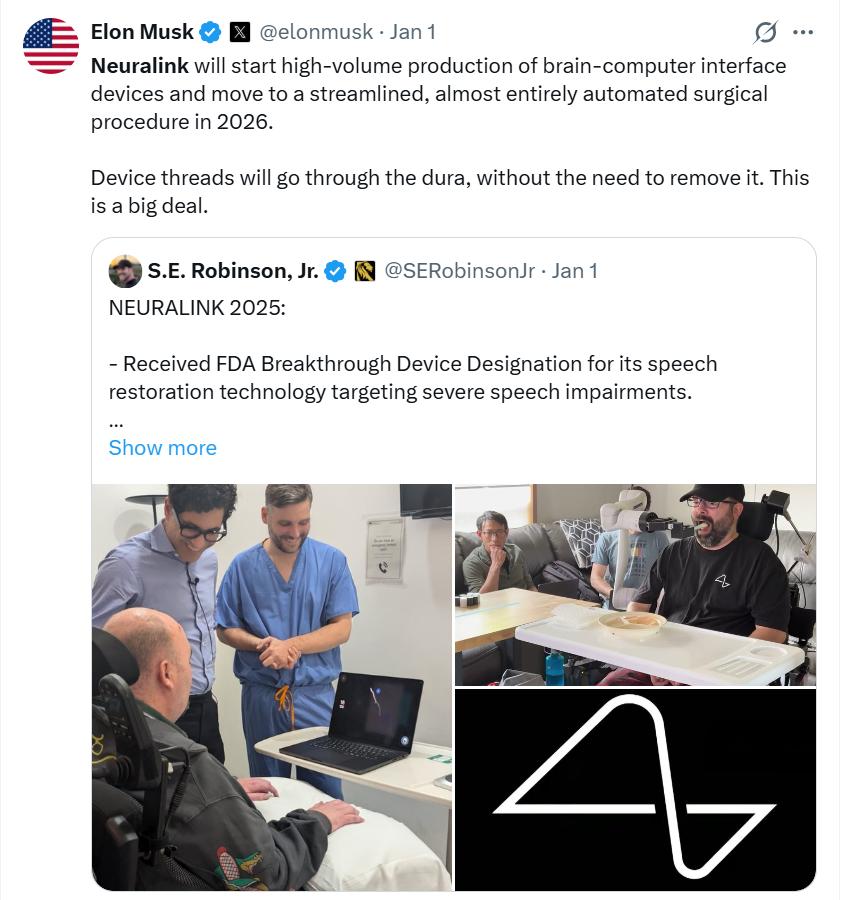
Both the capital market and the mass media are reveling in the medical myths of "paralyzed people standing up again" or "blind people regaining their sight". However, in the eyes of us Internet of Things (IoT) practitioners, the underlying logic of this news is entirely different. What we see is not a heart - warming narrative of medical rehabilitation, but a change in the "bandwidth" between humans and machines.
Over the past two decades, the IoT has connected everything, from huge industrial boilers to tiny temperature and humidity sensors, but it has never been able to efficiently connect the most complex intelligent terminal on this planet - humans.
For a long time, humans have been isolated from the digital closed - loop, communicating with machines through inefficient keyboards, touchscreens, or voice commands. This inequality in information transmission rate has become a bottleneck restricting the digital transformation of the industry.
Therefore, the Brain - Computer Interface (BCI) is by no means just a new type of medical device. It is the long - awaited "high - bandwidth modem" for the IoT.
With the development of the BCI, a new realm of imagination may be opened up: The Brain - Computer Internet of Things, also known as the Internet of Intentions.
At this stage, it's necessary for us to look beyond the scope of smart healthcare and the bubble of consumer - oriented metaverse games, and turn our attention to a more hardcore battlefield: the Industrial Internet of Things. Here, the BCI is not for entertainment, but for survival and efficiency.
Solving the Problem: From "Command Interaction" to "Intention Symbiosis"
The current human - machine interaction model in the industrial field has reached its limit.
In a highly automated lights - out factory, the decision - making and response speed of machines is calculated in microseconds, while human operators are still giving commands by clicking the mouse, pressing buttons, or pushing and pulling joysticks. This millisecond - level or even second - level delay is difficult to match the speed of machines. To solve this contradiction, we need to completely rethink the relationship between humans and machines.
Therefore, in the future Industrial Internet of Things architecture, the BCI may transform "humans" into a "biological edge node" of the IoT.
In the past, in the topology of the IoT, humans were "users" and observers outside the control loop. However, after the introduction of industrial - grade BCI, the brains of workers wearing the devices actually become a biological node with extremely high computing power in the network, achieving "cognitive adaptive automation".
Imagine a typical industrial scenario: In a traditional automation system, when a machine breaks down or gives an alarm, the system will stop and wait for workers to handle it. In a system integrated with brain - sensing technology, the Brain - Computer Internet of Things will process the brain signals of workers in real - time.
The Blue Book "Research Report on Brain - Computer Interface Technology and Applications" released by the China Academy of Information and Communications Technology in 2025 elaborated in detail on the technical paths of "brain sensing" and "brain regulation", which will gradually become a reality.
If the system detects that the operator is in a state of "cognitive overload" or "extreme fatigue", the industrial control algorithm will automatically intervene, actively reducing the operating speed of the production line or simplifying the display information on the dashboard, only retaining the most critical data. At this time, the BCI is no longer simply "controlling machines with thoughts", but making the physiological state of humans a real - time variable in the factory control algorithm.
This will fill a huge gap in the field of industrial safety.
For a long time, we could monitor the vibration, temperature, and voltage of equipment, but we couldn't quantify the state of humans. Now, the introduction of this "biological edge node" enables machines to understand human intuition. For example, Tsinghua University has in - depth research in the field of BCI, especially making progress in the multi - modal decoding neural network of cortical signals and the millisecond - level optimization of feedback delay, striving to achieve faster and more accurate intention recognition. In the future, special equipment operators may no longer need cumbersome exams and training because machines can directly understand their operation intentions and predict and avoid risks through fluctuations in neural signals before they even realize the danger.
This is the real face of the BCI in the industrial field: It's not about making workers superhuman, but about making machines understand humans better, achieving a qualitative change from "command interaction" to "intention symbiosis".
Blue Ocean: "Long - Tail Non - Standard Action" Scenarios
Meanwhile, when we turn our attention to more complex industrial sites, we'll find a seriously underestimated fact: The BCI is the only low - cost solution to the "long - tail scenarios" of robots.
Current embodied intelligence, such as Tesla's Optimus, is almost perfect in handling 90% of standard actions. However, when it comes to grabbing an irregular part on a chaotic construction site or tightening a rusty screw in an undersea pipe gallery, these remaining 10% of long - tail non - standard actions are an insurmountable obstacle for simple AI training.
A brand - new industrial collaboration model may emerge here: "Intention - based operation".
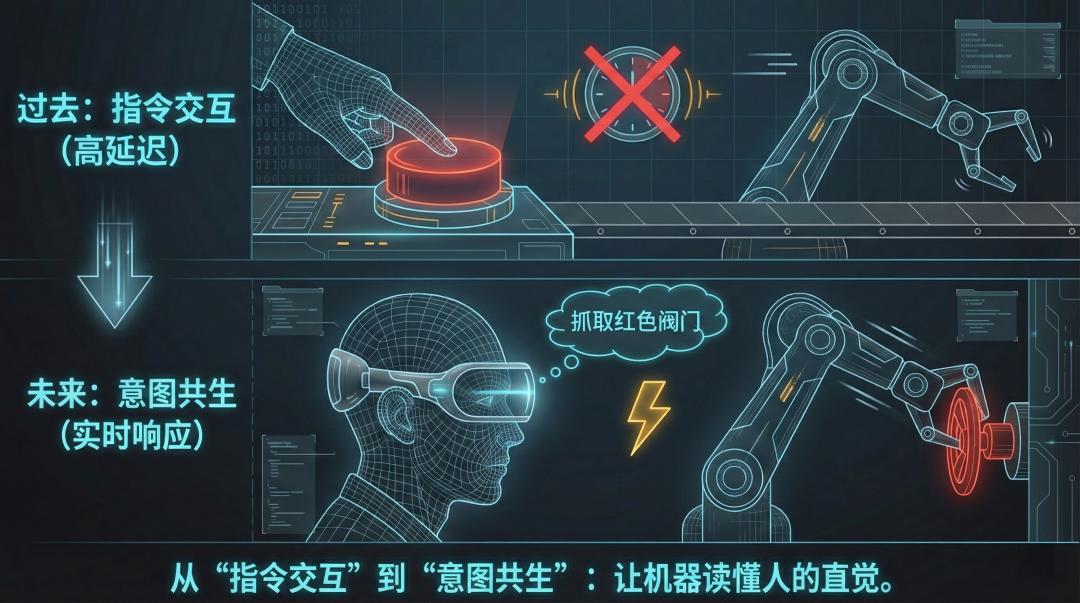
Traditional remote control relies on joysticks or data gloves, which have high latency and lack force feedback. Training a qualified tower crane or surgical robot operator is extremely costly. In the future, using BCI to extract "motor intentions" and combining it with AI's "shared control" may reshape high - risk work sites.
In this model, workers don't need to precisely control every joint angle of the robotic arm. They just need to think: "Grab that red valve." After the BCI captures this intention, the AI algorithm at the edge will immediately take over, responsible for calculating the precise movement trajectory and grasping force. This is a perfect distribution of computing power: humans are responsible for high - dimensional "decision - making and intuition", and machines are responsible for low - dimensional "execution and precision".
This transformation may first take place in high - risk and high - precision fields such as nuclear power plant maintenance, deep - sea operations, and high - altitude tower cranes.
A deeper commercial value lies in data. The biggest bottleneck for current embodied intelligence is the lack of high - quality training data. The reaction data of the cerebral cortex of skilled workers wearing BCI when dealing with complex faults may be precious materials for training the next - generation humanoid robots.
Avoiding Pitfalls: The Cruel Choice of Technical Routes
Facing such an attractive prospect, how should IoT enterprises enter the market?
Maybe we need to abandon our obsession with invasive "physical connections" and shift from "electrode contact" to "optical/field energy sensing". This is the real standard interface for the industrial - grade Brain - Computer Internet of Things.
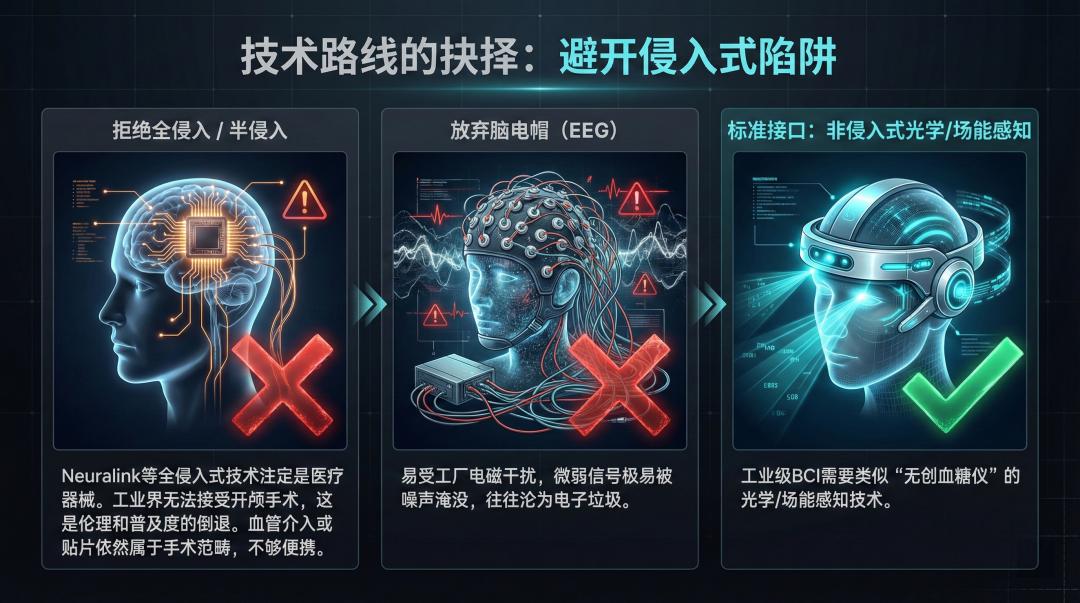
Although Musk's Neuralink is about to achieve mass production of fully invasive devices, fully invasive technology is destined to be a medical device for a very small number of severe patients and is difficult to be widely popularized in the industrial field.
Similarly, the so - called "semi - invasive" method is not a perfect solution either. Although vascular intervention or epidural patch technology minimizes trauma, it still belongs to the category of surgery.
Imagine that the current blood glucose meter technology has evolved to use optical or radio - frequency sensing to accurately monitor blood glucose without pricking the finger. If we still require workers to implant chips in their brains or blood vessels to work, it is undoubtedly a technological regression in terms of ethics and popularity.
On the other hand, traditional electroencephalogram (EEG) caps may be toys for geeks in the consumer market, but they often become electronic waste in the industrial field. Factories are full of electromagnetic interference from motor starts, and weak electrical signals are easily submerged by noise.
The real opportunity may lie in the next - generation sensing technology similar to the logic of "non - invasive blood glucose meters", such as functional near - infrared spectroscopy (fNIRS) and optically pumped magnetometers (OPM).
This solution no longer relies on physical contact to capture electrical signals but finds a new way.
Using light: Similar to how a smartwatch monitors blood oxygen, near - infrared light penetrates the skull to monitor the blood flow metabolism of the cerebral cortex. This optical signal is naturally immune to the strong electromagnetic interference in factories. Although the reaction speed is slightly slower, it is relatively accurate for monitoring "slow - state" data such as worker fatigue and attention load.
Using magnetism: Quantum sensors are used to capture the weak magnetic fields excited by neurons. Although it currently faces the challenge of environmental magnetic noise, with the maturity of active magnetic shielding technology, it is expected to achieve millisecond - level real - time thought control on a non - invasive basis.
This is the Type - C interface in the industrial field: It is directly integrated into the safety helmet, ready to use as soon as it is worn, without the need for conductive paste or any surgery. Therefore, in the short term, using fNIRS technology for "safety and status monitoring" of workers; in the long term, deploying OPM technology to overcome "precise control" in complex environments may be one of the feasible paths. Whoever can turn the huge detection equipment in the hospital into a portable terminal the size of a safety helmet will seize the brain - computer entrance of the Industrial Internet of Things.
Conclusion
The upcoming mass production of Brain - Computer Interface devices may transform the IoT from a simple "device networking" composed of cold sensors and gateways into an "Internet of Intentions" full of human intentions, intuitions, and perceptions.
Now, it may be time for us to pay attention to neuroscience and focus on that "super biological processor" weighing about 1.4 kilograms and consuming only 20 watts - the human brain. Because in the future industrial network, the most core node is still humans.
This article is from the WeChat official account "Internet of Things Think Tank" (ID: iot101). Author: Peng Zhao. Republished by 36Kr with permission.