Is OpenAI's first AI hardware a pen that can "lick"?
While tech giants are scrambling to integrate AI into personal devices such as glasses, watches, and earphones, OpenAI's first AI hardware product might take the opposite approach.
Build an AI pen.
According to a blogger named Zhihui Pikachu who obtained information from the supply - chain channel, the internal code name for the hardware project that OpenAI is collaborating on with former Apple Chief Design Officer Jony Ive is "Gumdrop". Currently, three projects are being advanced simultaneously during the supplier evaluation phase. One of them clearly points to a pen - shaped device, and the other is a portable audio device.

When netizens asked if it was a "Pin", the blogger specifically clarified: it's a pen. He also revealed that the project was initially planned to be manufactured by Luxshare Precision, but due to disagreements over the location of the production base, it is now highly likely that Foxconn will take over.

Did OpenAI spend $6.5 billion just to build an AI pen?
Although the supply - chain information is clear, the idea of an "AI pen" still seems dubious. It wasn't until we connected the clues previously revealed by Altman and Ive that we found that this seemingly outlandish conjecture actually has some basis.
In May last year, OpenAI spent $6.5 billion to acquire the hardware company io founded by Jony Ive. However, due to trademark disputes (suing by audio company iyO), it was later forced to spin off the brand.
Evans Hankey, co - founder and Chief Product Officer of io, clearly stated in a court declaration: "io currently has no plans to launch customized earphones." Another co - founder, Tang Tan, directly drew a clear line: The product prototype of io is neither an in - ear device nor a wearable device.
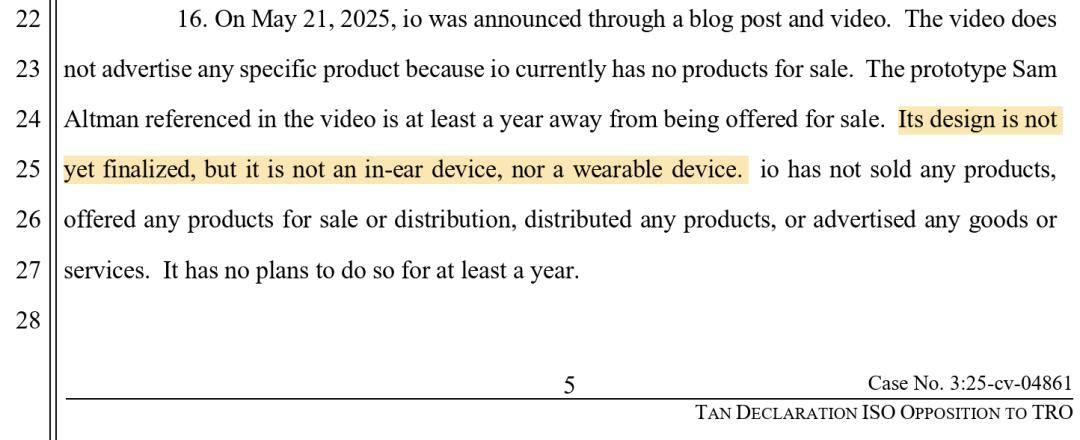
The picture is from Tang Tan's court complaint
The combination of these two statements basically rules out the possibility that OpenAI's first AI hardware will enter mature markets such as glasses, watches, and earphones.
Altman himself has given many hints about this device: It is small in size, can fit in a pocket or be placed on a table, and has environmental perception capabilities.
The key point is that it is not here to replace mobile phones and computers but to fill the scenarios where "it's inconvenient to take out a phone" or "deep concentration is required".
He once described it like this: Smartphones are like Times Square, bombarding users with information and shattering their attention. What OpenAI wants to create is a "lakeside cottage" where you can close the door and block out the noise when you need to concentrate.
From this perspective, a pen is indeed a smart choice. Compared with the 24/7 online AI pendant like Friend, a pen has a low cognitive threshold, doesn't look out of place on the table, and is far less intrusive to privacy than wearable devices.

Friend AI pendant
In terms of design, Ive once said that he prefers products that are extremely complex and intelligent inside but make people want to touch and use easily on the outside. He even joked that the ultimate standard for successful design is "making people can't help but lick or bite it".
Altman later directly confirmed this: The appearance of the prototype did make him have the impulse to "lick it", and he accurately summarized its appearance as minimalist, elegant, with a bit of playfulness and humor.
Ive also revealed that this AI hardware tends to use high - quality materials such as ceramics, with the core goal of pursuing "almost childlike simplicity". Based on this, it can be inferred that the device's interaction will be extremely simplified, and it will probably only retain a small number of physical buttons.

In addition to the high degree of compatibility between the product concept and form, the personal preferences of Jony Ive and Sam Altman for "pens" add more credibility to this conjecture.
Yes, Jony Ive himself is a senior pen collector. His collection includes vintage Montegrappa fountain pens and Hermès fountain pens designed by Marc Newson.
Early in his career, he made his first fortune with a sporty TX2 ballpoint pen. Later, he was also deeply involved in the design of the Apple Pencil, accumulating rich experience in pen - shaped design.
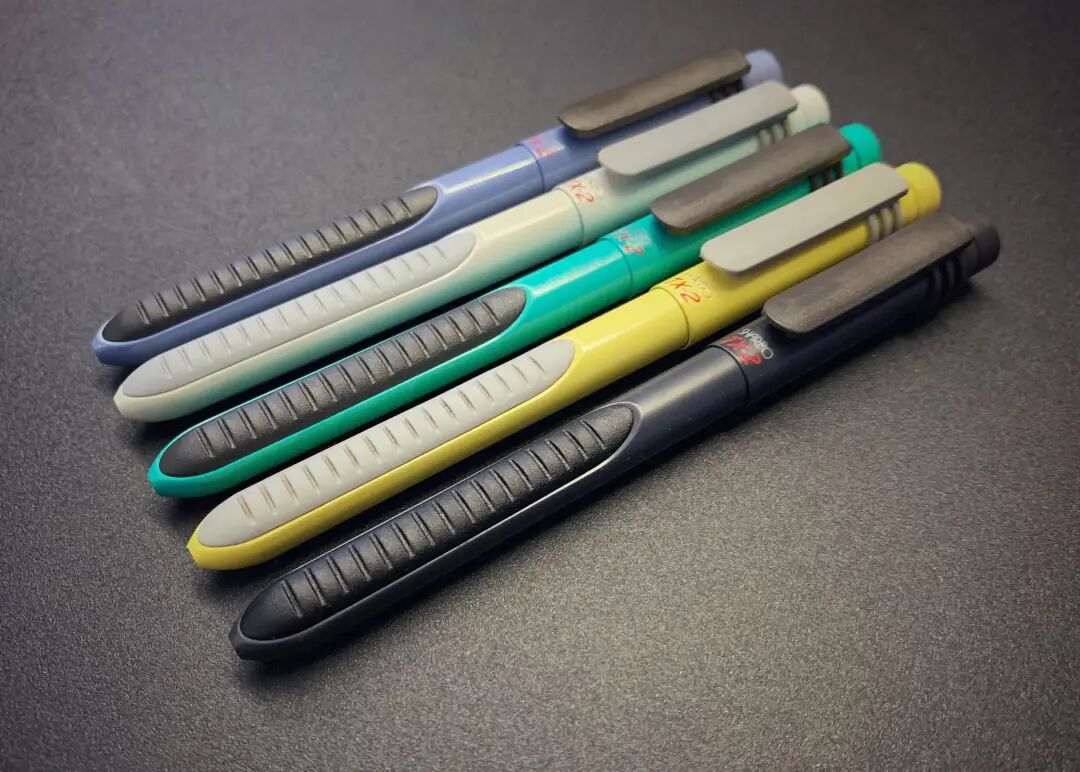
TX2 designed by Jony Ive
Sam Altman is even more of a kindred spirit, and perhaps even more so. In the September 2024 podcast "How I Write", Altman revealed that he is a "super note - taker", using up a notebook every two or three weeks on average. He also specifically recommended two pens: Uni - Ball Micro 0.5 and Muji's 0.36/0.37 models, which work best with dark blue ink.
In his own words, "This type of notebook paired with one of these pens is the ideal writing combination."
As early as April 2018, he wrote on his blog about the benefits of using pen and paper to record ideas: "I prefer to write lists on paper. It's easy to add or delete tasks. I can also check them at any time during meetings without being impolite."
It seems logical that two people with a penchant for pens would come together to create an AI pen.
The audio model is advancing rapidly, and OpenAI is preparing a big move in AI hardware
Two pen lovers building a pen obviously won't just create an ordinary one.
According to a report by foreign media The Information early this morning, OpenAI is accelerating the iteration of its audio AI model, with the core goal of laying a solid technological foundation for this AI personal device.
People familiar with the matter revealed that the device will focus on voice interaction as the core scenario.
In the past two months, OpenAI has completed the integration of multiple teams in engineering, product, and research to optimize the audio model with all its might. The new - generation model architecture has already shown initial results: it can generate more natural and empathetic voice responses, and the accuracy and depth of the content have also been greatly improved.
More importantly, this model will support synchronous conversations with users, handle interruptions smoothly, and is expected to be officially released in the first quarter of this year.

The report states that based on the plan demonstrated internally last summer, OpenAI's first AI hardware is positioned as a "smart companion" - not just a simple software interface, but something that can actively collaborate with users, offer suggestions, and help users achieve their goals.
With user authorization, it can also collect audio and video to sense the user and the surrounding environment, further improving the accuracy of interaction. Currently, OpenAI has assembled a cross - domain team covering the supply chain, industrial design, and model research, which shows its ambition in the hardware market.
The core team of this audio AI project has also been finalized: The person in charge, Kundan Kumar, joined from Character.AI last summer; Ben Newhouse, the product research director, leads the audio adaptation of the text technology architecture; Jackie Shannon, the product manager of the multimodal ChatGPT, is responsible for optimizing the interaction experience. The three of them perform their respective duties and form the backbone of the project.

However, there is a core obstacle in front of OpenAI: Most ChatGPT users haven't developed the habit of voice interaction. The reasons are the poor experience of existing voice models and users' zero knowledge of these functions. Therefore, the report directly states that OpenAI's top priority should be to teach users to "talk to AI using voice".
Once this device is launched and has environmental perception and online listening capabilities, it will surely disrupt the existing AI hardware market - AI recording hardware may face its strongest competitor.
Most existing AI recording hardware only offers functions such as voice - to - text transcription and summarization. If OpenAI's device is launched, voice summarization will only be one of its many native features, not all of them.
Just as smartphones eliminated MP3 players, when a multi - scenario universal device encompasses all your functions, the survival space for vertical single - function products will be completely squeezed.
Meanwhile, following the common practice of hardware + subscription, OpenAI will probably bundle its software services directly into the ChatGPT subscription system. With its large user base and extremely low marginal cost, it can quickly capture the market.
It's worth mentioning that, combining OpenAI's technological layout and the pen form, Max Child, the founder of San Francisco startup Volley, proposed an imaginative conjecture last year:
The top of this AI pen may integrate a mini - projector to project images onto the desktop, solving the core pain point of screen - less interaction. The pen clip may integrate a microphone or even a camera, which can not only parse text but also sense a broader environment.
This means that when users write on any piece of paper, the AI can not only digitize the handwriting but also interpret the content in real - time: when writing a mathematical formula, it can give the answer directly; when writing meeting minutes, it can automatically generate to - do lists and sync them to the phone.
It may even become an intelligent hub: controlling surrounding digital interfaces or serving as an advanced input device for tablets, injecting ChatGPT's capabilities directly into the creation at the tip of the pen.
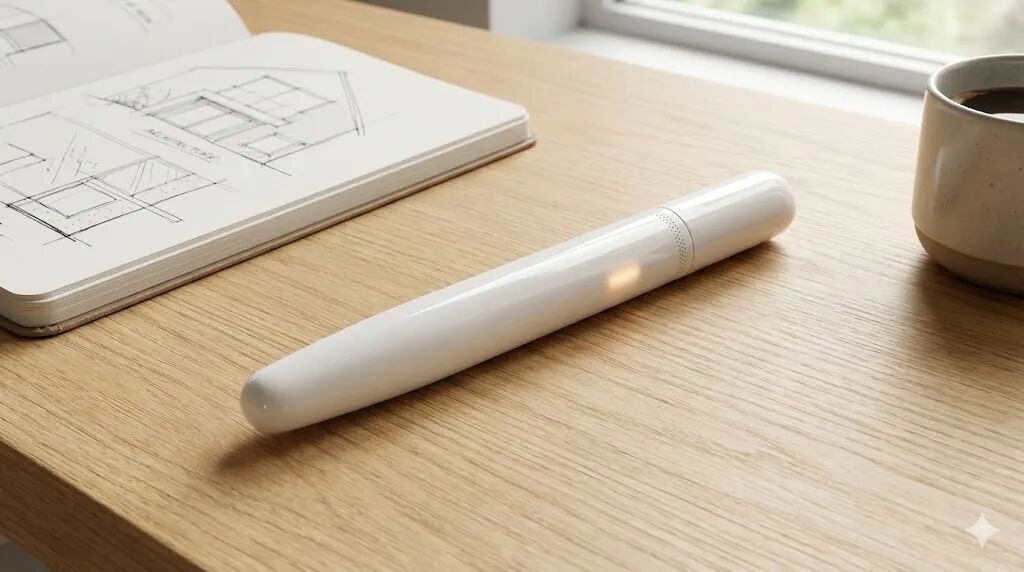
Hypothetical image generated by Nano Banana Pro
It's also worth noting that people familiar with the matter revealed that OpenAI doesn't just plan to release one device but will launch a series of devices one after another to cover more diverse usage scenarios.
Altman and Ive confirmed last year that the first batch of prototypes have been built. According to The Information, the first AI device is expected to be officially launched in about a year.
This time - frame also aligns with the current competitive rhythm of the AI hardware market.
Tech giants are accelerating their layout to seize the AI hardware market: Meta and Google are both quietly developing smart glasses. Bloomberg reporter Mark Gurman reported that Apple is also considering adding a camera to AirPods to create a new type of AI device.
Outside the fierce competition among giants, an AI pen like OpenAI's that can listen, see, and think may pry open a long - ignored but highly focused usage scenario with extremely low cognitive cost.
Compared with omnipresent AI hardware, this type of AI hardware that only appears when needed may be closer to the answer for the next stage.
This article is from the WeChat official account "APPSO", author: Discovering Tomorrow's Products. Republished by 36Kr with authorization.