Masayoshi Son's daughter steps into the spotlight
Masayoshi Son's daughter unexpectedly became an internet sensation.
This week, a notice released by Spiber, a well - known Japanese unicorn company, brought the daughter of Masayoshi Son, the head of SoftBank Group, into the spotlight.
Maya Kawana was born in the same year when SoftBank was founded. She worked at Goldman Sachs Japan in her early years and was a housewife for several years. However, she has never worked at SoftBank. Her father, Masayoshi Son, is well - known in the global venture capital circle. He has experienced ups and downs in recent years and regained the title of the richest person in Japan this year.
Although Masayoshi Son has stated that the successor of SoftBank will not be determined by blood, the reason why Maya Kawana has caused a stir this time is that it has, to some extent, touched on the topic of succession in the current venture capital industry.
Masayoshi Son's daughter appears in the venture capital circle
According to the notice, Spiber has signed a business support agreement with Maya Kawana. After the pre - conditions for the agreement to take effect are met, Maya Kawana will start her support work in the first half of 2026 to achieve business synergy.
The resume of the trading party clearly states: Maya Kawana is "the eldest child of Masayoshi Son" (Born as the eldest child of Masayoshi Son).
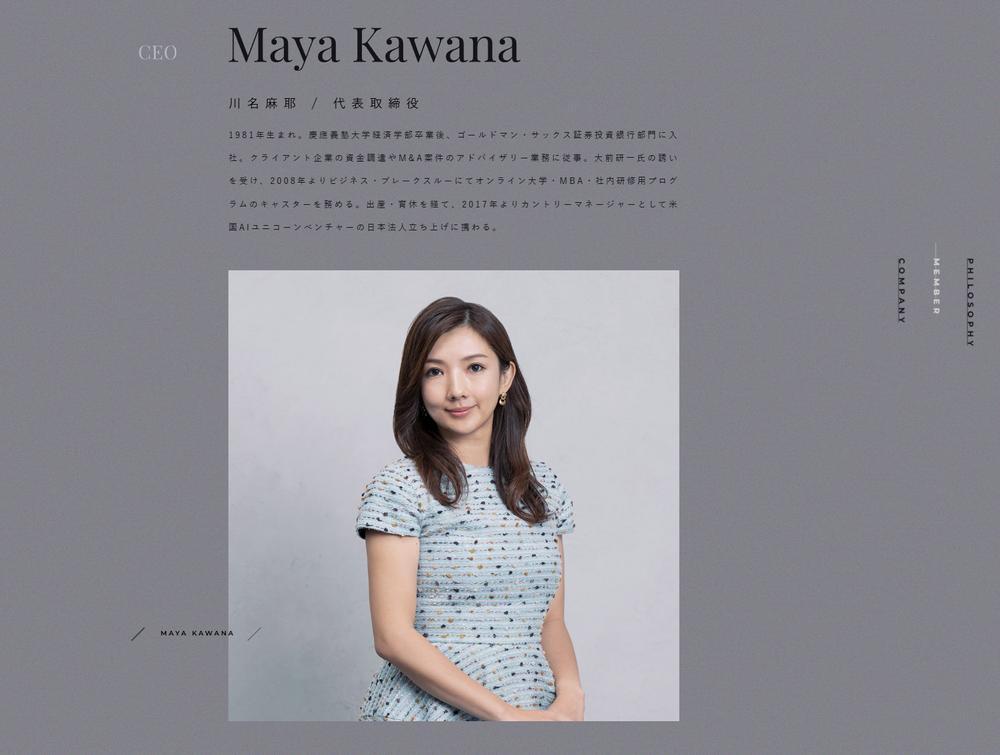
"My participation is not aimed at IPO or mergers and acquisitions. Instead, I want to build a truly globally competitive biotech company," Maya Kawana said in the notice.
Founded in 2007, Spiber uses spider silk protein to produce bio - fibers. The products claim to replace the traditional polyester's dependence on petroleum. As one of the few unicorn companies in Japan, its current valuation exceeds $1.2 billion.
Maya Kawana pointed out that although the company has high - level technology development capabilities, it still faces challenges in commercialization and social application. She said that in the future, she will help the enterprise achieve "economically sustainable growth" by adjusting the production system, optimizing the allocation of operating resources, and formulating sales strategies.
Over the past few decades, Masayoshi Son has rarely talked about his family in public. However, his daughter's appearance this time has caused quite a stir.
Maya Kawana was born in 1981. At that time, Masayoshi Son had just returned to Japan from the United States, and SoftBank was just a fledgling software sales company, far from the investment empire it is today. Her childhood witnessed her father's rise from scratch.
In 2000, Maya Kawana went to Keio University, a prestigious Japanese university, to study economics. During her university years, she was the representative of the tennis club and had an outgoing personality. After graduation, she joined the investment banking department of Goldman Sachs, responsible for corporate financing and M&A consulting.
After that, Maya Kawana had a full - time housewife life for several years. It was not until 2019 that she established the brand consulting company BOLD Co., Ltd., aiming to "bring the fashion industry into a new era".
Looking back at her past resume, it is surprising that Maya Kawana has never held any position at SoftBank Group.
Masayoshi Son regains the title of the richest person in Japan
Masayoshi Son has always been a topic of much discussion. The venture capital empire he leads, SoftBank, has an aggressive investment strategy, which once left its opponents at a loss.
The most sensational cases are Yahoo and Alibaba. In 1999, after a six - minute presentation by Jack Ma, Masayoshi Son decided to invest tens of millions of dollars in Alibaba, which had no revenue at that time. This became one of the most successful cases in the global venture capital history.
However, the story was not always so smooth. WeWork, OYO, Uber... One unicorn after another rose and then collapsed, bringing a series of troubles to Masayoshi Son. Remember in August 2022, SoftBank recorded its largest loss since its establishment, with "almost all listed and unlisted stocks wiped out".
It was not until 2023 that ARM, a chip design company controlled by SoftBank, was listed on the NASDAQ. Its market value once reached $190 billion, becoming the fulcrum for SoftBank to return to the peak. After that, SoftBank changed its strategy. In the fiscal year 2025 - 2026, the Vision Fund department delivered a beautiful profit report.
The latest news is that in the interim financial report as of the end of September, SoftBank's net profit reached 2.924 trillion yen, a year - on - year increase of 2.9 times, setting a record for the highest semi - annual profit in Japanese corporate history. In the third quarter, the investment income of the Vision Fund reached 3.5361 trillion yen, compared with only 610.3 billion yen in the same period last year.
About two - thirds of the income came from OpenAI. In the past year, Masayoshi Son has invested $9.7 billion in OpenAI through Vision Fund 2, and the $500 - billion "Stargate" plan is also in preparation.
"I sold my NVIDIA stocks in tears," Masayoshi Son once said. In order to raise funds to invest more in OpenAI, SoftBank sold about 90 million shares of NVIDIA in October this year, cashing out about $5.8 billion.
Quietly, the "big devil" is back. Since the beginning of this year, the market value of SoftBank Group has repeatedly hit new highs, reaching about 38 trillion yen at one point. In the latest Bloomberg Billionaires Index, Masayoshi Son, with a net worth of $55.1 billion, regained the title of the richest person in Japan.
The moment of succession in the venture capital circle
When his daughter appeared, the outside world always easily associates it with the succession issue of SoftBank Group. However, Masayoshi Son has emphasized many times that "SoftBank is not a family - owned enterprise. The future succession will be determined by AI and professional managers, not by blood."
Unconsciously, we can see that the once - powerful tycoons in the industry are starting to face the issue of succession.
In May this year, 94 - year - old Warren Buffett calmly handed over the baton at the 2025 annual shareholders' meeting, choosing Greg Abel, who had 25 years of experience, as his successor. In the venture capital industry, succession has always attracted much attention. In April 2024, Warburg Pincus welcomed Jeffrey Perlman as its third - generation leader. The helm of Sequoia Capital has also changed hands...
Let's turn our attention to China. A year ago, Qiming Venture Partners formulated an "inheritance plan for the management team" internally, aiming to achieve the handover of the management team in the next decade. Earlier, Xu Xiaoping, the founder of ZhenFund, gradually faded out, and Fang Aizhi stepped forward.
This situation is also urgent for domestic venture capital institutions.
Last week, Shenzhen Venture Capital celebrated its 25th anniversary, and almost all the local venture capital leaders were present. After 25 years, those well - known venture capital tycoons are getting older, and the issue of succession has to be put on the table.
This year, a partner of a leading domestic VC quietly announced his retirement within the company. It is rumored in the circle that his next plan is to "read books, travel, accompany his children, and spend time on things he is interested in."
In the venture capital circle, there is hardly a concept of "sons inheriting their fathers' businesses". More often, founders are willing to spend time training partners who have grown up within the company. In recent years, LPs have almost always talked about their concerns about succession. Therefore, investment institutions have begun to attach importance to team building and focus on training young investment backbones.
Compared with other industries, the venture capital industry needs to embrace new things and maintain curiosity more.
Retirement is a gradual process. As a venture capital tycoon said, "I like playing football. When I was young, I played as a forward. Now I play as a center. In the future, I will leave opportunities for the young people."
This article is from the WeChat public account "Investment World" (ID: pedaily2012), written by Yu Mengying and Yang Wenjing, and is published by 36Kr with authorization.