The State Administration for Market Regulation rarely issued a document. Are there really car companies selling cars at a loss?
"In the field of automobile production and sales, there are behaviors such as non - standard price marking, price fraud, price collusion, and irrational competition, which seriously disrupt the market order, infringe upon the legitimate rights and interests of consumers and operators, and are not conducive to the high - quality development of the automobile industry."
This statement does not come from consumers, but from the State Administration for Market Regulation (hereinafter referred to as the "SAMR").
On December 12, 2025, the SAMR issued the "Compliance Guidelines for Price Behaviors in the Automobile Industry (Draft for Comment)" (hereinafter referred to as the "Compliance Guidelines"), and some of its provisions quickly caught the industry's attention.
Automobile production enterprises, except for legally reducing prices to dispose of overstocked goods, face significant legal risks if they implement the following price behaviors for the purpose of squeezing out competitors or monopolizing the market:
(1) The ex - factory prices of complete vehicles and components are lower than their production costs;
(2) Using means such as using high - specification and high - grade products to pretend to be low - specification and low - grade products to reduce prices in a disguised way, resulting in the actual ex - factory price being lower than the production cost;
(3) Through price preferential means such as discounts and subsidies, making the actual ex - factory price lower than the production cost;
(4) Conducting non - equivalent material exchanges, making the actual ex - factory price lower than the production cost;
(5) Through debt settlement with goods, making the actual ex - factory price lower than the production cost;
(6) Adopting methods such as delivering more goods but issuing fewer or no invoices, making the actual ex - factory price lower than the production cost;
(7) Through means such as giving more quantity, reducing prices in a disguised way, making the actual ex - factory price lower than the production cost;
(8) In bidding, using methods such as lowering the bid price to make the actual ex - factory price lower than the production cost;
(9) Using other methods to make the actual ex - factory price lower than the production cost.
In this "Compliance Guidelines", the regulatory authorities even listed in detail various specific forms of "selling cars at a loss": through subsidies and discounts, making the actual ex - factory price lower than the cost; using high - specification products to pretend to be low - specification products, debt settlement with goods, non - equivalent exchanges, and even "delivering more goods and issuing fewer invoices" to lower the real transaction price in a disguised way.
This is equivalent to confirming at the institutional level something that has long been regarded as a "joke" in the public opinion field - There are really automobile enterprises selling cars at a loss, and the methods are not single.
This surprised many consumers, and even industry insiders were quite shocked. "It's hard to understand from a business logic perspective. Who would do a loss - making business for a long time?" A shareholder of an automobile enterprise dealer told Jazi Guangnian directly.
However, according to Jazi Guangnian's investigation, "selling cars at a loss" is not an extreme individual case, but a strategy repeatedly used in price wars. The rare revelation by the SAMR in the form of industry "Compliance Guidelines" also confirms the universality and scale of this abnormal phenomenon from the side.
The question then arises: Why is this the case?
1. Out of Necessity?
"Out of necessity" is the explanation given by some automobile industry practitioners for automobile enterprises selling cars at a loss.
There are mainly three situations where automobile enterprises sell cars at a loss.
Firstly, it is to legally reduce prices to dispose of overstocked goods, which is a compliant price - reduction behavior. For automobile enterprises that have gone bankrupt or are in business difficulties - such as WM Motor, Human Horizons, Jiyue, and Neta - whether it is the brand's direct - sales channels or dealer channels, selling cars at a loss is part of the enterprise's bankruptcy reorganization or liquidation process.
Therefore, there are cases in the market such as "buying a WM W6 with an original price of 280,000 yuan for 60,000 yuan" and "buying a Human Horizons HiPhi X with an original price of 730,000 yuan for 180,000 yuan".
Another more common situation is that automobile enterprises misjudge the future sales volume of a certain model, and the production capacity of the vehicle is much higher than the sales volume, so they have no choice but to sell cars at a loss.
Liu Ming (a pseudonym), a staff member of the procurement department of a joint - venture automobile enterprise, told Jazi Guangnian: "When an automobile enterprise develops a car, it involves the entire supply chain. The cost of not being able to sell the car is very high."
For example, for the outer covering parts of a car, many automobile enterprises obtain supplies from suppliers. Suppliers will open special production lines, design molds, introduce equipment, and recruit workers according to the production contracts and agreed production capacity signed with automobile enterprises to complete the production of special - purpose vehicles on special production lines.
However, if the sales volume of the model fails to meet expectations, the automobile enterprise will reduce the production rhythm. This situation will be transmitted to upstream suppliers, resulting in a serious shortage of production - line utilization rates of suppliers, and causing great waste of equipment and personnel costs.
Liu Ming told Jazi Guangnian: "If the production rhythm is reduced too low, the suppliers' production lines will not be able to start. The equipment and personnel are invested, but no benefits are generated. In this case, suppliers may even sue automobile enterprises for compensation."
Therefore, to avoid this situation, automobile enterprises often reduce prices or even sell at a loss to ensure the minimum sales volume of a model. On the one hand, this can maintain the minimum utilization rates of their own production lines and suppliers' production lines. On the other hand, it can also allow these unpopular models to "survive" for a longer time.
"Previously, for a high - end pure - electric model of a new - energy vehicle brand, their supplier said that if the monthly sales volume of this model could reach 4,000 units, it would be a relatively good result; if it dropped to 2,000 units, they could also accept it, and the production line could keep running; but if it reached 1,000 units or even hundreds of units, they would have to stop production. If the automobile enterprise still wants to continue production, it must make a certain proportion of compensation." Liu Ming revealed.
According to the sales data of November 2025 shown on Dongchedi, among high - end pure - electric models priced above 300,000 yuan, there are many well - known models produced by well - known manufacturers with monthly sales volumes of less than 2,000 units.
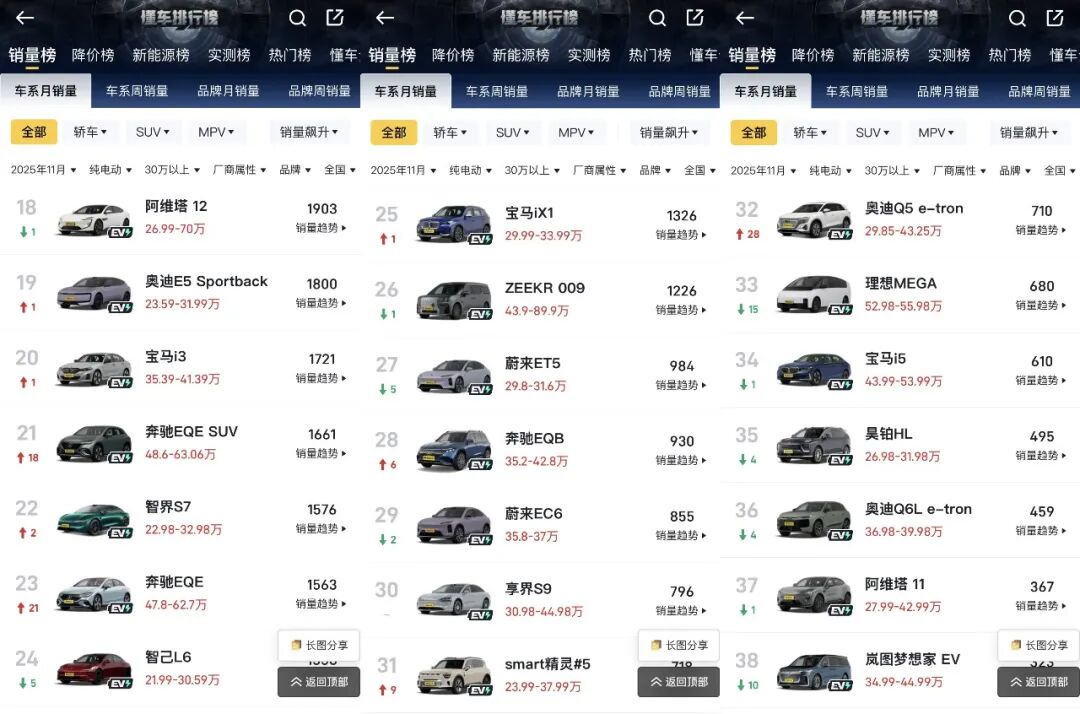
In November 2025, high - end pure - electric models priced above 300,000 yuan with monthly sales volumes of less than 2,000 units. Picture source: Dongchedi
In contrast, there is a kind of disguised price reduction that causes more serious damage to the industrial chain - actively setting low - price models.
Many automobile enterprises, when formulating their product line - ups, will actively set low - price models. They are willing to sell at a loss to seize the market in the segmented model field, create market attention, and build a user base for other high - profit - margin models in the future. Phrases such as "cross - class benchmarking", "breaking cost", and "standard configuration is full - configuration" are common in their promotions. Although this is a common business competition method, there are often no winners in this kind of "price war".
Although these behaviors exist in the industry, they are not well - known to consumers. This time, the SAMR can be said to have "broken the window paper".
2. A Subtle Timing
Why did the SAMR issue such an intriguing "Compliance Guidelines" at the end of 2025?
Looking back at the Chinese automobile market in 2025, price reduction and involution became the themes throughout the year. At the beginning of the year, BYD took the lead in reducing prices and carried out multiple promotions in a row. The prices of some models dropped below 100,000 yuan. Subsequently, automobile enterprises such as Tesla, Geely, Changan, and "Wei Xiaoli" quickly followed suit and started to reduce prices.
By the end of the first quarter, traditional fuel - vehicle brands such as Buick and Cadillac also began to compete for the market through official price cuts. In the third quarter of 2025, second - tier luxury - brand automobile enterprises such as Volvo and Jaguar also began to significantly reduce prices to stabilize sales. According to statistics, more than 30 automobile brands launched price - reduction promotion policies in 2025.
But this also brought a large number of quality problems.
On August 28, 2025, the authoritative market research institution J.D. Power released the 2025 China New Vehicle Quality Study Report. The report showed that in 2025, the overall new - vehicle quality situation in the Chinese automobile industry was 229 PP100 (Problems Per 100 Vehicles, meaning "the number of problems per 100 vehicles", and a vehicle may have more than one problem), a significant increase of 17 PP100 compared with 2024. The overall quality level of new vehicles declined seriously.
It should be noted that the research objects of new - vehicle quality here include both new - energy vehicles and fuel - vehicles. The overall decline in new - vehicle quality is also consistent with the fact that both new - energy vehicles and fuel - vehicles participated in the price war.
Not only did the quality of automobile products purchased by consumers decline, but in 2025, automobile dealers also suffered losses and closed down due to automobile enterprises' price cuts.
According to the data statistics of the China Automobile Dealers Association, in the first half of 2025, more than 52.6% of dealers suffered losses, and 74.4% of dealers had the phenomenon of price inversion, that is, the purchase price of vehicles was higher than the selling price.
It can be seen that the industry - wide involution and price reduction, which seemingly "benefit consumers", actually affect the healthy development of the entire industrial chain.
Liu Ming told Jazi Guangnian: "When automobile enterprises reduce prices, the pressure will be transmitted to first - tier suppliers. The first - tier suppliers will then transmit it to second - tier suppliers, and the second - tier suppliers to third - tier suppliers. Finally, it will reach the bottom - tier suppliers who make equipment and steel. When they can't bear it, they will reduce product quality and cut corners, and then transfer the hidden dangers to consumers. In the end, the entire industry will be the victim."
In addition, the low - price involution has also created a false prosperity in the Chinese automobile industry.
In July 2025, China Securities Journal published an article stating that through investigations, it was found that since May 2025, ZEEKR was accused of using its direct - sales store system to sell a large number of insured and transferred inventory vehicles as new vehicles to uninformed consumers with terms such as "time - limited discounts", which triggered a large number of complaints.
This kind of "zero - kilometer used car" practice damages the rights and interests of consumers as the first - owners, but it artificially inflates the sales volume of automobile enterprises.
In addition to "reselling new cars", a considerable number of automobile enterprises will also manipulate the number of "small - deposit" orders when a new car is launched to show the popularity of the model. The specific approach is mainly to jointly place orders with suppliers, partners, and even their own employees.
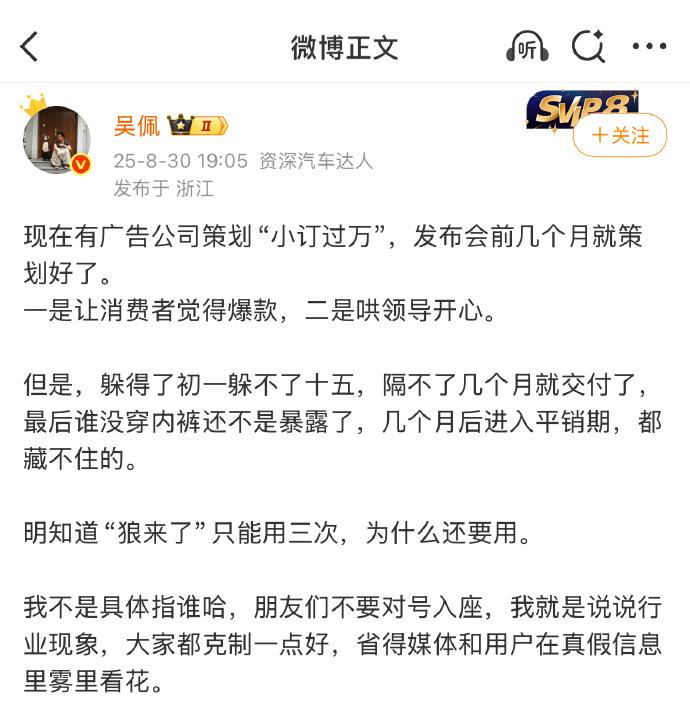
Well - known automobile blogger Wu Pei posted an article exposing the falsification of the number of "small - deposit" orders. Picture source: Wu Pei's Weibo
Since only a "small - deposit" is paid, it can be refunded at any time after the promotion period, and basically no loss will be caused. Many people will tacitly complete the operation under the pressure of automobile enterprises.
These illegal or even criminal behaviors essentially result in the loss of authenticity of product data due to the industry's low - price involution. The strange theory of "lifting oneself by one's bootstraps" is being practiced in the automobile industry.
As 2025 is coming to an end and 2026 is approaching, the decline of national subsidies also forces automobile enterprises to face a more severe sales test.
According to the new regulations, starting from January 1, 2026, the purchase tax for new - energy vehicles will be adjusted from full exemption to half exemption (with a cap of 15,000 yuan). This means that the cost of consumers buying a new - energy vehicle worth 300,000 yuan will increase by 15,000 yuan.
Therefore, from a time - node perspective, if the government regulatory authorities do not intervene, the situation of automobile enterprises reducing prices, involuting, and even "manipulating" sales data will become more serious.
The SAMR's announcement issued near the end of the year has a very obvious warning meaning.
The drafting note of the "Compliance Guidelines" clearly points out that with the rapid development of the automobile market, especially the new - energy vehicle market, new business models are constantly emerging, and price behaviors are becoming increasingly complex. A series of non - standard price marking, price fraud, price collusion, and irrational competition behaviors have had a substantial impact on the market order and industry development.
This means that the regulatory authorities have regarded the price problem in the automobile industry as a structural risk that requires "systematic governance", rather than a scattered individual - case problem.
A core motivation of the "Compliance Guidelines" is to "pre - define" these gray operations by unifying regulatory rules and clarifying legal boundaries. Compared with post - event law enforcement, this is more like a compliance operation manual, trying to write regulatory judgments into the pricing logic of enterprises in advance.
But there is still a question: How to implement it?
3. Sorting Out the "Muddled Accounts"
The production cost of automobiles is a "muddled account".
The definition of cost in the "Compliance Guidelines" is as follows: The production cost of automobile production enterprises includes manufacturing costs and period costs composed of management expenses, financial expenses, and sales expenses. The ex - factory price refers to the invoiced price at which automobile production enterprises sell to dealers, traders, and other enterprises.
However, the real cost of a car is often kept secret. Generally, only the top - level managers of automobile enterprises know the accurate figures. Even department heads cannot know the exact numbers, let alone industry observers.
What can be confirmed is that any automobile enterprise will allocate the R & D expenses, personnel costs, etc. of vehicles to each vehicle, rather than simply calculating the vehicle cost using BOM cost (production material cost).
In the current era of new - energy intelligent vehicles, in addition to the visible hardware structures such as the body, chassis, battery, suspension, and interior of a new - energy vehicle, the cost of the software part such as the vehicle's intelligent driving system and intelligent cockpit system is almost opaque.
How much does it cost for an automobile enterprise to develop its own intelligent driving system? Should the R & D investment of billions of yuan be allocated to each vehicle? Will the vehicle cost vary according to quarters, production batches, and sales volume? All these make the vehicle cost a muddled account that is hard to clarify.
Li Feng (a pseudonym), a former public relations manager of a self - owned brand, told Jazi Guangnian: "For a new - energy vehicle enterprise, from a production and manufacturing perspective, the profit of a car may be positive, but after allocating R & D and operation costs, it may become negative."
Previously, some media tried to analyze the cost of