A bunch of unicorns have emerged from the SenseTime ecosystem, but YAN Junjie cannot be replicated.
Text by | Zhou Xinyu
Edited by | Su Jianxun
In the hardware field, the term that makes investors collectively FOMO (fear of missing out) is the "DJI ecosystem." In the AI field, what has recently given people the same jitters is the "SenseTime ecosystem":
If you've ever driven on the Shanghai Middle Ring Road, you might have seen SenseTime's building, which is as massive as an aircraft carrier, on the elevated road. In fact, if you just walk along the tree-lined path behind the building for about ten minutes, you'll reach another AI unicorn: Shanghai Xiyu Technology Co., Ltd., which is better known as MiniMax.
The two AI companies are neighbors, and their founding teams have a deep connection. The founder of MiniMax is Yan Junjie, the former vice president of SenseTime, the former deputy dean of the research institute, and the former CTO of the Smart City Business Group.
In late December 2025, MiniMax and another large model startup, Zhipu AI, respectively passed the Hong Kong Stock Exchange's hearing and released their prospectuses. They are expected to go public as early as January 2026.
With a commercialization strategy that combines models and ToC products, MiniMax is one of the few Chinese AI companies that have entered the "hundred-million-yuan annual revenue club." The prospectus shows that in just the first nine months of 2025, MiniMax's revenue reached $53.437 million, exceeding the total revenue for the whole of 2024 ($30.523 million). It's worth noting that the prospectus emphasizes that MiniMax's C-end products are close to breaking even.
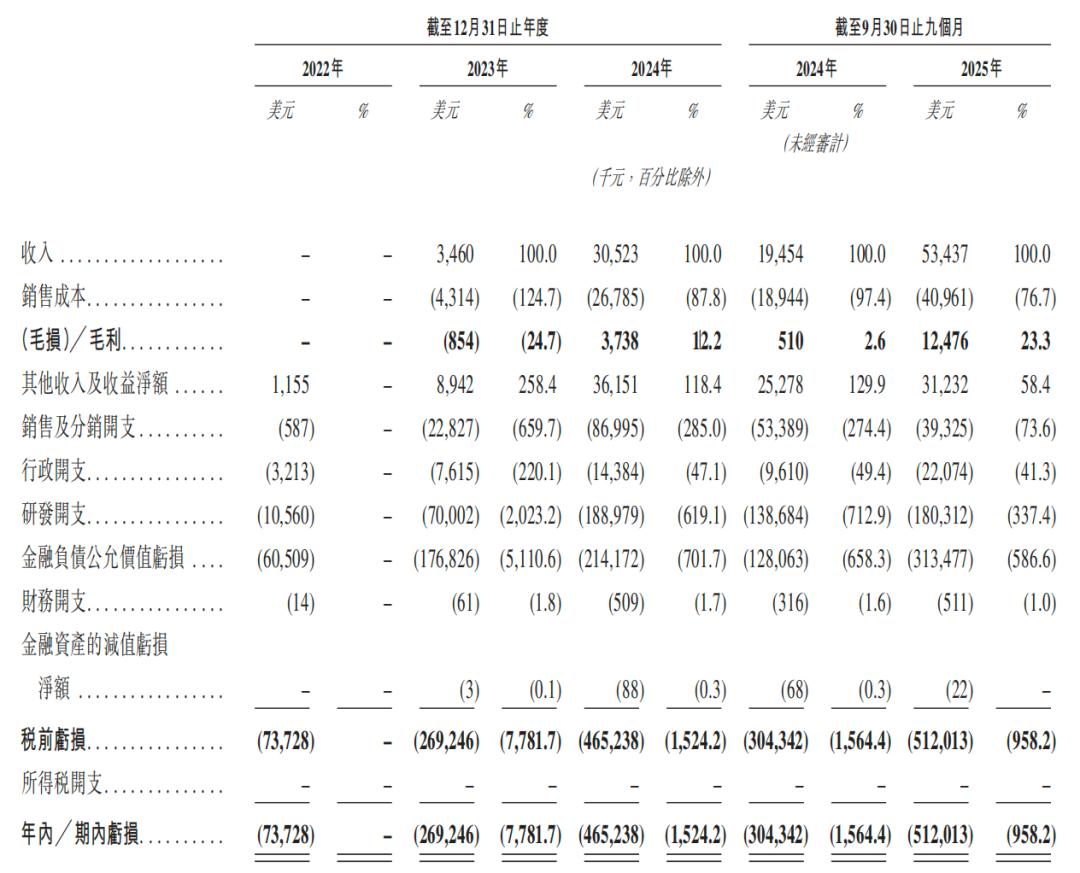
△MiniMax's financial data. Source: MiniMax's prospectus.
MiniMax isn't the only star AI company that emerged from SenseTime.
One of the fastest-growing AI unicorns at present is Vivix AI, an AI multimodal interactive content company founded overseas by Liu Yu, the former executive research director and the general manager of the AIGC business at SenseTime. In just ten months and at an early stage of model development, Vivix AI's valuation soared to $1.32 billion.
If you look at the AI startup landscape, it's not hard to find that there are SenseTime ecosystem startups at the top of almost every mainstream track:
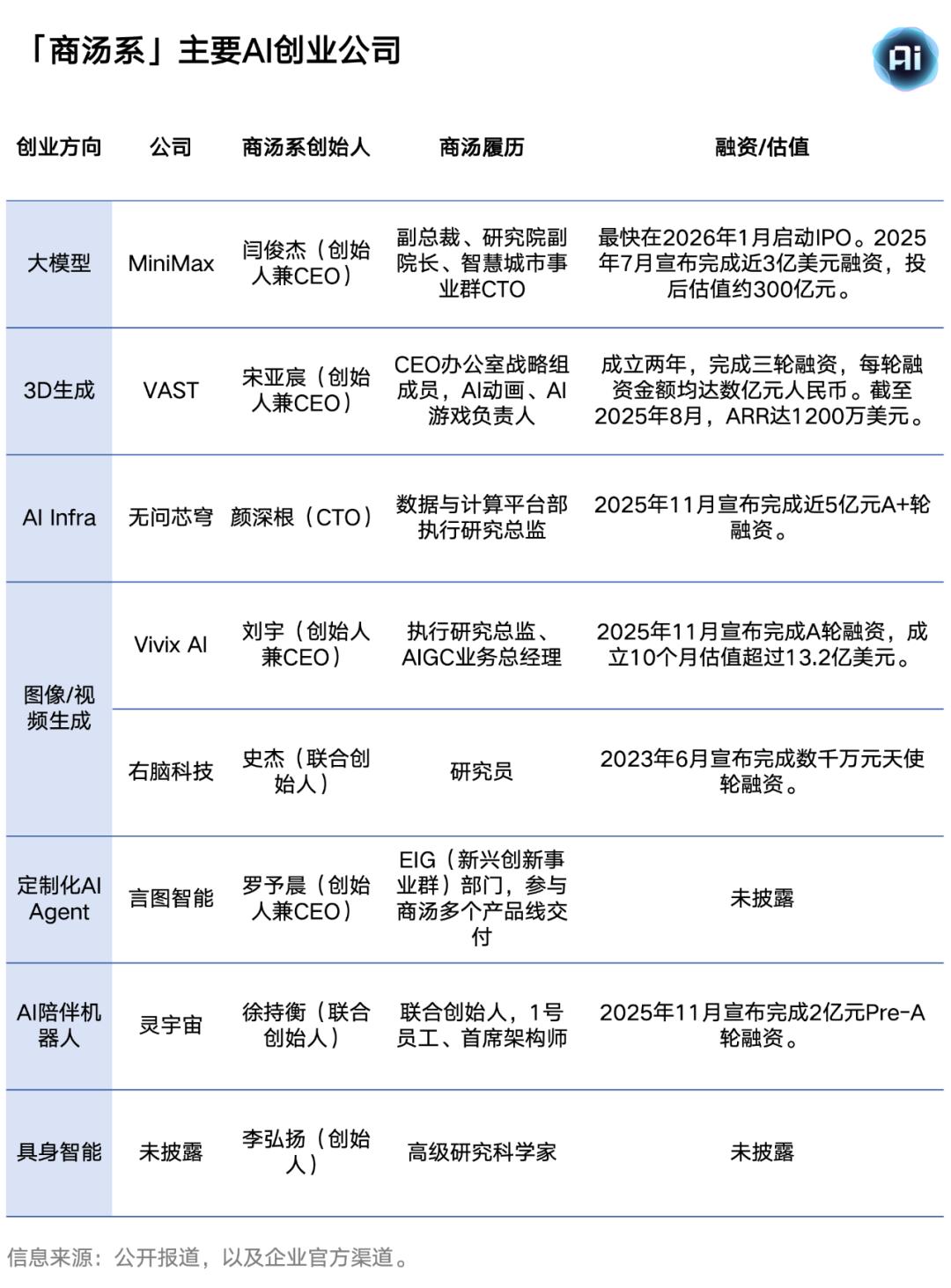
Chart of intelligent emergence.
In the view of most practitioners, there's no mysterious secret behind the current market appeal of the SenseTime ecosystem.
This is both due to the reputation of the SenseTime ecosystem accumulated from successful startups like Momenta (founded by Cao Xudong, the former executive R & D director of SenseTime) and MiniMax, and because most talents from the SenseTime ecosystem have precisely hit the essential elements of AI startups - technical accumulation and implementation experience.
How does the "AI startup cradle" create talent scarcity?
"Scarcity." In our conversations, every investor who has had contact with Liu Yu mentioned this trait about him.
In the context of AI startups, these three words refer to having both outstanding technical achievements (competitions, papers, academic qualifications) and a complete resume of product building.
In January 2025, after Liu Yu launched his overseas startup project, Vivix AI, it immediately received investments from top-tier funds such as IDG Capital and Sequoia China. A person familiar with the matter told us that at that time, an internal assessment by one of the institutions showed that in the field of vision, there were no more than five people with both algorithm and project experience. Liu Yu, who led a team of over a hundred people working on the basic model at SenseTime and had access to more than 4,000 GPUs, was one of them.
Similar traits can be seen in many AI entrepreneurs from the SenseTime ecosystem. For example, Yan Junjie is a Ph.D. from the Chinese Academy of Sciences. He led a team of over 700 people at SenseTime and made the facial recognition algorithm the best in the industry. Luo Yuchen, the founder of Yantu Technology, participated in the design of China's first batch of police dynamic facial recognition systems and the delivery of large-scale algorithm systems.
Undoubtedly, the technical accumulation is related to SenseTime's past technical precipitation in the fields of NLP and CV. Many practitioners commented that the mature technical pipelines and engineering systems from the previous AI era can also be quickly reused in the large model field - this was particularly valuable in 2023 when large model technology was still a "black box."
An early employee of MiniMax also told us that in building the technical team and the evaluation/engineering system, the early-stage company borrowed a lot of experience from SenseTime and Baidu (Yan Junjie also worked at Baidu before). "Even in the data annotation system, there are many mature and proven models from large companies that can be directly put into use."
On the other hand, it's important to recognize that technical strength alone isn't enough to attract capital. Most of the SenseTime ecosystem entrepreneurs who have emerged this time have experience or achievements in product or commercialization.
For example, Liu Yu was in charge of the AIGC product "MiaoHua" within SenseTime. Official data shows that this AIGC product, which opened for registration in September 2023, had over 3 million users and a DAU of over 530,000 just nine days after its launch. At a time when Midjourney was absent from the domestic market, "MiaoHua" occupied the niche of domestic substitution.
The experience with "MiaoHua" means that Liu Yu not only has multimodal technical reserves but also has experience in technical implementation.
A shareholder institution of Vivix AI commented to us that the scarcity of talent, the uniqueness of Liu Yu's positioning of "real-time interactive video," and the extremely fast iteration speed of the team in terms of models and infrastructure - these traits together have contributed to the rapid growth of Vivix AI's valuation.
MiniMax surges ahead, and the "SenseTime ecosystem" gains a halo in the AI field
In the AI era, the key factor in capital's rush to bet on the SenseTime ecosystem is MiniMax's rapid progress.
Judging from MiniMax's early steps, it's a company with quite forward-looking planning. In 2023, when the entire industry was focused on model parameters and performance, MiniMax already had an AI application, Talkie, that performed quite well overseas. In January 2024, when the MoE (Mixture of Experts) architecture was far from becoming the mainstream technology, MiniMax launched China's first MoE large model, abab 6.
In the second quarter of 2024, multimodality became the focus of MiniMax's layout. Later, whether it was the speech model Speech series or the video generation model "Hailuo AI," both had good reputations and a large number of users at home and abroad, ranking among the top in the industry.
With a rich product matrix and many self - sustaining products, MiniMax was the least affected model manufacturer during the reshuffle caused by DeepSeek.
Summarizing successful experiences and constantly reusing them is a natural choice to minimize risks. The background of MiniMax's founder, Yan Junjie, quickly made the "SenseTime ecosystem" a sought - after target.
For example, Liu Yu, who became a "dark horse" in terms of valuation in 2025, was identified as a potential entrepreneur early on.
A person familiar with the matter told us that at that time, since there was already MiniMax in the large language model track, IDG Capital planned to support a multimodal company targeting the overseas market. Liu Yu, who came from SenseTime and had technical and product experience, became the top choice.
Another typical example is VAST, an AI 3D generation company. Its founder, Song Yachen, has worked in SenseTime's CEO office and in the AI gaming field. He was also an early co - founder of MiniMax. He left MiniMax to start his own business at the end of 2022.
At that time, 3D generation was still a rather niche track. It's understood that thanks to Song Yachen's resumes at SenseTime and MiniMax, VAST had a valuation of about $200 million soon after its establishment. As of now, VAST's valuation has firmly ranked first among global AI 3D model startups.
However, the halo created by the success stories of individual founders from the "SenseTime ecosystem" has started to raise concerns.
"Some projects, just because of the founder's label, have sky - high valuations comparable to those of large model manufacturers without having any products or data. This goes against objective laws," an AI investor commented to "Intelligent Emergence."
He gave an example. In 2024, people were infatuated with entrepreneurs from the "ByteDance ecosystem," but after a year, only one or two projects had achievements that matched their valuations.
Moreover, the success of an enterprise can never be simply and crudely attributed. In a recent podcast hosted by Luo Yonghao, Yan Junjie mentioned that several key factors contributing to MiniMax's current achievements include making early trade - offs, recognizing the importance of the scaling law, and adopting an organizational model that abandons traditional management methods such as OKR and KPI.
An AI practitioner who listened to the podcast commented to us: "Entrepreneurs can copy resumes, but they can't copy Yan Junjie."

Welcome to communicate!