The calculation cost is halved. The chemical reaction discovery tool ChemOntology "encodes" human intuition into the system to accelerate the search for reaction pathways.
The ChemOntology framework developed by Hokkaido University in Japan has achieved a leap for chemical ontology from "descriptive annotation" to "instructive control". The successful application of this framework in the study of the classical Heck reaction mechanism not only verifies its effectiveness in accelerating path searches but also highlights the great potential of integrating "chemical knowledge" with "automated computation".
Chemical reaction mechanisms not only reveal the internal laws of material transformation but also provide key evidence for industrial applications such as the design of efficient catalysts and the development of green synthesis routes. To analyze reaction mechanisms, a key computational technique - reaction path search - is indispensable. This involves locating local minima and reaction intermediates on the potential energy surface (PES) to help people depict the real reaction path.
For a long time, computational chemists have mainly relied on the intrinsic reaction coordinate (IRC) method to explore reaction mechanisms by generating a limited number of configurations. However, this traditional approach has obvious limitations. It is often constrained by the researcher's preset path and is prone to missing unconventional reaction channels, potentially overlooking alternative mechanisms.
With the development of automated methods such as artificial force induced reaction (AFIR), unbiased reaction path searches have become possible. These methods view reaction paths as networks connected by "nodes" and systematically explore reaction possibilities by iteratively generating new configurations, thus opening a new window for discovering unknown reaction mechanisms.
However, automated path searches are not a perfect solution. The energy calculation of a large number of configurations incurs high costs, and the necessity of conformational changes for mechanism research further exacerbates the computational burden. Although methods such as semi - empirical methods and machine learning potential functions can partially reduce costs, the occasional inaccuracy of energy prediction may still affect the reliability of path searches.
As a "knowledge structuring tool", chemical ontology provides a new idea for breaking through the above bottlenecks. It organizes scattered chemical knowledge into machine - readable and processable structured information through the standardized definition of entities, attributes, relationships, and rules. For example, ontology frameworks such as RXNO have shown value in reaction path annotation.
On this basis, the research team at Hokkaido University in Japan developed a brand - new AI system, ChemOntology. As a chemical knowledge classification system, it formalizes human chemical reasoning into a machine - understandable framework to quickly explore and analyze chemical reactions. The successful application of this framework in the study of the classical Heck reaction mechanism not only verifies its effectiveness in accelerating path searches but also highlights the great potential of integrating "human chemical knowledge" with "automated computation".
The relevant research results, titled "ChemOntology: A Reusable Explicit Chemical Ontology - Based Method to Expedite Reaction Path Searches", have been published in ACS Catalysis.
Research Highlights
* It successfully "programs" the intuition of human chemists into the system without relying on training data sets, which has obvious advantages over traditional machine learning methods.
* Experimental results show that after combining with AFIR, ChemOntology can obtain effective results comparable to the complete search of AFIR_TARGET when exploring about half the number of paths, reducing the overall computational cost by nearly half.

Paper URL: https://pubs.acs.org/doi/10.1021/acscatal.5c06298
Data Methodology of the Knowledge - Driven Framework
The data resources relied on in this research are not the massive data sets used for training machine learning models in the traditional sense. This stems from the inherent characteristics of ChemOntology as a knowledge - driven framework: centered on chemical rules and mechanisms rather than relying on data fitting, thus avoiding the high dependence on large - scale data and its potential limitations at the methodological level.
First, researchers obtain standardized information on all key components in the reaction from the public chemical database PubChem, including molecular structures, names, and unique identifiers. This information can be regarded as the "ID card" of each chemical substance. It not only helps to accurately define the role of each component in the reaction system but also enables the tracking of target products and the exclusion of irrelevant or unnecessary by - products through the unique compound number, making the subsequent reaction path search more accurate and efficient.
Second, to test the reliability and applicability of the method in real and complex chemical scenarios, researchers selected the classical Heck reaction with diverse mechanisms and numerous reaction steps as a test case and provided complete input information for this system, including the three - dimensional structure files of reactants, catalysts, ligands, and bases, as well as reference energy data for known intermediates and final products. This representative case can fully examine the performance of the method in complex reaction networks. It not only verifies its ability to identify key intermediates and distinguish between main and side reaction channels but also intuitively reflects its advantage in reducing computational costs.
Overall, this research ensures the accuracy of information through authoritative databases, tests the method's effectiveness with typical complex reactions, and promotes collaboration and iteration through full - scale open - sourcing. As a result, it can maintain wide applicability to diverse organometallic reaction systems without relying on large - scale training data.
ChemOntology: A New Framework for Reaction Path Search in Organometallic Reactions
ChemOntology is a knowledge - driven computational framework. Its core idea does not rely on large - scale data to train models. Instead, it systematically integrates chemical reaction rules, structural constraints, and quantum chemical path search processes to efficiently explore reaction paths in a clear chemical context. This method uses AFIR (Artificial Force Induced Reaction) as the computational engine, guides the search direction by explicitly encoding chemical knowledge, and filters the generated structures in real - time to avoid meaningless or unreasonable reaction evolutions.
As shown in the figure below, the workflow of ChemOntology consists of steps such as user input parsing (User’s inputs), chemical information modeling (Process chemical information in setup file), reaction path generation (Construct reaction paths using ERPOs), structural rationality constraint (Construct hybridizations for all atoms), running and controlling AFIR (Run & control AFIR), and path analysis (Analysis of reaction nodes & paths).
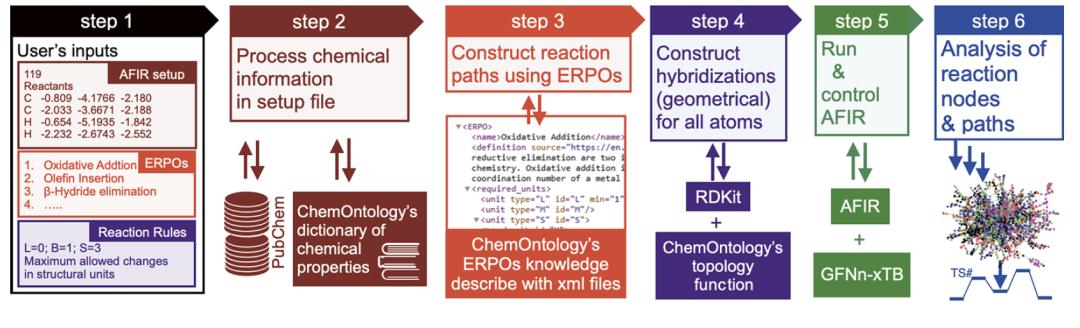
Six - step workflow of ChemOntology
The reaction system is first parsed into a set of structural units such as metals, ligands, substrates, and optional bases, and each type of unit is assigned a clear chemical role and attributes. The reaction process is described as the gradual transformation of structural units and the hybridization states of their internal atoms, enabling the tracking of structural changes at three levels: "reaction nodes - structural units - atoms". This hierarchical representation allows the model to judge the chemical rationality of reaction paths based only on geometric and topological information without relying on electronic structure details.
The generation of reaction paths relies on ERPO (Elementary Reaction Pathway Operator), which is a modular description of common organometallic elementary reaction processes such as the formation of coordination compounds, oxidative addition, olefin insertion, or β - hydrogen elimination. ERPO is not only used to construct reaction sequences but also performs rule verification during the search process to ensure that each step of structural transformation conforms to the expected chemical semantics. By decomposing complex reactions into combinable elementary processes, ChemOntology can significantly reduce the combinatorial complexity of the search space while maintaining reaction diversity.
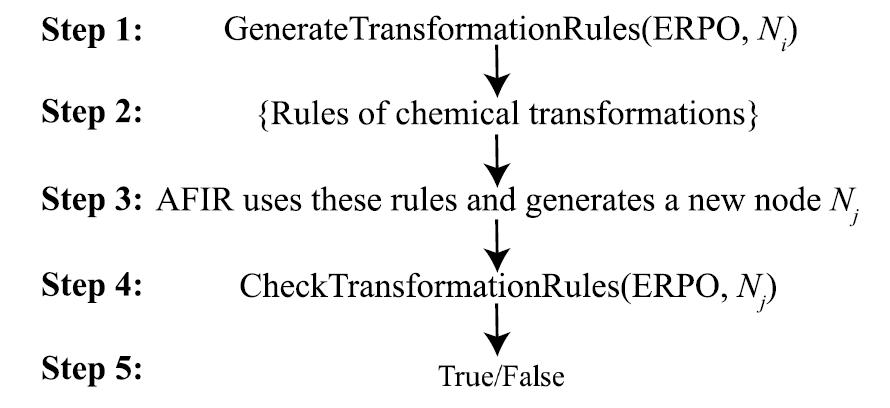
Example of the practical application of ERPO
To further constrain reaction evolution, ChemOntology introduces a filtering mechanism based on atomic hybridization changes. Users can limit the maximum allowable structural adjustment amplitude of different structural units during the entire reaction process through a small number of parameters. Geometric structures that exceed the constraints will be automatically identified and excluded from the search. This mechanism effectively suppresses the problem of structural explosion and significantly improves computational efficiency without presupposing specific reaction results.
In actual calculations, ChemOntology is embedded as a knowledge control layer above the AFIR search process and combines the semi - empirical tight - binding method GFN2 - xTB to describe the geometric evolution of reaction paths. Different from machine learning models, ChemOntology does not require dataset training. Its "knowledge base" mainly consists of functional group recognition rules, structural unit classification schemes, and ERPO files and can be flexibly modified by users according to the research object. This design makes ChemOntology more like a computable chemical methodology for systematically introducing human chemical intuition into the automatic reaction exploration process.
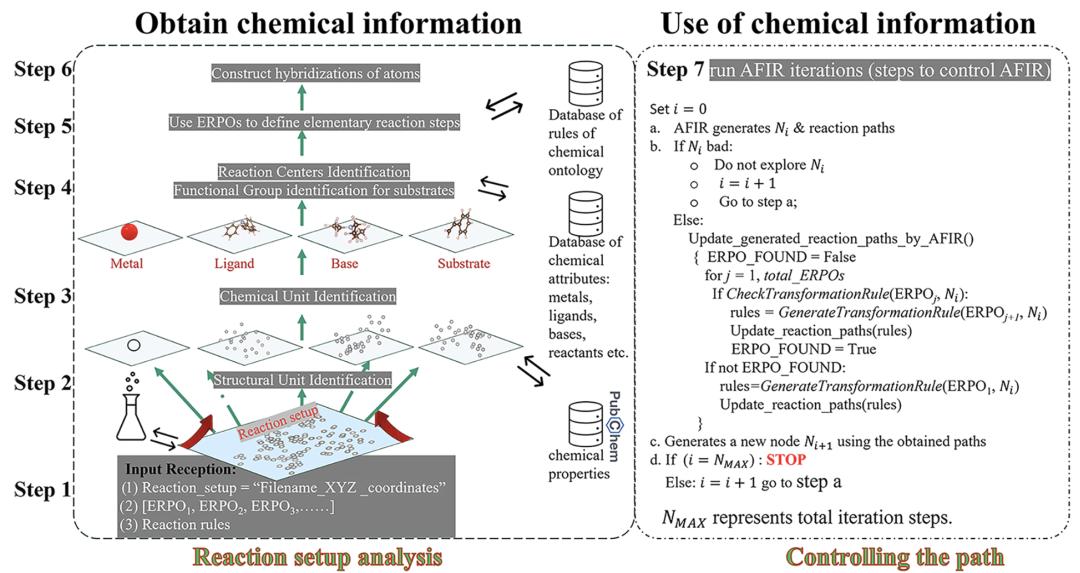
Computational workflow of ChemOntology
Overall, ChemOntology provides a platform for conducting reaction path searches under clear chemical constraints. It does not restrict the emergence of new reactivity but guides the computation to explore within the "reasonable chemical space" through structured rules, thus achieving a balance between reaction mechanism analysis and potential new chemical discovery.
Experimental Results: Halving Computational Cost and Doubling Path Clarity
To verify the effectiveness and efficiency of the ChemOntology framework in reaction path searches, the research team selected the classical Heck reaction with a complex mechanism and high representativeness as the test system. As shown in the figure below, this reaction uses iodobenzene and styrene as substrates. Under the conditions of palladium catalysis, triphenylphosphine ligand, and triethylamine base, it mainly produces trans - stilbene, accompanied by a small amount of cis - isomers and trace by - products. Its mechanism covers multiple key steps such as oxidative addition, olefin insertion, migratory insertion, β - hydrogen elimination, and base elimination. With numerous reaction centers, it poses a typical challenge to automated path search methods.
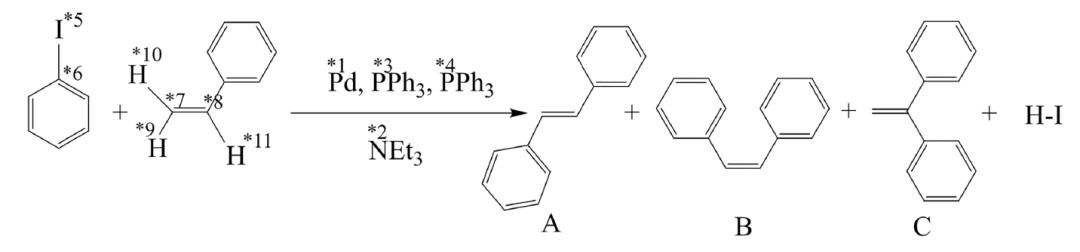
Schematic diagram of the Heck reaction
In the research, three parallel path search strategies were compared: AFIR_DEFAULT without guidance, AFIR_TARGET with partially defined reaction centers, and AFIR_ChemOntology with the introduction of chemical ontology. There are essential differences in the "intelligence" level of the three strategies: the former traverses the configuration space almost indiscriminately, the latter narrows the search scope through artificial constraints, while AFIR_ChemOntology automatically identifies the chemical roles of reaction components and key reaction centers through the framework and dynamically guides the search with elementary reaction processes.
Under the same computational conditions, as shown in the figure below, the reaction networks generated by the three methods are significantly different. AFIR_DEFAULT generates a large number of invalid nodes lacking chemical significance, and the effective paths are severely submerged; although AFIR_TARGET shows some improvement, there are still many redundant structures. In contrast, the search results of AFIR_ChemOntology are highly focused, able to outline a clear main reaction channel earlier and concentrate the computation on chemically reasonable paths. Further statistics on intermediates show that ChemOntology significantly reduces the proportion of "bad nodes", and the identified key intermediates are highly consistent with the classical mechanism of the Heck reaction.
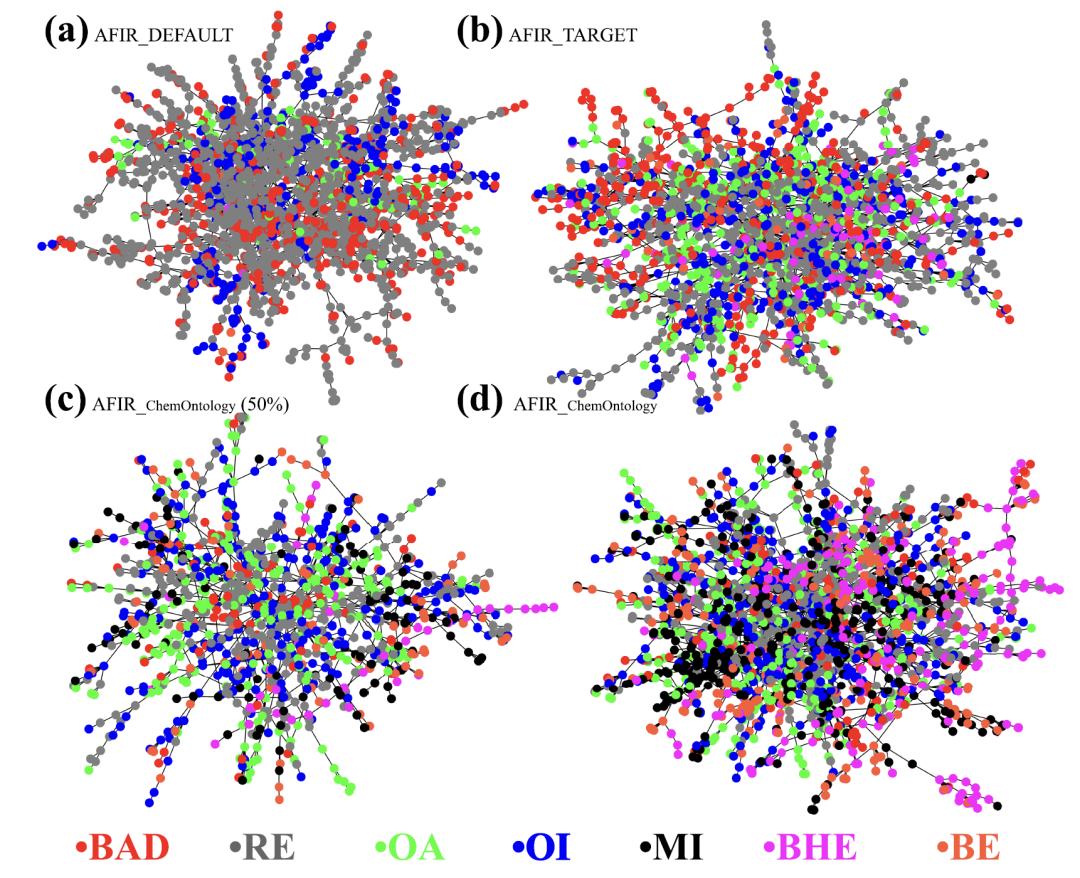
Reaction network diagram
As shown in the figure below, energy analysis shows that all three methods capture common steps in the early stage of the reaction, but only AFIR_ChemOntology can completely distinguish and track the specific paths leading to the main product and by - products respectively. In addition, characteristic interactions related to β - hydrogen elimination are commonly observed in effective paths. In the paths leading to trace products, this interaction shows weaker structural stability, which may explain the lower generation probability.
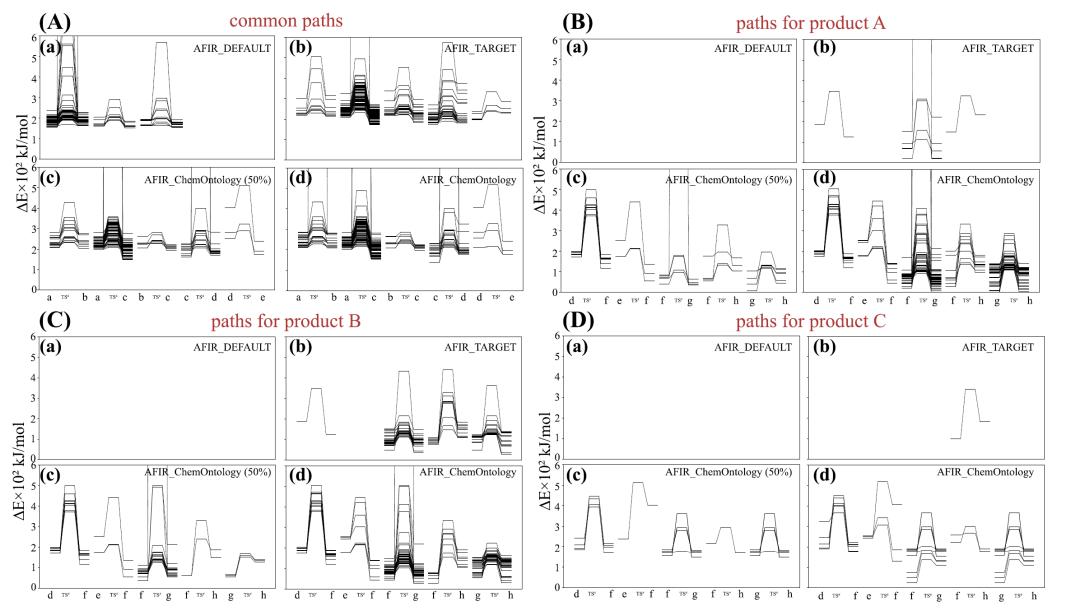
Comparison of energy curves of the three methods
In terms of computational efficiency, AFIR_ChemOntology can obtain effective results comparable to the complete search of AFIR_TARGET when exploring about half the number of paths, reducing the overall computational cost by nearly half. This advantage mainly stems from the guidance of chemical knowledge on the search direction and the real - time filtering of invalid structures. Overall, the experimental results show that integrating chemical ontology into automated path searches can significantly improve the efficiency of mechanism analysis while ensuring chemical rationality, providing a more efficient and reliable approach for the study of complex reaction systems.
From the Laboratory to the Factory: Chemical Ontology Remolds the Way of Reaction Exploration
The integration of chemical ontology and automated reaction path searches is building a key bridge between theoretical chemistry and industrial applications. This trend not only spawns a series of frontier explorations in academia but also triggers substantial innovation practices in the industrial circle, promoting the transformation of reaction mechanism research from traditional "post - hoc analysis" to more predictive "active guidance".
In academia, the research focus is on algorithm innovation and mechanism deepening, continuously expanding the cognitive boundaries of this field. For example, the team at the University of Iceland developed the "optimal transport Gaussian process" (OT - GP) algorithm. Its core lies in adopting an intelligent data screening strategy and can work efficiently with only a fixed - scale training data set. This algorithm significantly reduces the average time for molecular reaction path searches from 28.3 minutes to 12.6 minutes and significantly improves the success rate, providing a new tool for rapid mechanism exploration in complex systems.
Paper Title: Adaptive Pruning for Increased Robustness and Reduced Computational Overhead in Gaussian Process Accelerated Saddle Point Searches
Paper Link: https://doi.org/10.48550/arXiv.2510.06030
Meanwhile, the research team at the Swiss Federal Institute of Technology in Zurich (ETH Zurich) combined ab initio molecular dynamics with enhanced sampling methods to systematically study the key hydrogen transfer and rearrangement steps in zeolite and transition - metal - catalyzed reactions. They revealed the mechanism characteristics of reaction channels changing dynamically with the reaction environment and proposed a general microscopic picture for guiding the rational design of catalysts.
Paper Title: Ab initio molecular dynamics with enhanced sampling in heterogeneous catalysis
Paper Link: https://pubs.rsc.org/en/content/articlelanding/2022/cy/d1cy01329g
In the industrial circle, the practice focuses more on transforming these theories into actual productivity. Take Schrödinger, a representative enterprise in the field