The former president of Horizon Robotics starts a business in robotics for one year: For 9,988 yuan, you can "raise" a "little dog brother" at home.
Text by | Fu Chong
Edited by | Su Jianxun
At the end of 2023, after a strategic meeting of the AI chip unicorn "Horizon", Yu Yinan, then the President of Horizon's Intelligent Driving, along with executives such as CEO Yu Kai, CTO Huang Chang, and Vice President Su Jing, discussed their future visions for robots during a dinner. As a direct translation of the company's English name "Horizon Robotics", Horizon's ultimate vision is actually robots.
This was a discussion without a consensus: some were "Adventists", believing that robots would eventually occupy the Earth like the Trisolarans; others were "Controllers", believing that humans would create a large number of working robots and manage them.
Yu Yinan took a third stance: he preferred to regard robots as "partners", a "new species" that could live together and coexist equally with humans.
With this idealism, one year later, Yu Yinan left Horizon and founded the embodied intelligence enterprise "Vita Dynamics" to develop consumer-grade robots for the C-end market.
On December 23rd, Vita Dynamics launched the "Vbot Super Robot Dog" with a pre-sale price of 9,988 yuan. In terms of functionality, this quadruped robot dog, nicknamed "Big Head BoBo", currently covers the usage scenarios of three types of people:
For children, it can chat, run, jump, and play outdoors; it can also accompany and record daily life.
For the elderly, it can buy groceries (carry loads), lead the way, provide night lighting, accompany them for walks throughout the day, and independently patrol at home.
For geeks, its expandable backplate can be equipped with a storage basket to help carry things during camping; it can also be remotely controlled to perform tasks, such as picking up parcels from the community express station or exploring abandoned factories.
In short, the home scenario is the core positioning of this robot dog. However, for the robot dog to enter households, the product must meet extremely high standards in terms of stability, safety, etc.
Therefore, in terms of technical details, Big Head BoBo has all-terrain passing ability, can follow and lead the way without a remote control; in terms of appearance, it ensures that there are no sharp corners to prevent accidental injuries.
Today, with the emergence of numerous AI hardware categories, from the first day of entrepreneurship to the launch of the product, too many startup teams change their minds midway. However, if you saw Vita Dynamics' product design drawings in March this year, you would find that the product plan at that time has been almost completely realized today.
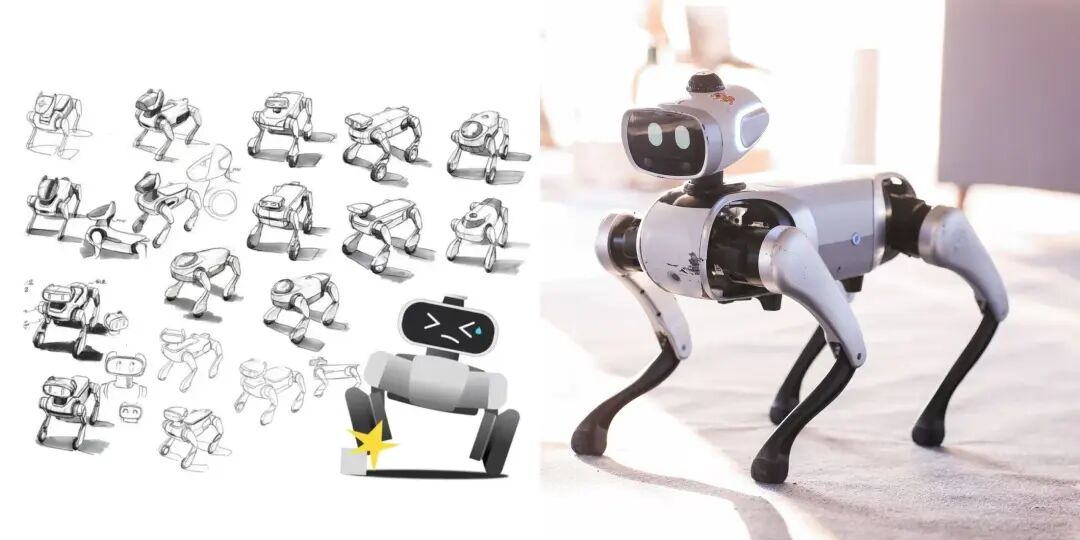
△ Design drawings and product pictures, Image: Provided by the enterprise
In one year, from design, finalizing the version, mold - opening, to manufacturing... Vita Dynamics is like a precisely - calculated machine. "Is this related to your background in To B business?" In early December, we asked Yu Yinan this question in Vita Dynamics' office.
He recognized the business determination given by his To B career experience. Taking Horizon, where he used to work, as an example: "You can look at Horizon's strategy in 2015. Ten years have passed, and it hasn't changed much." Yu Yinan worked at Horizon for nine years and was a member of the founding team. He led the team to promote the commercialization of the Journey series of AI chips and led the cooperation with car companies such as Changan and Li Auto.
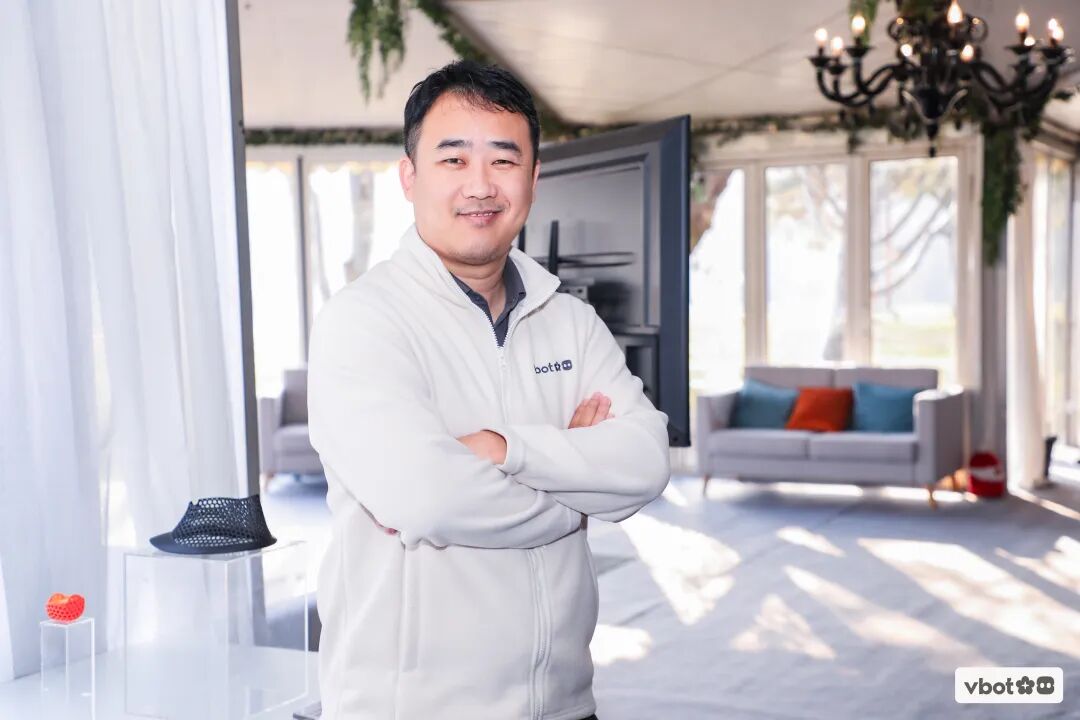
△ Yu Yinan, Image: Provided by the enterprise
However, there is an essential difference between To B business and To C products. To maintain determination in the To C market, the prerequisite is to have a clear product definition.
In an interview with us, Yu Yinan mentioned DJI and Insta 360, believing that they have done well in "insight into personalized needs" and can accurately target a user group.
"The most crucial point for a To C company in product design is to clearly determine who the product is for," Yu Yinan said.
The R & D process of Vita Dynamics is also an example of the founder using himself as a method.
The positioning of the "partner robot dog" stems from Yu Yinan's intuition as a father of two children - he hopes to have a partner that can accompany his 10 - year - old eldest daughter to explore the world and play with his 3 - year - old youngest daughter.
To put it in a more vivid metaphor - "Big Brother Dog". Vita Dynamics once conducted product research in a primary school in Beijing. After 40% of the children (both boys and girls) interacted with Vita Dynamics' robot dog, they tended to regard the robot dog as an "elder brother" - an image that can provide companionship, be relied on, and have an equal conversation.
That is to say, interaction is a higher standard for robots to enter households, which requires a smart AI model.
In terms of performance, Big Head BoBo entrusts complex language understanding to cloud - based large models (such as Qianwen, MiniMax), while all perception, decision - making, and control models adhere to self - developed models on the edge side. The cloud uses large models to be responsible for "understanding and reasoning", saving the cost and cycle of self - training ultra - large models; the self - developed edge - side models ensure the efficiency of task response and can run even in a weak network environment. The enterprise can also accumulate core motion data for future product iterations.
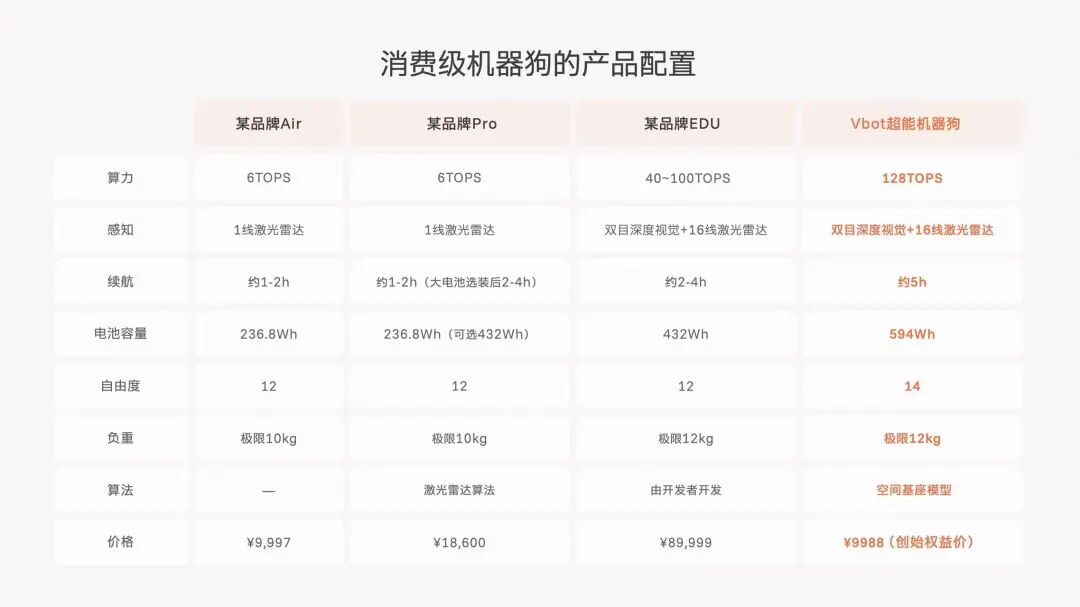
△ Product configuration data of Big Head BoBo, compared with similar products, Image: Provided by the enterprise
With the iteration of model capabilities, Big Head BoBo has learned to reason and think, and the Aha Moment of this AI robot dog has emerged.
A product manager of Vita Dynamics shared a story with us:
When they gave Big Head BoBo the instruction, "Find something interesting in the room and do an action", the robot dog thought for a while, then started to move, stretch, and adjust its posture, making its mechanical body form a dynamic reflection in the light - it chose its own shadow.
The following is the content of an interview between "Intelligent Emergence" and Yu Yinan, the founder of Vita Dynamics, sorted out by the author:
The Needs Behind the Needs
Intelligent Emergence: You held several product experience activities before the press conference, allowing many people to have their first close - up contact with the robot dog. What was the original intention of this activity?
Yu Yinan: From showing people robot demo videos, to on - site demonstrations, to actually letting users try it out themselves, the requirements for success rate or reliability corresponding to these three options are approximately 10%, 60 - 70%, and 90% respectively.
When shooting a demo, you can shoot ten times and select the best one. Moreover, the operator is an internal person who knows when it might fail and can "protect" the risks well during the control process.
However, when the product is in the hands of users, it must be operated in a more random and uncontrollable situation. We hope that users can personally feel the reliability.
Intelligent Emergence: Many startup companies constantly adjust their product directions, but when I saw your design drawings in March this year, they were almost the same as the current product form. How did you achieve this?
Yu Yinan: The most crucial point for a To C company in product design is to clearly determine who the product is for. For example, the products made by Wang Tao of DJI actually come from his unique view of the world in his heart, which can accurately meet the needs of a user group.
Regarding the robot dog, we are making products for ourselves. The surface - level demand we see is that "children want a playmate". But if we dig deeper, the more essential demand behind it is that "parents hope their children can go outdoors, engage in activities, and explore".
We have found the "needs behind the needs", and I myself am a typical representative of this user group. My family structure includes the elderly and children, so I took the first internal test machine home directly. We define products based on the most real life scenarios. Since our core needs do not change, the product direction will not be disturbed by the fluctuating "customer" needs from the outside.
Intelligent Emergence: Developing consumer - grade robots was your initial plan, but how was the form of the quadruped dog determined?
Yu Yinan: We analyzed the three main scenarios of consumer robots: public services, household chores, and family companionship.
The first two scenarios are suitable for humanoid or robots with arms. I hope to develop consumer robots that can be implemented immediately, so I excluded these two types. Humanoid robots are a future plan. The reason for choosing a quadruped is that its technology maturity is the highest and the commercialization path is the shortest.
Intelligent Emergence: Do you think the quadruped dog has reached the stage of being sold as a consumer - grade electronic product after having these functions?
Yu Yinan: I think the quadruped has reached the stage of being a consumer electronic product.
Let me first talk about my "passing line": it should have all - terrain mobility and recovery ability, be safe enough during remote control, and have sufficient battery life (Big Head BoBo can currently last for five hours). Big Head BoBo can provide different functions for three types of people in the family:
For children: Just like parents in 1995 wanted to buy a computer for their children, Big Head BoBo will be a window for children to access the future technology of robots at home.
Big Head BoBo can talk to children and go for walks outdoors with them like a puppy. It can pass through complex terrains such as mountains and slopes and accompany older children to play. At the same time, it is equipped with a camera, which can monitor and record for younger children.
For the elderly: It can follow, carry loads, and provide night lighting. For example, in the daily three - kilometer living circle, it can accompany the elderly for walks, buy groceries, and help carry things.
For adults: Big Head BoBo has a function called AVATAR, like a "substitute for remote exploration". Users can remotely control it to explore places where it is inconvenient for humans to go. For example, an abandoned factory. When traveling to a volcano, I would like to bring it and remotely control it to see what the crater looks like.
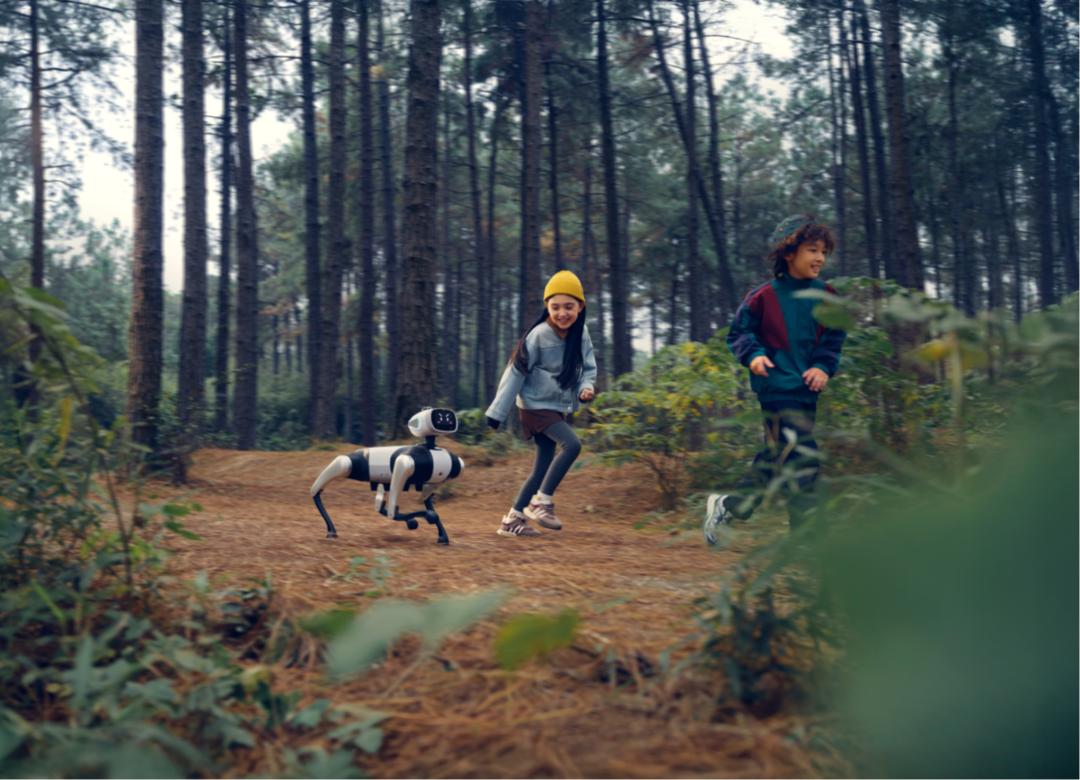
△ Parents' demand for the robot dog is to provide an outdoor playmate for their children, Image: Provided by the enterprise
The Intelligence of a "Partner"
Intelligent Emergence: "No remote control" is a featured function you promote. How does Big Head BoBo walk like a normal dog when following a person?
Yu Yinan: Our quadruped dog does not need a remote control because we hope it can be an intelligent agent that moves and thinks independently. The fundamental reason why it can walk stably when following is that our dog understands the environment through "cognition".
Other robot dogs may rely on sensors such as lidar to perform simple 3D environment modeling and regard many objects as obstacles. However, the core of Big Head BoBo is to use a large amount of data and algorithms to let it learn to "understand" what the things in front of it are like a living being.
Just like a human: I know this is a table, so I can put my phone on it; I know this is a wall, so I can't bump into it; but I also know this is just a hanging curtain or a pile of fallen leaves, so I can completely push it aside or walk through it.
This ability is not achieved through preset rules but is trained through a vast amount of real - world scenario data. When our robot dog is following, it does not mechanically avoid all objects but judges which are real obstacles and which are harmless and passable. This is the foundation of the "autonomous intelligent agent" we are committed to creating - it not only needs to react to the environment but also understand the environment.
Intelligent Emergence: Have you discovered any "Aha Moment" regarding Vita Dynamics' robot dog?
Yu Yinan: Our product manager should have shared with you that there was an impressive moment when, when asked Big Head BoBo to "find something interesting in the room and do something", it found its own shadow and would repeatedly change its posture to adjust and observe the shadow.
In fact, most of today's AI hardware is "responsive AI". You say a sentence and it replies; you make a request and it executes a task.
There is an underlying question: what is the difference between today's robots and an AI speaker?
But this is indeed different from the underlying concept of our product. You can see that our company is called Vita Dynamics, and our logo is a small flower, which also reflects this concept, that is, to have vitality.
For a robot, vitality means that it itself should be an independent individual and does not necessarily need external instructions to perform actions.
I will urge the team to create signs of autonomous cycles for the robot. Just like when it sees the shadow and explores it in a cycle, it seems to have self - awareness.
Intelligent Emergence: Besides curiosity and self - awareness, what other basic logics form the intelligence of Vita Dynamics' robot dog?
Yu Yinan: For the robot dog product, I hope it has three characteristics:
1) Curiosity to explore interesting things;
2) The survival instinct to charge when it is "hungry" (out of power);
3) The safety need to avoid danger. This is usually what parents expect from their children. Based on this, it can self - drive and interact autonomously in the environment. This is what a partner is, rather than a slave waiting for orders.
Intelligent Emergence: How do you balance the cloud - based large model and edge - side intelligence? Where is the core competitiveness of the algorithm?
Yu Yinan: We adopt a hybrid architecture. The cloud - based large model (such as MiniMax) handles complex language understanding and reasoning. There is no need for us to self - train a 200B or dozens of B - level language model.
However, all the things running on the edge side are developed by ourselves. For models related to perception, decision - making, and control, we prefer to develop them completely independently.
Intelligent Emergence: Data is the foundation of AI intelligence. Currently, the embodied intelligence industry is keen on collecting "hand - operation data", but the data you collect seems to focus on "movement and environmental interaction". Is it a bit too "basic" in comparison?
Yu Yinan: This is a bit like human growth. People only focus on "skill training", such as learning to drive in two weeks, but ignore the basic understanding of the world established through years of crawling, walking, jumping, and playing. This basic cognitive "pre - training" is the foundation of intelligence.
The data obtained by our robot dog through autonomous exploration in the environment is