Children's AI Hardware in 2025: A Mix of Breakneck Pace, Anxiety, and Dividends
This year, the children's AI hardware field is iterating at an unprecedented speed.
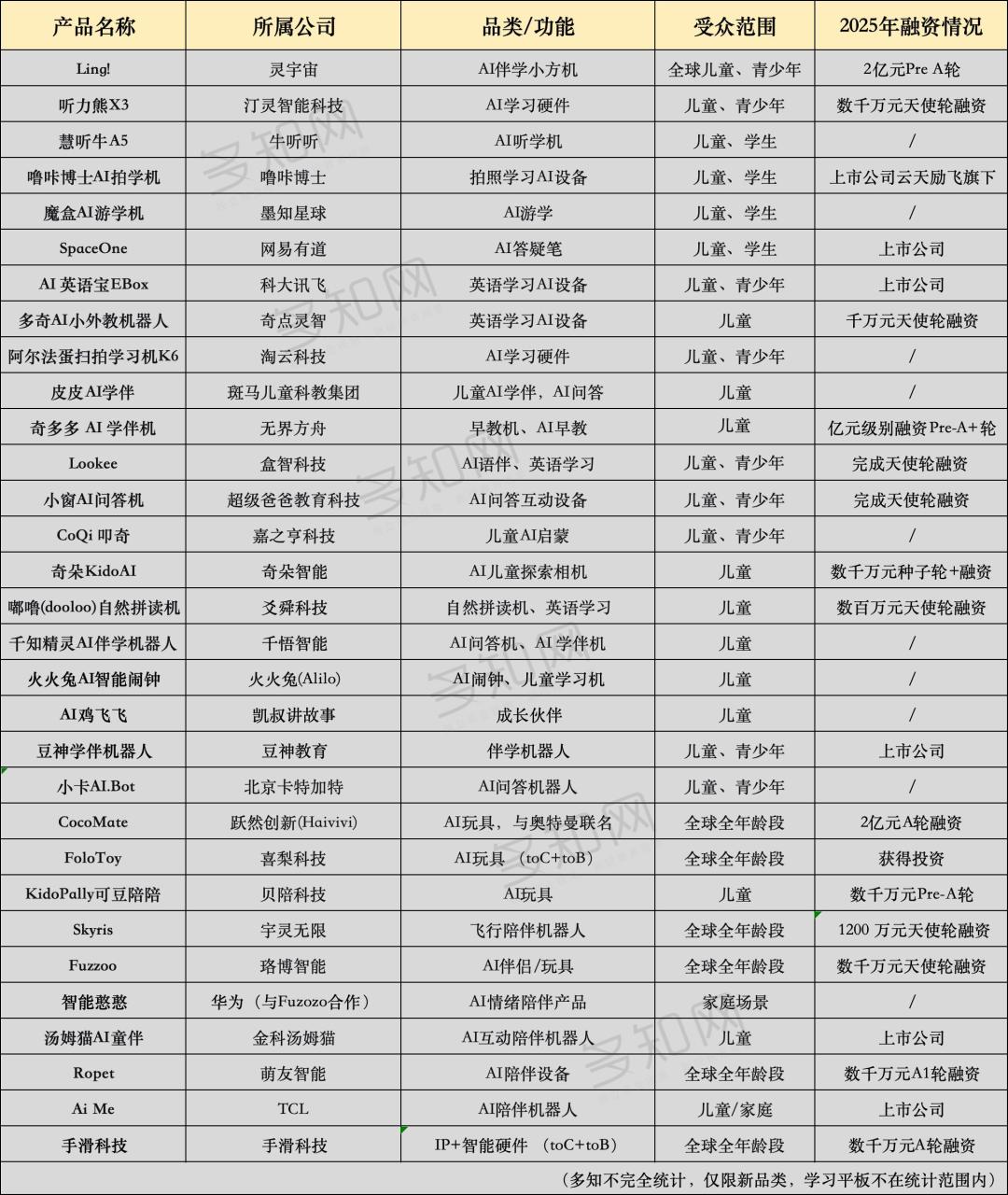
Based on incomplete statistics of public information by Duozhi, more than 15 children's AI hardware companies have raised funds this year. Among them, two have raised over 100 million yuan, and more than 30 new children's AI hardware products have been launched. Most of these companies are quite young, with an average establishment time of about two years.
All industries can be reinvented with AI. Taking toys as an example, the prospects are promising. Data from the Frost & Sullivan report shows that the global toy market is expected to further grow to 993.7 billion yuan in 2028, with an average annual compound growth rate of 5.1% in the future. In China alone, data from the Ministry of Industry and Information Technology shows that the market size of AI toys in China will increase to 29 billion yuan in 2025, with an annual compound growth rate of over 50%.
"AI is disruptive to all industries, and children's hardware is also a major category. Currently, the children's AI hardware market is booming with diverse product forms, and each company is still exploring," said Drew (a pseudonym), a practitioner in the children's AI hardware industry, to Duozhi.
A children's hardware distributor mentioned that "the children's AI hardware market in Shenzhen changes almost every month."
"It's in full swing," said Wu Weiming, the founder of Shenzhen Maiwei Times Technology Co., Ltd. (hereinafter referred to as "Maiwei Times"), using this idiom to describe the industry landscape in his eyes. He has been engaged in the hardware supply chain for more than 20 years and has witnessed the transition from the DVD era to the AI era. He said: "Nowadays, all hardware companies are transforming towards AI because almost all products can incorporate AI."
An unnamed investor believes that "the financing of children's AI hardware in the first half of this year was mainly focused on 'companionship', while in the second half, it was products in the form of 'small square machines'."
Many investors have looked at dozens of children's AI hardware products this year but have been hesitant. Investor Edwin (a pseudonym) expressed his concerns: "Some children's AI hardware has sold 200,000 units, which might be considered a 'good business model'. But are these children's AI hardware products really innovative? Where are their barriers?"
When we delved into the perspectives of children's AI hardware entrepreneurs, the person in charge of the Shenzhen supply chain, and investors who have long been concerned about this track, we outlined the current picture of the children's AI hardware industry: a mix of rapid development, anxiety, chaos, temptation, and dividends.
01 "In Full Swing"
Shenzhen is the global hardware capital, and the practitioners here are the first to sense the industry's trends.
Wu Weiming observed that "there is a new trend in consumer electronics products in Shenzhen almost every two to three years. This year, all hardware is incorporating AI. Factories are keeping up with the iteration speed of models, and various salons and forums related to AI hardware are always full."
Wu Weiming has been in the industry for 20 years. He came to Shenzhen in 2004 and founded a company focusing on hardware products in 2005. He has experienced the booms of consumer electronics such as DVDs, MP3s, tablets, and mobile phones. After several twists and turns, he founded Maiwei Times in 2013.
This company focuses on children's technology products, including children's mobile phones, children's walkie - talkies, children's cameras, AI printing cameras, and AI plush toys. On the one hand, the company focuses on developing self - developed products, and on the other hand, it provides professional ODM customized development services for industry partners. It can be said that its business covers a one - stop supply chain management service from ID design, structural design, R & D, assembly to after - sales.
"In the field of children's hardware, an obvious feeling this year is that entrepreneurs in AI toys, AI companion hardware, etc. are flocking in." Wu Weiming told Duozhi.
Another distributor also told Duozhi that "the children's AI hardware market is changing too fast now. The children's hardware market in Shenzhen changes almost every month."
From the perspective of producing a single hardware product, Wu Weiming introduced that "Shenzhen is extremely competitive and highly efficient. A simple imitation product can be made in one month. For normal products, it takes three to four months, and for slower ones, it takes half a year to a year, but few people dare to take it slow. It takes both wisdom and courage to be the last to act."
Gao Feng, the founder of Hangzhou Qianwu Intelligence, a children's AI hardware company, has a similar view. Their company's supply chain is also in Shenzhen. He told Duozhi that "indeed, many entrepreneurs are flocking to the children's AI hardware field. However, from a R & D perspective, in fact, the R & D cycle of AI hardware products is as long as one and a half years, far from the one - month turnaround for a disruptive product that the outside world imagines. It's not like just stuffing a voice box into a toy doll and getting a ready - made solution in half a month or a month."
He explained that "simple imitation products can indeed be quickly launched in one month, but these are just minor modifications based on existing hardware."
In Shenzhen, the real "speed" is not the disruptive innovation in product R & D but the ultimate efficiency of the supply chain.
In Wu Weiming's view, from the perspective of product iteration speed, 'changing every month' is too slow, and 'changing with each passing day' is no exaggeration."
"This speed is also inevitable. In the AI era, everyone is anxious and has the 'Fear of Missing Out' (FOMO), afraid of missing out and being left behind." Wu Weiming said.
Drew admitted that "we really can't afford to be slow. The main reason is that the performance of large models improves significantly every few months, which directly forces the upper - layer applications and hardware products to quickly adjust. The entire market also tolerates rapid trial - and - error."
In any case, there are more and more entrepreneurs in the entire children's AI hardware industry. Some of them are veterans with more than a decade of experience in the hardware industry, some are executives from Internet giants or leading education technology companies, and there are also newcomers...
In Drew's view, AI brings opportunities for entrepreneurs, which may disrupt the existing models and give rise to the next giant. For large companies, they are also trying various ways to create new solutions.
02 Choices and Divisions
In this frenzy of the children's AI hardware market, everyone has different development paths. In the AI era, what kind of interaction method is the most suitable? Currently, each company may have a different answer.
In terms of appearance, there are plush ones, non - plush ones (such as skin - friendly silicone), with screens, and without screens.
Most AI toy products are plush because "the soft touch provides a stronger sense of companionship." However, some choose silicone materials, especially for learning - oriented products. Their reason for not choosing plush is that "plush products are not easy to clean."
Products without screens are represented by Lookee, Pipi AI Learning Companion (a product of the Bama Group), Jifeifei, etc. It also includes AI companion products such as Haivivi, Kedou Peipei (a product of Beipei Technology), Luobo Intelligence (Fuzozo), etc.
However, Lookee and Pipi AI Learning Companion mainly focus on language interaction, while Fuzozo doesn't even require complex language interaction. Its main selling point is emotional value.
Children's AI hardware with pure voice interaction aims to return to the genuine communication of language and imagination and alleviate parents' concerns about their children's excessive eye use.
Since Lookee focuses on English speaking, it wants to be more in line with the characteristics of the scenario. Lu Yaqi, the founder of Hezhi Technology, once mentioned in a conversation with Duozhi that "removing the large screen allows children to break away from their dependence on text prompts and restores a more real communication environment."
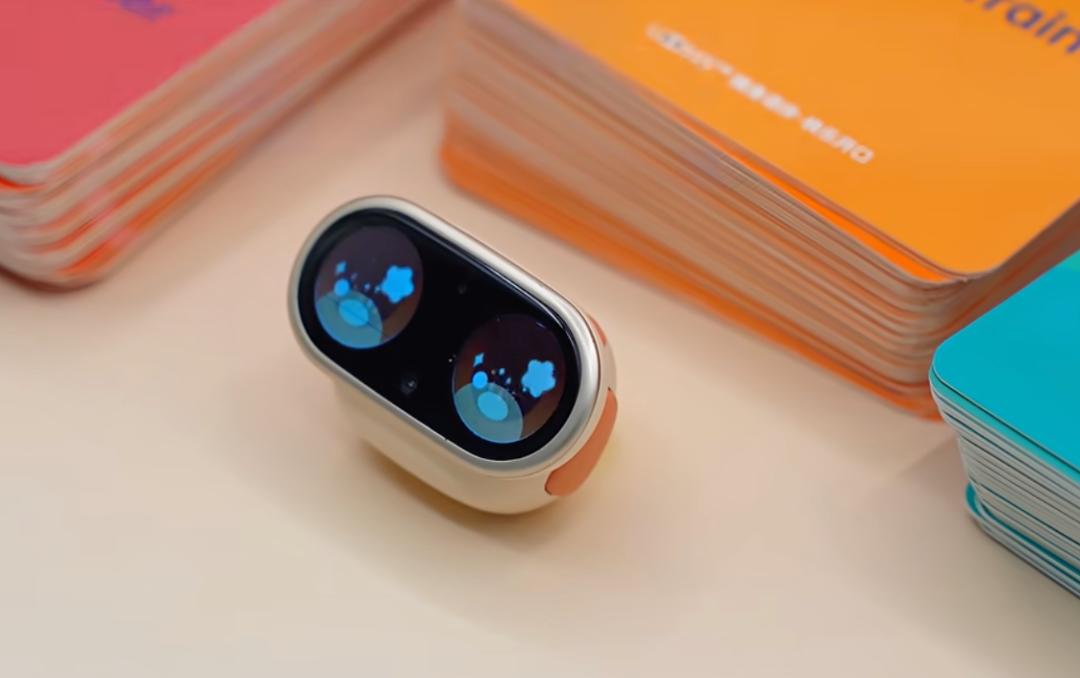
Products with screen - based multimodal interaction are represented by Ling! Small Square Machine, Duoqi AI English Learning Companion Robot (under Qidian Lingzhi), etc.
When considering equipping children's AI devices with screens, different design concepts have their own considerations and applicable scenarios, and it's difficult to measure them with a single standard. However, they all believe that the screen is not the core; it's more like an 'organ' of the product.
The Duoqi AI English Learning Companion Robot has a screen on its chest, which takes up half of the body. However, Xu Yifei, the co - founder of Qidian Lingzhi, once told Duozhi that "this screen is not a Pad placed in front of the child but an 'expression organ' for the robot to give feedback. We hope it's more like a little elf quietly standing on the desk with you. So we strive to make the graphics and text presented on the screen simple, intuitive, and clear."
Qidian Lingzhi wants children to return to the most natural physical space for learning, like a 'pretend - play' role - playing. Its core lies in promoting children's interaction with the physical desktop and physical props.
Gu Jiawei, the founder of Ling! Small Square Machine's Ling Universe, wants to create the next - generation AI terminal. He emphasizes "the transformation of interaction methods." In his view, the core of human - machine interaction does not lie in the screen.
Although the Ling! Small Square Machine has a screen, it is mainly used to cooperate with the camera for recognition. The core logic is to make the physical entity itself an intelligent carrier. Users can directly interact naturally with objects in the environment (such as picture books, toys, furniture) without intermediate devices such as mobile phones and computers.
Gu Jiawei once founded Wuling Technology. Its core product, Luka, is a picture - book reading and desktop interaction scenario based on screen - less touch technology. Now, the Ling! Small Square Machine turns the world into a classroom. This "device - less" interaction experience essentially transforms the entire physical world into an interactive interface, realizing the vision of 'the world is the classroom, and the world is the textbook'.
Although the Qianzhi Elf AI Learning Companion Robot has a screen, the screen is only for guidance and reference.
It can be seen that entrepreneurs may have similar understandings and expectations for children's AI hardware products, but the results are diverse.
In terms of operation ideas, entrepreneurs also have significant differences.
Taking AI companion toys as an example, Yueran Innovation is a typical example of IP operation. Its core logic is not simply to sell hardware but to build a competitive barrier through IP images and content ecosystems.
"Yueran Innovation has a clear positioning. Its essence is an IP operation company, and AI technology is an added value. Its approach is to start with IP dialogue for emotional companionship and then expand content through IP cooperation." Investor Edwin analyzed.
After raising funds this year, Yueran Innovation quickly launched a new product with the "Ultraman" IP. In addition, it has obtained AI toy authorizations for many well - known IPs such as Peppa Pig and Nailong and has reached strategic cooperation with several well - known IP parties at home and abroad.
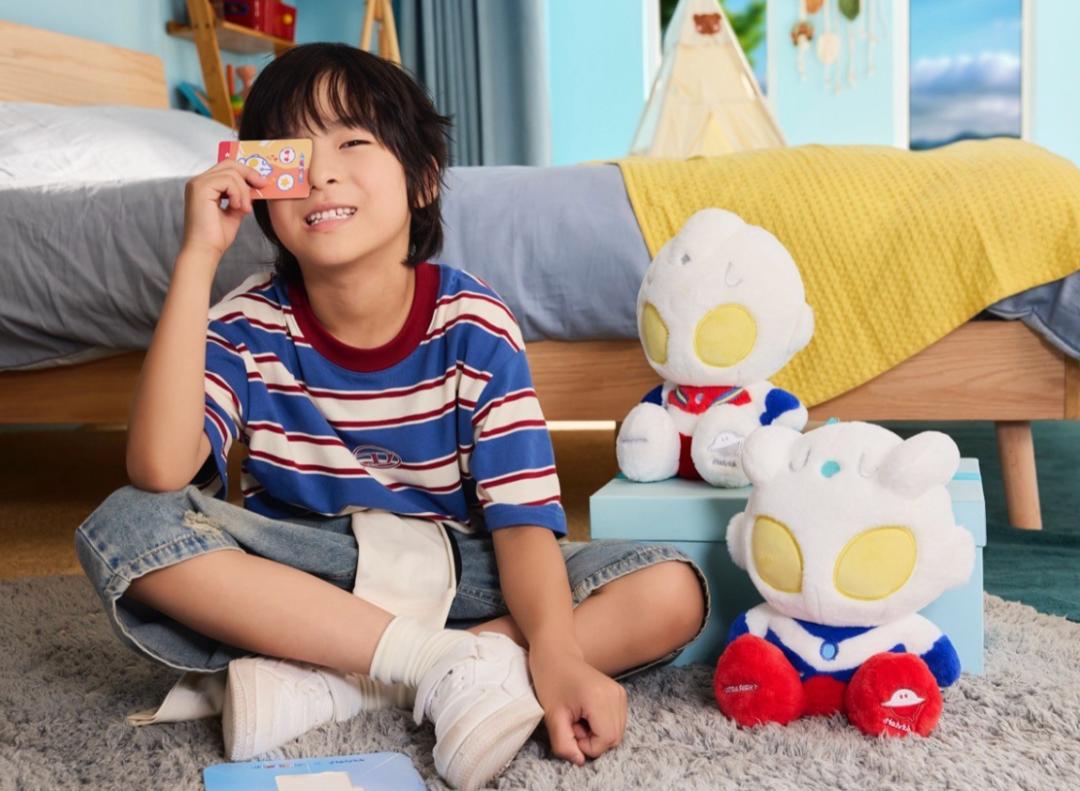
Moreover, under the IP operation logic, Yueran Innovation focuses on AI toys and is not limited to children.
This "IP + AI interaction" model has the potential for rapid growth. However, the challenge is that some companies with IPs are also "adding AI."
Most children's hardware operation ideas focus on functionality, represented by brands such as Ling! Small Square Machine, Duoqi AI English Learning Companion Robot, and Lookee, which target the rigid learning needs.
If learning machines represent the certain path for functional children's AI hardware products, then the new - form children's AI hardware is exploring new learning methods and interaction experiences in the AI era.
The Ling! Small Square Machine does not focus on rigid subject learning but hopes to be an "intelligent entity" for growth companionship, a child's AI friend, and focuses on "accompanying children to learn better." The Duoqi AI English Learning Companion Robot and Lookee target the pain points in the English learning track. These products have carved out a niche in the children's AI hardware market with their practical functional anchors.
The Qianzhi Elf AI Learning Companion Robot is strengthening its learning function. Gao Feng analyzed that "parents need some functions that can be used continuously. For example, with the encyclopedia Q & A function, once children use it and find they need it all the time, there will be a continuous demand."
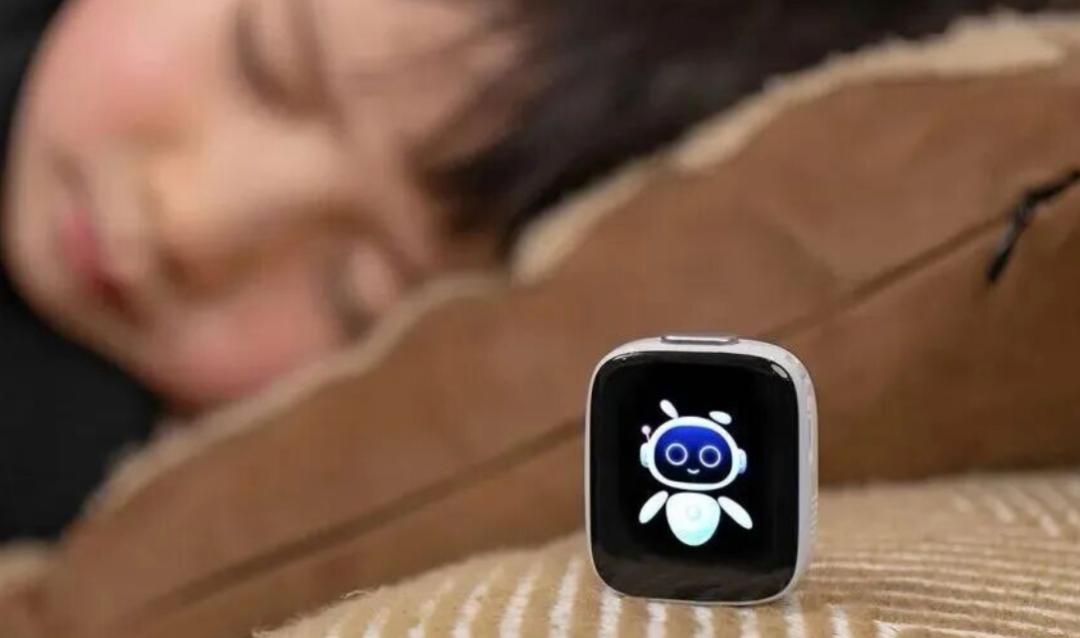
This kind of functional product relies more on content and effectiveness, which is a steady and slow - growth path.
In addition, each company also makes different choices regarding pricing. For example, there are products priced above 1000 yuan, products priced at a few hundred yuan, and products priced below 100 yuan. The choice may be related to positioning, cost, etc.
In Drew's view, the industry is still in a very early stage. The practitioners in the children's AI hardware field have not yet reached a consensus. Each company has its own views, and it's hard to say which one is the absolute truth. Each company is still in the stage of rapid trial - and - error, validating products through market feedback.
03 Hidden Worries
Behind the rapid development, problems such as high return rates and homogenization have become the unpleasant truths that the industry is reluctant to face.
Data statistics from an e - commerce platform show that for AI toys, the user experience satisfaction rate is less than 21%, and the return rate of some products reaches 40%.
Drew also admitted that from the perspective of the entire industry, the return rate is relatively high, and some brands are close to 50%.
In the view of investor Edwin: "A high return rate for AI toys is normal because they address emotional needs, and emotional needs are not persistent. AI hardware with continuous and rigid needs may be more resistant to returns."
The practitioners in the entire AI hardware industry chain are relatively optimistic about the return rate.
Gao Feng, the founder of Qianwu Intelligence, admitted that "new product categories usually have the problem of high return rates. Many users have a mentality of trying something new, and products with pure companionship and emotional value are prone to 'three - day enthusiasm'. How to retain users is indeed a problem that the company needs to think about. For example, we are strengthening the functionality of our products."
Wu Weiming said: "Now many are first - generation products. Hardware products usually have returns at the beginning and need continuous iteration to get better. Of course, the company is also gradually optimizing some problems. For example, the delay rate of AI dialogue in the entire industry has been significantly improved compared to the beginning of the year."
In Drew's