The era of legal "handover" has begun. L3 autonomous driving licenses have been issued, and taxi-hailing experiences will be available next month.
L3-level autonomous driving has entered a new stage of "legal operation."
On December 23, the Beijing Municipal Public Security Bureau Traffic Management Bureau officially issued the first batch of special license plates for L3-level highway autonomous driving vehicles in Beijing to three BAIC ARCFOX intelligent connected vehicles under Beijing Chuxing Automobile Service Co., Ltd. These are also the first batch of special license plates for L3-level highway autonomous driving vehicles issued in China.
This marks that China's autonomous driving vehicles have progressed from testing and demonstration to formal mass production, taking the lead in opening the era of L3-level autonomous driving.
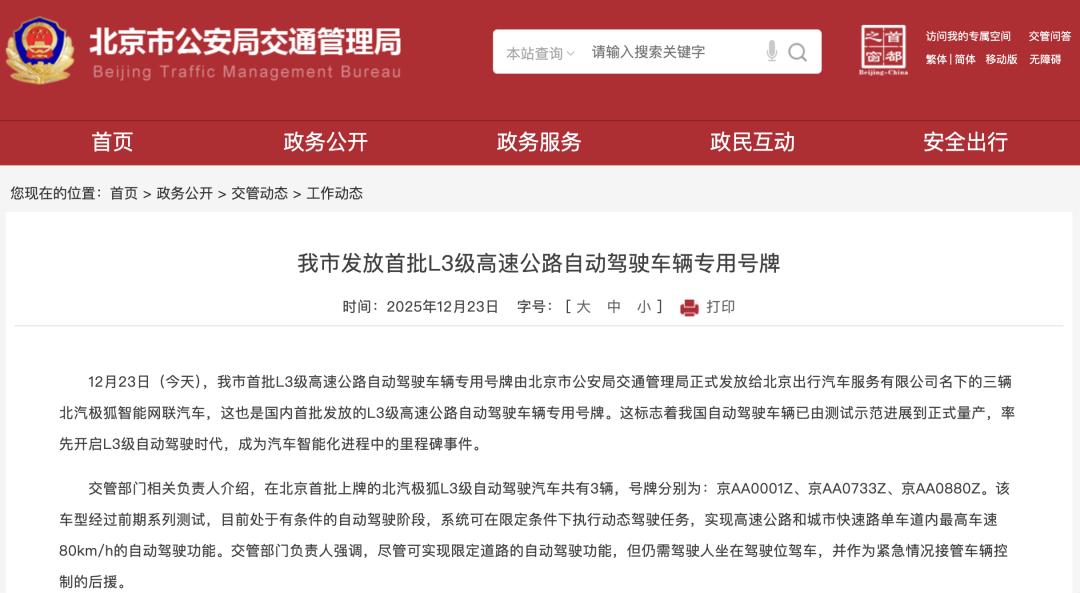
The Beijing Municipal Public Security Bureau Traffic Management Bureau issued an announcement
ARCFOX also posted on its official social media account, stating that the first batch of official special license plates for L3-level autonomous driving were installed on the ARCFOX Alpha S (L3 version) models. This indicates that ARCFOX has not only completed the product access certification but also successfully gone through the entire process of license plate registration, truly entering a new practical stage of "legal operation" from "technical verification."
Meanwhile, ARCFOX demonstrated the actual experience of its L3-level autonomous driving technology to the public through a live broadcast. During the live broadcast, Wang Yan, the chief engineer of BAIC's L3-level autonomous driving access pilot project, said, Obtaining the access permit is equivalent to getting a "graduation certificate," indicating that the product's safety has passed the complete verification of the national competent authorities and is eligible for market sales. The vehicle's status has officially changed from the R & D state to a mass-produced vehicle.

Wang Yan (right) interprets the L3-related policies and technologies
"The new car is a jointly developed and deeply customized product with strategic partner Huawei and has been produced in small batches." Wang Yan further said, The L3-level autonomous driving vehicles are not currently available for purchase by individual consumers. Since it is still in the pilot stage, the vehicle usage rights are limited to Beijing Chuxing Automobile Service Co., Ltd. It is expected that starting from January next year, consumers can experience L3-level autonomous driving models by taking a taxi.
Just a few days ago, on December 21, Deng Chenghao, the chairman of Deepal, also posted on social media, saying that Deepal had obtained the special license plate for autonomous driving, "Yu AD0001Z." Deng Chenghao said, "The last 'Z' represents autonomous driving. This is the first one."
According to the access pilot work specifications clarified by the four departments, the pilot includes two stages: the access pilot and the on-road operation pilot. Currently, the pilot entities can only operate within the limited road sections and vehicle models. Although there are restrictions on the driving route, speed, and user, there is no doubt that L3-level autonomous driving has taken the first step towards commercial application.
01
The issuance of license plates marks the first step of L3-level autonomous driving on the road
According to the relevant person in charge of the Beijing traffic management department, A total of three BAIC ARCFOX L3-level autonomous driving vehicles in Beijing have obtained the on-road permission this time, with license plate numbers: Jing AA0001Z, Jing AA0733Z, and Jing AA0880Z. This model has passed multiple previous tests and is currently in the stage of "conditional autonomous driving." The system can complete dynamic driving tasks under specified road conditions, enabling autonomous driving on highways and urban expressways within a single lane at a maximum speed of no more than 80 km/h.
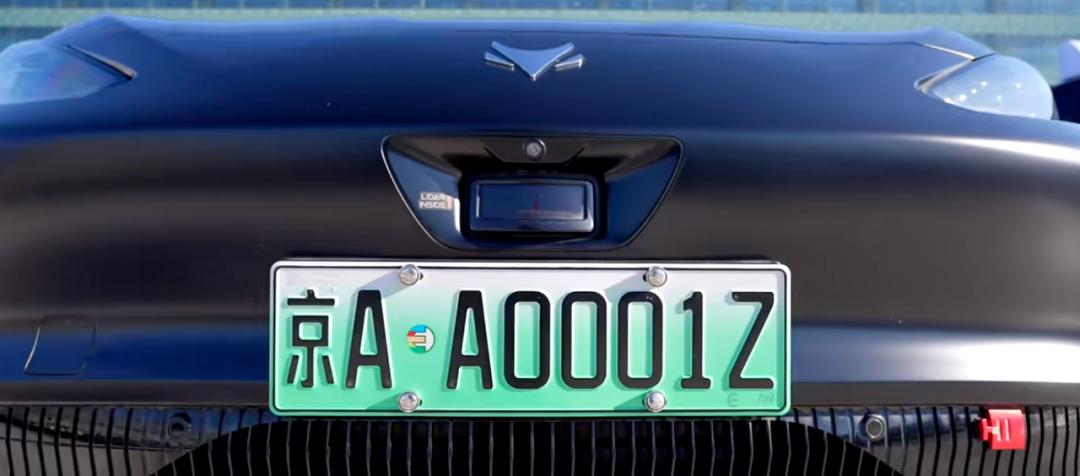
BAIC ARCFOX L3-level autonomous driving vehicles have obtained on-road permission
The person in charge of the traffic management department emphasized that Although the autonomous driving function can be realized on limited roads, the driver must still sit in the driver's seat and be ready to take over vehicle control in case of an emergency.
Currently, the "conditional autonomous driving" function is only allowed to be activated on some road sections in Beijing, specifically including the Beijing-Taiwan Expressway (Jiugong New Bridge in Daxing District - Airport North Line Expressway), the Airport North Line Expressway (Daqunan Bridge - Daxing Airport Expressway), and the Daxing Airport Expressway (South Sixth Ring Road - Airport North Line Expressway). On other roads or areas, this function will be forcibly disabled by the system.
Overall, The approved L3-level autonomous driving models this time have the characteristics of "limited road sections, single lane, speed limit, and designated users," reflecting the current regulatory idea of "steady and cautious progress, starting with controllable areas and then expanding."
The Beijing Public Security Bureau Traffic Management Bureau also stated that it had previously guided BAIC ARCFOX in the entire process of work, including simulation tests, closed-road tests, actual road tests, safety evaluations, emergency drills, license plate issuance, and safety officer filing, in conjunction with the Traffic Management Bureau of the Ministry of Public Security and the Road Research Center, helping BAIC complete the L3 pilot road operation regulation tests and officially obtain the national's first batch of access product announcements for L3 autonomous driving vehicles.
Next, the Beijing Public Security Bureau Traffic Management Bureau will continuously strengthen the management of intelligent connected vehicles and, in conjunction with the Municipal Economic and Information Technology Bureau, the Municipal Transportation Commission, and the Municipal Double Intelligence Office, implement the Beijing intelligent connected vehicle industry development plan in depth, creating a replicable "Beijing model" for the large-scale application of autonomous driving.
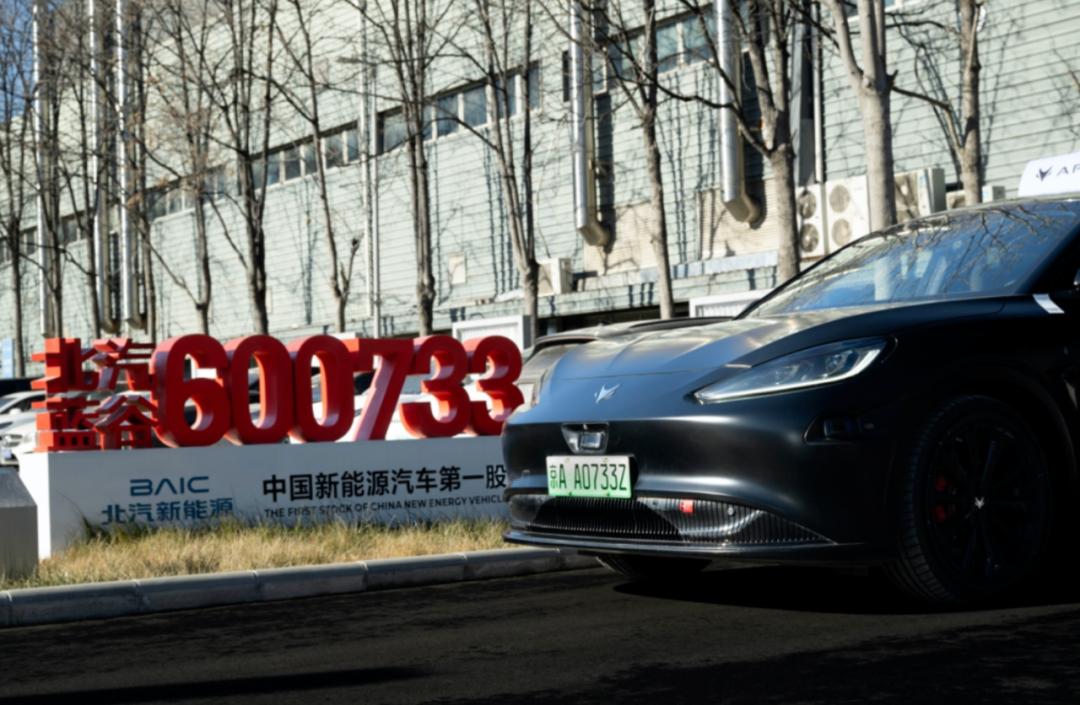
The license plate "Jing AA0733Z" echoes the stock code of BAIC New Energy
In the view of BAIC ARCFOX, the three official autonomous driving license plates obtained this time have special symbolic meanings. As the "first batch of identity marks" in the implementation process of autonomous driving in China, "Jing AA0001Z" means the first official license plate for autonomous driving in the country without being restricted by highway congestion; while "Jing AA0733Z" cleverly echoes the stock code "600733" of BAIC New Energy in the A-share market.
02
ARCFOX launches an L3 live broadcast to respond to hot topics
After obtaining the special license plates, BAIC ARCFOX immediately demonstrated the actual experience of its L3-level autonomous driving technology to the public through a live broadcast. During the live broadcast, Wang Yan gave a detailed interpretation of the relevant policies and technical features.
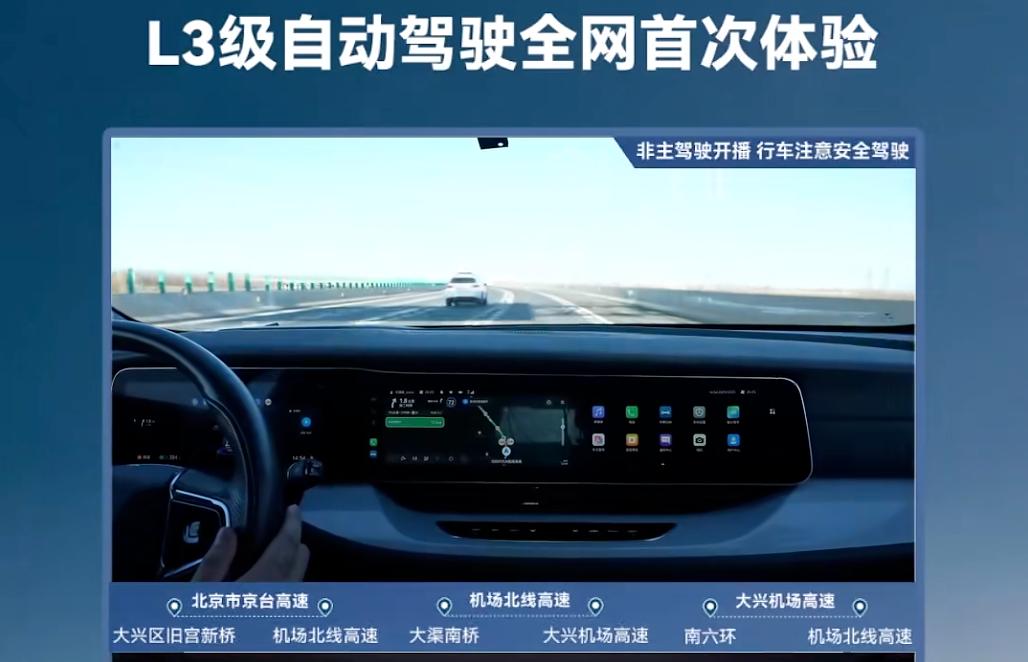
BAIC ARCFOX live broadcasts the L3-level autonomous driving experience
Wang Yan emphasized the essential difference between the "testing permit" and the "access permit."
He pointed out that obtaining a testing permit is like getting an "admission ticket," meaning that the vehicle is eligible for on-road testing; while obtaining the access permit is equivalent to getting a "graduation certificate," indicating that the product's safety has passed the complete verification of the national competent authorities and is eligible for market sales. The vehicle's status has officially changed from the R & D state to a mass-produced vehicle.
Although it has the sales qualification, currently, L3-level autonomous driving vehicles are not available for purchase by individual consumers. Wang Yan explained that since it is still in the pilot stage, the vehicle usage rights are limited to the application consortium enterprise, that is, Beijing Chuxing Automobile Service Co., Ltd. under BAIC Group. The new car has been produced in small batches. It is expected that starting from January next year, consumers can experience L3-level autonomous driving models by taking a taxi, but only in the limited areas of Beijing.
"The hardware and software of BAIC ARCFOX's L3-level autonomous driving vehicles are exactly the same as those of the mass-produced vehicles that will be on the road in the future." Wang Yan introduced that the new car is equipped with three lidars and more than a dozen cameras, achieving 360-degree panoramic perception. Different from L2-level assisted driving models, there is a protruding device on top of L3-level autonomous driving vehicles to collect real-time vehicle information, including whether the autonomous driving is in the active state. These data will be uploaded to the enterprise monitoring platform in real-time through the cloud and then to the relevant national competent authorities to monitor the operation level of domestic autonomous driving vehicles and support the improvement of regulations.
He also pointed out that Currently, in the pilot project, the existing models on sale will not be upgraded to L3. This is the requirement to be followed at this stage. In the future, with technological progress, a comprehensive evaluation will be made after fully assessing whether the existing models can meet the basic hardware and software configuration requirements of L3.
Wang Yan emphasized that the core of L3-level autonomous driving is to free the driver from driving tasks in specific scenarios. During the activation period, the driver can take their hands off the steering wheel and do not need to constantly focus on the road, but sleeping is not allowed. The core requirement is that when the system reaches its design limit and issues a takeover request, the driver needs to take over the driving authority from the system within a specific time.
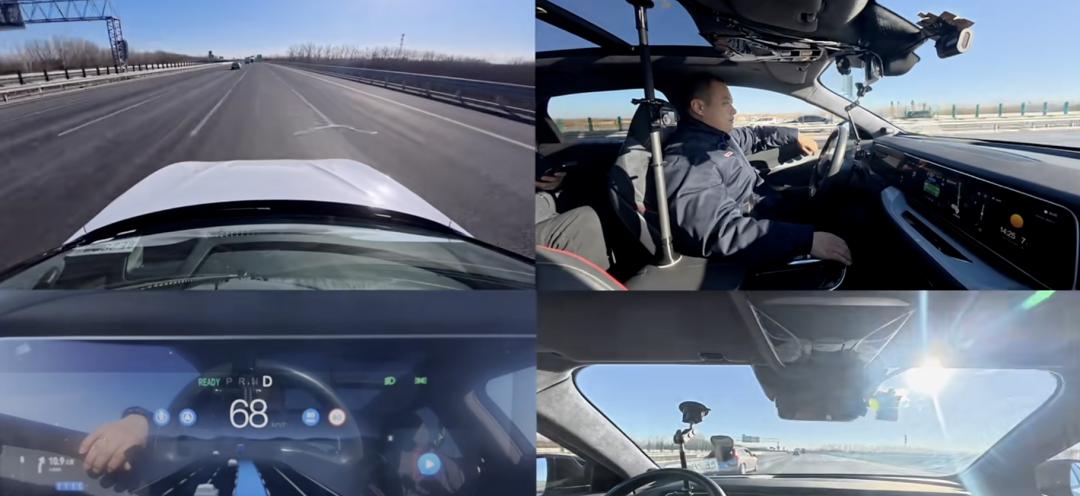
BAIC ARCFOX demonstrates L3-level autonomous driving technology
"On the surface, it is about taking hands off the steering wheel, but in essence, it is a major shift of responsibility." Wang Yan said, which means that during autonomous driving, the vehicle and the enterprise will assume the corresponding safety responsibilities.
Wang Yan revealed that The policy does not set strict speed limits for the application enterprises, but BAIC ARCFOX has set an overall principle during the pilot stage: implement step by step and start with a small scope. In fact, all the hardware and software configurations of ARCFOX vehicles can support a maximum speed of 120 km/h. In addition, the system will automatically recognize complex weather conditions such as rain and fog and issue a takeover prompt to ensure driving safety.
03
Step-by-step advancement: L3-level autonomous driving enters a new stage
In addition to ARCFOX, Deepal, a brand under Changan Automobile, also recently obtained the special license plate for L3-level highway autonomous driving vehicles. On December 15, the Ministry of Industry and Information Technology conditionally approved the L3-level autonomous driving vehicle products of Changan and ARCFOX in the 401st batch of the "Announcement of Road Motor Vehicle Manufacturers and Products."
According to the announcement information, the Changan brand SC7000AAARBEV pure-electric sedan (Changan Deepal SL03 L3 version) is equipped with an independently developed L3-level system and is allowed to achieve autonomous driving at a maximum speed of 50 km/h in a single lane on highways and urban expressways in traffic congestion. The function activation road sections are clearly limited to some expressways and arterial roads in Chongqing.
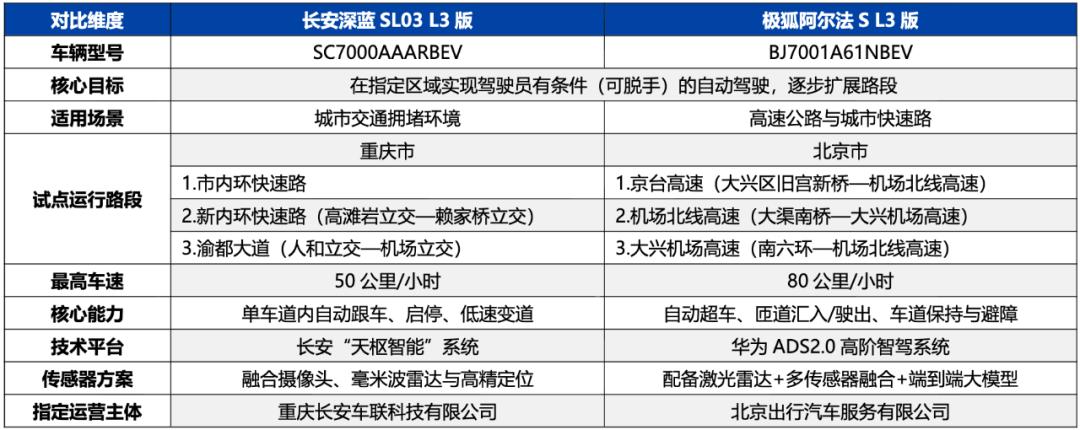
Comparison of two L3-level autonomous driving vehicles. Image source: AJ Securities
Comparing the policies in Beijing and Chongqing, it can be seen that there are differences in the pilot paths: Beijing focuses on high-standard traffic scenarios to verify the stability of the system under ideal road conditions; Chongqing uses complex three-dimensional road networks as the test environment to test the reliability of the system in challenging road conditions. Closed or semi-closed urban expressways, airport expressways, and other road sections have relatively simple traffic participants and stable road structures, making them the main scenarios for current L3 testing, with relatively limited tests on the long-tail problems of the system.
In addition to the two approved enterprises, BYD, Li Auto, XPeng, and multiple brands under Hongmeng Zhixing have also reported progress related to L3 testing.
The approval of L3-level autonomous driving vehicles to operate on the road is a standardized process of step-by-step advancement.
As early as November 2023, four departments, including the Ministry of Industry and Information Technology and the Ministry of Public Security, jointly issued the "Notice on Carrying out Pilot Work on the Access and On-road Operation of Intelligent Connected Vehicles," clarifying that the pilot is for L3 and L4-level intelligent connected vehicles with mass production conditions and will be advanced in stages such as application, access testing, and on-road operation.
In December of the same year, the first batch of national L3-level highway road testing licenses were issued, and many car companies began testing in Beijing, Shanghai, Chongqing, Shenzhen, and other places.
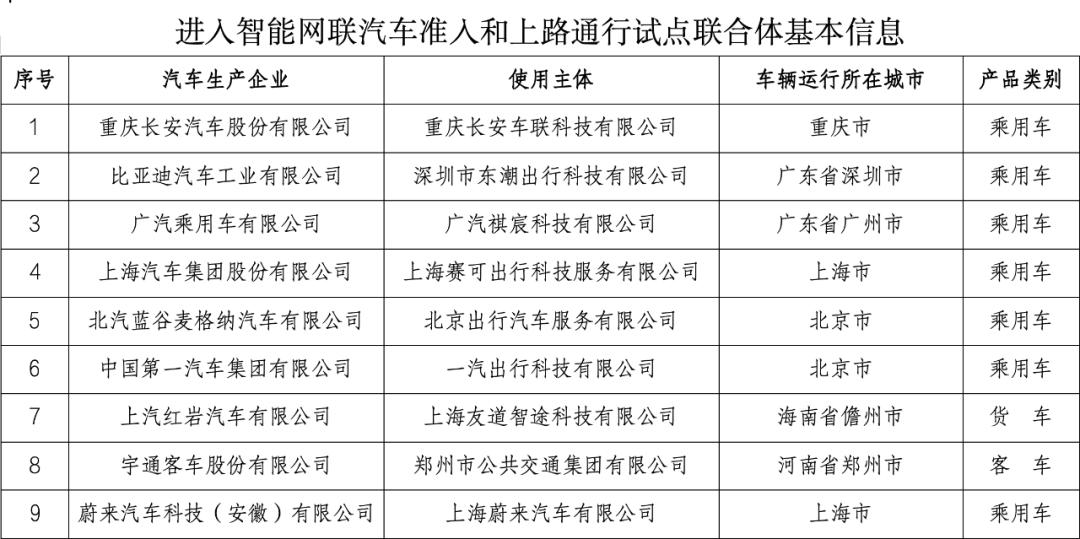
The list of nine selected car companies was announced in 2024
In June 2024, nine car companies were shortlisted for the first batch of national L3 autonomous driving on-road operation pilot lists, laying a practical foundation for this product access approval.
The access approval from the Ministry of Industry and Information Technology and the issuance of special license plates for autonomous driving vehicles announced this time are the basic thresholds for the commercial implementation of L3 vehicles. Although there are restrictions on the driving route, speed, and user, it means that L3-level autonomous driving has taken the first step towards commercial application.