To avoid being "strangled by the neck", the replacement of copper with aluminum in air conditioners is an irreversible trend. A welding technician says, "You get what you pay for."
An unprecedented revolution in material technology is taking place in China's air - conditioning industry.
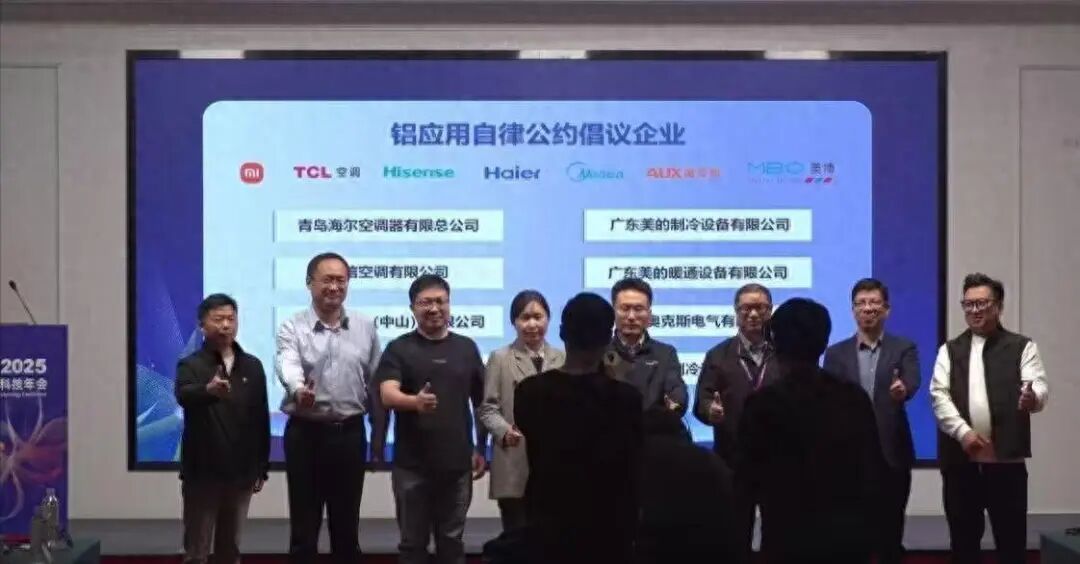
At the beginning of December, at the 2025 China Household Appliance Technology Annual Conference, mainstream air - conditioning brands such as Haier, Midea, Hisense, TCL, Aux, and Xiaomi jointly signed a "Self - Discipline Convention of the Research Working Group on the Enhanced Application of Aluminum in Air Conditioners" to jointly promote a transformation: "replacing copper with aluminum".
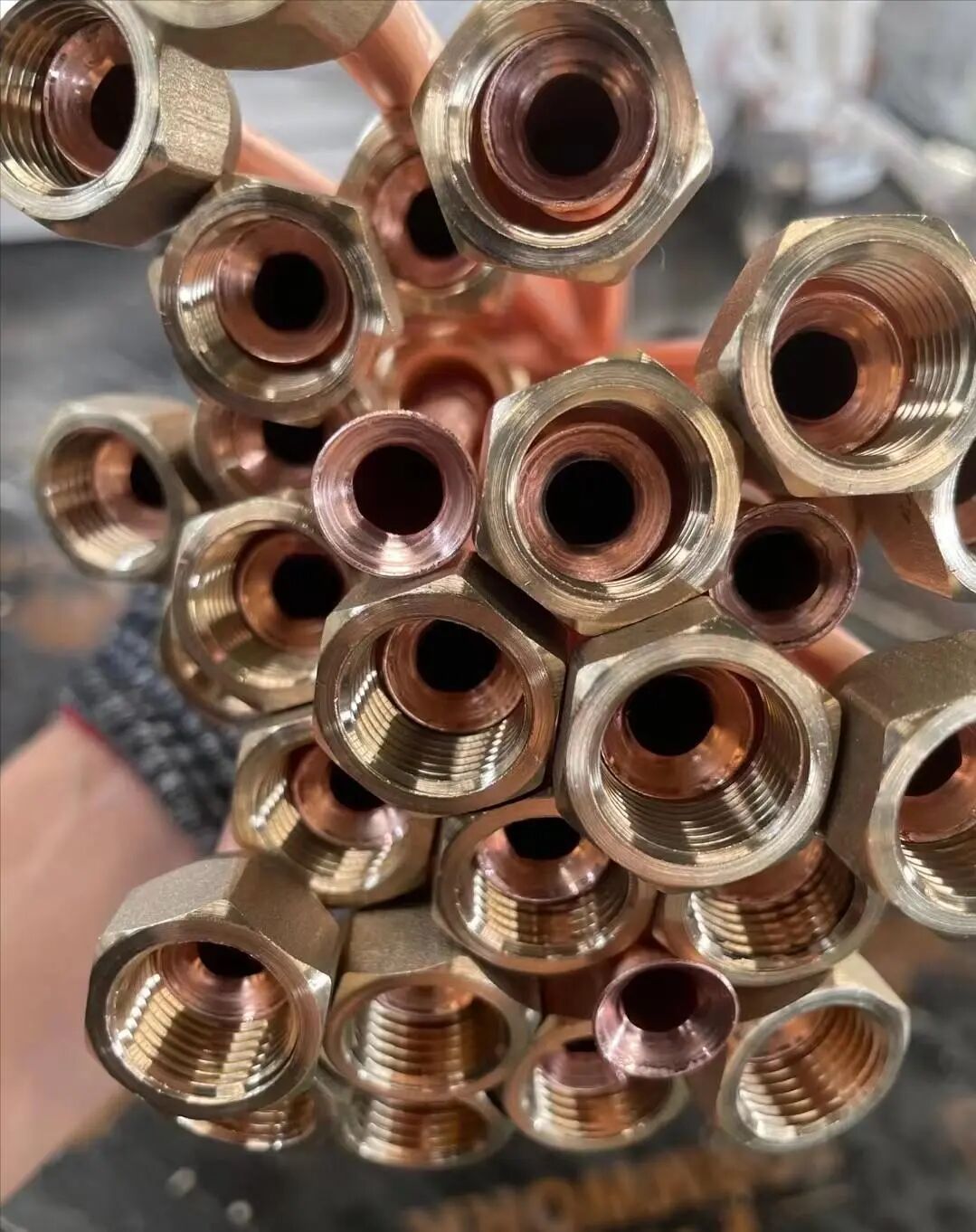
In the past, whether it was air conditioners, refrigerators, or even small appliances like induction cookers, good products were basically made of copper tubes. This is well - known to ordinary people in daily life.
Household air conditioners have a very high demand for copper. The core components, the condenser and the evaporator (heat exchanger), are all made of copper tubes. In 2023, the copper consumption of the domestic household air - conditioning industry accounted for 10.7% of China's total copper consumption, approximately 1.723 million tons.
The controversy over replacing copper with aluminum in the air - conditioning industry stems from the fact that aluminum has inferior thermal conductivity, corrosion resistance, and mechanical durability compared to copper.
As we know, all the pipes in an air conditioner, including the compressor, require welding. Copper is a metal with plasticity, corrosion resistance, and easy weldability. In contrast, aluminum has relatively poor weather resistance and weldability.
However, the problem is that copper accounts for 20% - 27% of the air - conditioner manufacturing cost. China imports 80% of its copper, while in the same year, China's electrolytic aluminum production accounted for 60% of the global total.
Recently, a user who claims to be a riveter and a welding technician warned the air - conditioning industry: "I won't comment on replacing copper with aluminum. One of my colleagues bought a cheap fan from an e - commerce platform this year, and the motor burned out in less than a week. When we disassembled it, we found it had aluminum wires. I told him, you get what you pay for. The compressor is the core of an air conditioner, but there is another core component that is not often mentioned because of its low failure rate. That is the four - way valve, which is made of copper. If copper is replaced with aluminum, it's better to change this part to aluminum too, because welding different materials like aluminum and copper is a global problem."
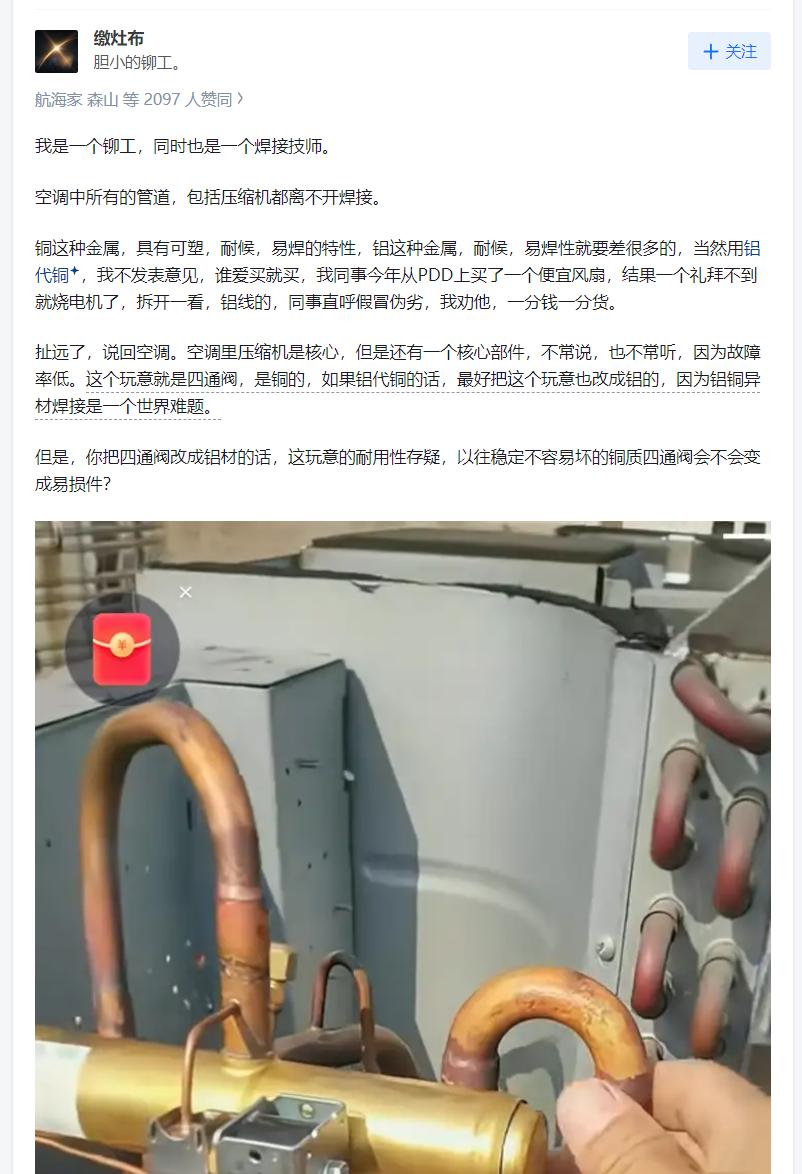
The technician also mentioned: "If you change the four - way valve to aluminum, its durability is questionable. Will the previously stable and non - fragile copper four - way valve become a vulnerable part?"
On the evening of December 14th, Dong Mingzhu also said directly in an interview: "We have been researching aluminum technology for many years, but we still insist not to use 'aluminum to replace copper' because it has not reached the same technical conditions and guarantees as copper."

Of course, from the perspective of manufacturers, one reason for replacing copper with aluminum in the air - conditioning industry is the huge cost difference between aluminum and copper -
Some industry insiders have calculated an account: For the most popular 1.5 - horsepower air conditioners, they usually use 4 to 8 kilograms of copper tubes. Taking 5 kilograms as an example, it should be a mid - range product with a single - row copper tube. The material of the air - conditioner copper tube is red copper with a purity of over 99%. The copper recycling price is 80 yuan per kilogram. So, the value of the copper tubes in a 1.5 - horsepower air conditioner is about 400 yuan.
"Then, for an air conditioner with aluminum tubes, the weight ratio of copper to aluminum is about 3.3. So, a 1.5 - horsepower air conditioner uses about 1.5 kilograms of aluminum. In reality, the aluminum tubes will be thicker. I'll add an extra 0.5 multiplier, so it's about 2.3 kilograms. I'll calculate the aluminum recycling price at 15 yuan per kilogram, so the price is about 34.5 yuan."
The price difference between using aluminum and copper in a single - row air conditioner is 365.5 yuan. If it's a double - row copper tube air conditioner, the copper consumption reaches 7 to 8 kilograms, and the price difference will be even greater, possibly approaching 1000 yuan.
Therefore, from the perspective of cost competition and price wars, using aluminum and using copper bring different price competitiveness.
"Replacing copper with aluminum" is an irreversible trend. Narrowing the quality gap between aluminum and copper through material technology innovation tests the capabilities of manufacturers.
Of course, "replacing copper with aluminum" in air conditioners is not just a cost issue. It is also an important strategic direction to avoid being "choked". China is the world's largest copper consumer, consuming 50% of the world's copper. However, our domestic copper ore reserves only account for 4% - 5% of the global total, and the self - sufficiency rate is only 8%.
Copper itself has high electrical conductivity, stability, and high thermal conductivity. These properties make copper not only the core material for photovoltaic cell solder strips and cables but also the power artery of AI computing centers. Whether it is power transmission, the construction of heat dissipation systems, or the manufacturing of chips, a large amount of high - purity copper is required as the basic material.

According to data, each GW of installed capacity requires 3950 - 4000 tons of copper, and the wind turbine generator winding requires about 3 - 4 tons of copper per megawatt.
A super - large - scale AI data center requires about 50,000 tons of copper, which is equivalent to the annual output of a medium - sized copper mine.
An electric vehicle consumes as much copper as four fuel - powered vehicles. In 2024, China's new energy vehicle production exceeded 12.88 million units, which means an additional consumption of hundreds of thousands of tons of copper every year. And the supporting facilities are also a problem. A charging pile uses 30 kilograms of copper. In other words, when parking spaces turn into charging stations, it's like moving a mountain of copper.
Therefore, with the development of the AI, chip industries, new energy vehicles, as well as the photovoltaic, battery, and power industries, the copper consumption is being re - defined, indirectly squeezing and reducing the copper consumption originally belonging to the air - conditioning industry.
This year, the United States has been hoarding copper crazily. According to a report from Goldman Sachs, the available days of copper inventory in the United States have soared to over 100 days, while in other regions of the world, it is generally less than 10 days. Just the copper inventory in the New York Mercantile Exchange has skyrocketed from 84,000 tons at the beginning of the year to over 400,000 tons, an increase of more than 300%. The copper inventory in the US COMEX exchange accounts for 62% of the global exchange inventory.
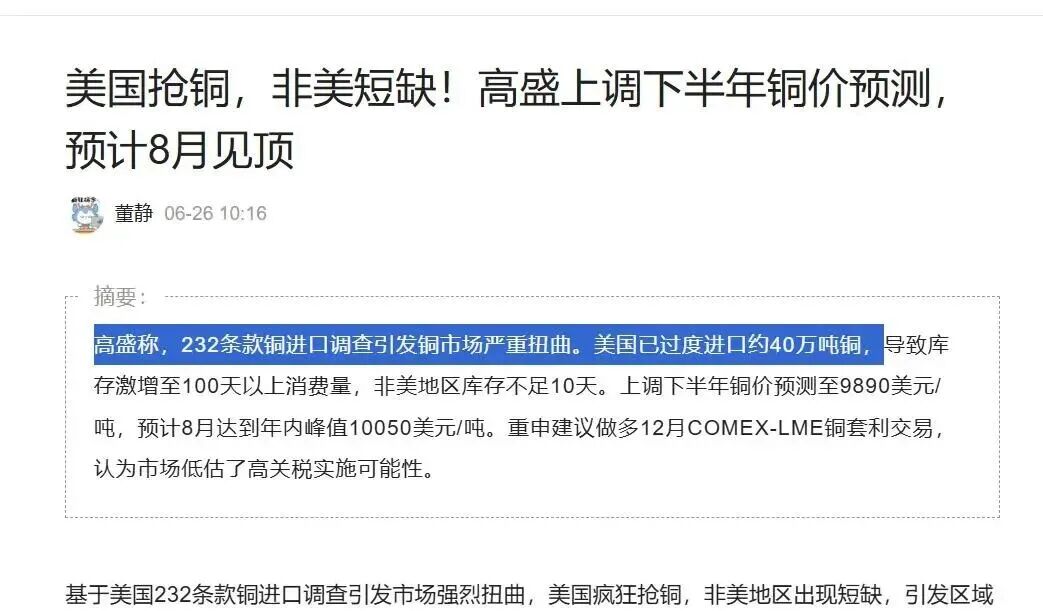
That is to say, in one year, the United States has almost secretly sucked up the global copper inventory. So, the copper price has exceeded 90,000 yuan per ton.
The United States' intention to hoard copper and target China is obvious. In the air - conditioning industry, which is a major copper consumer, this situation cannot be changed just because users oppose it. Instead of getting entangled in "whether to replace", we should focus on the core: We still have choices.
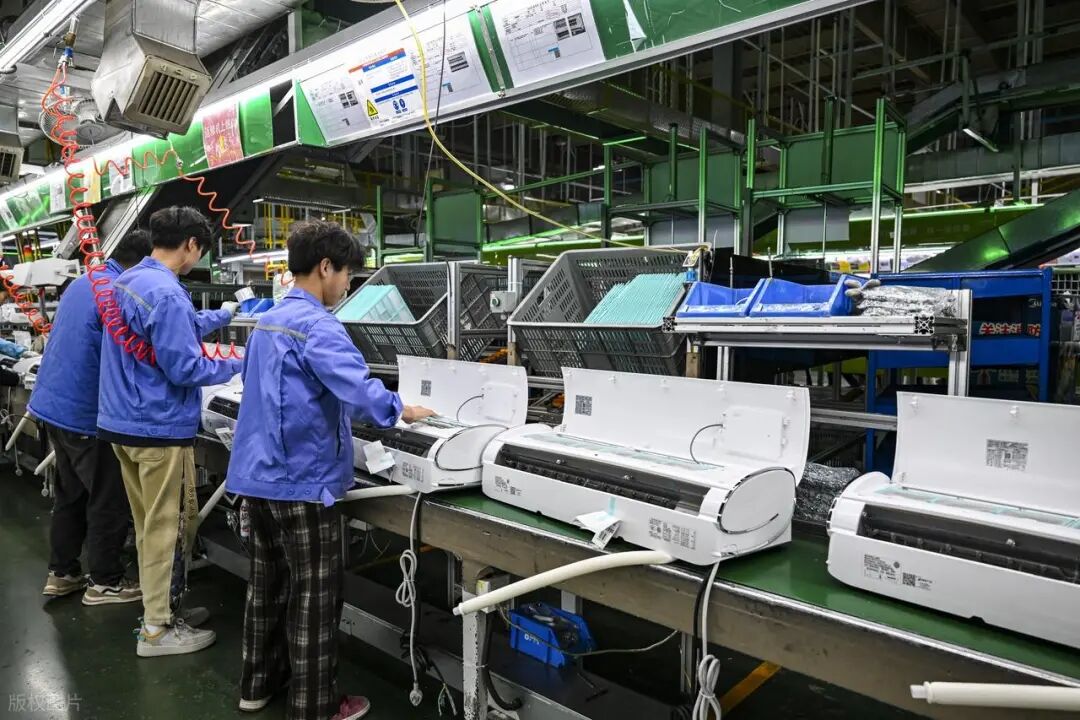
As the maintenance master said, you get what you pay for. Air conditioners using copper may not disappear, but they are likely to be positioned as high - end products.
Dong Mingzhu also admitted that Gree will continue to use copper in the future. For this high - value metal like copper, the recycling market is already very mature. And the air - conditioning market is in a replacement relationship of the stock market. More than 65% of new air conditioners this year are replacements for old ones. This shows that in the short term, materials are not a problem. It's just that products using copper will probably be much more expensive than those using aluminum in the future.
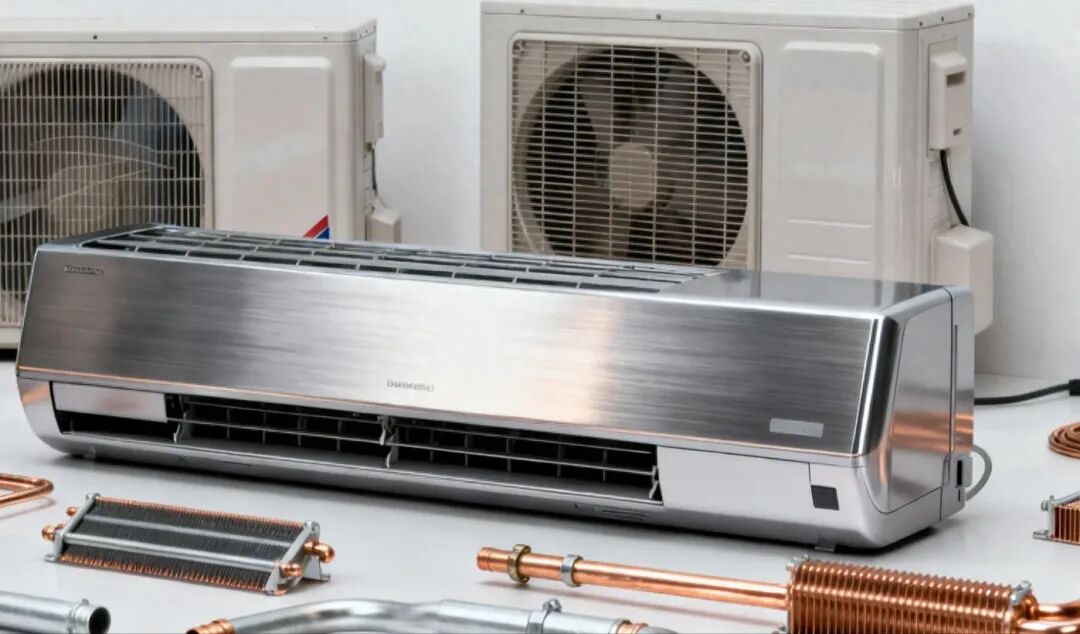
From another perspective, this is an inevitable path for industrial upgrading. We can't always have our resource lifeline in others' hands. The popularization of replacing copper with aluminum essentially forces the entire industrial chain to explore more economical and self - sufficient material solutions. It means shifting from relying on imported resources to focusing on technological innovation.
Although the thermal and electrical conductivity of aluminum is only 60% of that of copper, its weight per unit volume is one - third of copper, and its price is one - fourth. China's production accounts for 60% of the global total, which means there is huge potential. Once breakthroughs in replacement are achieved in multiple industries, it will have a great disruptive effect.
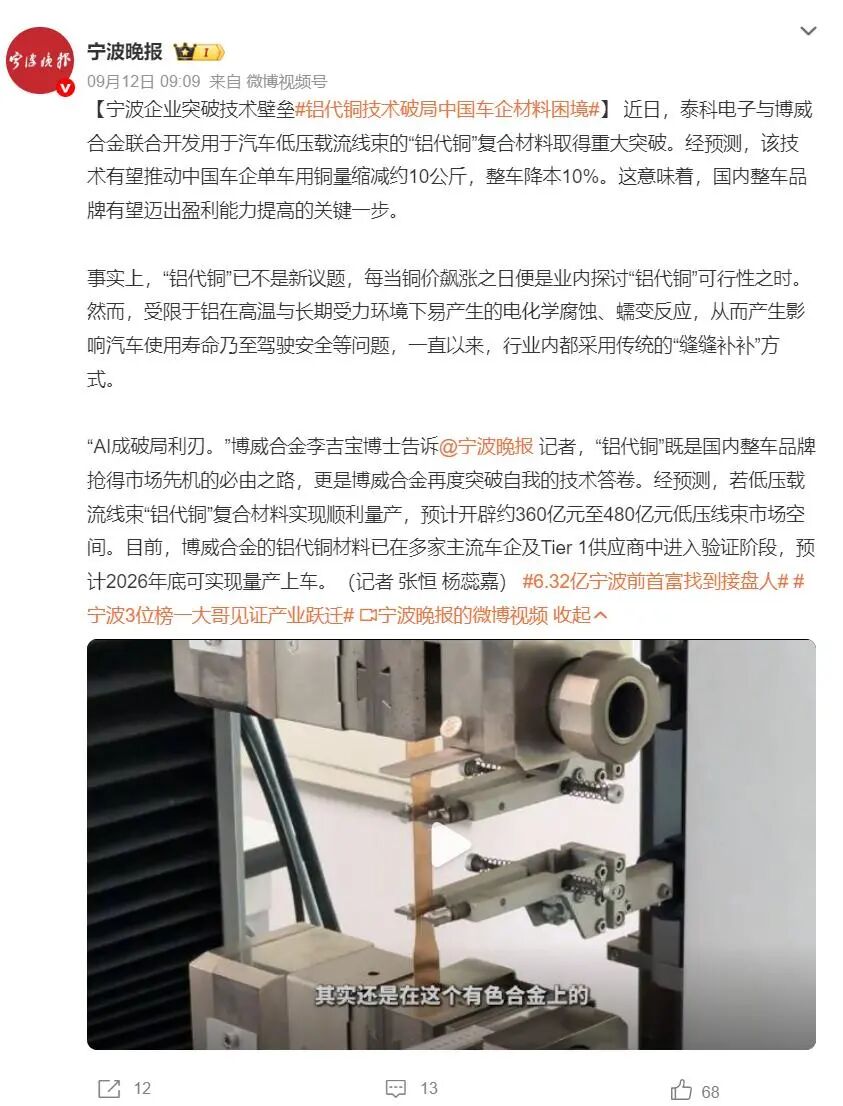
In fact, the innovation of "replacing copper with aluminum" materials in the automotive industry is already in progress. In September this year, TE Connectivity and BoWei Alloy jointly developed a "replacing copper with aluminum" composite material for automotive low - voltage power cables and achieved a major breakthrough.
It is predicted that this technology is expected to reduce the copper consumption per vehicle of Chinese automobile manufacturers by about 10 kilograms and reduce the vehicle cost by 10%.
Therefore, for air - conditioner manufacturers, the durability and quality of aluminum air conditioners can also be improved through technological innovation. Now, domestic manufacturers are optimizing the process design of aluminum tubes and matching them with high - efficiency heat exchanger structures to minimize the performance gap between aluminum and copper to a negligible level.
Therefore, how to improve the quality of aluminum air conditioners tests the technological and material innovation capabilities of manufacturers. How to narrow the performance gap and quality control between air - conditioner products using aluminum and those using copper through material technology innovation, breaking the industry's criticism and stereotype of "you get what you pay for", not only tests the capabilities of manufacturers but also will be a key factor in differentiating the competitiveness of manufacturers in the future.
This article is from the WeChat official account "Hotspot Micro - Review" (ID: redianweiping), author: Wang Xinxi. It is published by 36Kr with authorization.