With a single remark of "stupid as hell", Elon Musk has offended the entire Silicon Valley again.
Elon Musk has fired another salvo.
On December 15th local time, the outspoken "Iron Man of Silicon Valley," Elon Musk, lashed out at the nuclear fusion field, offending a large part of Silicon Valley. After all, a group of the richest and most influential people in Silicon Valley are collectively betting on nuclear fusion. Well - known tech tycoons and investors such as Bill Gates, Jeff Bezos, Sam Altman, and Peter Thiel, as well as tech giants like Google, Microsoft, and Nvidia, have also jumped in and invested heavily. Simply put, nuclear fusion is the process of "combining" two light atoms to release a huge amount of energy. This is the reaction that allows the sun to continuously emit light and heat.
To replicate this process on Earth, humans must heat matter to extremely high temperatures, turning it into a state called "plasma," and then precisely control the fusion of atomic nuclei. If stable and controllable nuclear fusion can be achieved, it will provide almost inexhaustible clean energy, making it one of the ultimate options for humanity's future energy.
In Silicon Valley, nuclear fusion is no longer just a scientific question but a future narrative that has almost reached a consensus. It is written into investment memorandums, included in the US national energy strategy, and regarded as the last piece of the puzzle for the "ultimate solution" in the AI era. Although the timeline for its maturity may be unclear, the direction is generally considered correct.
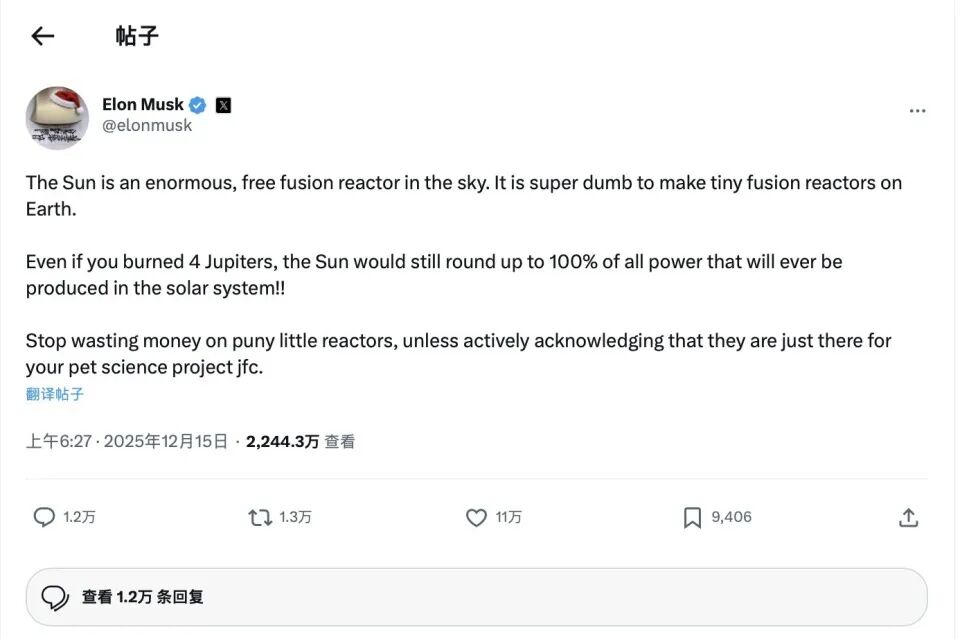
Musk posted on X, mocking the idea of generating electricity with small nuclear fusion reactors as "super dumb."
Regarding nuclear fusion, Musk expressed his attitude on the X platform: "It is super dumb to make tiny fusion reactors on Earth. We already have a huge, free nuclear fusion reactor - the sun."
Musk further emphasized that the energy produced by the sun, this "giant fusion reactor," is sufficient to meet the needs of the entire solar system. "Even if you burn four Jupiters, the energy produced by the sun still accounts for 100% of all energy." He called on relevant companies to stop wasting money on "small nuclear fusion reactors" unless they clearly admit that these projects are only for scientific experiments.
This is not the first time Musk has mocked nuclear fusion. He has repeatedly intervened in technological debates by challenging the mainstream consensus. He has publicly questioned hydrogen energy, downplayed high - speed railways, and dismissed lidar. In several fields, his views have been proven correct later, strengthening his authority as a "technologically intuitive" figure.
It cannot be denied that he has successfully rewritten the boundaries of electric vehicles, commercial spaceflight, and energy storage. Now, he is trying to build an energy narrative that does not rely on the maturity of nuclear fusion through solar energy, energy storage systems, and space infrastructure. This makes every time he goes against the grain not just a personal opinion but a real challenge to the mainstream technological route.
01 The Game between Patience and Capital: Many Tech Tycoons Bet on Nuclear Fusion
The image is generated by an AI tool.
In Silicon Valley and the global tech capital system it dominates, nuclear fusion has never been an edge experiment. Instead, it is a fundamental project that has been systematically invested in and advanced over a cycle of decades.
According to statistics from the Fusion Industry Association (FIA), as of July 2025, private capital flowing into the nuclear fusion field has approached $10 billion. Judging from the investment rhythm, participant structure, and commercialization narrative, Silicon Valley capital's attitude towards nuclear fusion is more like a long - term infrastructure investment rather than a typical "hot - spot track."
At the starting point of this capital chain stand a group of tech founders who are highly sensitive to "civilization - level infrastructure." Once such a system is proven feasible, it will not only change the cost structure of a certain industry but reshape the physical boundaries and long - term operation mode of human technological expansion. "Nuclear fusion is like a 'long - term insurance policy' in the eyes of investors," explained Xiong Weiming, the founding partner of China Growth Capital, to Tencent Technology. "It may not generate electricity for now, but we can't let others hold the key."
Since Bill Gates co - founded the Breakthrough Energy Ventures in 2015, nuclear fusion has been continuously included in its long - term clean energy layout. Against the backdrop of the rapid increase in AI energy demand in recent years, it is regarded as one of the key options to address both the growth of computing power and the climate crisis.
Among them, the support for Commonwealth Fusion Systems (CFS) is not a symbolic investment but a long - term and systematic bet on the high - temperature superconducting tokamak technology route. As CFS's cumulative financing scale approaches $3 billion, this route has gradually emerged from various technological attempts and has become one of the most seriously considered and fastest - progressing engineering directions in the current fusion startup field.
This optimism is not just Gates' personal judgment. Alphabet, Google's parent company, and chip giant Nvidia have also followed suit. Alphabet participated in CFS's Series B financing as early as 2021, and Nvidia joined the latest Series B2 financing of approximately $863 million in August 2025.
Why are these tech giants willing to invest heavily? Because the high - temperature superconducting technology used by CFS can make nuclear fusion reactors "smaller, faster, and easier to build." In other words, high - temperature superconductivity is not only a physical breakthrough but is also regarded as the key variable that can make fusion devices truly industrialized.
Meanwhile, another route is also being patiently supported. Jeff Bezos has long - term supported General Fusion through Bezos Expeditions, betting on the magnetized target fusion (MTF) scheme, which is more engineering - oriented and emphasizes pulsed implementation.
This route is not entirely consistent with CFS's idea. CFS pursues extreme physical performance parameters, while General Fusion focuses more on "whether it can be built" and "whether it can be replicated on a large scale." Through an engineering path similar to "repeated ignition," it gradually approaches commercial feasibility. Compared with pursuing theoretical limits, this route emphasizes manufacturing feasibility and industrial expansion ability.
According to statistics from the FIA and multiple industry reports, as of now, there are more than 70 private fusion companies globally, with technological layouts covering various routes such as tokamak, field - reversed configuration (FRC), and magnetized target fusion (MTF). Silicon Valley is not betting on a single "standard answer" but is leaving room for multiple possible engineering solutions at the same time.
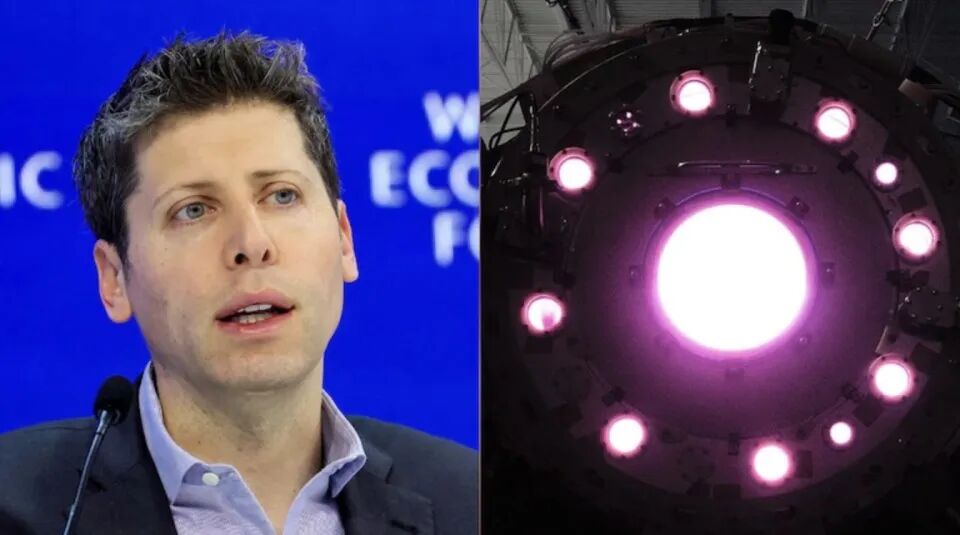
Sam Altman personally invested more than $375 million in the startup Helion Energy.
Among all fusion investors, Sam Altman's stance is the most radical and symbolic. In 2021, he personally invested more than $375 million in the nuclear fusion startup Helion Energy and served as the chairman of the board, directly linking nuclear fusion with his judgment on the long - term development of AI.
Helion's latest valuation has reached $5.425 billion. More importantly, it has signed a long - term power purchase agreement (PPA) with Microsoft, promising to start supplying power as early as 2028. This is not a scientific research cooperation but an early lock - in of future power delivery. Peter Thiel, a Silicon Valley tycoon, invested in Helion at an early stage through Mithril Capital, working with Altman to promote its financing process. In addition, heavyweights in Silicon Valley such as Eric Schmidt, the former CEO of Google, and Dustin Moskovitz, an early employee of Facebook, have also entered this field one after another.
These seemingly scattered investments actually point to the same logic: they are not a collective chase driven by emotions but a coordinated bet on different technological paths and at different time points. Ultimately, a long - term capital network is formed, which echoes each other, diversifies risks, and has a time scale of more than a decade.
When tech companies like Google and Microsoft start to "pre - order" the yet - to - be - built fusion power through power purchase agreements, a clear signal is sent: in the long - term models of these companies, nuclear fusion is no longer a science - fiction concept but an energy option worth locking in early. The real difference may not lie in whether nuclear fusion is feasible but in when it will become the underlying infrastructure to support the AI world.
02 The "Story" of Optimism about Nuclear Fusion: Why Humans Keep Forgiving Its Delays
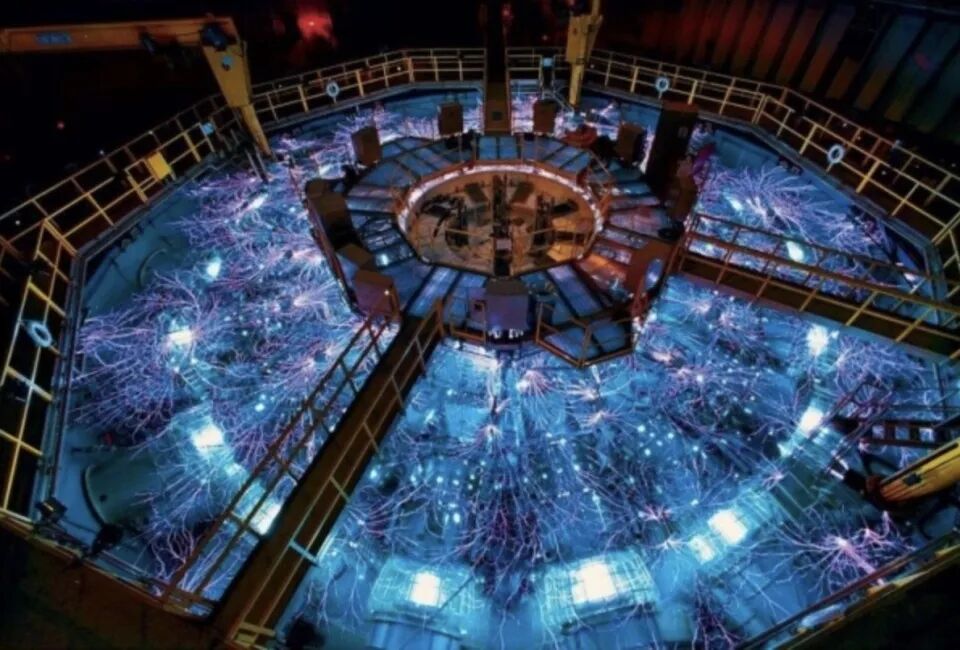
A nuclear fusion reactor
The reason why nuclear fusion can continuously attract capital despite repeated delays is not the technological progress itself but the strength of its narrative logic.
Nuclear fusion is packaged as "infinite energy." It has an abundant fuel source, is almost carbon - free, and can be scaled up. What it promises is not just electricity but a safe, stable, and continuously predictable energy state.
In the context of high energy consumption in AI, this stability is given strategic significance. A 2025 report from the International Energy Agency (IEA) shows that by 2030, the global data center's electricity demand will approach 945 terawatt - hours (945 TWh), with the AI - specific load increasing more than four times.
The limitations of the traditional energy system are quickly magnified. Wind and solar energy, which are highly intermittent, and nuclear fission, which is restricted by politics and cycles, are all difficult to meet the demand for all - weather stable base - load power from large - scale operators. Against this background, nuclear fusion is regarded as one of the few clean solutions that can provide reliable base - load power. The deuterium extracted from one gallon of seawater is equivalent to the energy of 300 gallons of gasoline, theoretically sufficient to meet the continuous power supply of global AI data centers.
The FIA report shows that 84% of nuclear fusion companies believe that they can connect to the grid before the 2030s, and more than half have a clear goal of building a reactor before 2035. Technological breakthroughs, such as high - temperature superconducting magnets, are also reducing the size and cost of reactors.
The narrative that nuclear fusion is "about to be commercialized" provides an excuse for tech giants worried about future computing power and energy shortages to delay their decisions. This optimistic expectation has become a "psychological placebo" for them to relieve their energy anxiety. Musk's negation of nuclear fusion precisely punctures this fantasy that avoids reality.
03 Why Does Musk Think Nuclear Fusion Is an "Economic Dead End"?
There is a reasonable part in Musk's negation. He pointed out the engineering bottlenecks faced by ground - based nuclear fusion reactors and emphasized that these difficulties make nuclear fusion unable to compete with solar energy economically in the foreseeable future.
Nuclear fusion still faces severe engineering challenges to achieve commercial application. The most critical difficulty is to ensure that the reactor continuously outputs electricity, and the output power must far exceed the power consumed to keep it running.
First, there is the problem of plasma stability and confinement. The plasma needs to be heated to hundreds of millions of degrees and stably confined for several seconds. Second, there is the problem of achieving net energy output. Although the US National Ignition Facility (NIF) achieved "ignition" scientifically for the first time in 2022 (i.e., the energy produced by nuclear fusion exceeded the energy required to heat the plasma), if you calculate the total energy consumption of the entire facility, the energy it consumes is still far more than the energy it finally outputs, which is still a long way from the requirements of commercial power generation.
In terms of fuel, tritium (one of the nuclear fusion fuels) has a half - life of only 12.3 years and is rare in nature. The global annual production is less than 4 kilograms. Commercial reactors need to breed tritium on their own, and the engineering has not been verified.
In addition, material tolerance is also a huge bottleneck. The high - energy neutrons produced by nuclear fusion will seriously damage the reactor wall materials, and materials that can withstand extreme radiation and heat loads need to be developed.
Finally, the cost of the first commercial reactor is as high as tens of billions of dollars, and the construction cycle is more than a decade. The huge cost and long cycle are major challenges to its economic viability.
Musk directly translates these high - difficulty engineering problems into "economically unprofitable." His logic is that in the past decade, the cost of solar energy has decreased by more than 89%, and it has become the cheapest energy source. Nuclear fusion is still expensive even in the best - case scenario, and it requires a lot of effort to replicate a complex system on Earth, while the sun is "free, works perfectly, and requires no maintenance."
In other words, in Musk's view, investing in ground - based nuclear fusion is a misallocation of resources. Since we already have a free nuclear fusion reactor (the sun), we should invest money in more mature and economical solar + energy storage technologies instead of spending tens of billions of dollars to replicate a "mini - sun."
However, some supporters of nuclear fusion refute this view, believing that it oversimplifies the problem. The value of nuclear fusion energy lies in providing all - weather base - load power (not affected by weather or night), strategic independence, and controllability, which are difficult to be completely replaced by solar + energy storage.
04 Musk's Energy Bet: From Solar Energy and Energy Storage to Space - Based Energy AI Satellites
Musk's doubts about nuclear fusion do not mean he negates clean energy. Instead, they stem from his firm belief that solar energy is the most realistic and economical path. Musk once said, "Just 100 miles by 100 miles of solar panels can power the entire United States. We should invest resources in solar energy and energy storage technologies." Currently, he is promoting the "comprehensive revival" of solar energy from the ground to space through Tesla and SpaceX.
On the ground, Tesla's photovoltaic business is recovering with the help of favorable policies (such as the US Inflation Reduction Act, IRA). The company produces new - type, high - efficiency, and low - cost residential solar panels at Gigafactory 2 in Buffalo, New York. These products are deeply integrated with the Powerwall home energy storage system.
At the same time, Musk has also connected large - scale energy storage systems such as Megapack to the grid level, forming a multi - level energy reserve capacity from distributed to centralized, effectively alleviating the intermittent problem of traditional ground - based solar energy affected by weather and day - night changes.
More forward - looking is Musk's grand vision of "space - based solar energy AI satellites." This is the real confidence behind his negation of ground - based nuclear fusion.
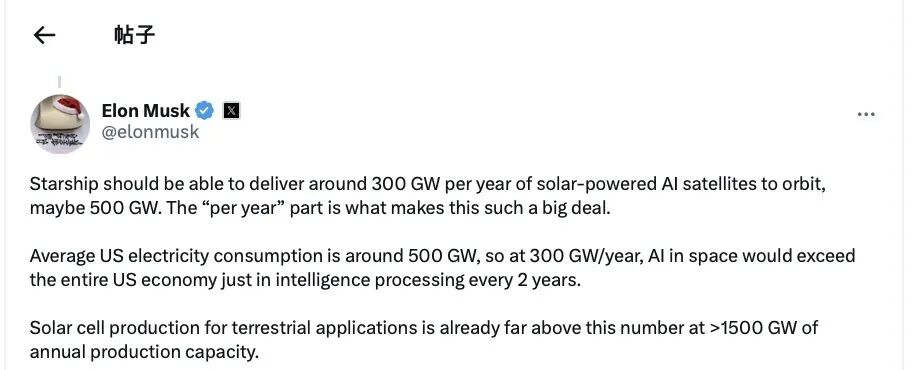
Musk posted that he plans to deploy solar AI satellites with a capacity of about 300 gigawatts (GW