Vegetarian Wang Tao is trapped in the multi-billion-dollar DJI empire.

DJI's Global Headquarters, "Sky City"
In 2024, DJI's revenue exceeded 50 billion yuan, and its net profit margin approached 40%, nearly twice that of Apple. Even if calculated based on the average price - earnings ratio of 30 times in the consumer electronics field, DJI's valuation should be 180 billion yuan. In fact, due to the uniqueness of DJI's products and profit level, this valuation may be even higher. However, since DJI is not listed, no one can accurately calculate its actual value.
DJI's headquarters building, Sky City, was completed and put into use in 2022. "Sky City" has two implications. Firstly, it symbolizes the pursuit of the dream of the sky and flight. Secondly, it echoes the idealized, true, kind, and beautiful spiritual world in Hayao Miyazaki's animations. This is also regarded as the technological ideal of the founder, Frank Wang.
However, the business world has never been a fairy - tale. Its ferocity and cruelty far exceed imagination. DJI has attracted much attention this year. It invested in a 3D printing company and entered the floor - sweeping robot market. Recently, Insta360 even accused DJI of "exclusivity" in the supply chain. All these can be attributed to DJI's anxiety about growth.
In the stock market, this is a story about how a giant makes choices when faced with the influx of numerous competitors.
Continuous Brain Drain
Frank Wang is getting thinner.
Wang Li, a former DJI employee, last saw Frank Wang a few months ago. The CEO, worth tens of billions, left the deepest impression on him as a person getting thinner with prominent bones. Wang Li believes this is the result of long - term vegetarianism.
Frank Wang's vegetarianism is well - known in the industry. There are no meat dishes in the canteen of DJI's Sky City office building. It's all kinds of vegetarian food. If employees want to eat meat, they go to the canteen on the fifth floor of Transsion Holdings next door. Liu Yang, an investor in the Shenzhen primary market, told us that he has eaten in the Transsion canteen several times, and every time he can see employees wearing DJI badges.
Frank Wang, who prefers vegetarian food, has always been assertive in technological pursuit and business warfare. Over the years, the labels on Frank Wang from the media's perspective include a paranoid perfectionist, a technological tyrant, and an idealist who criticizes reality. Among domestic product - oriented people, no one else has received such an evaluation comparable to Steve Jobs except Frank Wang.
It is precisely because of this character that Frank Wang single - handedly created DJI, a drone giant, and at the same time, it has also attracted controversy.
Frank Wang's assertiveness is especially evident in the competition between DJI and its competitors this year. Last month, DJI invested in the 3D printing company SmartPie, which triggered Tao Ye, who left DJI, to write a post expressing his feelings. Tao Ye used the word "suppressing bandits" to describe his former employer's actions against him. He quoted what Frank Wang said ten years ago: "We can't let competitors find a gap to make money. Once they have money, they will compete for talents, which is the biggest trouble."
Tao Ye was once a core member of DJI. During his time at DJI, he tried to suggest to Frank Wang to enter the 3D printing business. At that time, the domestic 3D printing market was still small, and he judged that Frank Wang would not enter this field. In 2020, Tao Ye left DJI and founded his own 3D printing company, TENLOG. He managed to turn what was once a geek toy into a consumer - grade market. Last year, TENLOG's revenue was 6 billion yuan. According to investor Liu Yang's prediction, it will at least double this year.
DJI is known as the "Whampoa Military Academy" of Chinese hardware. Entrepreneurs who have left DJI have founded at least 30 companies in multiple fields such as 3D printing, underwater robots, lawn mowers, and energy storage. Among them, 10 have valuations exceeding 100 million yuan. The capital market has a FOMO (fear of missing out) attitude towards "DJI - affiliated" entrepreneurs.
Wang Li, who has already left DJI, told us that people like Tao Ye of TENLOG and Wang Lei of EcoFlow couldn't do the products they wanted at DJI, so they went out to start their own businesses and did quite well. It is estimated that this has a great impact on Frank Wang psychologically.
The success of former DJI employees in starting their own businesses proves that Frank Wang's judgments on new markets are not always correct. When they leave to start businesses, they take away a group of people from DJI. For example, the founding team of TENLOG has 5 members, all of whom, like Tao Ye, are from DJI. Lu Zhihui, the former second employee of DJI, left to found Co - bit only two years after DJI's establishment and recruited Chen Jinying, the former first employee of DJI, as the R & D director.
Compared with DJI employees starting their own businesses, Frank Wang hates it more when the talents trained by DJI are poached. Investor Liu Yang contacted Frank Wang more than a decade ago. According to Liu Yang, around 2020, Shenzhen Yunjing Intelligence raised a lot of money and poached a large number of talents from DJI, almost poaching entire departments. Even though Frank Wang raised employees' salaries internally, he couldn't keep them.
"Finally, Frank Wang invited Zhang Junbin, the founder of Yunjing Intelligence, to dinner and said, 'Can you give me a heads - up before poaching people? You can't poach entire departments from me,'" Liu Yang told us.
The most aggressive company in poaching from DJI is Insta360, the giant in the panoramic camera market. Insta360 announced its entry into the drone field five years ago, but the solutions developed in the first two years were basically scrapped. It really started to develop a new version of the drone solution in 2023. To strengthen its position in the drone market, Insta360 poached core members Zhang Bo and Lin Dejun from DJI. Zhang Bo was a core member of DJI's sales system and led the reform of the agency system, while Lin Dejun was the former technical director of DJI.
This has completely soured the relationship between DJI and Insta360. Moreover, Liu Yang told us that Insta360 has poached many people from DJI in the past three or four years, and the core members of its drone business are basically poached from DJI.
Wang Li felt it more clearly. "In the past two or three years, Insta360's R & D team has basically been replaced with people from DJI. Half of our department has gone there, and the leader of the neighboring department has also joined Insta360."
The style differences between DJI and Insta360 are obvious, which can also be reflected in their founders. The post - 80s Frank Wang is low - key and self - confident, while the post - 90s Liu Jingkang is outspoken and high - profile. Investor Liu Yang has WeChat contacts with both of them. He told us that Frank Wang hasn't posted on his WeChat Moments for half a year, while Liu Jingkang often posts on his Moments at around 11 p.m. to criticize DJI.
Liu Jingkang regards DJI as a "devil coach." He once said, "DJI is much, much, much, much, much more powerful than what it shows and what most people understand." However, from the recent confrontation between DJI and Insta360, Liu Jingkang's true feelings towards DJI should be a mixture of respect, fear, and hatred.
Why Can't DJI Retain Talents?
In recent years, it has been an established fact that DJI can't retain talents. In its early days, DJI was known for its geek culture, technology - driven approach, and flat management, which attracted a large number of young people with ideals and creativity. DJI engineers used to call each other "geniuses" and referred to product managers as "gods." They only focused on creating perfect products.
Frank Wang also wrote in a message to new employees: "DJI is a pure land, with only pure entrepreneurship and artists born for dreams." "The year I first went to DJI was similar to my postgraduate years," said Tao Ye, the founder of TENLOG.
However, as the company's scale expanded and the organizational structure became more complex, DJI gradually exposed management problems. Wang Li worked in a technical position at DJI for more than two years. He had previous work experience in large Internet companies. When he first joined DJI, he felt that the company's management chain was long, and there was a generational gap compared with large Internet companies. As a mid - level employee at DJI, he was five levels away from Frank Wang.
The value foundation formed by the engineer culture also makes DJI prioritize technology. There are few professionally recruited managers through social recruitment in DJI. Management positions are usually promoted from R & D positions first. Wang Li believes this is the preference of the boss, Frank Wang. "Because he comes from an R & D background, he thinks that people who are good at R & D can do everything well."
In Wang Li's view, the problem this brings is that managers often only know how to do their own work and don't know how to organize people more efficiently.
Another reason for the high turnover rate of senior executives is that DJI's incentives for them are not sufficient, which is also one of the reasons why Insta360 can poach them. "The workload at Insta360 is relatively small, and it's not that busy. This is a very direct reason, and besides, the income is the same or even higher," Wang Li said.
On the other hand, the number of DJI's patents is also declining. In 2019, DJI applied for 3,318 patents, but in 2024, the number of patent applications was only 76.
Part of the reason is the reduction of R & D rewards at DJI. Wang Li revealed to us that in the past, DJI employees would get high rewards for writing patents, but now the rewards are much lower. "You will only get a reward if you bring benefits to the company. It gives a more short - sighted feeling."
This leads to employees giving up investing time and energy in some R & D innovations when they consider that there will be no short - term benefits.
Wang Li finally summarized that the pressure is the greatest at the senior and grassroots levels at DJI. Senior executives face the risk of being laid off, and grassroots employees work overtime more and more. The mid - level is a little better and can basically take it easy.
In the early days, DJI's talent recruitment had a strong personal imprint of Frank Wang. According to investor Liu Yang's observation, DJI had many excellent talents in its early days, and the talent density was very high. However, as DJI's scale expanded, there were even factional struggles within the company. "Frank Wang graduated from the Hong Kong University of Science and Technology, and he tends to favor people who graduated from HKUST when it comes to reusing talents."
Liu Yang gave an example. In 2014, Liu Yang met a young man who graduated from the University of Electronic Science and Technology of China in Chengdu. He was very good at technology and won many awards in various robot competitions in China. But after he joined DJI, he moved machines for two years and was not reused. Later, seeing no hope, he went back to his hometown.
"It's understandable. This kind of situation happens in all large companies," Liu Yang said.
Frank Wang's Anxiety
Frank Wang's anxiety stems from the fact that the drone market has hit the ceiling. In 2024, DJI's revenue exceeded 50 billion yuan. Although it still holds more than 70% of the global consumer drone market share, the slowdown of revenue growth is an established fact.
This means that the high - growth period of consumer drones has ended, and DJI is moving from an incremental market to a stock market stage.
Frank Wang's way of releasing anxiety is first reflected in consolidating the past market. At the end of October, DJI's Pocket 3 gimbal camera, known as the "electronic Moutai," suddenly dropped in price by 900 yuan, which caused great dissatisfaction among consumers who had previously purchased it. From a strategic perspective, the price cut is not only to deal with the decline of DJI's market share in handheld imaging devices but also to resist the entry of mobile phone manufacturers like OPPO next year. Therefore, DJI cut the price in advance to set a price threshold, leaving no profit for competitors.
Besides defense, there is also offense. In order to open up new growth curves, in the past two years, DJI has accelerated its layout in new markets and directly competes with Insta360 and companies founded by former DJI employees such as TENLOG. This year, DJI released a panoramic camera and a floor - sweeping robot. The release of its panoramic drone is on the countdown, and it also invested in consumer - grade 3D printing.
This also shows that DJI's strategy in recent years seems to be falling into a competition - oriented trend rather than a technology - innovation - oriented one.
Wang Li told us that Frank Wang seems a bit anxious because there are too many competitors. He can't afford to think about the long - term and wants to take some short - term effective actions immediately. "Actually, it's unnecessary because you are still rising, just at a slower pace."
DJI's panoramic camera and panoramic drone are both for direct competition with Insta360. According to Wang Li, DJI's panoramic drone started mass - production in October, but it will be released after stocking up hundreds of thousands of units to deal with the problem of out - of - stock. According to the normal schedule, DJI's panoramic drone will definitely be launched first.
However, Insta360's panoramic drone, Insta360 Air, originally scheduled to be launched early next year, was launched in early December this year, obviously to seize the opportunity. Liu Jingkang is no less anxious than Frank Wang. "So Insta360's forced early launch will lead to many technical problems not being solved," Wang Li said. Some negative reviews received after the launch of Insta360 Air also confirm this.
The recent supply - chain dispute between DJI and Insta360 has also escalated the situation between the two companies. Since the market response to Insta360 Air after its launch was not as expected, Liu Jingkang wrote an internal letter to boost morale and also mentioned that several suppliers of Insta360 Air faced "exclusive" pressure.
On December 12, the Economic Observer reported this event. The report said that in the industrial chain of imaging and drone precision manufacturing, suppliers have to take sides. If they do business with DJI, they can't do business with Insta360.
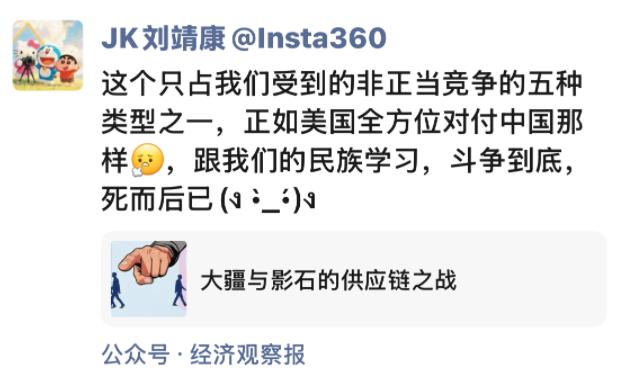
That night, Liu Jingkang reposted this report and wrote on his WeChat Moments: "This (supply - chain issue) is only one of the five types of unfair competition we face. Just like the United States' all - around confrontation with China, we should learn from our nation and fight to the end, even if it means sacrificing ourselves."
Regardless of right or wrong, this is at least a rare business case of a post - 90s upstart challenging an 80s giant.
Wang Li, a former DJI employee, believes that Insta360's struggle over the supply - chain issue doesn't make much sense. "Because DJI makes its most core components by itself. No one can buy them. They are their own suppliers, such as the most critical chips. But why does DJI block others in the secondary supply - chain? It's because the competition has escalated. The core technology has already restricted you, and now they want to restrict you in secondary aspects too." This is very much in line with Frank Wang's style in business competition.
DJI didn't start working on floor - sweeping robots this year. It has been working on them for four or five years and has iterated at least three times. Because Frank Wang was not satisfied, DJI officially launched its first ROMO floor - sweeping robot