Behind the popularity of Ant A Fu: Big tech companies' AI is dominating 2025
The narrative logic of China's AI is quietly changing.
Since 2025, startup companies, once represented by the "Six AI Tigers" and stirring up the market with innovative concepts, are now facing more in - depth competitive pressure. On the contrary, traditional Internet giants are making increasingly intensive and large - scale moves in the AI field.
The most obvious manifestation is the continuous deepening of the giants' layout. In addition to competing to launch new foundation models and applications, the giants have publicly stated that they will increase capital and technology investment in AI. For players like Alibaba and ByteDance that have made remarkable progress, they not only have full - stack AI capabilities but also have transitioned to seizing key positions in core scenarios with "killer" applications.
For example, on December 15th, Ant Group announced a full - scale upgrade of its AI health application "Ant Afu". With highlights such as health companionship, the new version of the app quickly climbed to the third place on the free list of the Apple App Store after its release, attracting wide - spread attention in the industry. This is also another major move by the Alibaba ecosystem following actions such as the sale of Quark AI glasses, the launch of "Qwen" and "Lingguang" applications, and the establishment of the Qwen consumer - facing business group.
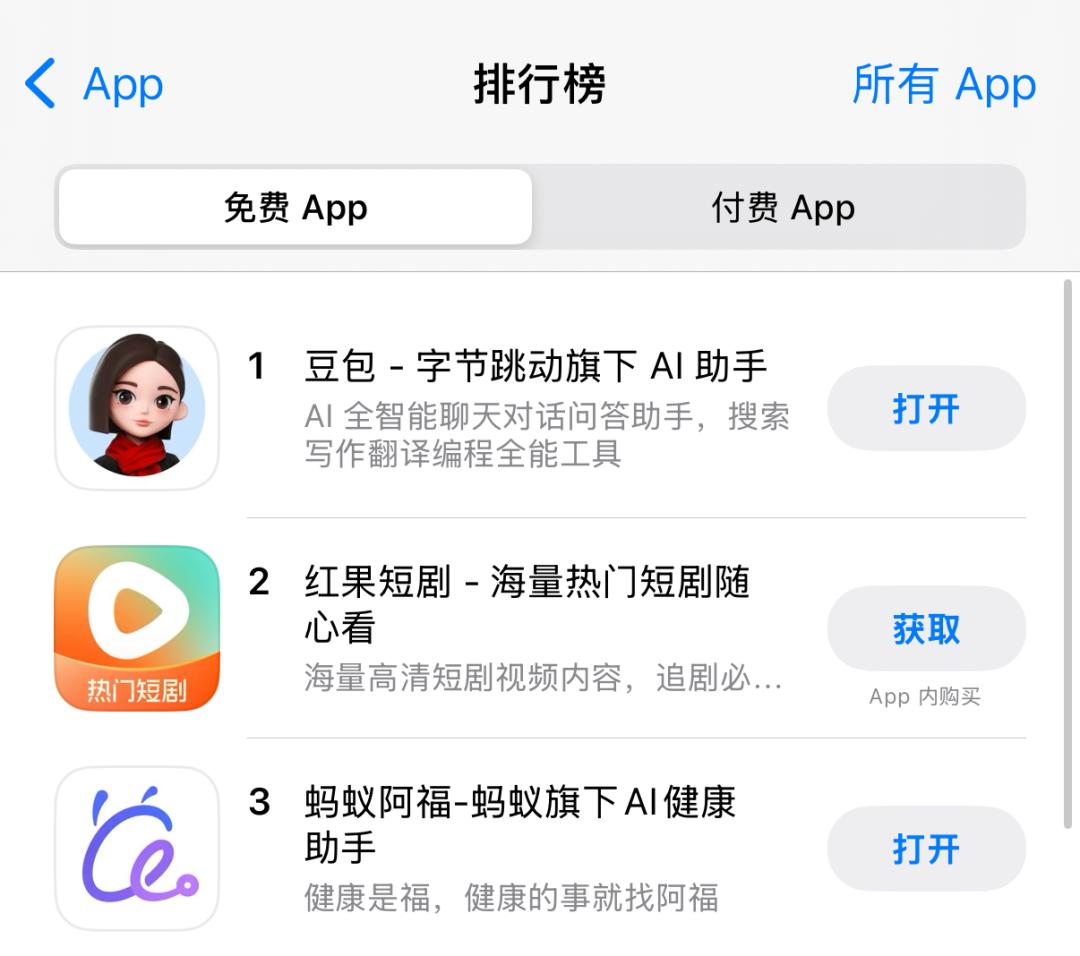
At the product level, the popularity of products like DeepSeek at the beginning of the year completed a round of AI market education with unprecedented intensity. The public's perception of AI products has truly changed from a novel technology to a handy daily tool. Internet giants such as Alibaba, ByteDance, and Tencent, with their huge marketing investments and natural ecological entry points, firmly control the "screens" of a large number of users.
Referring to the global top 100 consumer - grade Gen AI application list released by a16z this year, five Chinese products among the top 20 globally are DeepSeek, Quark, Doubao, Kimi, and Qwen3. According to the Q3 2025 AI application industry report by QuestMobile, the apps with the highest monthly active users are Doubao, DeepSeek, Yuanbao, Jimeng AI, and AQ (now known as "Ant Afu").
A more intuitive phenomenon is that most of the widely - used AI applications on the list mainly come from Internet giants, especially Alibaba and ByteDance, which occupy many positions on the list. It is quite conspicuous, giving a hint of a "dual - power" situation between Alibaba and ByteDance.
Understanding this change in the industry trend is the key to comprehending the current narrative logic of China's AI landscape.
01. Giants Leading, the "Dual - Power" Pattern Emerging
In terms of time, in the AI application competition a few years ago, startup companies achieved significant user growth for a while with their rapid model iteration and more flexible strategies.
However, this year, the voice of the giants' AI has been continuously rising in the perception of the outside world.
The reason for this change is that, in essence, as the model capabilities continuously improve, the competition in the AI industry has gradually shifted from the early - stage model - ability show - off to the deep - water area of application development and scenario implementation. This is precisely the home - court advantage of the giants that have been deeply involved in the Chinese market for many years.
First, in terms of resource investment. Although several leading startup companies are highly sought after by the market and have high valuations, due to high model R & D costs and immature commercialization, their overall development speed is still limited by the financing scale and cash - flow situation.
In contrast, the stable and mature main businesses of the giants can generate their own "blood", with rich capital reserves. Moreover, they often have stronger ecological synergy capabilities of "data + scenario + traffic", which enables them to bear the trial - and - error costs and long - term investment in the process of AI application development without overly caring about short - term profits. The relevant person - in - charge of Ant and Quark have both mentioned to 36Kr that they do not take commercialization as the core goal in the short term.
Under the combined effect, once the giants anchor their AI strategies, they will not be stingy with resource investment.
On the one hand, it's about money. This year, ByteDance announced an additional investment of 160 billion RMB for computing power procurement and AI infrastructure construction. Wu Yongming, the CEO of Alibaba Group, said at the Yunqi Conference that they are "actively promoting a 380 - billion - RMB three - year AI infrastructure construction plan". Baidu and Tencent have also respectively stated that they will firmly invest in the AI field.
Meanwhile, the battle for AI talents among the giants has also reached a white - hot stage. ByteDance and Tencent's special programs, "Jingdouyun" and "Qingyun", are offering high salaries to recruit AI talents. In Alibaba's autumn recruitment plan for the class of 2026, 60% of the positions are related to AI.
Secondly, it is the accumulation of their own ecosystems. The advantage of the giants is that they don't have to start from scratch completely. They can choose to upgrade their original products with AI, or bring natural ecological entry points and distribution channels to new AI - native applications with the user, scenario, and traffic pools accumulated from their past businesses. Representative examples are Alipay and Ant Afu, Douyin and Doubao, or WeChat and Yuanbao.
However, this doesn't mean that startup companies have lost their opportunity advantages. Starting from the second half of this year, several leading AI startups have successively released new models and "returned" to the competition. This means that they can still rely on their model capabilities or focus on niche scenarios and rely on a faster decision - making chain to find new living space for their products.
For example, "Hailuo" under MiniMax has continuously gained popularity with its video - generation capabilities. Models like K2 of Yuezhianmian and GLM - 4.5 of Zhipu have also performed outstandingly.
It can be seen that although the trend of giants dominating AI applications is becoming increasingly obvious, in the context of the increasingly intense product competition, the key to breaking the situation still lies in whether one's professional barriers are high enough.
02. The Battle of AI Applications: Stalemate in General - Purpose, Breakthrough in Vertical Fields
In the early stage of the overall development of AI applications, general - purpose AI assistants have become the battleground for major manufacturers due to their wide - range demand coverage. However, on the other hand, during this period, the core functions of products are concentrated in areas such as dialogue interaction, content generation, and information retrieval. As the capabilities of large models become more widespread, ordinary users can feel that the differences between products are gradually narrowing, and the problem of homogenization is gradually emerging.
So, if one wants to further enhance their AI competitive advantage on this basis, what should they do?
For the giants, a layout of using general - purpose AI as the foundation and building moats with vertical - field applications may be a feasible idea, and some leading enterprises are indeed doing so.
The emergence of vertical - field AI applications is the result of the combined effects of factors such as the upgrading of user needs and clear monetization paths. Currently, AI enterprises have driven a large number of related products into a booming development stage by exploring the needs in professional scenarios such as health, finance, education, and emotional companionship.
Take the Alibaba ecosystem, which has been accelerating its efforts in the consumer market since the second half of this year. At present, its internal ecosystem has gradually formed a collaborative "combat" model of products such as Qwen, Quark AI, Ant Lingguang, and Ant Afu. This can not only cover a wider range of user needs through the first three products but also build a moat in the high - barrier vertical field of medical health through "Ant Afu", forming a dual competitiveness of "breadth + depth".
The medical industry has long suffered from problems such as uneven distribution of high - quality resources and low operational efficiency. The industry hopes to use the power of AI to transform the knowledge reserves of top doctors into intelligent tools, let the remote consultation system drive the sinking of resources, and build a high - value commercial closed - loop while achieving health inclusion. Therefore, the medical vertical - field scenario has become a battleground for both giants and AI startups.
Based on its more than a decade of accumulation in the medical and health field, Ant also launched its strategic product, Ant Afu, this year. As an industry - level application, it now has more than 15 million monthly active users. This not only proves that Ant's foray into vertical - field AI is not a blind follow - up but also shows that although the medical field has high thresholds, once broken through, a high - barrier moat can be built.

Moreover, health needs can also show high - frequency potential, not as low - frequency as the outside world thinks.
Zhang Junjie, the president of Ant's Health Business Group, mentioned that since the launch of Ant Afu half a year ago, user needs have gradually extended from core medical issues to various "minor matters" related to health, such as weight loss and smoking cessation, accounting for about 20% - 30% and still showing an increasing trend.
"We have evolved from the initial medical insurance payment service team to today's health business group. We hope to achieve the greater goal of 'a healthier life' on the basis of'making medical treatment easier'. Therefore, Ant Afu is now positioned as a'medical - knowledgeable friend'. It can match suitable medical institutions and doctors when users have serious medical needs and also provide help and directly solve problems when facing daily health issues." Zhang Junjie said.
03. Users Want AI That "Gets Things Done"
Previously, OpenAI proposed dividing the evolution of AI into five levels. At the stage when humans can still use AI as a tool, the development of AI products should gradually grow from a dialogue tool to a super - assistant, that is, from "Chat" to "Act".
This coincides with the current demands of the public for AI products. When users are already used to opening the AI on their mobile phones just like opening WeChat to chat or Taobao to shop, they will also put forward higher requirements for its product functions. That is, AI applications should shift from light - weight scenarios such as chatting companionship, text - to - image generation, and auxiliary writing in the past two years to more functional "task - performing" links.
Simply put, it's about how to transform AI into real - world productivity.
This requires enterprises not only to have the ability to develop consumer - grade AI applications but also to make forward - looking strategic arrangements around full - stack capabilities and a diversified product matrix. Looking back at the concept of "full - stack capabilities", it requires enterprises to complete the logical closed - loop from application development to implementation in real - world scenarios while having basic computing power and model capabilities.
This places very high requirements on enterprises' own capital, technology, and resource integration capabilities. Globally, only a few giants like Google can achieve this. In China, currently, large enterprises such as Alibaba and ByteDance, as well as some dark - horse enterprises with good potential, are favored by the market.
Their core logics are actually similar. Vertically, they make a full - stack layout from underlying hardware to upper - layer applications to form a synergistic effect of cost and experience. Horizontally, they build an open ecosystem by synchronously developing consumer - grade product traffic and enterprise - level services.
However, affected by the differences in the enterprises' past technological genes and product ecosystems, they have different focuses in their paths. The Alibaba ecosystem follows the heavy - asset + software - hardware integration route, while ByteDance excels in traffic - driven feedback + agile iteration.
This differentiation may give rise to two different AI scenarios. For example, the Alibaba ecosystem attaches more importance to practicality and inclusion. The health and finance fields, which are the key investment areas of Ant's AI strategy, follow the logic of "lowering the threshold of professional services", which also aligns with the practical - oriented thinking of the domestic market. The fact that 55% of the more than 5 million daily health questions answered by Ant Afu come from cities below the third - tier can also prove this from the side.
ByteDance's companionship and content ecosystem may enable AI to better integrate into lighter touch - points such as content consumption, entertainment, and office work, becoming an "intelligent partner" in users' life and entertainment.
However, the explorations of these two enterprises only represent the relatively mature technological and product development levels in the current AI industry, not the end of the competition. The verified achievements and some unanswered questions in the current situation may bring the most profound understanding to the AI industry in 2025: AI is still in the first half, and the battle has just begun.