Founders' self-awareness
Dr. Emily Anhalt, a psychologist and co-founder of Coa, reveals five traits of high-impact founders and how these traits that make founders successful can also hinder their development.
She also works on "self-awareness" - that is, helping people discover patterns that hold them back and consciously build new ones to drive success.
Today, I'd like to share her thoughts with you. Please savor them slowly.
"The whole concept of self-awareness is that the more you know, the more you realize how much you don't know. Self-awareness is a moving target, and we always need to learn more about ourselves."
Anhalt worked as an executive coach for ten years, collaborating one-on-one with founders. She gained a unique behind-the-scenes perspective into the founders' inner worlds and helped them navigate the ups and downs of their entrepreneurial careers. This perspective gave her a deeper understanding of the founders' DNA - that is, the core traits of successful founders, which allow them to dream bigger, work harder, and withstand the doubts of naysayers.
But as she has seen in practice (she is also a founder herself), it's a double-edged sword. The traits that make founders successful can also hold them back. "Anything that can make you successful can also become a stumbling block. For example, working hard is good, and having high expectations for your employees is good. But when does this start to become a problem?" Anhalt said.
Successful leaders pay attention to the character traits that have helped them achieve success. Without self-awareness, an advantage can turn into a disadvantage. However, regularly examining your strengths can turn them into a superpower.
She identified five common characteristics and behaviors she observed in successful founders.
1. Work is their identity
2. A stronger ability to delay gratification
3. Value autonomy and independence
4. The equal help of narcissism and impostor syndrome
5. Something to prove
She delved into the duality of these traits - how each trait can be an incredible buoy in rough seas and how it can also be an anchor dragging at the bottom, hindering progress. She shared strategic advice for each trait so that founders can amplify the positive aspects and mitigate some of the factors that may drag them (and their companies) down.
Why is this work important (especially now)?
In her coaching practice, founders are often reluctant to peel away these layers of traits. "When I work with founders and start to explore these traits, they get worried. 'Don't take these things away from me - this is why I've been able to succeed.' I remind them that I'm not trying to take these traits away or change them. My goal is to examine which traits are helpful to you and which ones are holding you back."
Founders who don't take the time to cultivate curiosity and strive for self-growth cannot create an environment where others feel they can be curious and grow.
"I think many employees in startups feel like they're carrying a heavy burden in the company because the leaders haven't dealt with it properly. As a founder, you can lighten the load on your team, allowing them to have more time and energy to focus on doing their jobs well and making the company successful," she said.
This may sound a bit far-fetched - but the common saying "Healthy founders, healthy returns" is not without basis. "If your employees don't have to spend time dealing with your emotions because you don't understand how your actions as a founder affect them, your company will be more successful," Anhalt said.
Founder Trait #1: Work is their identity
The line between a founder's work and personal life is almost blurred because their identity is closely tied to the success or failure of the company. Therefore, work may become all they think and talk about.
I. Why is this an advantage?
In any industry, early-stage founders don't work a 9-to-5 job. On the path to product-market fit, there are countless things to focus on. From building the product, trying to sell it to customers, assembling an early team to formulating a fundraising strategy. To keep up with this intense 0-to-1 pace, it takes focus and unwavering effort.
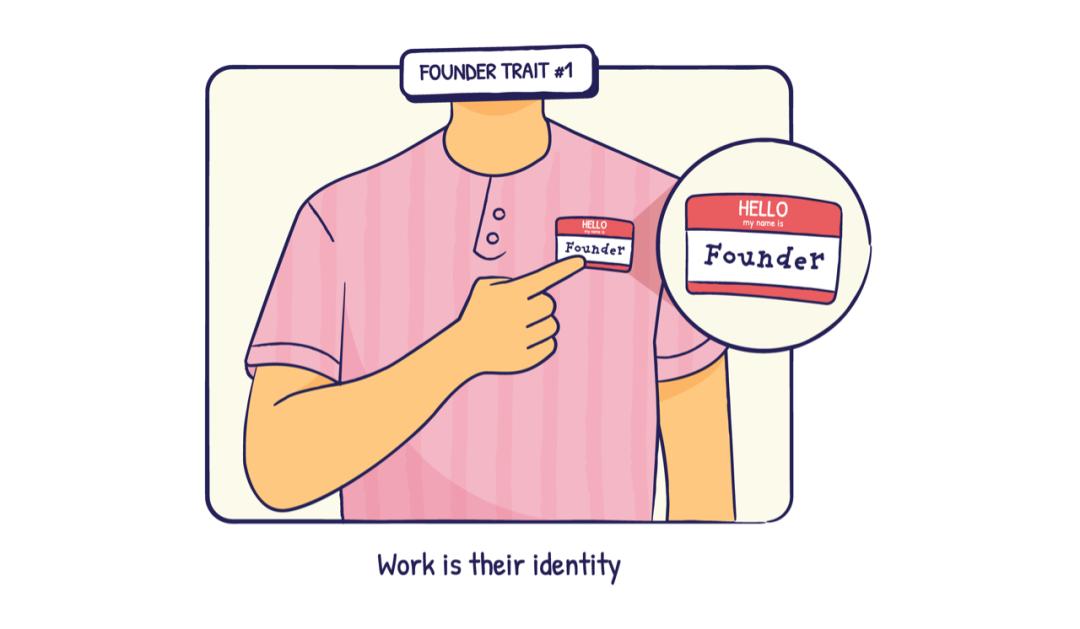
Image source: review.firstround.com
"When we deeply care about something, we can do our work better. Some of the most amazing things in the world were created by people passionate about their fields. In short, when founders are obsessed with a problem and how they might solve it, transformative companies emerge."
II. Why can this also be a disadvantage?
"Any good financial expert would advise you to diversify your investments for better returns, and the same goes for our own lives. If we only invest completely in one part of our lives, it becomes a problem." Anhalt said.
Startups are characterized by ups and downs. A perfect company growth trajectory is often a myth that masks the more difficult details. There are always days, weeks, months, or even years when the company doesn't develop as expected.
If founders don't prioritize other parts of their identity that are worth their time and energy, they may suddenly feel like their entire life is in flames, not just their work life not meeting their expectations.
This can affect your decision-making ability as a founder. "If you feel like your whole life is in trouble, it's difficult to focus on solving problems, and you'll get caught in an even bigger crisis." she said.
In terms of how you interact with other team members, when work becomes your entire identity, delegating tasks becomes more difficult. "You'll find it harder to trust others because you'll feel like you're entrusting your entire life to them, not just your work. You may find yourself becoming a nervous micromanager," Anhalt said.
When you pour all your energy into the company, it sends a message to other team members that they should also put in the same amount of effort. "I've seen many people leave startups because they feel the company expects them to sacrifice everything. But the average employee in a startup doesn't have a 42% stake like the founder," Anhalt said.
Even if you think you're not prone to burnout, how can you ensure that other team members don't get exhausted from keeping up with you?
III. How to protect your most valuable resource: yourself
As a founder, the idea that work should be your entire identity leads to an all-or-nothing mindset, which Anhalt has seen time and time again. "They either work themselves to the bone or worry that they shouldn't be a founder at all. This mindset is not good for founders. You need to have the ability to play the long game," Anhalt said. She borrowed the words of investor Michael Dearing:
"Startups have money and talent. What founders really need is the emotional ability to withstand the hardships of startup life."
In her one-on-one executive coaching work, she often found a hidden undercurrent starting to drag founders down. Anhalt said: "Imagine you're playing a card game that will last a long time. You may start making unwise moves without realizing it, causing you to lose the game and drop out."
Anhalt also saw such self-sabotage in founders. "They're so tired that they don't realize it's okay to slow down or prioritize other parts of their lives. Instead, I see them subconsciously self-sabotaging because it feels like the only way out." This could be like this: "They may not send the information investors need and start ruining those relationships. Or, they may start having more conflicts with their co-founders."
Techniques to avoid burnout: Anhalt found that many times, founders and startup leaders don't notice the signs of burnout until they're already in the whirlpool. "In our noisy workplace culture, no one bats an eye when founders sacrifice sleep, skip most of their meals, or lose relationships for the sake of the company. In fact, this kind of behavior is even praised," she said.
Just as your romantic partner shouldn't be your only deep relationship, your work shouldn't be your only passion. For healthier returns, you need to diversify your life.
Anhalt proposed a three-step framework so that when burnout starts to creep in, you can start taking preventive measures instead of reaching for a bottle of vitamins when you're already seriously ill. "Solving burnout is much more difficult than preventing it," Anhalt said. "You need to prioritize your health as an asset to the business."
Step 1: Identify your warning signs. The early warning signs of burnout vary from person to person. You may be reluctant to have lunch, or you may become impatient with people more easily. You may find yourself less eager to get out of bed and go to work, or you may complain more, or you may even start having trouble sleeping. Therefore, take some time to dig deep into yourself and understand what your warning signs are.
Step 2: Find an accountability partner. Find someone to keep an eye out for these signs of burnout. It's difficult for us to notice these signs in ourselves, so ask people around you, such as your co-founder or romantic partner, if you've started skipping lunch or complaining more.
Step 3: Take action. When someone tells you that you haven't had lunch for four days, what should you do? Arrange a vacation or a learning course? Delegate more tasks or ask your co-founder for help? Don't just sit there and listen to the information; take action. Instead of just telling others to take care of themselves, start showing them how.
Founder Trait #2: A stronger ability to delay gratification
Dr. Anhalt's definition: Founders work in a way that others aren't willing to for ten years so that they can live a life that others can't. They take lower salaries and sacrifice relationships for a 1% chance of a company exit.
I. Why is this an advantage?
The path to sustainable development is winding. Few founders succeed on their first idea. Instead, they need to keep changing directions to find something to stick with. Moreover, even after they achieve product-market fit, the road to the ultimate goal is still long. Anhalt said: "Few startups achieve immediate success. You have to play the long game."
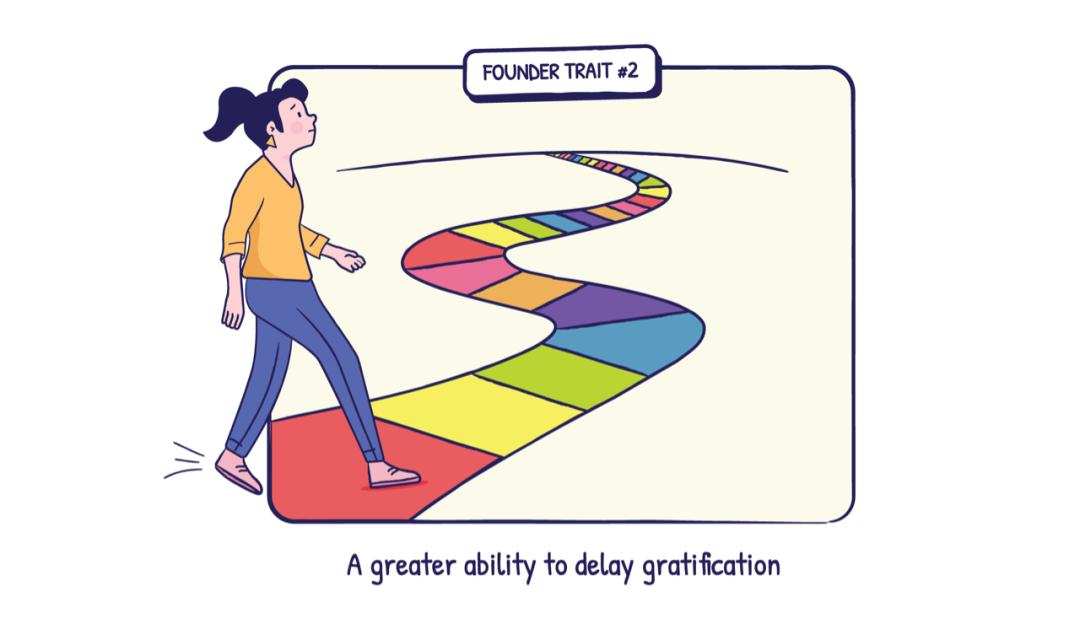
Image source: review.firstround.com
In addition to delaying gratification (such as financial rewards), founders are unlikely to receive a lot of recognition during the startup process. "Whether as a founder or working with other founders, my experience is that people don't always cheer for you. People don't know all the hard work you do behind the scenes. Investors won't pat you on the back for every small victory because they're eagerly looking forward to the next milestone." Anhalt said.
Founders have a unique talent for working hard and moving forward without being recognized.
II. Why can this be a disadvantage?
Anhalt reminds us: "In a founder's life, for every goal achieved, five new goals are created. It's well-known that founders aren't good at slowing down and celebrating along the way. Yes, they may need less recognition than others, but as humans, we still need to find satisfaction in life," she said.
I once worked with a founder who had just reached a huge, amazing milestone, the most important goal he had been working towards for years. I said in a coaching session, 'Wow, can we stop and celebrate?' His reply was that there was no time because he needed to focus on the next milestone he needed to reach," she said.
But eventually, the seemingly endless well of confidence and motivation will dry up. Anhalt said: "If you don't stop to be proud of what you've achieved so far, it's difficult to keep going forever." She also found that founders have the same tendency when interacting with other team members.
If founders don't think their small successes are worthy of recognition, they're less likely to recognize their team.
They're less likely to say 'Well done' and less likely to celebrate milestones." Anhalt said. A common mistake founders make is that because they need less recognition along the way, others in the team also don't get the satisfaction they deserve.
III. How to find satisfaction in the tough startup life Anhalt provided some suggestions for founders to help them adjust themselves, give themselves a dose of affirmation, and offer praise to others.
l Be a co-founder supporter. "It can be very lonely when your work goes unrecognized, but it can also be very uncomfortable to boast about yourself. I suggest co-founders encourage and cheer for each other and share with other team members what the other has done. For example, I'll introduce my co-founder to the team, 'Ericson has put in a lot of hard work behind the scenes to secure the next round of funding.' In this way, other team members can also share in the pride."
l Ask questions. "Founders quickly seek constructive feedback, but I suggest they also ask for positive feedback. Ask your team what they think you're doing well or where they feel supported. What milestones are they eager to reach? Why are they most excited about working at the company?"
l Tell people they're making a difference. "People want to know if what they're doing matters. It's important to let employees know that their hard work is noticed, recognized by the company, and plays an important role in achieving the company's goals. It's important to let employees know when they need to make changes, but it's also important to cheer for them when things are going well."
What people want isn't a participation trophy but to know that they're making a contribution.
Founder Trait #3: Value autonomy and independence
Dr. Anhalt's definition: For many founders, the idea of working for someone else is unacceptable. Founders want to take control of their own lives.
I. Why is this an advantage?
When you give up a traditional career and embark on the founder's path, you take a huge risk, going all in, hoping to change your fate. Anhalt said: "For many people, being able to decide their own lives is a powerful motivation for choosing the startup lifestyle."
As she has seen in her therapeutic practice, this idea is often deeply ingrained early on. "I've found that many founders I work with, for better or worse, are very independent people. I say for better or worse because many people are really independent because they have to be. Their living environment leaves them with no other choice, so they learn to be independent at a young age."
"This independence can benefit you greatly. Because building a startup doesn't come with a step-by-step navigation system. In many cases, you have to forge ahead, follow the first principles, and move at your own pace."
II. Why can this be a disadvantage?
Even if you're a very independent founder, you can't build a company alone. You need to assemble an early team and eventually bring in investors and a board of directors. Anhalt said: "The downside of this independent personality is that you can't trust others to support you and can't seek help, even when you know you want or need it."
Especially when you start building a team, this impulse starts to spread. "We all know that ideally, you should hire people who are smarter than you and better at certain aspects. But if you think you're someone who doesn't need others, you may unconsciously not want to hire people better than you," Anhalt said.
For any founder, it's unacceptable to give up the half-built Lego bricks of your own. "You may see a founder delaying hiring a product director because they want to hold onto that role tightly. They think, 'Product is my specialty. No one will do it better than me, so I'll do