Private gas stations are directly facing a survival crisis.
A super industry is facing serious questions as the times change.
As a truly fundamental resource, refined oil is a strategic industry related to the national economy and people's livelihood. With the rapid increase in the penetration rate of new energy vehicles and the accelerated evolution of a cleaner energy structure, refined oil consumption peaked last year and began to decline rapidly.
In 2024, China's apparent oil consumption was 756 million tons, and the total refined oil consumption was 390 million tons, a year-on-year decrease of 2.4%. The growth rate changed from an increase to a decrease.
The rapid progress of downstream energy substitution has led to weak demand for traditional energy. In addition, the international oil price has been oscillating downward, with both volume and price dropping. This has further compressed the operating rate and profit margins of the midstream refining industry, and private refining and chemical enterprises are beginning to face survival pressures.
Entering 2025, the refined oil industry is facing severe challenges, and the performance of the two major state-owned oil companies has slumped. Gas stations that directly face consumers are the first to bear the brunt. Especially the large group of private gas stations, which account for more than half of the total, will face a brutal battle for the existing market share.
Against the backdrop of being inferior to the two major state-owned oil companies in terms of price, location, brand, and service, they will be forced to face a severe survival crisis.
Peak
When the penetration rate of new energy vehicles reached a record high of 53.2%, the "reverse siphon effect" it caused began to be prominently manifested.
According to the latest data from the China Association of Automobile Manufacturers, in November, which has just passed, new energy vehicles still performed strongly. The monthly sales volume reached 1.823 million, a year-on-year increase of 20.6%, and the penetration rate reached a record high of 53.2%. In the first 11 months, the cumulative sales volume of new energy vehicles was 14.78 million, a year-on-year increase of 31.2%, and the cumulative penetration rate also reached 47.5%.
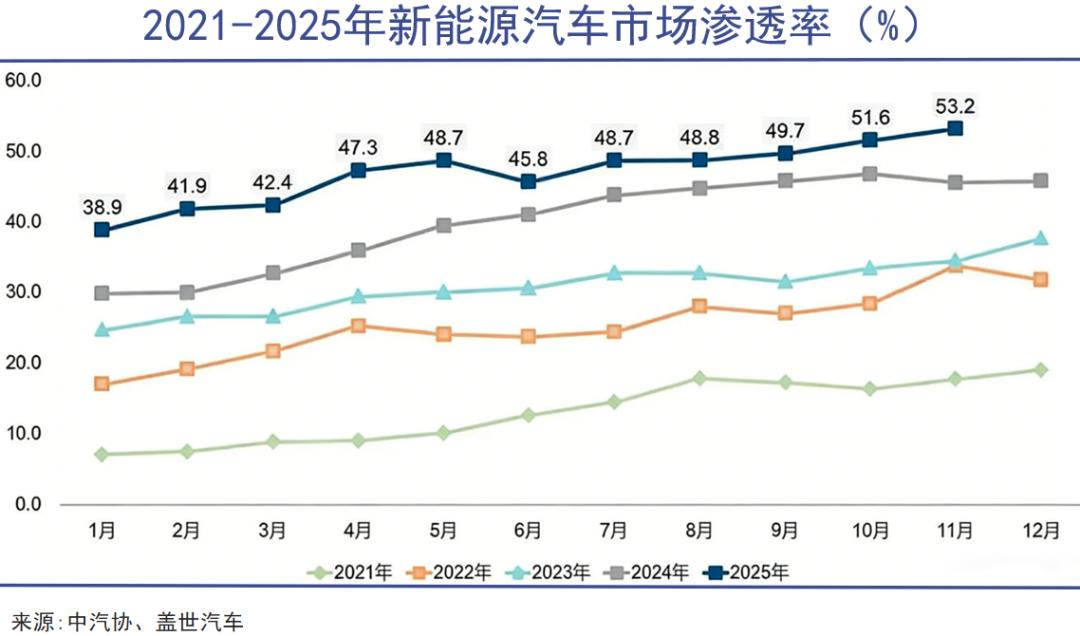
China is the world's largest automobile producer and seller. The large number of vehicles in use and the considerable number of new fuel-powered vehicles on the road every year form the basis for gasoline consumption. Now, there has been a historic turning point in China's automobile energy structure.
As of the end of June 2025, the total number of vehicles in use in China was 359 million, among which the number of new energy vehicles in use reached 36.89 million, accounting for 10.27% of the total number of vehicles. This figure was only 8.9% at the end of 2024.
In the first half of this year, the number of newly registered new energy vehicles reached 5.622 million, a year-on-year increase of 27.86%, setting a new record. The number of traditional fuel-powered vehicles in use was 322.11 million, only an increase of 510,000 compared with the end of 2024. The expansion period of fuel-powered vehicles is coming to an end.
Moreover, traditional fuel-powered vehicles are also undergoing technological upgrades, with simultaneous improvements in fuel efficiency and oil quality, resulting in a continuous reduction in fuel consumption. Coupled with the change in travel modes, gasoline sales have entered a downward trend.
When the driving force of vehicles changes from engines to power batteries and the energy replenishment locations change from gas stations to charging stations and battery swapping stations, gasoline sales are inevitably affected.
Zhuochuang Information once conducted a model deduction and concluded that in 2025, the substitution volume of gasoline consumption by new energy vehicles is expected to be 34.58 million tons, equivalent to 21% of the national gasoline demand in 2024.
That is to say, under a pessimistic outlook, 20% of the gasoline demand in the Chinese market will disappear.
The monthly data continuously confirm this trend. As of October 2025, the average monthly gasoline consumption in China was 12.2635 million tons, a year-on-year decrease of 5.04%. Except in October, the monthly gasoline consumption decreased throughout the year.

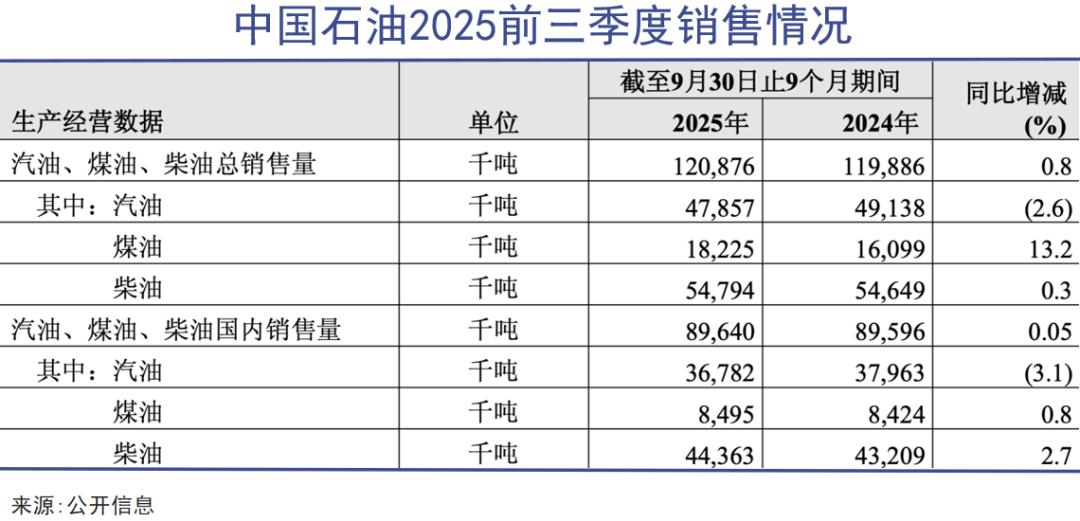
China's refined oil consumption reached its peak in 2023. According to the "2024 Report on the Development of the Domestic and International Oil and Gas Industries" by PetroChina, China's refined oil consumption in 2024 was 390 million tons, a year-on-year decrease of 2.4%. Gasoline and diesel consumption decreased by 3.1% and 4.8% respectively. The refined oil industry has entered a new historical period of "development with a decreasing volume".
Three years ago, the three major state-owned oil companies made huge profits due to the sharp rise in international oil prices. Now, they have all entered a period of performance contraction. In 2022, PetroChina made a huge profit of 148.738 billion yuan, becoming the "most profitable company" in the A-share market that year, with a year-on-year increase of 61.39%. CNOOC was also not far behind, earning 141.7 billion yuan and ranking second.
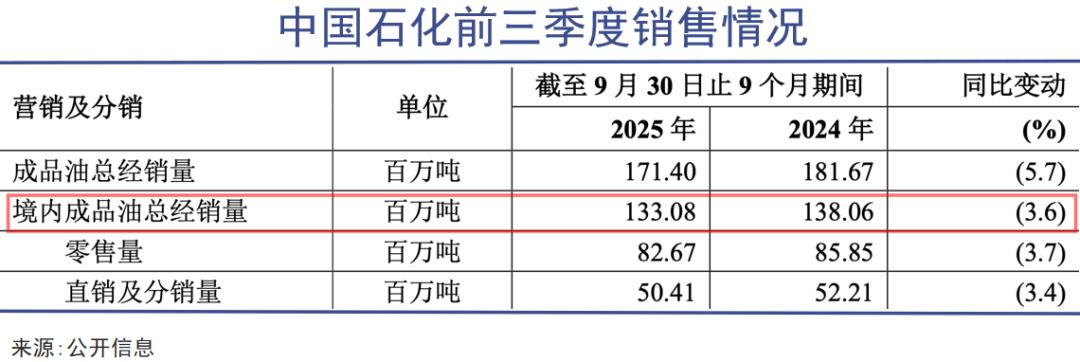
This year, with the international oil price oscillating downward and sales volume decreasing, the performance of the three major state-owned oil companies has declined to varying degrees. Among them, Sinopec was more affected. In the first three quarters, its refined oil sales volume was 170 million tons, a year-on-year decrease of 5.7%, and its net profit attributable to the parent company dropped significantly by 32.23%.
Currently, as the automotive industry accelerates its transformation, the negative "siphon effect" of electric vehicles will continue to be apparent. It is predicted that in 2026, the penetration rate of new energy vehicles is expected to exceed 55%, and China's gasoline consumption will drop to 141.5 million tons, a continued year-on-year decrease of 4%.
In addition, as the "dual carbon" goals are approaching and the policies of dual control of carbon emissions are being further strengthened, the incremental scale of fossil energy will be further compressed.
Volume Reduction
Gas stations, which are responsible for fueling terminal fuel-powered vehicles, bear the brunt of the structural change in energy consumption.

The performance of the three major state-owned oil companies is shrinking, and the situation of private gas stations can only be worse. On multiple social media platforms, private gas station owners have been complaining that their sales have plummeted, there are fewer cars coming to refuel, and business is difficult.
In the refined oil distribution field, a fact that goes against the subjective perception of the Chinese people is that the two major state-owned oil companies are not the main body of gas stations in China. The large number of private gas stations with a long-tail effect are the mainstay of the gas station system.
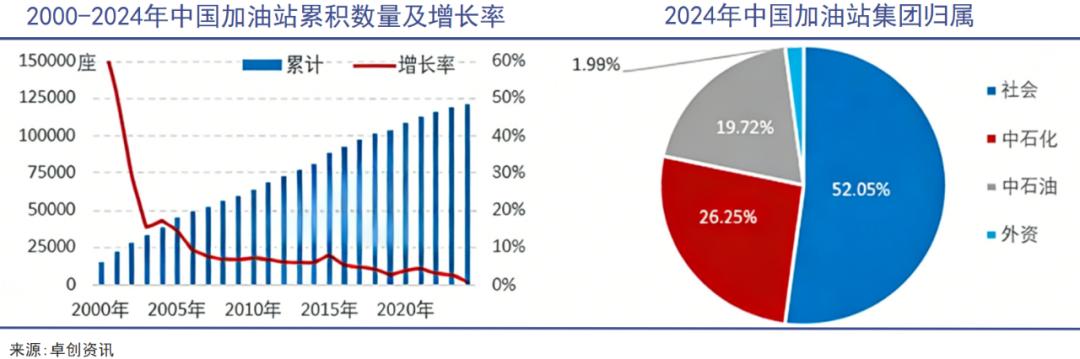
According to the statistical data of Zhuochuang Information, as of the end of 2024, the number of gas stations in China was nearly 121,000. Sinopec and PetroChina together accounted for nearly 46%, the number of private gas stations exceeded half of the total, and the remaining less than 2% of gas stations were owned by foreign-funded enterprises.
Considering cost control such as rent and avoiding direct competition with state-owned enterprises, private gas stations are generally located in relatively remote areas such as suburbs, national highways, and villages. With relatively low oil prices, they are the capillaries of the national energy supply system.
Before 2006, along with the rapid economic growth, the number of gas stations increased by more than double digits on average every year, and even doubled in some years. By 2024, due to the approaching saturation of the number and the shrinking demand, the annual growth rate of gas stations dropped to 1.13%, the lowest growth rate since 1956 when statistical data began.
Moreover, although there are a large number of private gas stations, their sales volume is quite small. Last year, 63,000 private gas stations only sold 100 million tons of refined oil, accounting for only 25% of China's total refined oil consumption.
The situation of too many competitors and too little business is already very severe, and the electrification of vehicles has made it even worse. Meanwhile, the oil and gas production is still increasing, and the three major state-owned oil companies are still expanding production. It is predicted that in 2025, the refined oil production will reach 422 million tons, while the demand in the same period is only 382 million tons, resulting in an oversupply of 40 million tons.
That is to say, if it was incremental development before, now it is not only competition for the existing market share but also a "battle in a shrinking market". It is quite common for the sales volume to decline by 30%, and the gasoline sales volume of some gas stations has decreased by more than half compared with the peak.
Due to their remote locations and price advantages, logistics heavy trucks are usually the main customer group of private gas stations. However, now heavy trucks are also accelerating their transformation to natural gas and hydrogen energy. In 2023, the sales volume of natural gas heavy trucks increased by 255%, and the increase in 2024 was also 17%. This has directly impacted the diesel business of gas stations, and an important source of income has been eroded.
Under the pressure of multiple factors, a brutal battle and a drastic reshuffle in the refined oil sales sector are inevitable.
Meanwhile, since this year, China has continued to strengthen the supervision of the refined oil circulation sector, including cracking down on "illegal gas stations", carrying out the reform of refined oil consumption tax, shifting the consumption tax from the production end to the direct sales from storage and the sales at the pump. Gas stations need to directly bear the obligation of tax payment. All these have caused a new round of impact on private gas stations.
The Economic and Technological Research Institute of PetroChina Group has not hesitated to point out in its report that it is expected that by 2030, the number of gas stations in China will directly decrease by 20,000, from the current 110,000 to 90,000. This is equivalent to 10 gas stations disappearing every day.
Diversification
"In the next 10 years, 90% of users will still choose fuel-powered vehicles. The popularization of new energy vehicles can only be a gradual process."
On the afternoon of May 16th, at the shareholders' meeting of Heshun Petroleum, the "first listed private gas station company", Chairman Zhao Zhong said, "The popularization of new energy vehicles must meet the requirement of being fully charged within 3 minutes. Only then will the consumption scenario of electric vehicles explode."
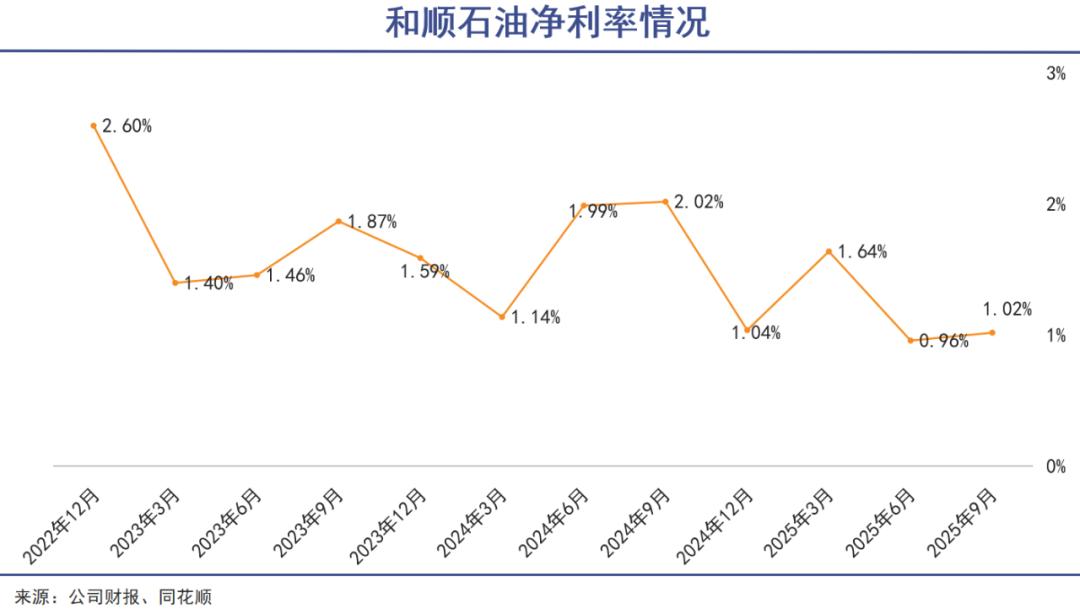
Maybe to encourage the shareholders, Mr. Zhao ignored the real data happening at present. However, compared with his "stubbornness", Heshun Petroleum's net profit in the first three quarters plummeted by nearly 50%, with a profit scale of only 22 million yuan, a gross profit margin of less than 8%, and a net profit margin of only a pitiful 1%.
Due to the structural change in the downstream demand, the transformation from traditional "fuel suppliers" to "comprehensive energy service providers" has become an industry consensus.
However, the transformation is not easy. On average, it costs 2 million yuan to build a charging pile, and more than 60% of private gas stations are unable to afford it.
Currently, the three major state-owned oil companies are still the main force in the transformation. Relying on their large networks and capital strength, Sinopec is actively building itself into a "comprehensive energy service provider integrating oil, gas, hydrogen, electricity, and services". At present, it has built 30,000 comprehensive energy stations and more than 10,000 ultra-fast charging stations. It has also joined hands with CATL and plans to build no less than 500 battery swapping stations this year, aiming for the goal of 10,000 battery swapping stations in the future.
In 2024, Sinopec earned 430 million yuan in charging service fees. Although this is negligible in its three-trillion-yuan business volume, the year-on-year increase was more than 20 times. The charging volume was 1.8 billion kWh, a 21-fold increase.
PetroChina is also accelerating the coordinated development of "oil, gas, hydrogen, electricity, and non-oil businesses". In 2024, it spent 7.188 billion yuan on the construction of domestic comprehensive energy stations and charging and battery swapping stations, and it is expected to invest another 7.6 billion yuan this year, continuing to increase its investment in the "non-oil and gas" sector.
Diversified energy services, high-end petrochemicals, etc. will become important growth engines for the three trillion-scale giants in the era of shrinking competition.
However, for private gas stations, this is an extremely difficult test.
On the one hand, limited by funds and technology, private gas stations have difficulty keeping up with the pace of the times in transformation. The relatively strong Heshun Petroleum