The affordable alternative to Nano Banana has quietly gained popularity, with Elon Musk and Meta competing for cooperation.
Why is a low - key German AI startup hailed as "the DeepSeek in the field of AI image generation"?
According to a report by ZDONGXI on December 15th, in the latest ranking of the text - to - image list by Artificial Analysis, FLUX.2[pro] of the German artificial intelligence laboratory Black Forest Labs ranked second, only after Google's Nano Banana Pro. The lightweight version, FLUX.2[flex], ranked fourth, ahead of ByteDance's Seedream 4.5.
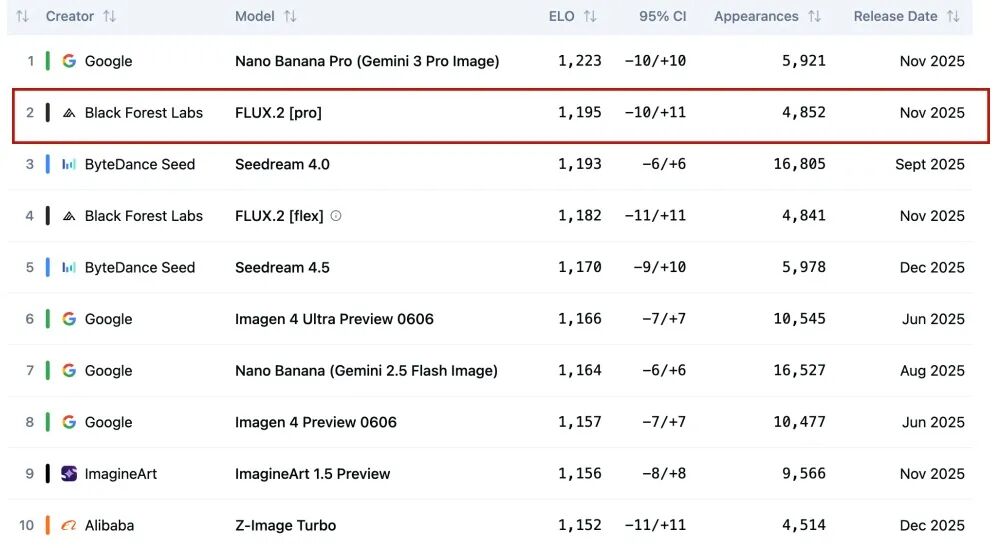
Artificial Analysis list (Source: Artificial Analysis)
In the text - to - image list of LMarena, FLUX.2[flex] tied with Gemini 2.5 Flash Image and ranked fourth. Both FLUX.2[pro] and FLUX.2[dev] made it into the top ten, ranking 6th and 7th respectively.
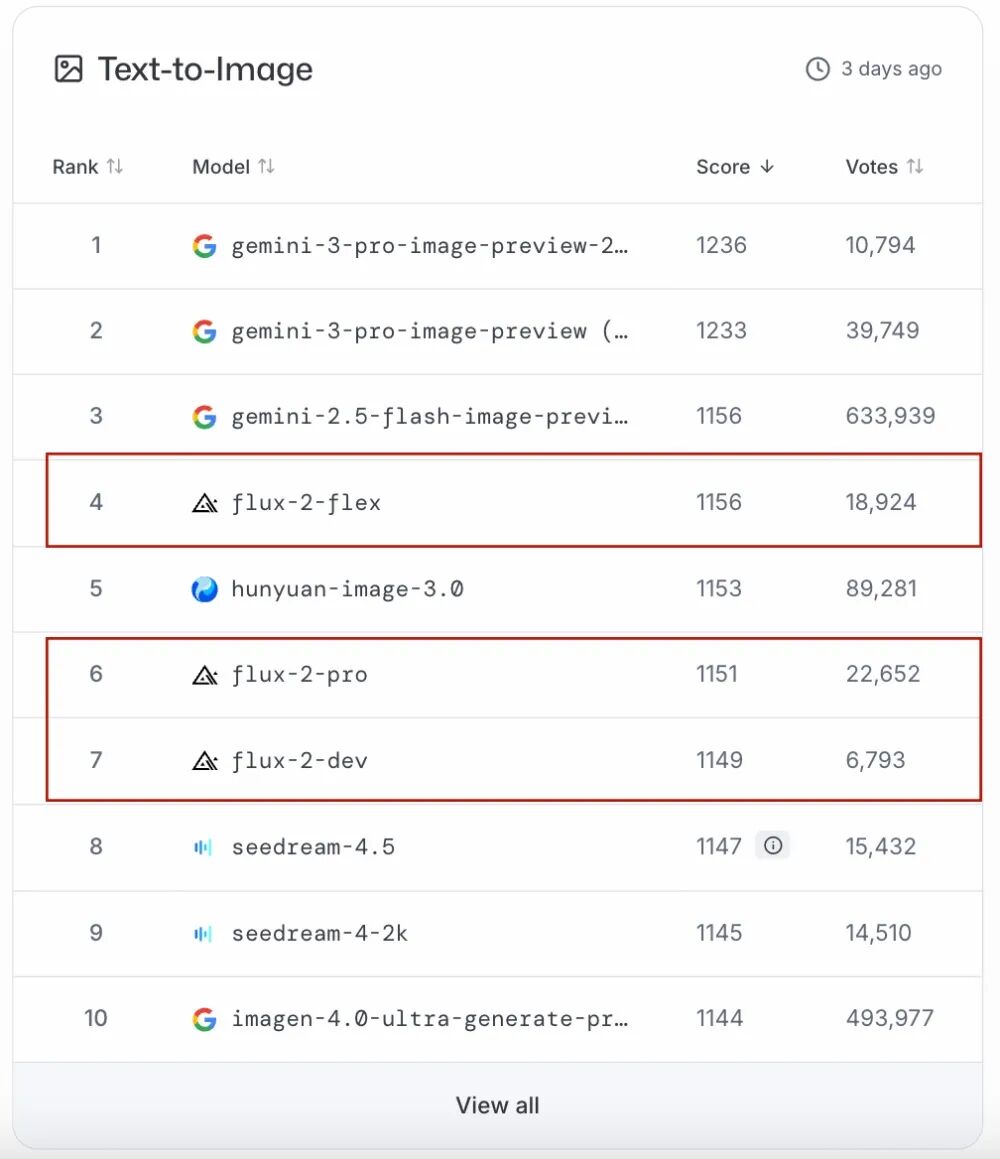
LMarena list (Source: LMarena)
Not only does FLUX.2 perform well in benchmark tests, but it is also open - source. Its download volume on Hugging Face has reached 225,346 times, ranking second in the image - to - image model ranking, only after Qianwen.
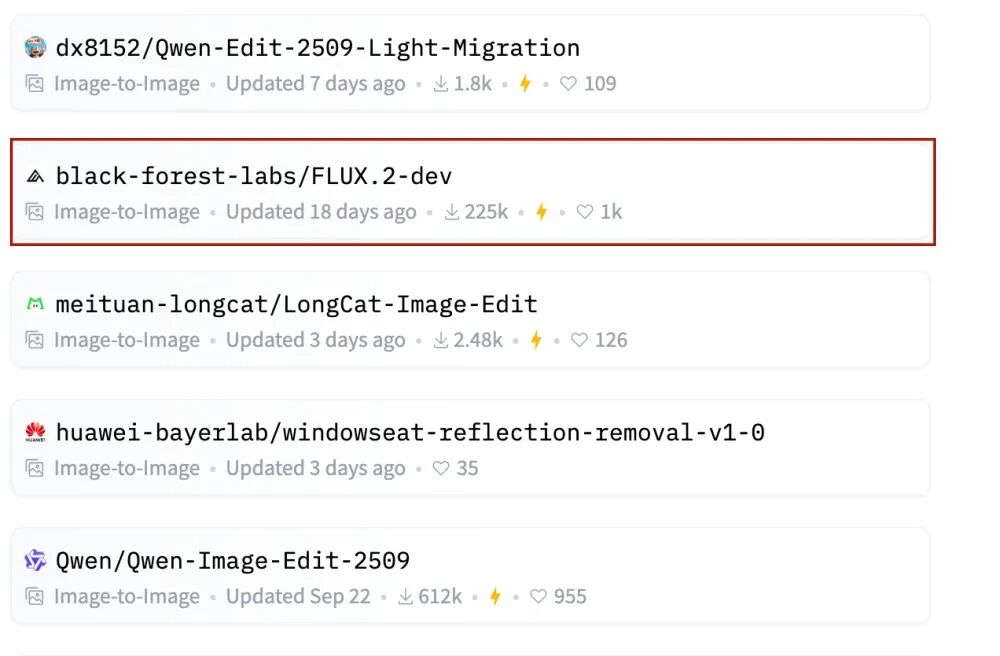
Hugging Face ranking of FLUX.2 (Source: Hugging Face)
Different from peers like OpenAI that love to be in the spotlight, Robin Rombach, the co - founder and CEO of Black Forest, once said in an interview with the Financial Times that he prefers to "let the product speak for itself". And the performance of its FLUX series of AI image models really lives up to expectations:
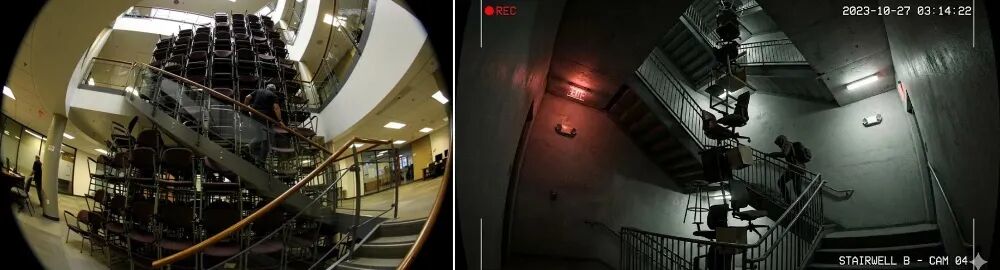
FLUX.2, released by Black Forest Labs last month, almost tied with Google's Nano Banana in the comparative test. Take a look at these comparison pictures. Can you tell which pictures were generated by Nano Banana and which were generated by FLUX.2?
Prompt: Surveillance footage of an office building stairwell: Piles of chairs are impossibly stacked several stories high, and a person is passing by these chairs on the stairs. The scene has emergency lighting, fisheye lens distortion, and an obvious sense of anomaly that violates the logic of the building structure.
Prompt: A photo in the style of a 2000s CCD camera, showing two sloths drinking in a tavern.

Prompt: While maintaining the unique styles of the reference images respectively, a man and a woman are posing for a photo side by side. The color of the background wall is the same as that in Image 1, but the style and texture are consistent with those in Image 2. She is wearing cool and gorgeous clothing in bright blue.
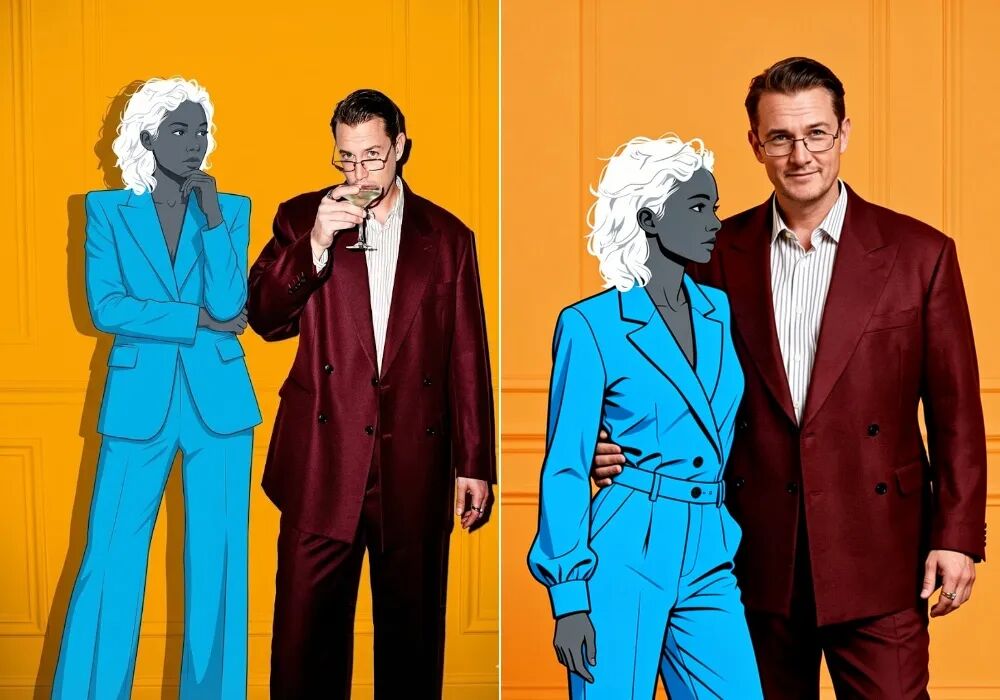
The pictures generated by FLUX.2 from top to bottom are: left, left, right
This company, founded in August 2024, has cumulatively raised over $450 million (approximately RMB 3.18 billion) to date. On December 1st, Black Forest Labs announced that it had completed its Series B financing, raising $300 million (approximately RMB 2.12 billion). The company's valuation has reached $3.25 billion (approximately RMB 22.96 billion), tripling in just over a year.

Financing announcement of Black Forest Labs (Source: Black Forest Labs official website)
At the beginning of its establishment, Grok of Musk's xAI cooperated with it to launch an AI image function. In September this year, Bloomberg reported that Black Forest Labs had reached a deal worth $140 million (approximately RMB 990 million) with Meta and established partnerships with Adobe and Canva.
From becoming popular in the open - source model community to winning nearly a billion - dollar order from Silicon Valley giants, this AI company from a small German town seems to have caught every wave.
Where does all this technological foundation come from? Why are Musk and Meta willing to pay for its technology? Behind the tripled valuation in a year, what kind of team and strategy are supporting the rise of this "European - style DeepSeek"?
01. "The Father of Stable Diffusion" Opened the Door to Generative AI
Robin Rombach, the co - founder and CEO of Black Forest Labs, studied physics at Heidelberg University from 2013 to 2020 and then pursued a Ph.D. in Computer Science at the Computer Vision Group of Heidelberg University. In 2021, he and his research team moved to the University of Munich. His research mainly focuses on generative deep - learning models, especially text - to - image systems.

Robin Rombach, co - founder and CEO of Black Forest Labs (Source: Latent Labs)
During his Ph.D. studies, Rombach met the team that later became his co - founders. They jointly published a series of research papers focusing on the AI technology of "latent diffusion". His paper "High - resolution image synthesis with latent diffusion models" has been cited 27,039 times to date.
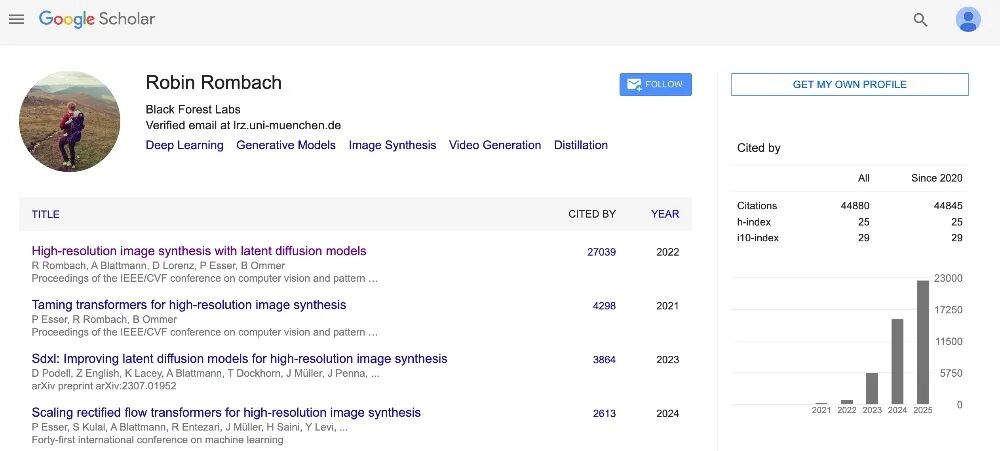
Robin Rombach's Google Scholar profile (Source: Google Scholar)
Rombach said that this technology is "the foundation of many generative AI technologies being built in the field." He also revealed: "We were running on an ultra - small GPU on consumer - grade hardware at that time," he said. "To get really good performance from it, we had to come up with a more efficient algorithm."
Early recognition in the academic and research communities prompted Rombach to expand the technology for commercial use. In 2022, Rombach and his AI research team joined the London - based AI startup Stability AI together.
During this period, they collaborated with Stability AI to expand the latent diffusion method and finally created the Stable Diffusion model.
"In the summer of 2022, when the Internet exploded with hyper - realistic image generation, it was largely the result of their work," said Nathan Benaich of the investment firm Air Street Capital.
But after Stability AI got into trouble, Rombach and his team left in 2024 and founded Black Forest Labs. The company quickly raised startup funds from investors including a16z and General Catalyst.
"There are only a very few people on Earth who know how to push the boundaries of general AI models. Robin and his team, as the inventors of latent diffusion, have this advantage," said Anjney Midha, a venture partner at a16z.
02. Endorsed by Musk, Meta, and Nvidia, Black Forest Labs Has an Annual Revenue of Nearly $100 Million and Tripled Its Valuation in a Year
Black Forest Labs focuses on developing basic AI models for image generation and editing. Since its establishment, it has won the attention and cooperation of many giant enterprises.
Among them, the cooperation with the tech giant Meta is particularly eye - catching. According to Bloomberg, in September this year, Meta signed a multi - year contract worth $140 million (approximately RMB 990 million) with Black Forest Labs to introduce its AI image technology.
Specifically, according to people familiar with the matter, Meta will pay the German startup $35 million (approximately RMB 250 million) in the first year of cooperation, and the payment will increase to $105 million (approximately RMB 740 million) in the second year.
In fact, Meta is not the first industry giant to favor Black Forest Labs. As early as last year, Grok, the chatbot of Musk's xAI, relied on the company's technology to launch an AI image generation function. Black Forest Labs successfully opened up market awareness and became well - known through this cooperation case.
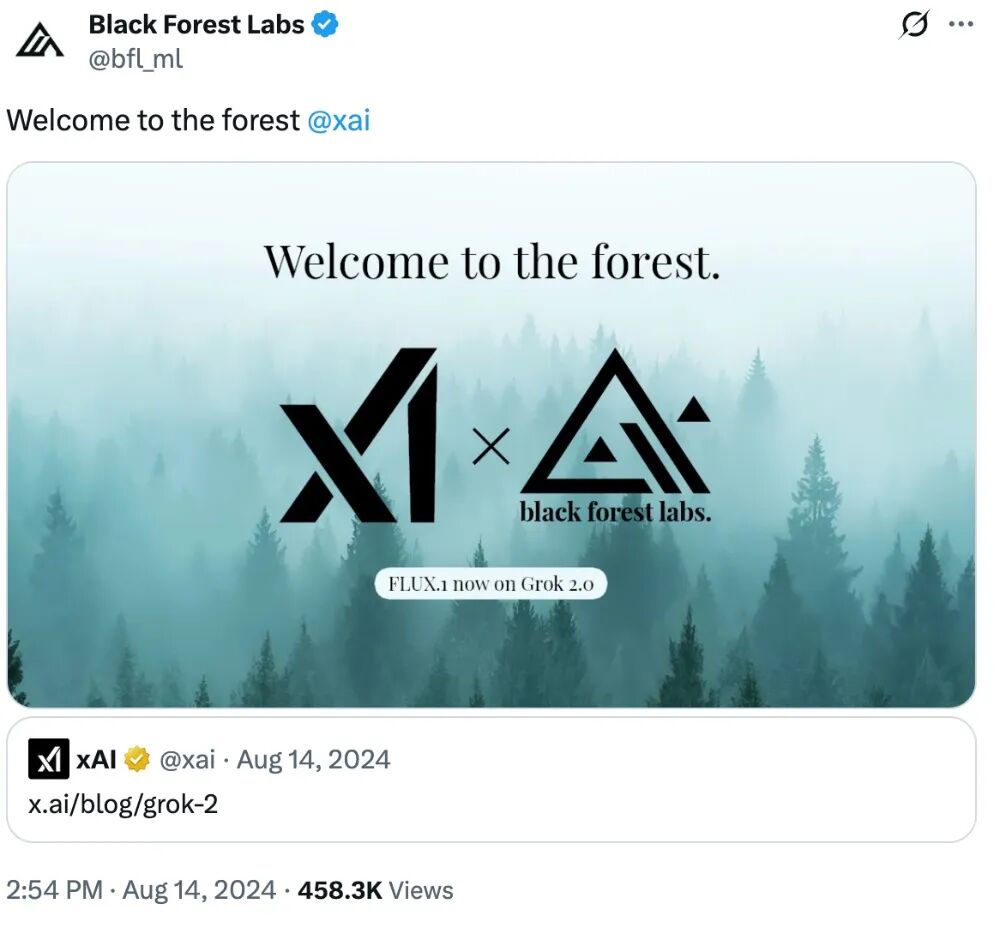
Cooperation between Black Forest Labs and xAI (Source: X)
With the continuous improvement of market recognition, the cooperation map of Black Forest Labs continues to expand. People familiar with the matter said that the company has successively signed cooperation agreements with well - known enterprises in the industry such as Adobe, Canva, and Snap. If the agreement with Meta is included, the total contract value of these cooperations has reached approximately $300 million.
The rapid expansion of the business is also directly reflected in the revenue data: As of August this year, the annual recurring revenue of the startup has reached $96.3 million (approximately RMB 680 million). And according to the person, Black Forest Labs expects its annual recurring revenue to climb to $300 million (approximately RMB 2.12 billion) in the fiscal year 2026.
While carrying out business cooperation and achieving revenue growth, Black Forest Labs has never stopped in the research and development of core technologies.
The FLUX.1 series of models introduced with Black Forest Labs have amazing generation effects and quickly became popular on the Internet. Even AI guru Andrej Karpathy once recommended them.

Tweet by Andrej Karpathy (Source: X)
In May this year, it released FLUX.1 Kontext, which introduced the dual - input mechanism of text and image for the first time, supporting context - aware generation and editing.
This model uses the Flow Matching technology, which changes the traditional diffusion model architecture.
In November, Black Forest Labs officially released the latest version of the image - generation model, FLUX.2. Compared with the previous generation of products, this model has optimized its performance in text and image rendering. It also innovatively supports up to 10 images as references. In addition, it can generate high - definition images with a maximum resolution of 4K. (FLUX.2 is open - source! Can the "DeepSeek" of AI image generation replace Google's Nano Banana? Attached with first - hand actual tests)
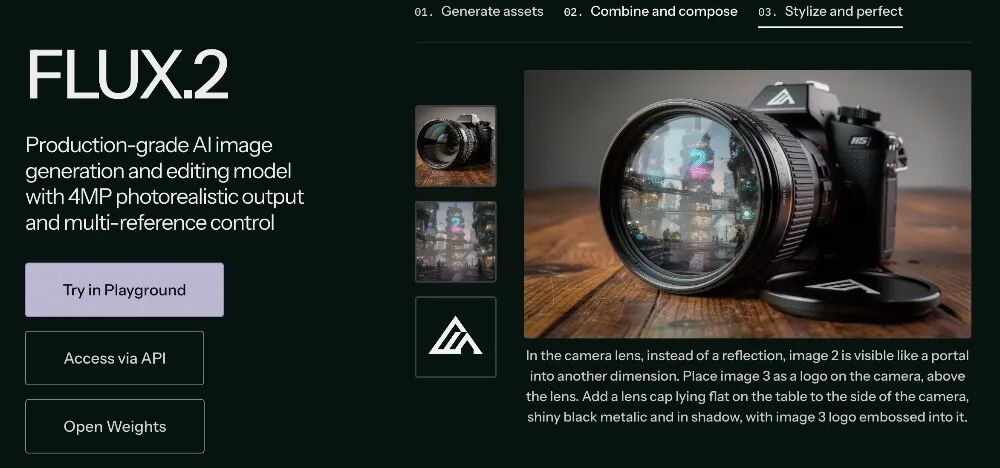
FLUX.2 (Source: Black Forest Labs)
The double breakthrough in technological strength and market performance has also won the favor of the capital market. On December 1st, Black Forest Labs announced that it had successfully completed its Series B financing, raising $300 million (approximately RMB 2.12 billion). The company's valuation has climbed to $3.25 billion (approximately