The era of eFuse is coming.
Undoubtedly, from electric vehicles to AI data centers, from energy storage and industrial sectors to the consumer electronics market, electricity has become the lifeblood driving everything.
However, accompanied by this is a series of potential risks such as overcurrent, short - circuit, surge, and system - level coordination, which constantly threaten the stability and security of complex electronic systems. Traditional fuses, due to their limitations of one - time fusing, slow response, and single function, have shown their obvious drawbacks.
Against this backdrop, the electronic fuse (eFuse) — an intelligent circuit protection solution based on semiconductor technology — is moving from niche areas to the center stage and becoming a key cornerstone for ensuring industrial innovation and reliable operation.
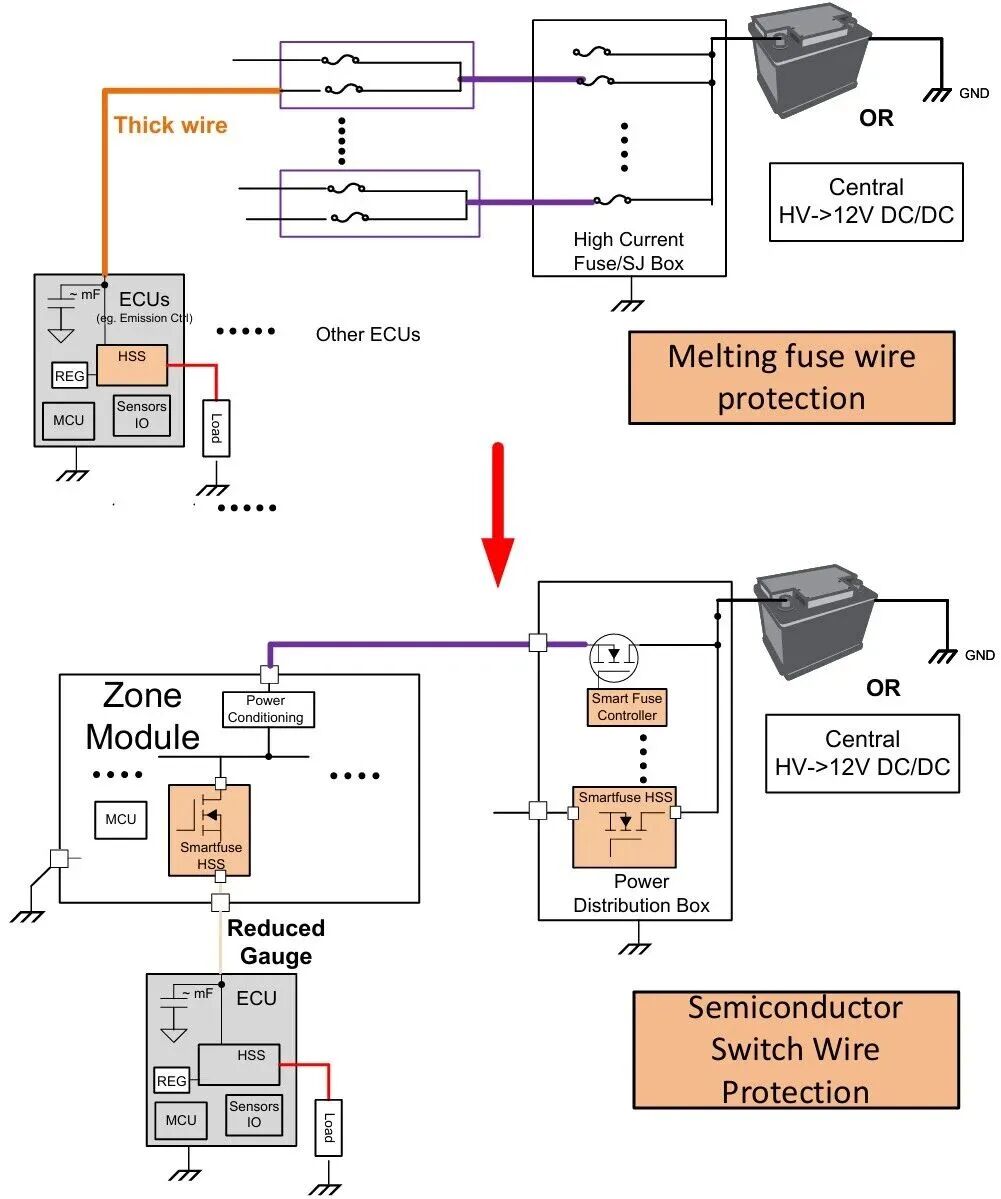
From traditional fuse technology to eFuse (Source: Automotive Electronics and Software)
eFuses are usually integrated with power MOSFETs, current detection circuits, control logic, and various protection function modules. Many models also integrate over - voltage protection, thermal shutdown, reverse current blocking, soft start, and fault reporting functions. Its core functions include multi - dimensional intelligent protection against overcurrent, over - voltage, over - temperature, and reverse current. It also has a microsecond - level response speed, programmable thresholds, and self - recovery ability, significantly improving the safety and reliability of the system.
Compared with traditional fuses and PPTC self - recovery fuses, eFuses have significant advantages in many aspects.
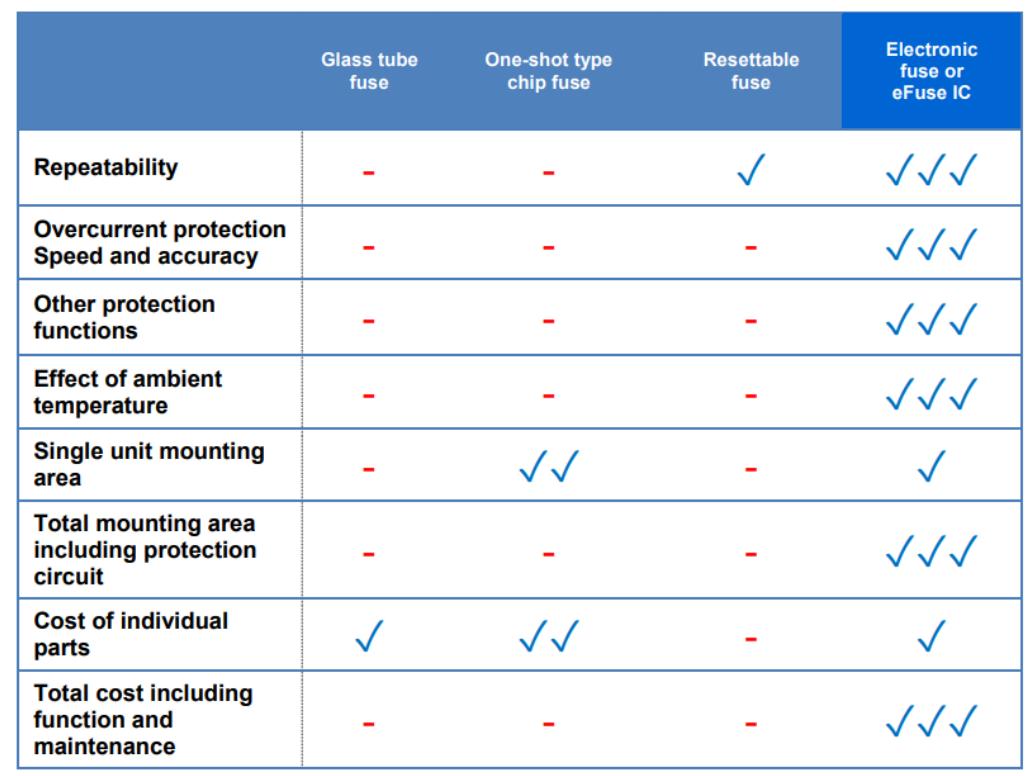
Comparison of eFuse with other fuse technology characteristics (Source: Electronics Engineering World)
eFuse, Entering the Fast Lane
The booming development of the eFuse market is strongly driven by multiple rapidly growing market sectors.
- Electric Vehicles: The electrification transformation of the automotive industry is one of the most powerful engines for eFuses. Data from the International Energy Agency (IEA) shows that from 2022 to 2023 alone, global electric vehicle sales soared by approximately 3.6 million units. As vehicles evolve from 400V to 800V high - voltage platforms, the safety isolation and protection of core high - voltage components such as battery management systems, electric drive inverters, and on - board chargers have become extremely complex and important.
With its millisecond or even nanosecond - level fast response, precisely settable protection thresholds, and automatic recovery characteristics, eFuses can effectively prevent the spread of faults, protect expensive high - voltage components, and support function updates and diagnosis through OTA, perfectly meeting the needs of intelligent electric vehicles.
Tesla was an early and firm advocate of eFuse technology. As early as the launch of the Model 3 in 2017, Tesla widely replaced the traditional relay and fuse combination in the low - voltage system with eFuses. This measure not only simplified the wiring harness but also significantly improved the reliability, safety, and maintainability of the vehicle's electrical system through the fast response, diagnostic capabilities, and recoverability of eFuses, laying a solid electrical architecture foundation for its intelligent functions.
Subsequently, as the automotive intelligent power distribution architecture gradually shifts from the traditional centralized distribution to the distributed architecture, eFuses play a key role. Each regional control unit (RCU) is equipped with eFuses to achieve intelligent power distribution within the region. This design greatly reduces the length and weight of the wiring harness and improves reliability.
On the other hand, with the popularization of 48V mild - hybrid systems, the automotive power distribution system is evolving from the traditional 12V system to the 48V system. eFuse technology plays an important role in this transformation.
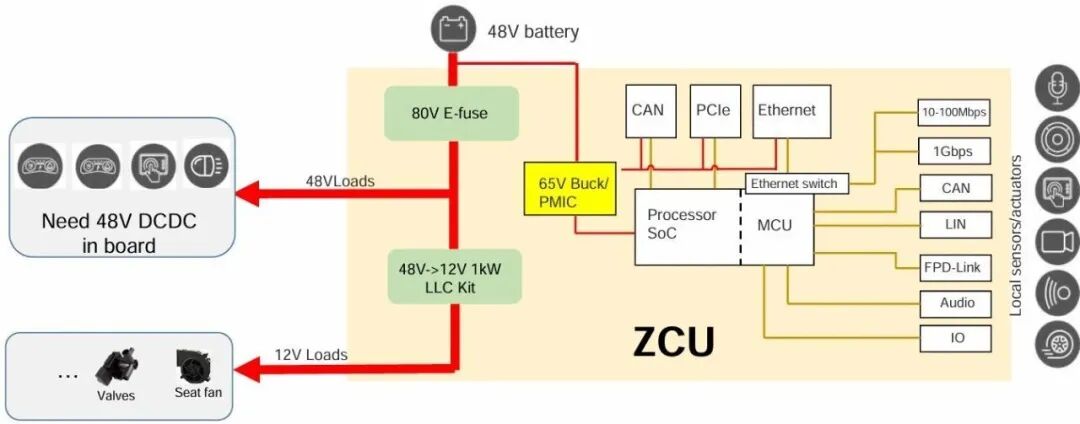
Source: Automotive Electronics and Software
In the 48V system, eFuses are used to isolate the 12V and 48V systems to ensure the safe operation of both systems. When a fault occurs in the 48V system, the eFuse can quickly cut off the connection between 48V and 12V to prevent the fault from spreading to the 12V system.
Overall, the transformation and intense competition in automotive technology are pushing electrical safety to a new level of intelligence and electronification. With its revolutionary advantages such as extremely fast response, precise protection, automatic recovery, intelligent diagnosis, space - saving, and cost - reduction, eFuses have become an indispensable core protection component in the new - generation automotive electrical architecture. From Tesla's early adoption to the current fierce competition between global semiconductor giants and emerging domestic manufacturers, the eFuse market has become highly competitive. With the popularization of ADAS/AD and the upgrade wave of 48V systems, this competition around automotive safety will undoubtedly accelerate the electrification and intelligentization process of the entire industry.
- AI Data Centers and High - Density Storage: The explosive growth of generative AI has pushed data centers into a new stage of power and density competition. The power consumption of AI servers is continuously breaking records. For example, a server equipped with eight H100 chips can consume up to 8.4kW at full load, and the single - slot power of a larger cluster may exceed 15kW. This change has driven the power supply architecture to move from 12V to 48V and even higher voltages to meet the power requirements of kilowatts and above. In this context, ensuring the absolute reliability of the power supply path and enabling hardware hot - swapping without interrupting services have become critical for data center operation and maintenance.
eFuses, especially those combined with hot - swap controllers, have become the core of building an "uninterruptible power supply defense line". They can not only provide extremely fast fault isolation but also integrate digital monitoring functions to report voltage, current, power, and fault status in real - time, providing data support for predictive maintenance, maximizing server uptime, and directly reducing the total cost of ownership of data centers.
In addition, in high - density and complex storage systems, the demand for thermal safety and power path protection has increased the need for precision eFuse chips. Large - capacity SSDs and servers are increasingly deployed in enterprise environments, and eFuse solutions are integrated into the power transmission architecture to optimize performance and avoid heat dissipation problems.
- High - End Consumer Electronics: While consumer electronics such as smartphones, tablets, and high - end laptops are pursuing faster charging, more powerful functions, and thinner designs, the complexity and risks of their internal power supply architectures are also increasing simultaneously. With its recoverable, high - precision, high - integration, and small - package characteristics, eFuses can provide precise protection for key paths such as USB ports, battery charging and discharging circuits, and display modules, while helping engineers save valuable PCB space. According to Research Nester data, there were more than 4.69 billion smart device users globally in 2024, providing a broad market for eFuse applications in the consumer electronics field.
- Energy Storage Field: eFuses are mainly used for overcurrent protection at the battery pack PACK level, entrance protection of energy storage systems, and intelligent early warning. For example, in the battery management system (BMS), eFuses can be integrated into the battery pack to prevent faults caused by overcurrent or over - temperature and ensure battery safety.
- Industrial Field: eFuse applications cover power management in industrial robots, multifunction all - in - one machines, and other devices, providing multiple protections such as overcurrent and over - heat protection; in industrial automation scenarios, eFuses are used for the protection of I/O ports of PLCs to avoid equipment damage caused by power fluctuations or short - circuits.
It can be seen that with the support of product feature advantages and diverse market demands, eFuses have become a track with a solid demand foundation and a clear growth logic. According to industry analysis reports, the global eFuse IC market size reached approximately $550 million in 2024 and is expected to grow to $950 million by 2037.
Behind this growth is the inevitable result of the digital and intelligent wave of electronic products, which also depicts huge growth potential and market space for the development of the eFuse track.
Industry Giants Competing in the eFuse Track
Facing clear market opportunities, global semiconductor giants have increased their investment, and market competition has become increasingly fierce. International manufacturers are consolidating their barriers through technological innovation, product portfolio expansion, and ecological cooperation.
Texas Instruments
Texas Instruments (TI) is one of the outstanding players. Relying on its profound power management technology accumulation, it has built a differentiated layout in the eFuse field. Facing the many limitations of the traditional combination of hot - swap controllers and discrete FETs in high - power scenarios, such as large size, complex design, high difficulty in fault detection, uneven current sharing, and easy false triggering, TI took the lead in integrated innovation and launched a family of 48V hot - swap eFuse devices specifically designed for data centers, breaking through the bottlenecks of traditional solutions with an integrated design.
Among them, the TPS1685, as the core representative, has become the preferred solution for high - power power protection with its multiple differentiated advantages. The core advantages of the TPS1685 span the entire dimensions of design, performance, and reliability. In terms of integration, it abandons the external detection resistors and current detection amplifiers in traditional solutions. By integrating core functions, it greatly simplifies the circuit layout. With the LQFN package, it reduces the overall solution size by 50%, meeting the miniaturization requirements of data center equipment.
In terms of power expansion, the TPS1685 can be seamlessly upgraded to 6kW, far exceeding the 4kW limit of traditional discrete solutions. It realizes the total system current limit through the IMON pin, avoiding the problem of path resistance mismatch. With a configurable overcurrent blanking timer, it effectively improves the operation stability. In addition, the device supports the stacking function to enhance the current - handling capacity and also integrates features such as fault recording, FET safety protection, and active current sharing to comprehensively enhance the system reliability.
Overall, the device can greatly simplify the design, improve the integration, and provide a reliable and compact solution for data centers. With its accurate grasp of industry needs and technological innovation, TI has built a technological barrier and market advantage in the eFuse field. Its eFuse layout is centered on scenarios and driven by technology, not only providing reliable support for key fields such as data centers but also leading the industry towards integration, high - power, and high - reliability development.
Toshiba
Toshiba has also been deeply involved in the eFuse field. With the core layout of precisely matching diverse needs and expanding the product line, it has established a differentiated advantage with its integrated design and flexible adaptability. Recently, Toshiba has mass - produced five new products in the 40V TCKE6 series, which are benchmarks for efficient protection. They not only integrate multiple protections such as short - circuit, overcurrent, over - voltage, and over - heat, far exceeding physical fuses, but also have advantages such as a wide input range of 4.4V - 30V, a low on - resistance of 52mΩ, and a small TSOP6F package (2.9mm×2.8mm), greatly simplifying the circuit design, reducing power consumption, and saving board - level space. These eFuse ICs are suitable for a wide range of applications including industrial and consumer devices. In the future, Toshiba will continue to enrich its eFuse product line and strengthen its competitiveness in niche areas.
STMicroelectronics
STMicroelectronics (ST) has built a multi - scenario core layout of "automotive + industrial/computing" in the eFuse field. Based on its proprietary STi²Fuse technology, it has formed a rich product matrix from single - channel to four - channel, covering both intelligent automotive power distribution and the protection needs of industrial control, servers, and other scenarios.
For high - safety automotive application scenarios, the STi2Fuse can replace traditional fuses. It has both advanced diagnostic capabilities and high functional safety. The distribution box equipped with this device can achieve a 25% weight reduction, extend battery life, and provide autonomous wiring harness protection. It can monitor current, voltage, and temperature in both on and off states. Combined with a dedicated algorithm, it can detect early performance degradation, and its fault prevention coverage far exceeds the standard mechanism. It can also meet the high - safety requirements of autonomous driving and the EDA450 standard, and can quickly cut off the circuit within 100 microseconds when a fault occurs.
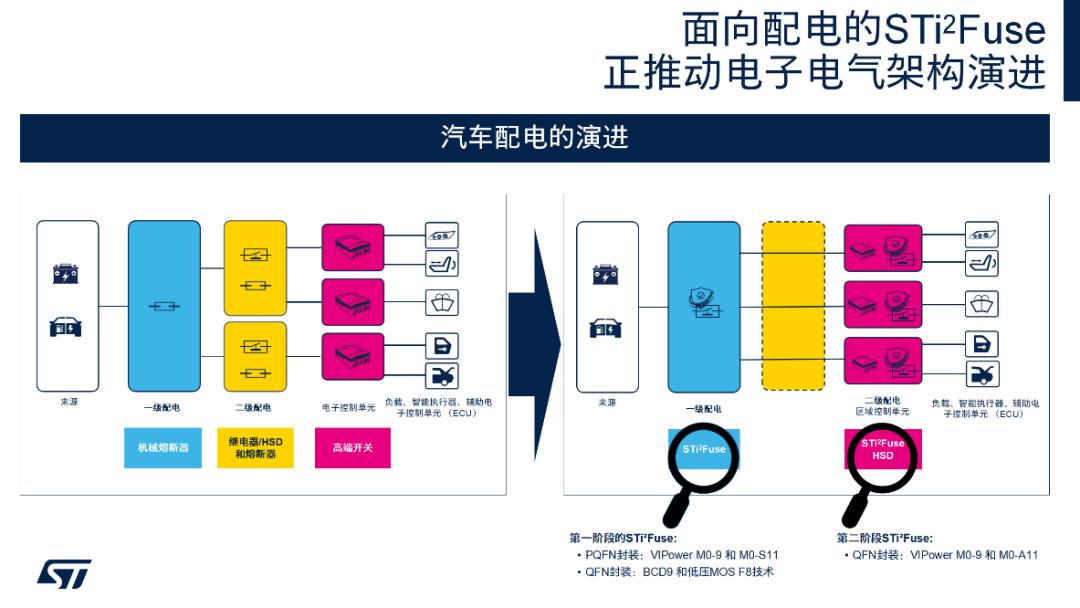
Source: STMicroelectronics Automotive Electronics
In addition, this series offers multiple specifications of single, double, and four - channel options and has the advanced feature of a configurable I2T fusing curve, helping customers reduce costs. It has been widely adopted by many global automakers, consolidating STMicroelectronics' leading competitiveness in the automotive eFuse field.
Infineon
As a global leader in the power system field, Infineon has built an eFuse layout focusing on the 800V HVDC in AI data centers and the high - voltage trend of new - energy vehicles. Its solutions cover the entire voltage range from 48V to 800V, precisely matching the needs of high - power scenarios. It not only solves the current power supply protection problem of AI servers but also lays the foundation for the next - generation high - voltage architecture.
Recently, Infineon launched a series of 48V intelligent eFuses (XDP730/XDP720/XDP721/22) and the REF_XDP701_4800 hot - swap controller reference board, precisely matching the needs of high - power computing scenarios.
It is understood that Infineon's 48V eFuse is highly integrated with modules such as a digital protection controller and OptiMOS power transistors. It supports hot - swapping and nanosecond - level fault response and can also output telemetry data such as voltage and current in real - time. The REF_XDP701_4800 is equipped with 1200V CoolSiC JFET technology, suitable for 400V/800V architectures. It has programmable SOA control of inrush current, and its TDP reaches 12kW. Compared with competitors, Infineon's solutions, with full - voltage coverage, SiC high - voltage technology, high integration, and real - time monitoring capabilities, maximize the uptime of AI servers, simplify the design, and reduce the TCO. It is not only the core guarantee for the current 48V architecture but also lays the foundation for the power protection of future megawatt - level data centers.
onsemi
onsemi has built a differentiated layout focusing on the core scenarios of automotive and industrial applications in the eFuse field. Relying on its intelligent circuit protection technology, it has established a leading position in the industry and provides solutions for scenarios with high - reliability requirements. Its eFuses have significant advantages over traditional fuses and PTC thermistors. They have an automatic reset function, can achieve multi - dimensional protection against overcurrent, over - voltage, reverse current, and over - heat, and can also monitor voltage/current/temperature and interact with the system controller. They support power sequencing control and inrush current limitation, meeting the intelligent protection needs of modern power distribution architectures.
Taking onsemi's typical product NIV3071 as an example, this product is designed for harsh automotive scenarios. It has a withstand voltage of 60VDC/65VTR, integrates four independent channels in a compact 5.0mm×6.