In less than two minutes, a 6-year-old kid built a website using AI. His lawyer father was immediately "emotionally overwhelmed": "I've been trying to prevent this for over a decade, but he just did it effortlessly."
In the new era of generative AI, people have been discussing whether it will revolutionize education, transform programming, and reshape the way we work. However, you might not have expected that even a 6 - year - old child can now become an "infringement generator" with the help of AI.
Recently, a senior intellectual property (IP) lawyer in the United States witnessed a "nightmarish future scenario" while playing with an AI tool with his son on the weekend:
His son simply typed a few words, and Google's AI Studio quickly generated a fully functional website that can automatically tell stories, add illustrations, and even mix the copyrighted characters of major companies like Sony, Nintendo, and Disney in an adventure.
Seeing this scene, the lawyer - father was stunned: "My son accidentally did what I've been trying to prevent others from doing throughout my more than a decade - long career."

(Image generated by AI)
01
A 6 - year - old child built a complete website with AI:
Launched in 2 minutes, zero - code, and customizable story templates
As mentioned at the beginning, the story took place on an ordinary parent - child weekend. At that time, Jonathan Menkes, a well - known IP lawyer in the United States and a partner at the Knobbe Martens law firm, was playing with Google AI Studio with his son.
As a result, in less than 2 minutes, his 6 - year - old son with zero coding experience "developed" a fully interactive website:
● Name: Bedtime Story Weaver
● Function: Based on user input, AI will generate a complete story + illustrations with one click
● Interaction: Select characters, story themes, tones, learning objectives, story lengths, etc.
● Implementation method: Simply enter a few words, such as "story telling for kids". There is no need to write code at all. The child doesn't even understand what variables, back - ends, or template languages are.

After the Bedtime Story Weaver website was built, his son first asked it to generate an "adventure story of a dragon and a knight". The accompanying illustrations were colorful and had a gentle style. Jonathan Menkes thought it was okay when watching from the side:
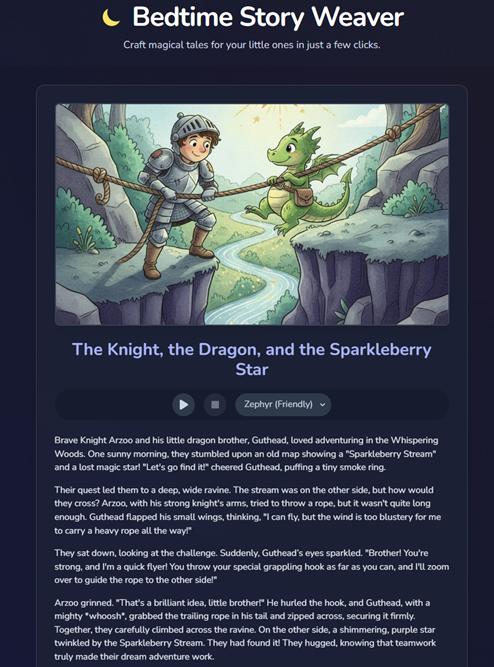
Subsequently, his son entered the theme of "Let Sonic and Mario go on an adventure together". A few seconds later, another story and a picture were generated: Sonic from Sony and Mario from Nintendo appeared in the same picture, embarking on a cross - universe adventure, and even "fighting monsters and collecting coins" together.

Seeing this picture, Jonathan Menkes instantly became extremely worried because in the traditional field, this is a very clear and serious copyright infringement.
"As an IP lawyer, I was completely stunned. My child completed in a few seconds what I've been desperately trying to prevent others from doing throughout my more than a decade - long career."
02
The copyright crisis in the AI era: Infringing content can be generated in 1 second
Jonathan Menkes emphasized in his blog that this incident shows that many people in the IP industry are not prepared to deal with the challenges brought by AI.
In the past, infringement might have required downloading software like PS, Maya, Photoshop, having painting, modeling, and writing skills, and a certain technical threshold. But now, as long as you have an AI account and can type, or even if you can't read and can use voice input, infringing content can be generated in 1 second.
"AI is greatly 'democratizing' creative ability. It is no longer exclusive to professionals but can be participated in by everyone, and even children can generate potentially infringing content."
Therefore, Jonathan Menkes advocates that relevant IP practitioners must truly understand how this technology works and anticipate the upcoming problems and opportunities in advance. Although there has been continuous controversy in the industry about "AI using copyrighted content to train models", Jonathan Menkes believes that even without talking about the training data, the AI applications themselves are enough to give IP holders a headache.
Based on this, Jonathan Menkes warns: "IP holders should prepare for the upcoming 'infringement tsunami' of software and websites, which will continuously challenge the boundaries of existing copyright laws." Specifically, the measures that IP holders can take include:
(1) Comprehensively evaluate whether the current copyright monitoring system is sufficient
The scale, speed, and volume of infringement in the AI era far exceed the capabilities of traditional detection tools. For example, even if you enter "video game plumber", AI will still generate a character similar to Mario.
(2) Enterprises should actively test every new AI tool on the market
It is necessary to confirm whether it has a built - in copyright security mechanism or is an unrestricted "completely free canvas". If it is the latter, enterprises should actively contact the AI tool provider to promote the addition of a filtering system.
(3) Establish a rapid response mechanism
Once infringement is discovered, the content must be taken down and reported immediately to avoid the content spreading into an "uncontrollable state". In other words, in the future, IP enforcement may evolve into a situation where those who can force AI companies to add filters can protect their own copyrights from being misused.
However, Jonathan Menkes also clearly points out that the times have changed, and IP holders should also accept appropriate "secondary creation" by users. For example, Disney is currently testing on Disney+ to allow users to generate their own AI - version Disney stories. In the future, the winners will not be "companies that extremely block IP" but brands that can prevent infringement while building a controllable and commercializable user - created ecosystem.
03
Will big companies win, and will small companies be "crushed"?
The story shared by Jonathan Menkes has attracted the attention of many netizens. Many people suspect that AI might really completely destroy copyright laws, and some have deduced the possible future trends:
"It is more likely that copyright enforcement will become a game that only giants like Sony and Disney can afford to play. What about individual creators and small companies? Their IP will continue to be freely used and trained by various AIs without any means to fight back. This is the current situation on the Internet, and AI will only push this situation to the extreme."
Indeed, Disney, Sony, and Nintendo can spend millions to hire lawyers, negotiate with AI companies, and customize filtering rules. However, small studios and independent artists cannot afford the legal expenses and have no ability to influence AI companies. This will cause obvious inequality - AI will further dilute the rights of individual creators, while giants will continue to strengthen their IP fences.
However, as Jonathan Menkes said, currently, AI makes the update of copyright laws extremely urgent, but even a professional like him is not sure "what the future will be like". After all, all the current disputes and contradictions need time to be resolved.
Reference link:
https://www.knobbe.com/updates/sound-the-alarm-how-my-6-year-old-almost-became-a-copyright-pirate-overnight/
This article is from the WeChat official account "CSDN", author: Zheng Liyuan. It is published by 36Kr with authorization.