Dr. Link Healthcare: Generating revenue from mothers through pediatric referrals.
Author | Huang Yida
Editor | Zhang Fan
Recently, Zhuozheng Healthcare, well - known for its pediatric services (hereinafter referred to as "Zhuozheng"), submitted its prospectus to the Hong Kong Stock Exchange for the third time. It has been one and a half years since its first application. The latest prospectus updates the performance up to the end of August this year. The financial report shows that after turning a profit for the first time in 2024, the net profit level in the first eight months of 2025 further expanded. Meanwhile, the number of patient visits increased steadily, and the average customer spending in major departments, except for pediatrics, also increased slightly.
While Zhuozheng has shown impressive performance, there are also many hidden concerns in its operation. At the industry level, competition in the private medical industry where it operates is intensifying. In particular, the international departments of public hospitals have diverted many customers from traditional high - end private medical services, and foreign - funded hospitals are also accelerating their entry into the market. In terms of demand, against the backdrop of long - term weak economic recovery, the growth of the mid - to high - end medical customer base is slowing down.
So, for Zhuozheng Healthcare, which is about to enter the capital market, how sustainable is its performance? What are the core factors affecting its performance growth?
01 Weak Profitability Leads to Performance Pressure
In 2024, Zhuozheng Healthcare achieved an income of 959 million yuan, a year - on - year increase of 39%. Its business scale has doubled compared to 2021. The income growth in recent years is mainly due to the expansion of the scale of medical service institutions and the matching of good demand. Since the beginning of this year, the company's income growth has slowed down significantly. The financial report shows that the cumulative income in the first eight months of this year increased by about 13% year - on - year.
In terms of income structure, Zhuozheng's main business includes four major segments: physical medical services, online medical services, membership plans, and out - of - hospital medical services. Among them, physical medical services are the company's pillar business, and its annual income has accounted for more than 90% since 2024. The income of the other three businesses accounted for only single - digit percentages during the same period.
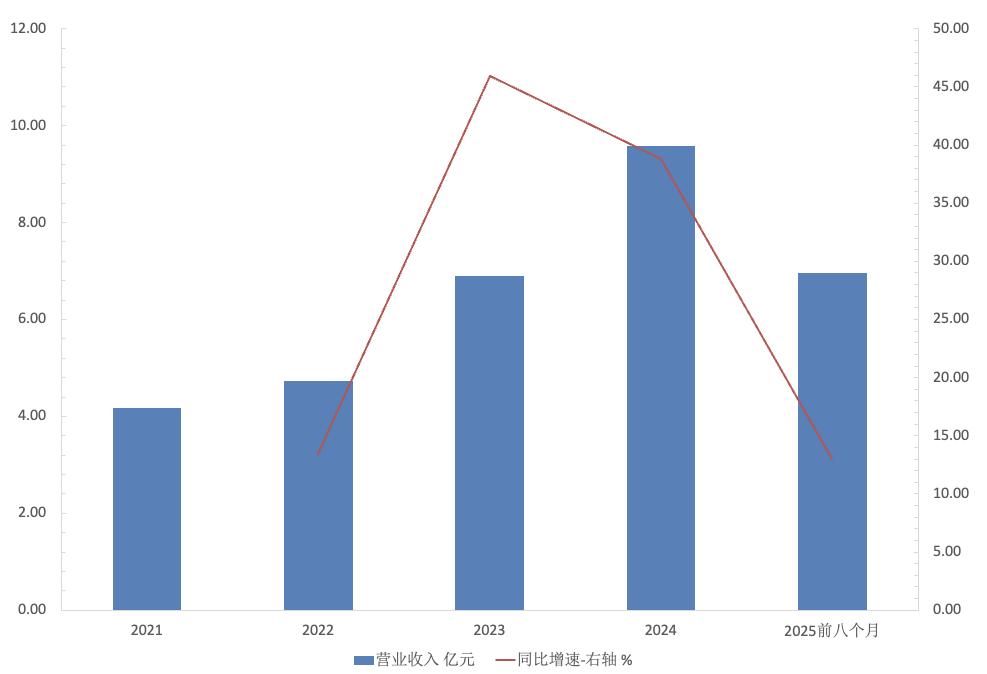
Chart: Zhuozheng Healthcare's Income and Year - on - Year Growth Rate; Source: Company Prospectus, 36Kr
The physical medical service business can be further divided into departments such as pediatrics, dentistry, ophthalmology, dermatology, otolaryngology and surgery, internal medicine, and gynecology. As of the end of 2024, pediatrics was Zhuozheng Healthcare's largest department in terms of both the number of patient visits and the operating income achieved, which is in line with the company's first impression on the outside world.
However, the profitability of pediatrics ranks at the bottom among all departments. Dermatology and dentistry, which rank second and third in terms of income scale, lead pediatrics to varying degrees in terms of average cost per visit. In terms of strategy, Zhuozheng uses relatively affordable pediatric service pricing as an entry point to attract patients to other departments such as dermatology and ophthalmology. As of the end of August this year, dermatology has surpassed pediatrics in terms of income and become the company's largest department.
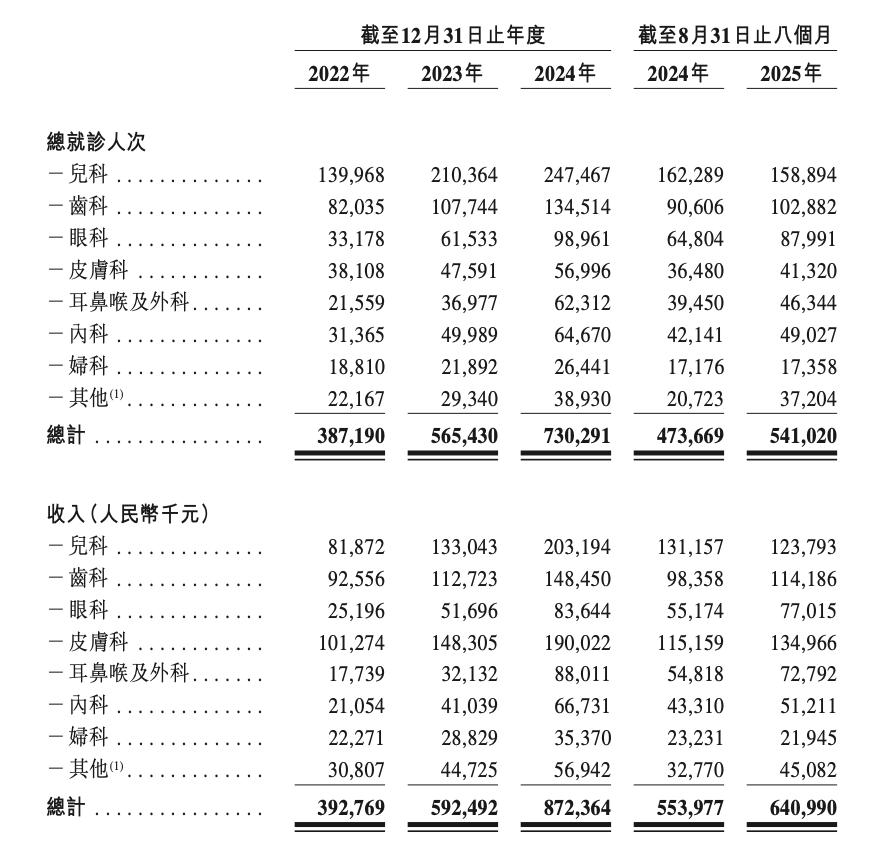
Chart: Number of Patient Visits and Income by Department of Zhuozheng Healthcare; Source: Company Prospectus, 36Kr
Regarding the service price of Zhuozheng's pediatrics, taking the pediatric health care project as an example, Zhuozheng's pediatric health care package for children aged 7 - 12 months is priced at 2,300 yuan, including 2 pediatric health care sessions and 5 physical examinations, with three free blood routine, blood lead, and vision screenings each. Calculating only the pediatric health care and physical examinations, the average price per session is less than 330 yuan. The basic pediatric health care and vaccination package for children aged 0 - 1 year at United Family Healthcare costs 13,988 yuan, including 6 pediatric health care sessions and vaccination projects within 1 year. After subtracting the vaccination part (calculated at the imported price for Class II vaccines), the average price per pediatric health care session exceeds 700 yuan.
In terms of business volume, Zhuozheng's pediatrics department had 247,000 patient visits in 2024. Calculated based on a total of 24 institutions (19 in China and 5 overseas), the average number of patient visits per institution per day is about 28 (including holidays). Compared with the overcrowding in public tertiary - level hospitals, Zhuozheng's pediatrics department indeed offers a superior environment and no waiting, which is also a major advantage of high - end private medical institutions.
Currently, Zhuozheng's profitability is relatively weak. The comprehensive gross profit margin as of the end of August 2025 was only 24%. Looking at a longer period, Zhuozheng's gross profit margin has shown a steady upward trend year by year, mainly due to the improvement of operating efficiency and the release of a certain degree of scale effect.
The major part of the period expenses is administrative expenses. In 2024, administrative expenses accounted for about 28% of the income, while the proportion of sales expenses was relatively low, less than 2%. This reflects that the company mainly relies on word - of - mouth for brand building, so it spends little on marketing. On the other hand, due to the relatively limited profit margin and the relatively rigid wage expenditure, the company cannot afford to invest heavily in marketing.
Salaries account for about 80% of administrative expenses. The annual increase in administrative expenses is mainly due to the growth in the number of employees caused by the expansion of medical institutions. In terms of the employee structure, as of the end of 2024, Zhuozheng had 379 full - time doctors, accounting for 21% of the total number of employees. In terms of work experience, the average practice experience of the doctor team is about 15 years, and 79% of them have practiced in tertiary - level hospitals. The existing employee structure reflects Zhuozheng's business strategy of relying on well - known doctors to attract patients, and the total salary of the doctor team is expected to be the major part of the company's overall wage expenditure.
In terms of net profit performance, after mainly excluding the impact of the fair value change of convertible and redeemable preferred shares, Zhuozheng achieved a profit for the first time at the end of 2024 in terms of adjusted net profit. The adjusted net profit in the first eight months of 2025 was only about 10 million yuan, which is still small in scale but has been improving year by year. There are two main core factors affecting Zhuozheng's net profit:
1. The annual increase in gross profit margin has thickened the profit space, which is the basis for the improvement of net profit.
2. Administrative expenses are the main item eroding profits. As the company's business scale expands, employee salaries, as a rigid expenditure, have significantly dragged down the net profit. Relying on well - known doctors to attract patients is a double - edged sword for Zhuozheng at this stage.
02 Private Medical Services in a Tight Spot
From an industry perspective, the domestic medical service industry is still dominated by public medical services at present.
Public data shows that as of the end of 2024, there were a total of 1.09 million medical service institutions in China, including 537,700 public medical institutions and 554,300 private medical institutions. Moreover, the number of private medical institutions has been growing steadily, while the number of public medical institutions has declined to some extent.
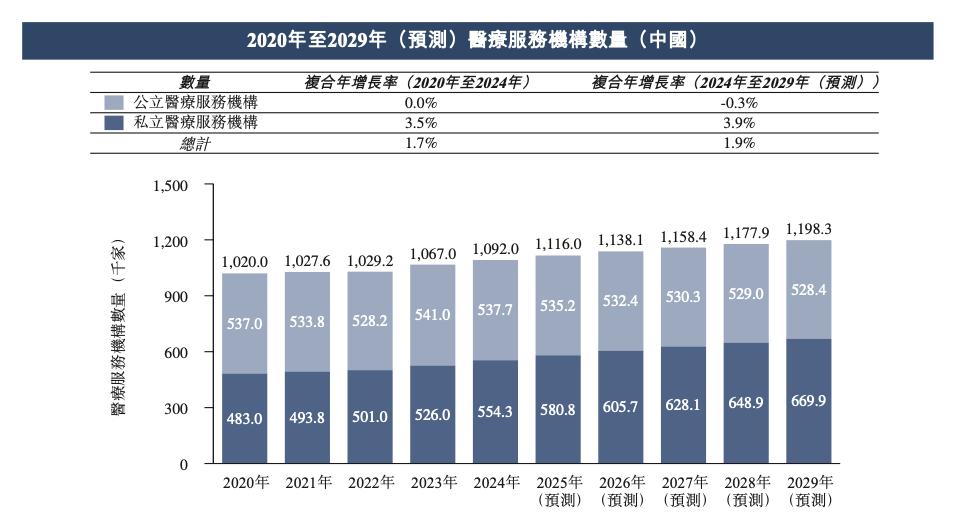
Chart: Structure of the Number of Domestic Medical Institutions; Source: Company Prospectus, 36Kr
Although the number of private medical institutions has exceeded that of public ones, the income of private medical institutions is far less than that of public ones. Public data shows that in 2024, the total income of private medical institutions was about one - fifth of that of public medical institutions. At present, the numerical advantage of private medical institutions has not been transformed into a strength advantage, and they generally feature "small scale, low level, and poor efficiency".
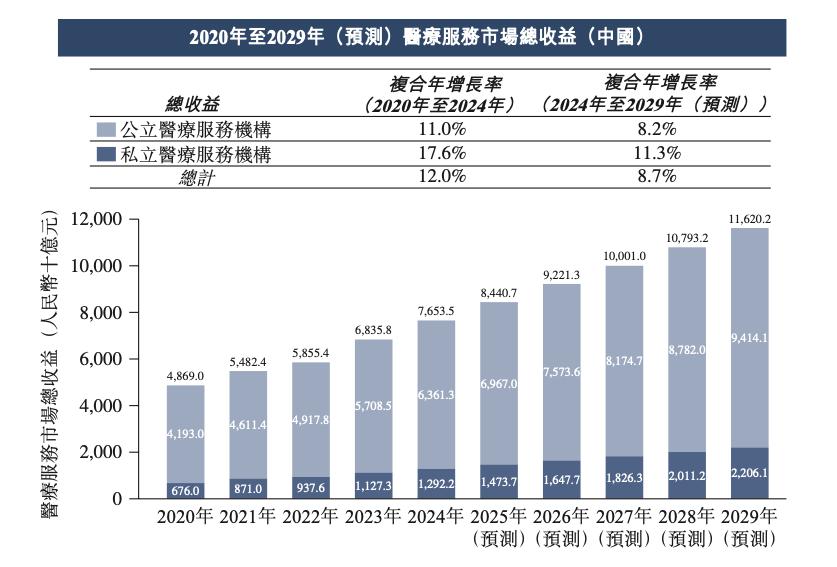
Chart: Income Structure of Domestic Medical Institutions; Source: Company Prospectus, 36Kr
For Zhuozheng Healthcare, even though it is a leading player in the private medical industry, as of the end of 2024, it ranked third among private high - end medical institutions in terms of income. However, it is also affected by the industry's prosperity. In terms of business scale, Zhuozheng's business platform mainly consists of clinics, and some departments have established a good reputation in the industry. However, compared with leading public hospitals in the same period, there are still significant gaps in terms of scale, technology, etc. This gap is essentially the chasm between private and public medical institutions in terms of resources and credibility, which is difficult to bridge in the short term, resulting in relatively low overall trust from patients in private medical services.
Although private medical services have higher flexibility in pricing mechanisms, the long - standing pattern of the domestic medical system dominated by public medical services has not changed. Especially affected by the medical insurance cost control in recent years and the backdrop of weak economic recovery, the business logic of "high - quality services corresponding to high premiums" in high - end private medical services is facing multiple challenges. At the same time, it also needs to deal with the rising core operating costs such as labor and consumables, which is also one of the main reasons for Zhuozheng's relatively weak profitability.
03 Common Industry Problems in the Expansion of Medical Institutions
From the perspective of industry development trends, the differentiation in the private medical industry is intensifying. On the one hand, leading private institutions in fields such as ophthalmology, dentistry, and tumor rehabilitation have successfully connected with the capital market through chain - style and group - style operations and differentiated services, showing good development momentum. On the other hand, a large number of small and medium - sized private medical institutions are being gradually eliminated from the market due to their lack of core competitiveness and weak risk - resistance ability, and the "Matthew effect" in the private medical industry is becoming more and more obvious.
Looking at different departments, ophthalmology and dentistry are highly replicable and have relatively low investment barriers, which are conducive to rapid expansion with the help of capital. As of the end of August 2025, for Zhuozheng, the income of ophthalmology and dentistry ranked third and fourth respectively among all departments, second only to dermatology and pediatrics.
Zhuozheng's layout in ophthalmology and dentistry is in line with the current trend of the continuous increase in the chain - style operation rate in the medical service industry. Moreover, one of the advantages of the company's chain - style operation is that it has stronger bargaining power in terms of fixed asset allocation and consumable procurement, which can release the scale effect to a certain extent and help improve the company's overall gross profit margin.
However, it should be noted that due to the particularity of the medical service industry, the scale effect has obvious boundaries. That is, there are almost no shared equipment among different clinics, and there is no sharing in terms of doctors' operations. This means that in the process of expanding the scale of medical institutions, the fixed asset investment increases simultaneously, but it is difficult to significantly reduce the unit cost.
This phenomenon essentially reflects that the continuous deepening of the chain - style operation of medical institutions is mainly reflected in the management form, but it is unable to release a more significant scale effect through resource concentration and collaborative operation. This results in an obvious ceiling for the company's future gross profit margin improvement, which will have a relatively large impact on the company's performance and valuation.
Now, let's look at the dermatology department, which currently has the highest income in the company. In addition to diagnosing and treating traditional skin problems such as dermatitis, acne, and eczema, it can also provide non - surgical cosmetic procedures such as photon rejuvenation, Thermage, and hyaluronic acid injections. In recent years, the overall demand for cosmetic procedures in China has been relatively weak. The income of cosmetic companies such as Amicogen and Haohaishengke showed negative growth in Q3 this year.
As a downstream terminal in the cosmetic industry, Zhuozheng's dermatology department achieved positive income growth against the industry trend as of the end of August this year. The core reason is that as a representative of high - end private medical services, Zhuozheng's main customer group is high - net - worth individuals, who have a stronger willingness to consume cosmetic procedures. Based on the high - frequency and high - repurchase consumption characteristics of non - surgical cosmetic procedures, as the company's scale expands and the number of members increases, it will support the future growth of Zhuozheng's dermatology department.
Overall, Zhuozheng Healthcare uses pediatrics as the core entry point to drive the coordinated development of multiple departments such as dermatology, ophthalmology, and dentistry, and this business logic has been verified. However, the company still faces the common industry problem of being unable to release a greater scale effect in the process of expanding medical institutions, which makes its future performance growth relatively lack explosive power and more inclined to be stable and sustainable. At the same time, restricted by the pricing constraints of the domestic medical service system, its relatively weak profitability is another major factor suppressing performance growth.
*Disclaimer:
The content of this article only represents the author's views.
The market is risky, and investment should be made with caution. Under no circumstances do the information or opinions expressed in this article constitute investment advice to anyone. Before making an investment decision, if necessary, investors must consult professionals and make decisions carefully. We have no intention of providing underwriting services or any services that require specific qualifications or licenses to engage in for the trading parties.