CHAGEE: Are the Flagship Products Losing Their Appeal?
Author | Xie Yunzi
Editor | Zhang Fan
Cover Source | Visual China
After the news of the "marriage" of the founders sparked heated discussions, Cha Ji Ba Wang recently released its financial report for the third quarter of 2025.
Cha Ji Ba Wang was established in 2017. In the years when fruit tea dominated the "new tea - drinking" market, this brand from Yunnan focused more on the milk - tea category. With its printing design similar to the Dior tote bag and the hit product "Boya Juexian", it quickly opened up the market.
At Beijing time on April 17, 2025, Cha Ji Ba Wang was listed on the NASDAQ, successfully raising $411 million. The opening stock price soared to $33.75, and its market value once exceeded $7.5 billion (approximately over 54 billion yuan). However, like many new tea - drinking brands that "reach their peak upon listing", Cha Ji Ba Wang's performance in the capital market took a sharp turn for the worse. Since the beginning of 2025, its revenue and net profit have declined for three consecutive quarters.
The third - quarter report of 2025 shows that Cha Ji Ba Wang achieved a net income of 3.208 billion yuan, a 9.4% decrease compared to the revenue of 3.541 billion yuan in 2024, and a continuous decline compared to the revenues of 3.392 billion yuan and 3.331 billion yuan in the first and second quarters of this year.
Specifically divided by business model, the revenue of franchised tea houses (franchised stores) in the third quarter reached 2.8116 billion yuan, while the figure in the same period of 2024 was 3.299 billion yuan. In the financial report, Cha Ji Ba Wang attributed the decline in the income of franchised stores to consumers' price sensitivity caused by the "subsidy war" on food - delivery platforms.
As early as the performance communication meeting in the second quarter, Zhang Junjie, the founder of the company, clearly stated his stance of "not participating in the war". At that time, he admitted that short - term subsidy behavior was not beneficial to the long - term market development.
Some viewpoints hold that Cha Ji Ba Wang's price range is concentrated between 15 and 22 yuan. Participating in the price war is likely to impact consumers' perception of its mid - to high - end brand. On the other hand, participating in the price war may also accelerate the iteration of the life cycle of Cha Ji Ba Wang's "hit product". In the short term, the company cannot better adjust its gross profit through "specific food - delivery products".
However, refusing to participate in the war does not mean being care - free.
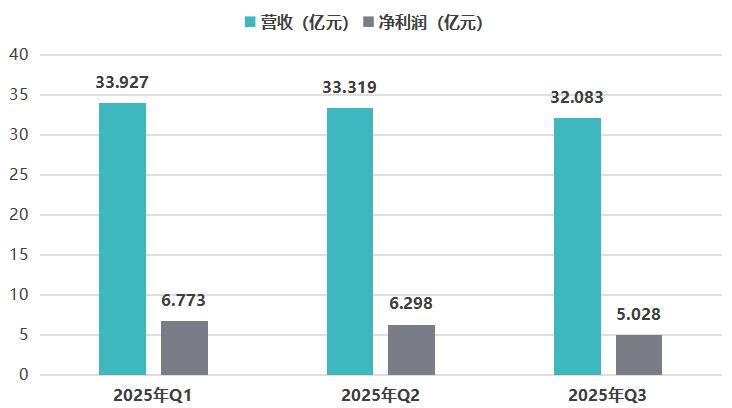
Financial report data of Cha Ji Ba Wang for each quarter. Charted by 36Kr based on the financial report
Continuous decline in same - store GMV
The financial report data shows that in addition to net income, other indicators of Cha Ji Ba Wang also declined.
In the third quarter of 2025, the company's operating profit was 454.4 million yuan, with an operating profit margin of 14.2%; in the same period of 2024, it was 794.3 million yuan, with an operating profit margin of 22.4%. The adjusted net profit was 502.8 million yuan, a 22.23% decrease compared to 646.6 million yuan in the same period last year; the net profit margin was 12.4%, lower than 18.3% in the same period last year.
Meanwhile, Cha Ji Ba Wang's GMV also decreased.
In the third quarter of 2025, its total GMV was 7.9295 billion yuan, a 4.48% decrease compared to 8.3014 billion yuan in the third quarter of last year. The data for the first and second quarters of this year were 8.2268 billion yuan and 8.1031 billion yuan respectively.
In terms of the average monthly GMV of same - stores, from the third and fourth quarters of 2024 to the first, second, and third quarters of 2025, Cha Ji Ba Wang's figures were 528,000 yuan, 456,000 yuan, 432,000 yuan, 404,400 yuan, and 378,500 yuan respectively, showing a continuous downward trend. From a timeline perspective, since the fourth quarter of 2024, the average monthly GMV of the company's same - stores has been in negative growth. Regionally, the GMV in the Greater China region has declined significantly.
This also means that the reasons affecting Cha Ji Ba Wang's financial performance are not limited to the food - delivery war.
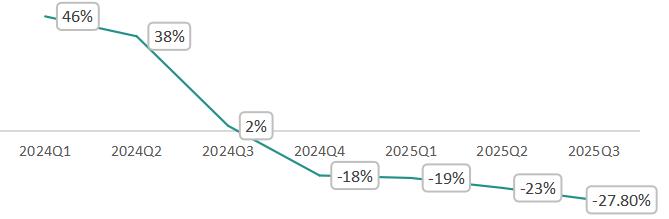
Average monthly GMV data of Cha Ji Ba Wang's same - stores in China; Charted by 36Kr based on the financial report
It is generally perceived in the industry that since 2023, high - end new tea - drinking brands such as Heytea and Nayuki have opened up franchise opportunities and continued to penetrate into lower - tier cities. Under full competition, the competition in the domestic new tea - drinking market has intensified, entering a red - ocean market with cut - throat competition and slowing growth. However, it was also during this period that Cha Ji Ba Wang rapidly opened stores with the help of capital and entered the first echelon of the milk - tea industry.
As of September 30, 2025, the total number of Cha Ji Ba Wang's stores reached 7,338, among which 6,971 were franchised stores, and the number of franchised stores in the Greater China region reached 6,836.
The increase in the number of stores may dilute the revenue of single stores. From the trend of consumption segmentation, whether it is coffee or new tea - drinking, brands positioned in the mid - to high - end market generally experience a slowdown in growth.
Like Nayuki, Cha Ji Ba Wang is also a "Chinese apprentice" of Starbucks. In the prospectus, Cha Ji Ba Wang clearly stated that its inspiration comes from international coffee chain brands.
In terms of the target customer group, the company also focuses on white - collar workers. The store model also centers around "light assets and high floor - space efficiency", with most stores having an area between 60 and 80 square meters and being more likely to be located in prime locations in shopping malls or on the streets.
In recent years, Cha Ji Ba Wang has also been opening larger stores. For example, the "Super Tea Warehouse" opened in Hong Kong, China this year has a construction area of over 1,000 square meters.
All these may result in Cha Ji Ba Wang being unable to lower its stance like other brands. Meanwhile, there are also hidden concerns in the company's long - held market strategy of "hit product, high repurchase rate".
Slower new product launch rhythm
Zhang Junjie once summarized his business model into three points: choosing Chinese culture as the brand - positioning differentiation, choosing the mid - range customer - unit - price positioning, creating hit products based on the concept of tea lattes, and highly focusing on repurchase rate.
Compared with many of its peers, Cha Ji Ba Wang's product portfolio is relatively streamlined. Currently, it has around 25 SKUs, while other tea - drinking brands usually have around 40 SKUs. Among Cha Ji Ba Wang's products, "Boya Juexian" is an absolute hit.
According to data from Frost & Sullivan, from 2022 to June 2025, a total of 1.25 billion cups of Boya Juexian were sold. Calculated at 16 yuan per cup, it is equivalent to a sales volume of 20 billion yuan. Cha Ji Ba Wang also announced that its top three SKUs, mainly led by "Boya Juexian", contributed 60% - 70% of the sales volume.
With fewer SKUs, Cha Ji Ba Wang's rhythm of launching new products is not fast.
According to the prospectus, from 2022 to 2024, the numbers of new products launched were 14, 22, and 15 respectively. Since 2025, only 8 new products have been launched, among which two are the low - caffeine and floral - scented versions of Boya Juexian, and the other new products have failed to replicate the popularity of Boya Juexian.
In the new tea - drinking industry, although hit products are important, consumers' repurchase also depends on new products.
The "2025 China Beverage Industry Research Report" shows that from 2022 to 2024, Heytea launched 60, 63, and 48 new products respectively each year; Guming launched 55, 70, and 51 new products respectively; and Chabaidao launched 43, 53, and 60 new products respectively. These are almost three times the number of new products launched by Cha Ji Ba Wang. Moreover, including Luckin, more brands have launched light milk - tea products. Among them, "Ye Ye Bu Pao Cha", which has a more flexible store area and is more suitable for the sinking market, and "Cha Pubu", a brand under Hushang Ayi specializing in light milk tea, are also developing rapidly.
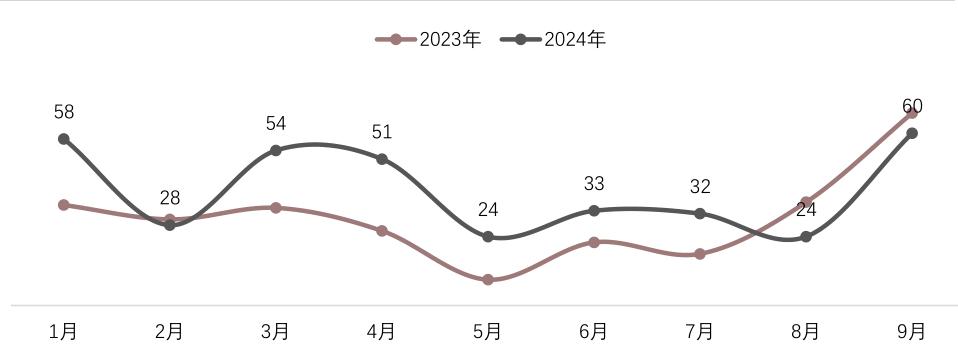
Number of new milk - tea products launched by 50 chain brands in the Chinese beverage industry; Image from ToB Research Institute
In contrast, Cha Ji Ba Wang not only slowed down the pace of launching new products but also reduced its marketing activities.
In the third quarter of 2025, its sales and marketing expenses were 304.5 million yuan, a 13.4% decrease compared to 351.7 million yuan in the same period of 2024. The financial report stated that this change was mainly due to the prudent adjustment of the brand - promotion strategy, resulting in a reduction in relevant advertising expenditures.
Searching for a way out
Actually, in a market environment full of changes and challenges, Cha Ji Ba Wang has always been looking for a way to break through.
36Kr learned that starting from mid - December, Cha Ji Ba Wang will launch more new products. In the third quarter, its R & D expenses also reached 53.6 million yuan, mainly used for product innovation and supply - chain optimization. From these aspects, Cha Ji Ba Wang may have realized the fact that its main hit product is in a passive position.
In the financial - report communication meeting, the senior management of Cha Ji Ba Wang mainly introduced the implementation path of the future "high - quality development strategy".
Zhang Junjie said that in the next few quarters, the company will enrich the product portfolio, launch a 4.0 menu, explore new consumption scenarios, and enhance the experience of featured stores. In terms of brand building, Cha Ji Ba Wang is also comprehensively upgrading. In the future, the company will explore consumption scenarios during breakfast and evening hours.
In addition, it must be mentioned that Cha Ji Ba Wang has performed excellently in the overseas market.
Public information shows that in 2018, the second year after the company was established, Cha Ji Ba Wang established an overseas business department.
As of the third quarter of this year, the number of its overseas stores reached 262. Among them, there were 196 in Malaysia, 22 in Singapore, 17 in Indonesia, 14 in Thailand, 8 in Vietnam, 3 in the Philippines, and 2 in the United States. In terms of GMV, Cha Ji Ba Wang's overseas data in the same period exceeded 300 million yuan, a 75.3% increase compared to last year and a 27.7% increase compared to the second quarter of this year.
Some industry insiders once told 36Kr that Cha Ji Ba Wang has almost become a national brand in Malaysia, which may be attributed to its excellent localization strategy and marketing activities.
In September this year, Cha Ji Ba Wang collaborated with the IP HACIPUPU under Pop Mart. In Malaysia, the company also simultaneously launched a limited - edition "Qingyu Xiangti" series of products, setting a record for the highest sales volume in the brand's history.
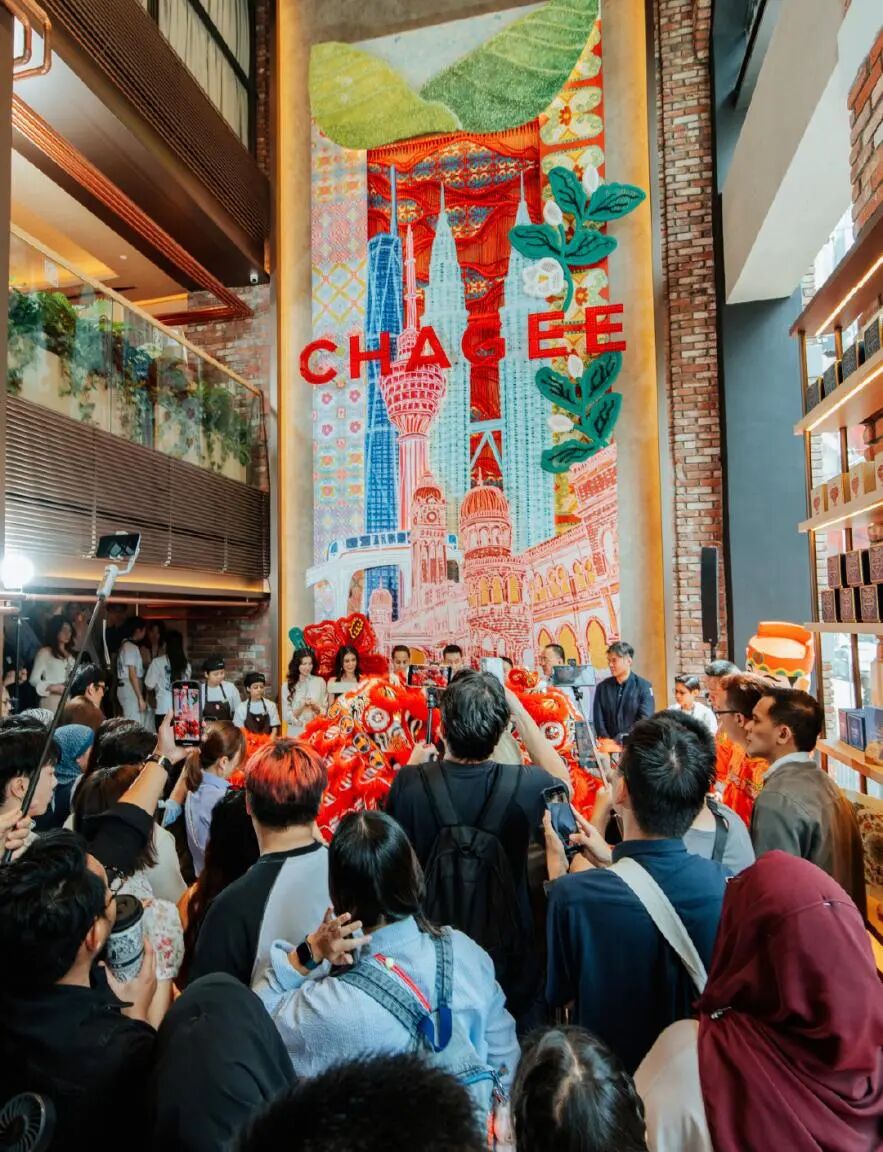
A Cha Ji Ba Wang store in Kuala Lumpur
From this case, the efficiency of Cha Ji Ba Wang's overseas stores may be higher than that of some mature domestic stores, of course, only in the mature Southeast Asian market. In its overall GMV structure, the Greater China market always accounts for the vast majority, reaching 96.2% in the third quarter.
It is a clear fact that behind the rush of new tea - drinking brands relying on chain franchising to go global is the reality of a saturated domestic market and weak growth. The competition of enterprises in the overseas market is essentially a contest between supply chains and capital.
In July 2020, Nayuki opened its first store in Japan but closed it a year later due to the pandemic and business strategy. As of now, Nayuki's overseas expansion strategy also focuses on Southeast Asia. However, the 2024 financial report also shows that it closed some stores that "underperformed". In the domestic market, Nayuki is also adjusting its single - store profit model to find a balance between store area and operational efficiency.
Of course, Cha Ji Ba Wang's profit performance and franchisee ecosystem continue to improve.
The third - quarter report also shows that the company has achieved profitability for 11 consecutive quarters, with stable cash flow and no interest - bearing liabilities. As of September 30, the number of its registered members reached 222 million, a 36.7% increase compared to the previous year. The store - closing rate has remained at 0.3% for three consecutive quarters, better than the industry level of 2% to 10% in recent years.
Judging from such data, the key for Cha Ji Ba Wang at present still lies in retaining the attention of domestic consumers.
As of December 2, before the press time, Cha Ji Ba Wang was quoted at $16.24 per share. Since its listing in April, its stock price has dropped by more than 51%. According to Citigroup's forecast, the same - store sales in the fourth quarter may continue to be under pressure, but due to Cha Ji Ba Wang's enhanced return to shareholders, it still maintains a "Buy/High - Risk" rating.
*Disclaimer:
The content of this article only represents the author's views