The annual target completion rates of many automobile manufacturers have exceeded 90%. The second-tier players in the automotive market are engaging in a fierce three-way competition.
Entering December, the competition in the Chinese automotive market in 2025 has reached a crucial stage of year - end sprint.
Judging from the currently disclosed sales volume, the sales pattern of the domestic automotive market is gradually becoming clear. Leading automakers maintain a steady growth trend, while the competition in the middle - tier camp has entered a crucial sprint stage. In particular, the ranking battle among the second - tier group composed of Geely Auto, Changan Automobile, Chery Holding Group, etc. is in full swing. Under the main theme of "growth", domestic brands continue to expand their market share, and the penetration rate of new energy vehicles is steadily rising. Meanwhile, joint - venture brands are also accelerating their efforts in the plug - in hybrid vehicle segment to seek a breakthrough.
Amid the interweaving of multiple variables, the final battle of the Chinese automotive market for the year is approaching its final revelation.

Image source: AI - generated illustration
The competition in the "second - tier" of the automotive market heats up
Public data shows that BYD sold approximately 480,000 vehicles in November, compared with about 507,000 vehicles in the same period last year. From January to November this year, BYD's cumulative sales volume reached approximately 4.182 million vehicles, a year - on - year increase of 11.3%. This year, BYD's annual sales target is 4.6 million vehicles, and the current completion rate is about 90.9%.
Following BYD is SAIC Group, which sold approximately 461,000 vehicles in November. The cumulative sales volume in the first 11 months of this year was about 4.108 million vehicles, a year - on - year increase of 16.4%, exceeding the full - year sales volume of last year.
This year is a year of transformation for SAIC Group. While undergoing internal organizational optimization and adjustment, SAIC Group launched several strategic models such as MG4, IM LS9, and Roewe H5 in the second half of the year, further boosting its sales performance.
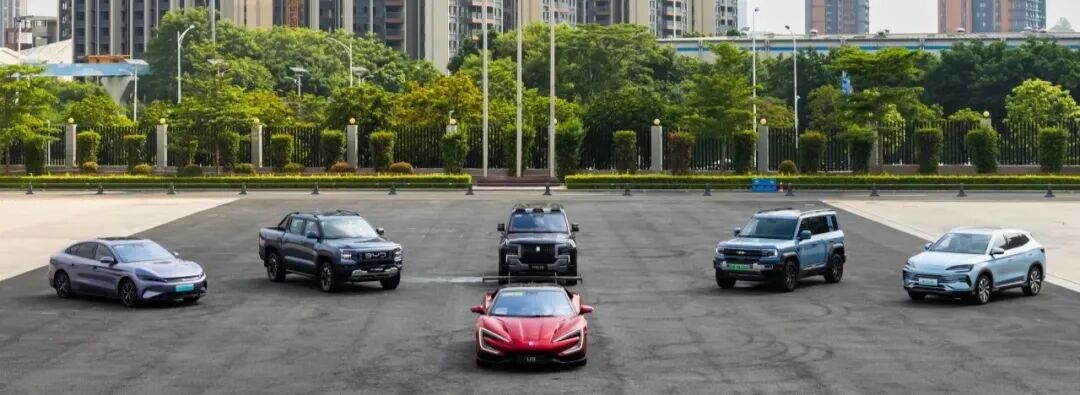
Image source: BYD's official WeChat account
Compared with the steady leadership of leading automakers, the sales competition in the "second - tier" of the automotive market is more intense, and each automaker is clearly in a sprint state.
Currently, FAW Group may rank third in the automotive market sales this year. Data shows that FAW Group sold 306,000 vehicles in November, and the cumulative sales volume in the first 11 months of this year reached 2.995 million vehicles, a year - on - year increase of 4.8%.
Compared with the stable situation of FAW Group, the competition for the fourth and fifth places in the annual sales volume of automakers is even more intense. The competition among Geely Auto, Changan Automobile, and Chery Holding Group has entered a sprint stage. Their cumulative sales volumes are arranged in a "stepped" manner, with a difference of about 100,000 vehicles between each other.
Specifically, Geely Auto currently ranks fourth in the automotive market. Its cumulative sales volume in the first 11 months of this year was 2.788 million vehicles, a year - on - year increase of 42%, and the achievement rate of the annual sales target is 93%.
Changan Automobile follows closely behind Geely Auto, with a sales volume of approximately 2.658 million vehicles in the first 11 months of this year, a year - on - year increase of 9.25%.
Chery Holding Group sold approximately 2.5615 million vehicles in the first 11 months of this year, a year - on - year increase of 11.1%. A dense new - car strategy has always been the means adopted by Chery Holding Group. In the just - passed November, Chery Holding Group also launched several new models. For example, EXEED, a brand under Chery, released the extended - range electric SUV EXEED ET5. After the replacement subsidy, the price range is from 134,900 to 149,900 yuan.
Will Geely Auto maintain its leading advantage, will Changan Automobile achieve an overtaking, or will Chery Holding Group become the biggest "dark horse" with its new - car offensive? The final ranking of the fourth and fifth places in the annual sales volume of automakers this year is still unclear.
In contrast, Great Wall Motors, which ranks seventh, shows a steady and progressive performance. Official data shows that Great Wall Motors sold 133,200 vehicles in November, a year - on - year increase of 4.57%. The cumulative sales volume in the first 11 months of this year was approximately 1.1997 million vehicles, a year - on - year increase of 9.26%.
The market share of domestic brands continues to expand
Putting aside the individual performances of the above - mentioned automakers and focusing on the overall automotive market pattern, it is not difficult to find that "growth" in sales has become a characteristic of the automotive market throughout the year, and this trend has directly promoted the continuous expansion of the market share of domestic brands.
Data from the China Passenger Car Association shows that in October, the market share of domestic brand passenger cars reached 68.6%. In the first 10 months of this year, the market share of domestic brand passenger cars was 65.2%.

Image source: China Passenger Car Association
New energy vehicles remain the main driving force for the growth of the automotive market. Data from the China Passenger Car Association shows that from November 1st to 23rd, the retail sales volume of the new energy passenger vehicle market nationwide reached approximately 849,000 vehicles, a year - on - year increase of 3% and an 8% increase compared with the previous month. During the same period, the retail penetration rate of new energy vehicles in the national passenger vehicle market was 61.3%, and the wholesale penetration rate of new energy vehicles among national passenger vehicle manufacturers was 58.8%.
It is worth noting that joint - venture brands, which were previously a bit slow in the new energy field, are now constantly gathering strength to boost sales. For example, SAIC Volkswagen will launch several plug - in hybrid models next year. SAIC General Motors will launch the second model "Shijia" of Buick Zhijing this year. Dongfeng Nissan has launched the first plug - in hybrid model N6 under the "Tianyan" architecture, with a starting price of 99,900 yuan to compete with domestic brands for market share.
Lai Yizhe, the head of Asian automotive industry research at J.P. Morgan, said in an interview with a reporter from National Business Daily: "Currently, joint - venture brands that act quickly are embracing China's platforms, market supply chains, and technologies. At the same time, in some joint - venture automakers, local executives have high decision - making power in product development, which has led to the emergence of relatively competitive models in many joint - venture brands. There may be a significant polarization within joint - venture brands. Joint - venture brands where local management has the opportunity to lead the product process still have a chance to 'turn the tables', while joint - venture brands still dominated by foreign parties may face greater pressure."
This article is from the WeChat public account "NBD Auto", author: Huang Xinxu. Republished by 36Kr with permission.