Technology Drives Innovation: Leveraging Technology to Build Brands and Create Categories | 36Kr WISE2025 King of Business Conference
From November 27th to 28th, the 36Kr WISE 2025 King of Business Conference, hailed as the "annual technology and business trendsetter," was held at the Conduction Space in the 798 Art District in Beijing.
This year's WISE is no longer a traditional industry summit but an immersive experience centered around the concept of "technology-driven short dramas." From AI reshaping the boundaries of hardware to embodied intelligence opening the door to the real world; from the globalization of brands in the wave of going overseas to traditional industries equipping with "cyber prosthetics" - what we present here is not just trends but also the insights gained from numerous business practices.
In the following content, we will dissect the real logic behind these "exciting dramas" frame by frame and explore the unique business landscape of 2025 together.
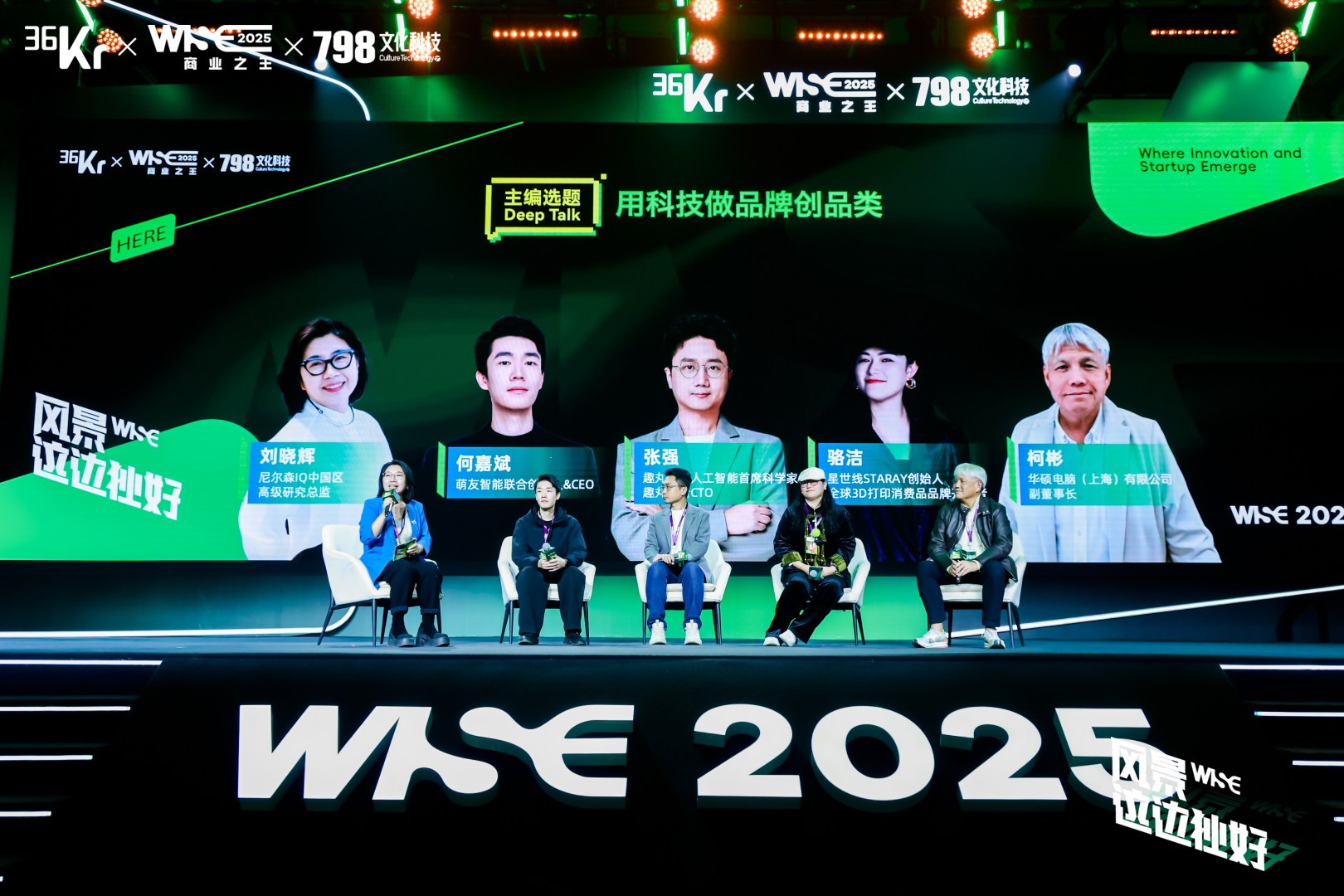
Roundtable on Promoting Innovation with Technology: Building Brands and Creating Categories with Technology
The following is the content of the roundtable dialogue, edited by 36Kr:
Liu Xiaohui | Senior Research Director of NielsenIQ China (Host)
He Jiabin | Co-founder & CEO of Mengyou Intelligence
Zhang Qiang | Chief Scientist of Artificial Intelligence at Quwan Technology and CTO of Quwan Qianyin
Luo Jie | Founder of STARAY, Pioneer of the Global 3D Printing Consumer Goods Brand
Ke Bin | Vice Chairman of ASUS Computer (Shanghai) Co., Ltd.
Liu Xiaohui: Good morning, ladies and gentlemen present here, colleagues, and of course, many of our clients. Also, a warm welcome to the guests on the stage!
I'm truly honored to be here today. I'm Liu Xiaohui from NIQ. I'm usually a researcher. When I came to this event, I felt a sense of cyberpunk and a very rock - and - roll vibe, which injected some energy into me. With this energy, I'm hosting this roundtable on promoting innovation with technology.
As I'm engaged in research work, we often collect data for surveys and analyses. For my first question, please be patient, dear guests. I'd like to ask the audience here. If you have used NIQ's data and consulting research services, could you please raise your hand? You can look around. The blue ocean for our business next year lies here. Thank you to those who raised their hands. Our boss is sitting at the front desk today. You can come directly to negotiate a discount when renewing the contract next year.
Now, let's focus on the stage. Do you know that when I got your profiles, I found that some of you are in the field of intelligent voice, some in intelligent companionship, some in intelligent wearables, and some are hardcore in PC engineering. Can you imagine that this group of guests sitting on the stage is like a technology timeline presented in front of you? So, next, I'd like to invite our guests to introduce themselves to the audience to help everyone get acquainted quickly. Let's start with Mr. He on my left!
He Jiabin: Thank you, Xiaohui. I'm He Jiabin, and our company is Mengyou Intelligence. Our product is Rollplay, an AI robotic pet. We position ourselves as a future pet company. We hope to combine AI brain technology with the physical body of embodied intelligence to create a new breed of future pets that meet the lifestyle and breeding habits of contemporary young people and provide emotional value.
Thank you!
Zhang Qiang: Hello, everyone. I'm Zhang Qiang from Quwan Technology. Our company was founded in 2014, and our flagship product is TT Voice, which has now become one of the largest voice - interest social platforms in China, with 200 million registered users. In recent years, we have been continuously investing in the AI field and have achieved technological breakthroughs in areas such as voice large models, music large models, and digital humans, and also have some commercial applications. In the field of AI voice, we have a product called "Quwan Qianyin," which mainly provides multilingual video translation solutions for film, animation, and short - drama companies going overseas.
Thank you, everyone!
Luo Jie: Hello, everyone. I'm Luo Jie, the founder of STARAY. STARAY is a company that uses lattice design, relies on 3D printing technology, and integrates ergonomics and foot rehabilitation systems to provide precise and comfortable products. We also pioneered the category of 3D printed integrated shoes and the 3D printing consumer goods brand.
Thank you!
Liu Xiaohui: Thank you! When we were backstage, Ms. Luo let me experience their 3D printed shoes in person. I won't say more here to avoid the suspicion of promoting products.
Ke Bin: Hello! I'm Ke Bin from ASUS. I'm very honored to have this opportunity to communicate with both the online and offline audiences today.
I think ASUS is the oldest brand among the four companies here today. However, in the field of digital technology products, ASUS is also the company that has the most diverse product lines. We have products ranging from DIY computers, gaming consoles, laptops, to some personalized terminals. I hope I can fully express and let you understand ASUS today.
Thank you!
Liu Xiaohui: Thank you. As you can see, our guests have very different backgrounds. We have AI at home, AI in voices, and AI in wearables. Mr. Ke, what kind of AI are you involved in?
Ke Bin: The AI that you can't live without every day.
Liu Xiaohui: To be honest with you, I'm quite anxious. You know, the organizer gave me a thick outline for today. If I were to expand on it, it would take at least three hours. If the guests on the stage were to expand, I think it would take three days. But this is the era of AI. It makes many impossibilities happen and become reasonable. So, we look forward to today's dialogue being a high - tech - density conversation. Get ready, everyone. I think today might be a show of high - tech and amazing skills. Let's get straight to the point. Here's my first question.
The first question is about growth, innovation in categories through technology, and brand breakthroughs with technology. In your respective industries, when do you think technology can drive innovation or create new categories? And how has technology changed the underlying logic of your industries? Here, the underlying logic refers to the underlying logic of category innovation, which is a bit abstract.
Let's start with Mr. He on my left.
He Jiabin: My view on this question is that the thinking of traditional Internet product managers or those engaged in traditional product R & D usually comes from the explicit needs directly expressed by users. For example, in the fields of daily chemical products and household appliances, because people want their hair to dry quickly, hair dryers emerged. And because people hope not to damage their hair, Dyson's high - speed hair dryers came into being. However, the category of AI pet robots is something unheard of. Five or three years ago, no one would have imagined creating such a product. I think this is due to the fundamental changes in many leap - forward technologies or scientific and technological advancements, which allow us to imagine new experiences and scenarios. These scenarios may be the underlying needs of users that they don't directly express at first. So, the logic of product development is gradually shifting from meeting the needs of tool - based products to meeting the most fundamental human needs, such as the ability to feel love and happiness. We should create products to serve users in a more comprehensive way and form new categories. I think this is possible today, especially with the emergence of AI.
Liu Xiaohui: That's really insightful! In the past, we might have thought that technology was about hard - core and tangible products. But in Mr. He's field, technology is combined with emotions to create a new category.
Mr. Zhang is in the field of intelligent voice. What's your opinion on this question?
Zhang Qiang: As a programmer, I'd like to share my thoughts from a technical perspective. First of all, the development paradigm of large models has leveled the basic capabilities of many technical teams and raised the ceiling of basic capabilities to a very high level. Against the backdrop of the continuous strengthening of technology, it has become more difficult to use tools effectively. Therefore, in our own industries, we must go deep enough to truly make good use of the large - model technology paradigm.
Moreover, since the ceiling has been raised, we can see things from a higher perspective. Many high - value points that we couldn't see before have now become achievable. So, we are allowed to explore more high - value directions using technological means.
Liu Xiaohui: I understand. Mr. Zhang means that technology has made it possible in some high - value scenarios.
Ms. Luo, the only female guest here, what's your view on this question?
Luo Jie: Thank you!
I think the best contribution of technology to growth is that it is no longer just a marketing gimmick but has become a real anchor for defining value. From my perspective, there are three points, which I'll briefly mention:
Firstly, in terms of products, in the past, our products might have been more about creating needs or fabricating pain points and then solving them. We have established a large - scale data model. For example, for people with high arches, what kind of support do they need? For those with flat feet, what kind of pressure distribution is required? From this perspective, we have created products for different groups with specific pain points.
Secondly, regarding the logic of trust, in the past, brands might have needed to rely on advertising and channels to build trust. But now, consumers don't need to listen to how well we speak. As long as they can feel the authenticity when they put on the product, it will be more effective than a lot of marketing or advertising. Just like when Mr. Liu tried on our shoes, she had a very real feeling.
Thirdly, in terms of flexible manufacturing, in the past, in traditional industries, large - scale production was required for mold - opening and manufacturing. With 3D printing, we can first conduct small - scale market launches. Based on market feedback, we can then meet precise order demands.
So, I think the best technology is the kind that people can hardly feel but can really accompany them. Thank you!
Liu Xiaohui: I understand. It means that technology has made the experience more real.
Mr. Ke, sitting on your right are all new species. As the leader in the PC engineering field, what do you think of the innovation logic of new categories? And what role does technology play in it?
Ke Bin: This topic is very interesting. ASUS entered the industry during the information age. At that time, clients had to be respected because their confidentiality and usage scenarios did not allow technology manufacturers to participate or intervene. However, with the progress of digital technology and its interactive features, we have seen a new field. Through the characteristics of digital technology, in new and innovative areas such as gaming and design fields that we didn't focus on before, when there is a need for more targeted technology and usage - scenario functions, we have provided these functions in recent years.
Under the ASUS brand, we have launched many product brands. For example, ROG in the gaming field. In the design field, whether for architectural designers, creative designers, or product designers, we have developed many special and proprietary functions that are well - received by customers and connected them with our technology products.
I can say that in the gaming field, our innovations in peripherals, among game players, in game scenarios, and in the peripheral field, the products we have created in recent years have reached the scale of a listed company in the Chinese mainland market alone. So, with the improvement of consumption and the connection of technology, we can do more and do better.
Liu Xiaohui: Thank you. The guests' sharing just now all mentioned that technology is changing the needs in their respective fields. I'm very curious because in our consumer research, the driving force behind our research is to understand consumers' needs. We conduct interviews and ask questions skillfully. But this requires consumers to be able to feel and express their needs so that we can capture them. However, in the guests' statements just now, I heard a different trend. That is, as a consumer, I may not be aware of a certain need, but suddenly this unrecognized need becomes a new category and appears in my life.
Do you have a similar feeling? Or does the logic I mentioned hold? I have no idea what my needs are, but suddenly a new category emerges. Mr. He, do you have any special feelings about this?
He Jiabin: Let me analyze this question in two steps. At first, my thinking was not very clear. I just started this business out of interest. Suddenly, I found that there was a group of people with a demand for this product, and then we gradually iterated and refined our product to make it more popular. First, we noticed the growth of the pet market. At the same time, in the process of urbanization and the increase in per - capita income, the birth rate is decreasing, the marriage rate is decreasing, and the divorce rate is increasing. It is becoming more and more difficult to establish intimate relationships between people. Naturally, the pet market is booming.
We found that there is a 70% chance that people will abandon their pets in their lifetime for various reasons, such as the death of the pet and the resulting trauma, cat - hair allergies, and the energy required for pet - keeping. People have a need to establish an intimate relationship with a non - human being, but they can't do it for various reasons. So, this has given rise to our product, which actually has a market demand.
In the long - term development, from a social and ethical perspective, we don't want people to establish a long - term, cocoon - like interaction with a virtual product or object, which will reduce their interaction with the real world. This is not a good phenomenon. We hope to establish a new community through a new breed of pets. For example, if you and I both keep Shiba Inus, we may form a new connection because we are all Shiba Inu lovers. So, the ultimate goal of creating a new robot is to connect the new generation of pet owners and bring people back to closer relationships.
This is our second - step thinking.
Liu Xiaohui: That's very profound. I think technology doesn't make us more divided but ultimately brings us together again.
Dear guests, I see that we are running out of time. Just like in the AI era, it's impossible to fully expand on today's outline. So, please forgive me, organizers. For the last question, I'd like to ask the four guests here. Based on your professional insights, where do you see the opportunities for technology - driven brand innovation in your respective fields in the next 24 months? Please take two seconds to think about it. I'll ask Mr. Ke to answer first.
Ke Bin: The interaction of generative natural language is something that researchers have never thought of in the past few decades of technological development. In fact, the entire field of artificial intelligence was initially explored by a group of professors in universities. They believed that human progress over the past few hundred years has come from individual human intelligence, so they simulated human intelligence through technologies like deep learning. Then, a technology company suddenly launched a new form, which is actually a variant of search. In the past, search engines pushed advertisements to users, but now they directly give answers, just like an expert.
As ASUS, we must seize this opportunity of technological progress, especially in the Chinese mainland market, where there are so many young entrepreneurs exploring different fields to bring different experiences, applications, and solutions to consumers. As a leading company in digital technology products, we need to play our role well. We have specifically established a department to integrate AI into each of our computer products and explore how to interact with consumers in the future. Of course, we can't do what companies like Alibaba or Baidu are doing in terms of large models, but we have many cooperation opportunities. We will surely live up to expectations, do a good job in our products, and serve consumers in the Chinese mainland well.
Thank you!
Liu Xiaohui: Thank you, Mr. Ke! From the perspective of the entire PC engineering field, it provides a solid foundation for AI productivity tools.
Ms. Luo, if you were to summarize the brand opportunities in the next 24 months in one or two sentences, how would you see it?
Luo Jie: I'm actually quite concerned about fields such as humanoid robots, AI algorithms, 3D printing, and intelligent manufacturing. But ultimately, I think technology should return to real human needs. In my field, I hope it will be a sensory - based intelligent wearable device.