The 17th year of Tmall Double 11 and the new map rewritten by AI
The national shopping festival has entered its 17th year, and the exciting digital competition is no longer the focus. In today's e - commerce world, the most practical question is being asked: When the traffic dividend fades away and all the price wars and cut - throat competitions come to an end, where is the next stop for growth? And what is the decisive factor in the competition?
Among all the possibilities, AI has become the most notable variable.
Justine Moore and Alex Rampell, partners at the top - tier venture capital firm Andreessen Horowitz, painted a new picture of e - commerce in the AI era through an in - depth analysis of the potential threats Google might face. In this picture, they pointed out that the traditional search - compare - purchase model is being replaced by an intelligent purchasing experience driven by AI Agents.
Data from the Canadian market research firm Precedence Research shows that the global AI - empowered e - commerce market was worth $7.25 billion in 2024 and is expected to grow to $64.03 billion by 2034.
All the clues seem to indicate that we are on the verge of a major transformation. However, different from the grand narratives about AI in the outside world, those within the industry have a more personal feeling: What e - commerce needs is AI that can truly solve problems.
As one of the pioneers in the e - commerce industry, Taobao has once again taken the lead in exploring new territory. While people are still enthusiastic about discussing the disruption or bubble of AI, Taobao in 2025 has chosen a more pragmatic path: exploring and building a bridge that can be truly implemented between technological concepts and its own business.
In fact, as one of the fields closest to the implementation of AI, Taobao has been constantly trying and opening up new application scenarios for AI in the past two years. This year's Double 11 is the first comprehensive review of this silent transformation - Taobao has taken the lead in fully applying AI to all aspects of transactions in terms of traffic distribution, consumer experience, and merchant operations, using "useful AI" to improve the efficiency of e - commerce transactions.
The scattered dots have finally been connected into a line, marking the debut of Taobao's AI panorama. It tries to prove that the value of AI never lies in empty talk but in actively promoting growth and efficiency.
As Kaifu, the President of the Search and Recommendation Intelligence at Alibaba's China E - commerce Business Group, said: "'Useful AI' is the test standard for Taobao's AI applications. We hope that AI can solve consumer pain points and enable merchants to achieve growth."
01. Changes in Traffic
When discussing where the incremental growth in the e - commerce industry comes from, a long - ignored premise is that the growth of e - commerce is essentially a problem of "the matching efficiency between people and goods". Whether users can express their needs, whether the platform can understand this expression, and whether it can identify, organize, and push the most suitable results from a vast number of products jointly determine whether a transaction can occur.
Over the past decade or so, e - commerce platforms have relied on three systems - search, recommendation, and advertising - to solve this problem. These systems form the underlying technological infrastructure of e - commerce. However, with the generational change in model technology, this system is undergoing its first structural rewrite.
This step begins with Taobao's transformation of the underlying system of its product library.
Before this year's Double 11, Taobao made a major move internally: Using generative AI, it thoroughly cleaned, enriched, and indexed about 2 billion products in its product library. Simply put, it enables AI algorithms to better understand what each product is for, what problems it solves, and what features it has. The goal is to allow brands and merchants to enrich product information and enable more consumers to accurately obtain the products they need, achieving a two - way connection.
Taking search as an example, the traditional "search system" mainly relies on keyword matching. However, users often find it difficult to clearly and accurately describe their actual needs in words. For example, "There are many small flying insects in the sewer. I want to find something to solve this problem." Before the intervention of the model, such needs were difficult for the system to understand because merchants do not describe products in this way, making it impossible to conduct a search.
After transforming search and semantic understanding with AI, Taobao introduced generative retrieval into the platform, enabling the system to understand this natural - language - style demand expression and directly provide solution - oriented products. Internal random experiments show that in such complex semantic scenarios, the relevance of search results has increased by about 20 percentage points. For a mature system that has been optimized for many years, such an improvement is rare.
The same change has also occurred in the "recommendation system". Before this, there has long been a problem in the e - commerce industry that the recommendation results are too narrow. Once a consumer buys something, the platform will repeatedly recommend products in the same category. After introducing AI - driven generative recommendation, Taobao enables the system not only to generate more candidates but also to understand the consumer's behavioral intention behind the purchase.
"Just because I bought a kerosene stove doesn't necessarily mean I like kerosene stoves. Maybe I'm a camping enthusiast," Kaifu gave an example. Following this line of thought, many other camping equipment can become recommended items. Without violating user privacy, the large AI model can analyze the user's long - term consumption preferences and push more diverse products in the recommendation process, achieving "breaking through the interest circle". This measure has increased the click - through rate of the information stream on the Taobao platform by about 10%.
The incremental efficiency improvement brought about by this has been initially verified during Double 11. Taking the pet industry as an example: Based on pet owners' increasing concern about pet nutrition, Taobao found through AI analysis of the factors influencing consumers' decisions that "raw material composition", "efficacy", and "net content" are the most concerned elements. Based on this conclusion, many "persuaded" cat food merchants promptly adopted the algorithm's suggestions and put information such as "crude protein content" as important attributes on the main product images.
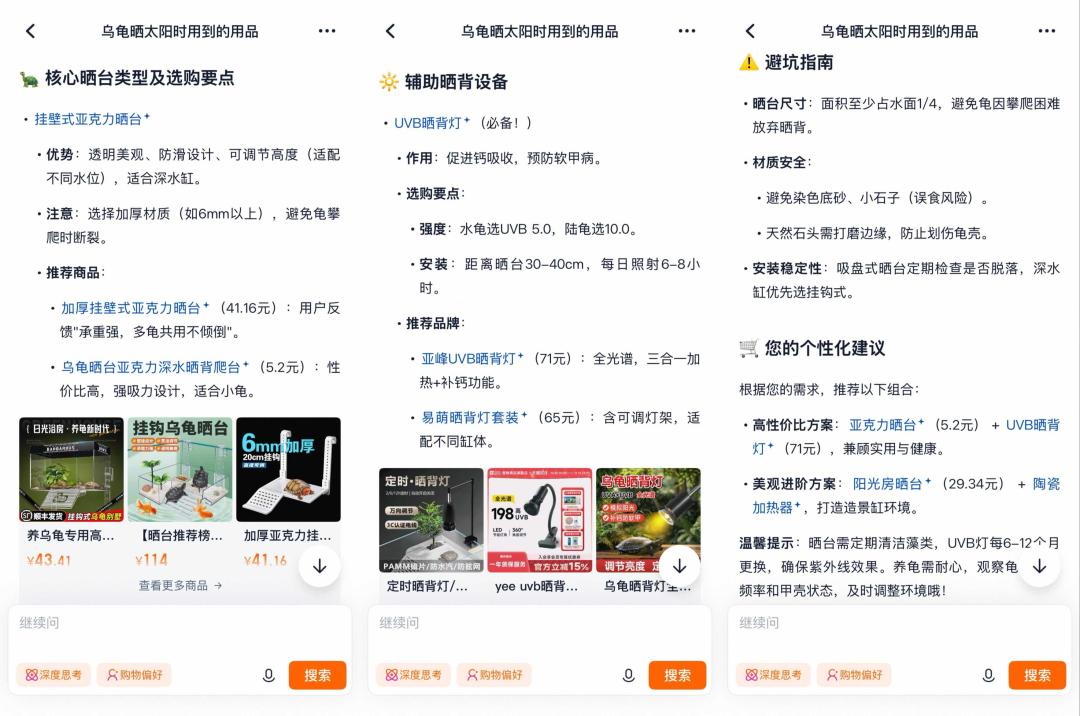
Taobao's AI Universal Search Page
The effect is remarkable: Platform data shows that during Double 11, the richness of product information in the pet industry has increased by 34%. And thanks to the more accurate push of the "Guess You Like" function, since the start of the promotion, the transaction volume of the pet industry brought by the home - page information stream recommendation has increased by more than 40% year - on - year.
Meanwhile, Alimama has also launched the super - intelligent business agents "Wanxiangtai AI Boundless" and "Full - platform Product Promotion". The former can automatically understand user needs and accurately connect products with interested users, while the latter can further simplify the merchant's business process. AI can complete product selection, placement, and conversion optimization, driving up the return on investment and increasing the ROI of merchants during the pre - sale period by more than 15% year - on - year. On the evening of October 15th, just one hour after the pre - sale started, 35 brands achieved a transaction volume of over 100 million yuan, and 1,802 brands doubled their year - on - year growth.

Alimama's "Full - platform Product Promotion"
This year's Double 11 is also the first time that Tmall has scaled up the use of the AI "Smart Benefit Engine" to decide on the issuance of time - limited coupons. From the data results, the conversion rate brought by AI red envelopes has increased by 81% month - on - month, and the number of ordering users has increased by 41%. For some merchants, the transaction volume and new customers brought by AI red envelopes account for nearly half.
It can be said that AI is no longer just a conceptual narrative in the e - commerce industry but has become a real productivity tool for releasing incremental growth. The efficiency improvement of Taobao's AI in search, recommendation, and advertising also fully matches the change in Taobao's internal focus since 2025, which is more concerned about the confirmed - receipt GMV indicator (the final transaction volume after excluding refunds), effective revenue, and effective consumers.
In a sense, AI does not create new needs. It just rebuilds the connection between supply and demand, like expanding a narrow and congested bridge, allowing demand and supply to meet more smoothly, accurately, and naturally, thus giving rise to new growth.
02. Changes in Experience
For e - commerce platforms, optimizing products and traffic is just the foundation. The real key lies in whether they can retain users through a more complete and warm - hearted consumption experience.
After conducting a survey on more than 10,000 consumers in 13 countries, Capgemini Consulting said in its "2025 Report" that 71% of consumers hope to integrate generative AI into both physical store and online shopping experiences. Among them, the younger generation is more positive: 66% of Gen Z and 65% of Millennials hope to receive hyper - personalized recommendations driven by generative AI. The "2025 E - commerce Trends" report released by DHL also shows that 70% of consumers hope that online stores can provide AI - driven shopping functions.
The above surveys confirm that AI is no longer regarded as a distant future technology but is about to become an indispensable part of the customer experience.
This is the second major change Taobao made in 2025 - In response to the core question of how to improve consumers' shopping efficiency, Taobao launched products such as Taobao Scan, AI Universal Search, AI Help Me Choose, AI Try - On, and AI Shopping List. All these new capabilities do not appear in the form of new apps but are quietly integrated into the shopping process that users are already familiar with. Users don't even need to realize that they are using AI, but their shopping experience has already changed.
Among them, the presence of AI Universal Search is the most intuitive. Users can find the entrance by simply clicking on the search box on the home page. This innovative product, which was fully launched in August this year and integrates the in - depth thinking of large models and online search capabilities, is like an always - online intelligent shopping guide - It can not only understand users' shopping needs expressed in natural language, provide executable solutions based on text + products + video pictures, but also solve consumers' problems such as shopping guides, word - of - mouth evaluations, and discount consultations. In other words, it can not only tell you what to buy but also why to buy and how to buy most appropriately.
For example, in the past, if a consumer wanted to prepare a wedding gift for a friend, they usually had to go through processes such as searching for guides, reading reviews, making comparisons, and checking prices. The whole process was time - consuming and prone to information overload. Now, users only need to directly enter a sentence in the Universal Search: "My friend is getting married. I have a budget of 300 to 500 yuan and want to give a thoughtful and reliable gift." It will automatically generate a set of optional answers, along with corresponding reason explanations and product details.
For consumers who have difficulty making choices in daily life, Taobao has additionally launched the "AI Help Me Choose" function. If "AI Universal Search" solves the problem of consumers not knowing what to buy, then "AI Help Me Choose" solves the pain point of "knowing what to buy but not knowing which one to choose". It can quickly filter out candidate products that are more in line with personal characteristics based on the user's price ceiling, aesthetic preferences, and functional requirements, preventing consumers from being distracted by a sea of product information and reducing the cost of trial and error. Currently, "AI Help Me Choose" is still in the gray - scale testing phase, but it has already shown a significant improvement in decision - making efficiency among a large number of users.
In addition to "finding" and "choosing", during this year's Double 11, Taobao also let AI play the role of "predicting what users want to buy in advance", that is, the AI Shopping List. It will automatically generate a personalized shopping list for consumers based on their browsing, collection, and purchase records over a period of time, as well as seasonal and life - scene changes. For example, if someone is just preparing for winter, the AI will list essential items such as cotton slippers, hand warmers, and blankets in advance and provide choices in different price ranges, which can avoid impulsive consumption and reduce the time cost of making shopping guides and comparing prices.
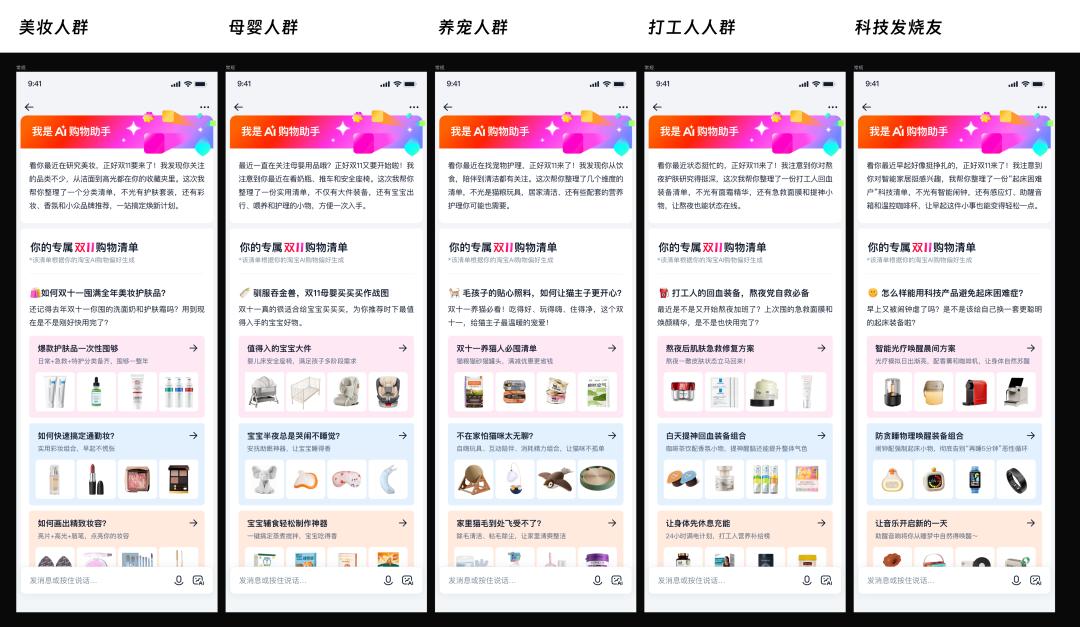
Taobao's AI Shopping List
During the big promotion, many users have started using the AI shopping guide to assist their shopping. Data shows that "AI Universal Search" has helped users solve nearly 50 million shopping needs, and the "AI Shopping List" has provided about 2 million personalized shopping lists for users.
In the past, the value of the platform lay in integrating products. In the future, the value of the platform also lies in helping consumers make better choices. Moving from a simple "product information platform" to a current "consumer decision - making platform" may be the real starting point for AI to reshape e - commerce.
03. Changes in Operations
The last aspect of the change occurs on the merchant side. Since this year, Taobao's AI products for merchants have hardly stopped iterating: From graphic design to marketing, from data analysis to customer service response, AI is gradually improving those trivial but crucial capabilities in e - commerce operations.
During this year's Double 11, Taobao has comprehensively upgraded these AI products for merchants.
First is the comprehensive upgrade of the AI Business Manager. Before this year's Double 11, Taobao fully upgraded the "Business Manager", forming an Agent combination consisting of 1 "AI Store Manager" - the "Double 11 Assistant", and 6 "AI Employees" - the "AI Data Analyst", "AI Marketing Tool Operator", "AI Personnel Operator", "AI Graphic Designer", "AI Order Assistant", and "AI Customer Service".
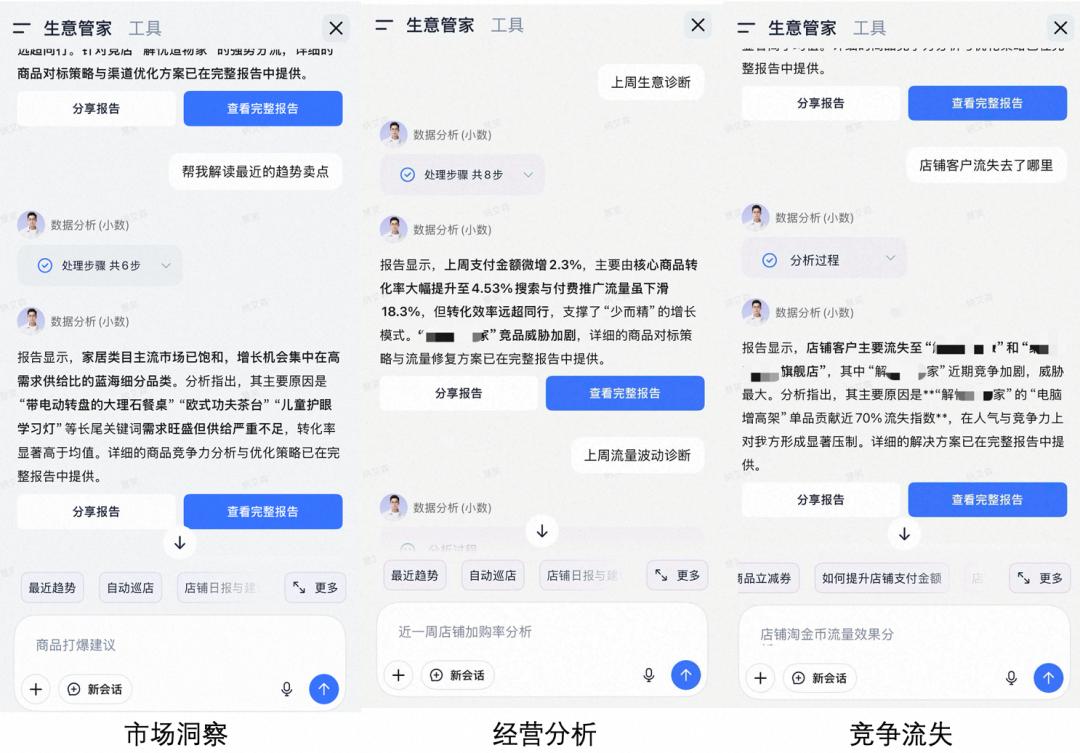
Taobao's AI Business Manager
For many small and medium - sized merchants with limited manpower, a long - standing pain point is that to compile and obtain a data analysis report, they often have to jump back and forth between dozens of pages, which consumes a lot of time and energy and requires high concentration to avoid errors. And this work is precisely the basis for business decision - making - Only when the data is complete and accurate can correct decisions be made. In the past, carrying out these tasks posed a huge challenge to small and medium - sized merchants on e - commerce platforms.
The "Double 11 Assistant" launched during this year's Double 11 can provide real - time business interpretations and diagnose the risk of customer loss for merchants according to different stages of the promotion. By exploring the "blue ocean" in the market, it helps merchants identify new growth opportunities. For example, after real - time monitoring of core indicators such as store traffic, conversion rate, inventory, price, and promotion, the "Double 11 Assistant" will directly tell merchants the conclusion: "Your number of added - to - cart items is only 50, 10% behind your peers in the same tier. The main problems include a 10% higher loss rate of promotional items compared to competitors and a promotion click - through rate of only 3%." This saves the manpower and time cost of data compilation.
In addition, in the traditional model, merchants rely