Strategic Analysis of Chinese AI Enterprises: Competition Among Four Organizational Philosophies
Before I start my analysis, I must clarify one thing.
I've been researching corporate strategies for many years and have seen numerous analysis articles discussing "whose model is stronger," "whose financing is more substantial," and "whose monthly active users are higher." While these aspects are undoubtedly important, I've always felt that something has been overlooked.
That overlooked factor is: why do these companies make such choices?
When it comes to AI, why does Liang Wenfeng choose open - source, ByteDance under Zhang Yiming chooses to burn money to acquire users, and Tencent under Ma Huateng chooses to delve deep into application scenarios? This is not a coincidence, nor is it a "spur - of - the - moment decision" by an individual. Instead, it is the result of the combined effects of each company's organizational genes, the founders' cognitive styles, and path dependence.
This makes me think of the core issue I repeatedly encounter when studying human thinking: the essence of an event is not the logic of the event itself, but what the person who drives the event sees and chooses at that critical moment.
DeepSeek's choice of open - source is underpinned by Liang Wenfeng's corporate cognitive structure of "sealing off technology is like building a wall, while open - source is like building a bridge." Tencent's decision not to compete for monthly active users is based on Yao Shunyu's judgment of the nature of the second half of the AI competition. ByteDance's choice to burn money for subsidies reflects whether an organization accustomed to the advertising economy logic can break free from path dependence when it first encounters the situation where "scale becomes a burden."
This is the real reason I want to write this article.
Below, I will conduct the analysis from three levels: the surface level is the strategic landscape, the middle level is the organizational logic, and the deep level is the cognitive structure of individuals.
1. From "Model Competition" to "Strategic Route Competition"
If we look at several key events in the recent Chinese AI industry together - DeepSeek's announcement of a 50 - billion - yuan first - round financing, Tencent's insistence on not competing for rankings despite limited computing power, and Doubao's launch of a paid subscription that triggered an online storm - you'll find that the nature of the Chinese AI competition has undergone a fundamental transformation.
In 2023, the competition was mainly about model capabilities: who had more parameters, who had a higher benchmark score, and who was the first to release.
After 2025, the competition has shifted to strategic route competition: where you choose to build your moat and whether your organization can support the long - term existence of this moat.
The significance of this transformation is far deeper than it appears on the surface. As the gap in model capabilities narrows, architectural innovations are quickly caught up, and computing power is no longer the sole bottleneck, what determines the outcome is no longer the technology itself, but the company's position in the industrial chain and the organizational capabilities that support this position.
Michael Porter's competitive theory holds that a company's sustainable competitive advantage comes from cost leadership, differentiation, and focus. However, what he didn't fully discuss is that different strategic routes require different organizational forms for support, and what strategy a company can choose is often determined by its historical accumulation and organizational genes.
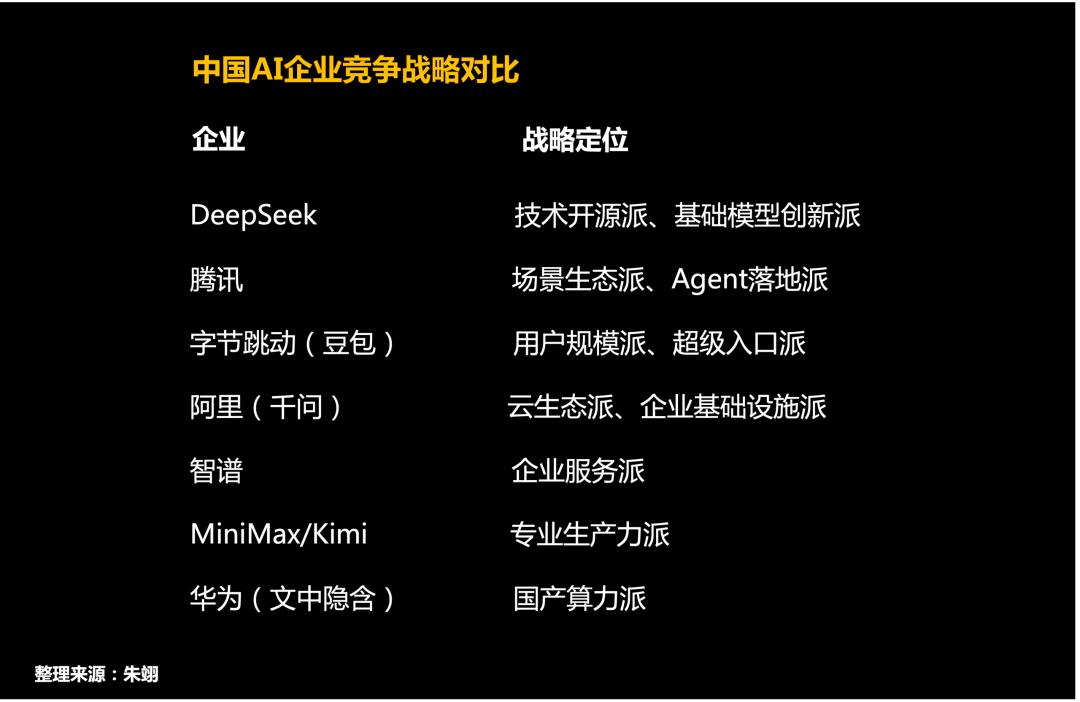
Chinese AI companies have currently formed at least four distinct competitive strategies, and behind these four strategies are four completely different organizational philosophies.
2. DeepSeek: The Logic of a Scientific Community
DeepSeek is the most difficult to understand because most people try to understand it using the "company" logic, but in fact, it is more like a scientific community.
During an interview, Liang Wenfeng said a sentence that, in my opinion, sums up DeepSeek's organizational philosophy: "Sealing off technology is like building a wall, while open - source is like building a bridge." Furthermore, he said, "Blindly piling up computing power is like quenching thirst with poison. If it takes ten times the cost to improve performance by 5%, it is an unethical innovation."
Behind these two sentences is a complete cognitive framework, not just a business strategy.
From the perspective of organizational behavior, James March distinguished two types of activities when studying organizations: exploration and exploitation. Exploration is about seeking new knowledge, while exploitation is about converting existing knowledge into profits. The two are inherently in conflict because exploration requires tolerance for uncertainty, acceptance of failure, and permission for deviation, while exploitation requires efficiency, predictability, and replicability.
Most Internet companies are exploitation - oriented organizations because their users, revenues, and markets already exist, and optimizing existing business is their primary goal. DeepSeek is an exploration - oriented organization. It is looking for new architectures, new training methods, and new inference mechanisms, and no one knows what these things will look like before they are discovered.
This also explains why DeepSeek has no KPIs, allows researchers to freely use GPUs, form teams freely, and has no strict reporting system. Many people think this is "management chaos," but if you understand that this is a deliberate optimization of the probability of innovation rather than execution efficiency, you'll find that this is actually an extremely rational choice.
Psychologist Teresa Amabile found through a large number of experimental studies that the three most important factors for high - creativity teams are autonomy, professional ability, and a sense of mission, while performance bonuses and KPI pressure actually compress the space for creative thinking. Driven by external rewards, people tend to choose the safest and most predictable path rather than the most creative one. This has been repeatedly verified in the laboratory, and DeepSeek's management style is a practical application of this scientific discovery.
Historically, the greatest technological breakthroughs often came from this form of scientific community: Bell Labs invented the transistor, Xerox PARC invented the graphical interface, and the early culture of OpenAI was also like this. Their common feature is that researchers have a high degree of autonomy, the evaluation criteria are academic reputation rather than commercial output, and the organizational incentive mechanism is peer recognition rather than salary.
DeepSeek was able to train R1, which can rival the top closed - source models, with only $6 million precisely because this organizational form stimulates real algorithmic innovation. And this innovation is not achieved by piling up more money, but by better cognition.
However, there is a thought - provoking question, which is also clearly revealed in the article: the scientific community form has its inherent flaws.
Guo Daya went to ByteDance, Wang Bingxuan went to Tencent, and Ruan Chong went to Yuanrong Qixing. Members of a scientific community are naturally mobile because in this culture, personal reputation follows the individual rather than the organization. This is not a problem unique to DeepSeek but a structural feature of the scientific community form. Bell Labs also faced a similar problem.
In addition, while the open - source strategy builds ecological influence, in essence, it allows potential commercial value to flow to the entire community rather than to DeepSeek itself. Just as Linux has influenced the entire Internet infrastructure, but Red Hat is the company that built a business model on top of Linux, not the main contributor to the Linux kernel.
I think the announcement of a 50 - billion - yuan financing this time is a signal that DeepSeek is truly entering the strategic transformation stage: evolving from a scientific community to an industrial company. Liang Wenfeng personally promised 20 billion yuan and still maintains more than 80% control, which conveys a very clear message: transform, but the direction remains unchanged, and the control remains unchanged. He does not allow the logic of capital to replace the logic of research, even in the process of introducing external investment.
The significance of this control structure is that it essentially uses the capital structure to protect the cognitive structure. Liang Wenfeng knows that once the control is dispersed, the organization's attention will inevitably shift from long - term innovation to short - term business indicators, which would be the real death of DeepSeek.
3. Tencent: The Most Misunderstood AI Strategy
Tencent is currently the most misunderstood AI player.
The outside world has labeled Tencent as "slow," "conservative," and "uncompetitive." The evaluation criteria are monthly active users, model rankings, and financing scale. However, if you carefully read every word that Yao Shunyu of Tencent said in the conversation, you'll find that Tencent has no intention of competing in these dimensions.
Yao Shunyu said a sentence that, in my opinion, is the deepest judgment in the Chinese AI industry to date: "The first half of AI is about finding methods, and the second half is about finding good problems worth solving."
The subtext of this sentence is: when pre - training and post - training mature, the gap in model capabilities will become smaller and smaller. Just like when electricity first emerged, each factory built its own generator, but later, when the power grid became popular, no one regarded the power plant as a core competitiveness. Large models are rapidly going through this commoditization process.
Economics calls this phenomenon the Commodity Trap. When a technology becomes a commodity, its price tends towards the marginal cost, and the competitive advantage shifts from owning the technology to the scenarios and efficiency of using the technology.
This is exactly what Tencent sees: the future competition is not about large models, but about who can embed AI capabilities into real - world workflows and create irreplaceable value.
The Co - Design model emphasized by Tencent, on the surface, is a product development method, but in essence, it is about building an organizational capability: forming a close feedback loop between model iteration and scenario verification, rather than having the model team optimize benchmarks in a vacuum. This is consistent with the insights of organizational theory master Herbert Simon: in a complex environment, there is no optimal solution, and one can only approach the sub - optimal solution through continuous iteration. AI is precisely such a complex environment.
I've observed an interesting structure: Tencent doesn't have the strongest model, but it has the most complete scenario matrix in the Chinese Internet. WeChat connects 1.4 billion people, Enterprise WeChat connects a large number of enterprises, Tencent Meeting and Tencent Docs connect workflows, and Tencent Cloud connects millions of enterprise customers.
Sociologist Ronald Burt proposed the concept of "Structural Hole": in a social network, the position that connects more nodes has greater power and value because information and resources must flow through this position. Tencent is striving to become the largest structural hole in the AI era: not the smartest model, but the key hub through which AI capabilities flow to all scenarios.
This is exactly the same as the logic of Microsoft Copilot. Microsoft's advantage has never been the strongest AI, but the organizational tool ecosystem formed by Office, Teams, and Azure. When AI capabilities are embedded in this ecosystem, the switching cost is extremely high, and user stickiness is extremely strong. This is the real moat that is difficult to replicate.
When Yao Shunyu joined Tencent, he said a sentence that, I think, can be regarded as the underlying logic of Tencent's AI strategy: "The most important thing in the second half of AI is context. Do you know what this person is doing and do you know all kinds of information about the enterprise?"
This sentence means that Tencent is betting not on "smarter AI," but on "AI that understands users better." And in terms of understanding users, Tencent, which has a complete social relationship chain, office data, and enterprise data, has an innate advantage that no other AI company can replicate.
Of course, Tencent also has real weaknesses. The shortage of computing power is the biggest current hard constraint, and after the export control of NVIDIA H20, this problem has no short - term solution. The multi - business - group architecture has brought internal collaboration barriers, and it is difficult to integrate data between different BGs due to compliance considerations, which weakens Tencent's greatest advantage - context data.
4. ByteDance: The Cost of Organizational Path Dependence
ByteDance is the most thought - provoking case in this competition because it is the first time it has encountered the situation where "its greatest advantage has become a burden."
The launch of Doubao's paid subscription, on the surface, is a business decision, but at a deeper level, it is a struggle of an organization between path dependence and new realities.
ByteDance's genes come from the advertising economy. The business logic of Douyin is extremely clear: user time × user scale = advertising value. All product designs, algorithm optimizations, and operation strategies serve this equation. The research of behavioral scientist Skinner found that the variable reward mechanism is the strongest means of behavior reinforcement. Douyin perfectly combines infinite scrolling, uncertain content rewards, and instant feedback to build the strongest attention control system. This is not accidental but a deliberately designed behavioral engineering.
Doubao also followed this logic in the early stage: free subsidies, crazy customer acquisition, and the pursuit of monthly active users. The result was successful, and Doubao reached 345 million monthly active users, becoming the number one C - end AI application in China.
However, problems emerged. The completely different economic structure of AI and advertising has collided with ByteDance's organizational DNA.
Internet products have network effects and scale effects: the more users WeChat has, the greater the network value, and the marginal cost approaches zero. However, each interaction of AI large models requires real - time GPU computing power. The more active the users and the more complex the tasks, the higher the cost, and there is no cost reduction due to scale effects. According to the data disclosed by Doubao, with a daily consumption of 120 trillion Tokens, the daily text - reasoning cost alone is as high as tens of millions of yuan.
This is the first time ByteDance has encountered the situation where "scale has become a burden."
The economic concept is called negative externality: in traditional Internet businesses, growth generates positive externalities, and the faster the growth, the higher the value; in AI businesses, some types of growth generate negative externalities, and the faster the growth, the higher the cost.
ByteDance's organization lacks historical experience in dealing with this structural contradiction. The subscription - based business model requires a completely different product logic, operation system, and user mindset, and ByteDance is best at traffic operation rather than subscription operation.
The problem with Doubao's pricing is not just the price itself, but the obvious gap between product capabilities and pricing expectations. Behavioral economics research shows that the core prerequisite for users to be willing to pay for a service is that the perceived value is higher than the payment price. When users perceive that Doubao's capabilities in professional productivity scenarios are behind those of competitors at the same price, their willingness to pay is naturally affected. Kahneman and Tversky's Prospect Theory tells us that loss aversion is an extremely strong psychological mechanism - users' feelings about "something that was originally free starting to charge" are much stronger than their feelings about "new paid features." This is also the psychological root of the public outcry caused by Doubao's charging.
I don't think ByteDance will fail. ByteDance's traffic operation ability is unique among Chinese Internet companies. Once it finds the synergy point between AI and advertising business or the entry point for high - frequency productivity scenarios, ByteDance may still become the largest AI traffic entrance in China. However, what it is currently experiencing is the friction period between organizational path dependence and new business logic, and this friction can only be resolved through time and active cognitive adjustment.
5. Alibaba: The Most Undervalued Infrastructure Player
Alibaba has the weakest presence in this discussion, but from the perspective of the industrial structure, Alibaba may be one of the companies with the clearest strategic logic at present.
Nobel Economics Prize winner Ronald Coase proposed that the core reason for the existence of a company is to reduce transaction costs. When AI capabilities are embedded in an enterprise system, in essence, it is reducing information friction and execution costs within the organization. What Alibaba has been doing is providing infrastructure for enterprises to reduce transaction costs: from the e - commerce platform to cloud computing, the logic is consistent.
In the AI era, this logic continues. Qianwen's open - source strategy has made it one of the most active open - source models globally, and its deep binding with Alibaba Cloud gives it a natural ability to reach enterprise customers. Compared with ByteDance, which needs to convert C - end users into enterprise value, Alibaba is rooted in the enterprise market and is naturally suitable for the AWS route.
Alibaba's weakness lies in its C - end influence, and its presence in consumers' minds is far weaker than that of Doubao. However, if the main battlefield of future AI competition shifts from consumer applications to enterprise AI infrastructure, Alibaba's position will be more stable.
6. The Deep - level Structure of Competition: Four Organizational Philosophies
When I synthesize the above analysis, a clearer deep - level structure emerges: the essence of the Chinese AI competition is the competition among four organizational philosophies.
The first is the scientific community, represented by DeepSeek. The core resource is innovation ability. The incentive mechanism is academic reputation, the organizational value is technology - first, the strongest aspect is to generate real fundamental breakthroughs, and the weakest aspect is commercialization ability and talent stability.
The second is the platform ecosystem, represented by Tencent. The core resource is scenario synergy. The incentive mechanism is ecological value - added, the organizational value is connection - first, the strongest aspect is to build irreplaceable workflow embedding,