Silicon Valley in the AI Bubble: Sober Gamblers and a Table of Doubling Madness
"There are still six months until the AI bubble is put to the test." At the end of April this year, a Silicon Valley investor calmly told us.
But less than a month later, the "six months" was compressed into "three weeks."
It was SpaceX that advanced this timeline. On May 20th, it publicly released its prospectus, raising $75 billion in funds and with a valuation of $1.75 trillion. This might be the largest IPO in the history of the U.S. stock market. Right after that, Anthropic and OpenAI submitted their prospectuses, and their valuations both soared above $1 trillion. The money that these three AI giants' upcoming IPOs will draw from the entire market is 10 times that of the entire U.S. stock IPO market last year.
Once listed, the financial books will be laid bare for everyone to see. The real quality of the AI business, the renewal rate, and the cash flow. As long as one figure fails to meet expectations, panic will be ignited. The secondary market will collapse first, and the money in the primary market will follow suit. A market built on the expectation of AGI will have to re - evaluate the value of AI. And those startups that have just entered the market, rely on AI stories to support their valuations but cannot produce real revenue will be the first to be out.
But this week in Silicon Valley, what we saw was not panic. Today's AI bubble is no longer the kind of early - stage fanaticism of "being carried away by the trend." More subtly, the bubble is still expanding, but some people have quietly prepared lifeboats. We talked to a circle of investors, founders, and engineers. None of them really left, but everyone was leaving a way out for themselves.
Why don't these smartest people leave first? Why do they keep investing even though they know the ground beneath their feet is shaking? Where will this bubble, which is expanding while people are preparing to escape, ultimately lead? What is happening in Silicon Valley today will never stay only in Silicon Valley. Whether you are working in AI, investing in AI, or just having your work changed by AI, the problems that these people in Silicon Valley are facing will sooner or later be presented to each of us. Before we get involved, we can first see what those who are already in the game are doing, thinking, and betting on.
The AI Bubble in Silicon Valley: Everywhere, but No One Leaves the Table
In the past, the AI bubble was just a set of numbers to us. The five major technology companies will spend nearly $700 billion on AI this year, more than the entire GDP of Sweden in a year; Wall Street has bet 40% of the profit growth of the S&P 500 on this one track; some institutions have calculated that the scale of this AI - related construction is $3 trillion. The larger the numbers, the less relevant they seem to be to ourselves.
When we were in Silicon Valley, the bubble turned from a string of numbers into more concrete details. The validity period of a contract, the product progress of a team, the real slope of a growth curve. These things are never written in reports, but when put together, they are the most real appearance of the bubble.
What is more worthy of attention is the people in Silicon Valley. We found that most people don't think they are the ones blowing the bubble. After staying in the bubble for a long time, the rhetoric of blowing the bubble becomes the way of speaking. Without a product, one can talk about the future first; without profit, one can report growth first; without verification, one can ask for a valuation first. When everyone talks like this, after talking so much, it becomes "normal." It is so normal that people in it can't tell which is really valuable and which is just lifted by the bubble. And those who have just entered the industry even think that the AI industry should be like this.
But what really defines this bubble is not the numbers themselves, but the structure behind the numbers. The more we dig in, the more we find that the bubble is not in one corner. It is in every layer. Big companies, startups, and those who haven't entered the market all have their own bubbles, just in different forms.
The top layer is the big companies. Bryan Liu, the investment director of Alumni Ventures, explained the logic to us: This year, big companies buy AI not because they have calculated the effects in many cases, but because "adopt AI" has become a consensus. "It must be in the CEO's annual plan, and the procurement door must be opened first." Buying is not because they are sure it is useful, but because not buying means admitting that they have fallen behind. This exactly matches the report released by MIT at the end of 2025. Enterprises have spent tens of billions of dollars on generative AI, and 95% of the projects have no returns so far. The money has been spent, but the effect is almost zero, yet people are still spending. In front of enterprises, the AI bubble is not about blowing value, but about showing a stance.
This money flowing down becomes the growth story of startups. But we found that just because enterprises open the door doesn't mean they will make long - term real - money bets. They are signing fewer three - year long - term contracts and instead giving a six - month trial first, and then talking about renewal after seeing the results. So many startups are holding a bunch of six - month short - term orders, writing them into their business plans, making them into cases, and stacking them into a growth curve that keeps rising. As for how many of these short - term orders will eventually become long - term contracts, no one can be sure.
So the bubble of startups is actually hyped up by both the upstream and downstream:
Big companies show their stance with short - term orders, entrepreneurs raise funds with short - term orders, and investors pay the bill and then resell. No one is in a hurry to expose the truth.
However, in such a bubble, those who have just entered the market are the ones who suffer. When the valuations and ARR of the first - movers are pushed to high levels, later - comers will find that it is very difficult to catch up just by making real products, unless you can also tell a beautiful enough story to quickly boost the financing and valuation. The customer threshold is getting higher and higher, financing is getting more and more difficult, and more and more people are being dragged into the bubble.

Founders on the streets of Silicon Valley are "depicting" their futures | Image source: GeekPark
Three types of people, three positions, and three betting methods.
Of course, there is not all water under this prosperity. There are also real things growing.
For example, in the voice AI track, in the past, a customer service center of a multinational company had to employ hundreds of thousands of people. But after voice companies like ElevenLabs emerged, many big companies directly shut down their entire call centers and replaced them with voice agents, signing contracts for six or seven years. "This kind of demand is real, and the money is also real. It's just that in today's Silicon Valley, there are still only a few companies that can translate value into reality like this." Bryan sighed. Nowadays, it is getting more and more difficult to find such real enterprises in the bubble.
But what impressed us the most was not how big this bubble was, but that almost everyone could see it, yet no one was willing to let it stop. After seeing clearly, what people did was not to leave, but some secret protection. For example, enterprises no longer sign long - term contracts easily and first test the waters for six months; startups, for example, tell stories while quietly leaving a way out for themselves.
The bubble is still expanding, but each person blowing it has left a way out for themselves.
What Are the People Staying at the Table Looking At?
"What exactly are the people who stay betting on?" After going through this week's conversations, we found that the answers were diverse.
Founders bet that they can reach the next round and survive. Investors bet that they have bet on the right company in advance, betting on probability. Engineers bet on a technology route that no one is optimistic about, betting that it will turn around in the future. The three people are sitting in different positions at the poker table, and no one can convince the other. But no one really left. Perhaps this is the most abnormal thing about this bubble. Everyone sees the risk, but everyone is still continuously investing, just in different ways.
Founders: Some Step on the Gas, Some Hit the Brakes
The most interesting ones are the founders. This week in Silicon Valley, we met two completely different types of founders who chose opposite directions in the face of the same bubble.
San Wen belongs to the former. He had worked in the parking software industry, which has nothing to do with AI, for ten years and only entered the AI startup wave in this round. He believes that AI is creating a brand - new market. In his words, this is "market pull," not you pushing, but the market demanding, "and it's still not enough."
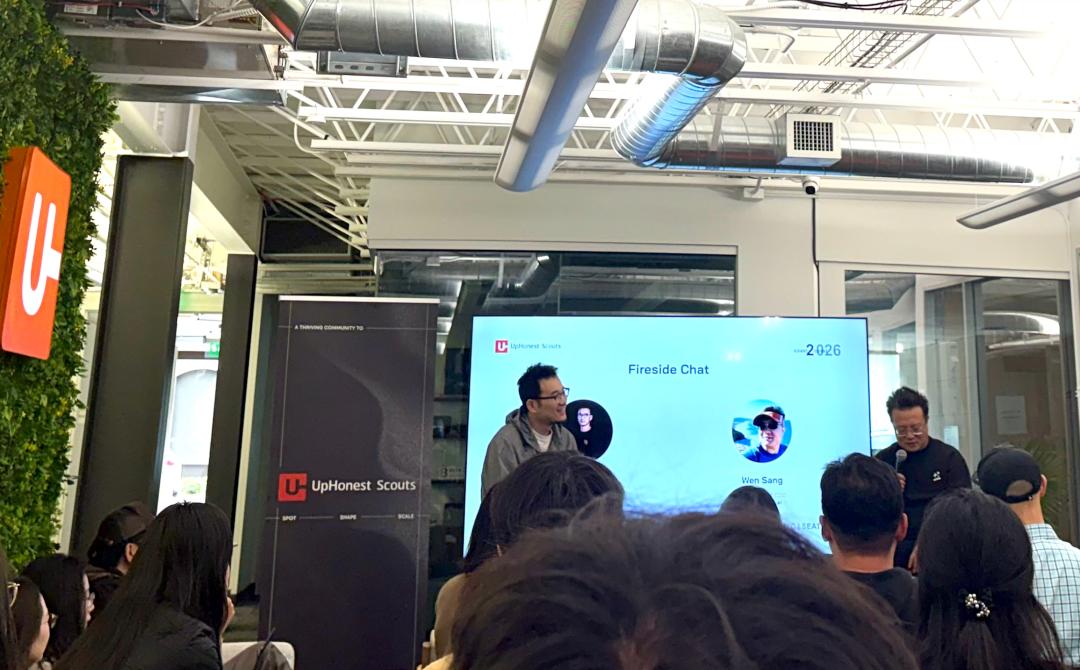
San Wen is telling his early startup experience | Image source: GeekPark
And Genspark really caught the wave when the AI narrative was most valuable. When it raised $60 million in the seed round and had a valuation of $260 million, the company had no revenue. But it is also one of the few companies that have really achieved high - speed growth. Nine days after the product was launched, its ARR exceeded $10 million, reached $36 million in 45 days, exceeded $50 million at the end of September, and broke through $200 million in March 2026 and $250 million at the end of March.
Neither money nor confidence is lacking for Genspark. In New York and San Francisco, we can see Genspark's advertisements everywhere, on subways, buildings, and streets.
But even for a star startup that has succeeded, it rarely puts all its chips on one path. In this round of AI startup wave, we can already see many leading unicorns laying out another path at the high - valuation point. While maintaining high - speed growth, they are quietly observing the possibility of being acquired by big companies. Being acquired by giants is becoming another backup plan for this round of star founders.
However, AI startups like Genspark that succeed at the first attempt are ultimately in the minority. Another founder, Xiang Feng, has experienced more twists and turns in his startup journey.
He has a good resume. He has served as a senior executive at Baidu and Xiaomi, growing Xiaomi's overseas app store from scratch to about 150 million monthly active users. He left to start a business at the end of 2022 and turned to AI as soon as ChatGPT came out. His first project was an AI English learning app. He ran it for two years, made a profit, and exited. The second project was a video agent. He raised funds but finally failed to make it work. Now, his third project plans to develop a computer - side agent similar to Claude Computer Use.
After going through several rounds in the AI bubble, he has become much calmer in viewing the market. In his opinion, the penetration rate of AI is far lower than what the outside world thinks. Ordinary people's lives have little to do with AI, and the opportunities are precisely hidden in this unexcavated area.
When we met him, he was conducting market research in Palo Alto to find the next vertical direction. He even thinks that some changes brought about by the bubble are actually good for entrepreneurs: "After Claude 4.6, making a product doesn't require so many people and so much money. One can get closer to the product - market fit before raising funds, and the founder's control and equity are more cost - effective." So he is not in a hurry. He would rather go slowly, choose the right direction, and build a stable ship.
One steps on the gas pedal to the bottom, and the other actively eases off the accelerator. But neither of them leaves the table. San Wen's "fast" bet is that scale and momentum can carry him through the cycle, either becoming big enough to survive or becoming expensive enough to be bought. The latter's "slow" bet is that cognition and patience can let him survive the ebb tide. When the wind stops, the ship will still float steadily on the water. Although the directions are opposite, they are actually both preparing for whether they can survive after the bubble bursts.
Investors: Beyond the Bubble, See the Essence of the AI Revolution
If founders are the ones who know how big the bubble is, then investors are the ones who know how the bubble is formed. Their entanglement lies here. Rationally, they know exactly how much water there is and how difficult it is to distinguish between truly excellent and fake companies. But they also know better than anyone that the part left after the bubble is squeezed out is the real direction worth betting on in this round of industrial revolution.
We met a senior investor, Holly from Jiajia Capital, who has very strict principles. "I don't spread my investments thinly," she said. She doesn't participate in the earliest round. She must see a market - oriented product and the product - market fit before making an investment. In her opinion, the return of spreading investments widely is actually very limited. "In the end, it's diluted to nothing."
But even such a person recently broke her rule. A group of top AI researchers formed a company. Before they even made a specific product, the valuation had soared to billions of dollars.
Holly finally made an investment, although she clearly knew that this didn't fully conform to her usual investment framework. But some opportunities themselves don't belong to the standard answer. In Silicon Valley, what is truly scarce is never capital, but the combination of top - notch talents. When the best people start to start a business together, financing is often not a one - way selection, but a two - way pursuit.
Investors are judging projects, and founders are also judging who can be their long - term partners.
After all, good projects are won by striving, not by waiting.
"The bubble is not scary. The essence left after squeezing out the bubble is the key." In Holly's view, what investors need to do is to still dare to enter the market rationally while recognizing the risks. The bubble will burst, but the essence of the industrial revolution will not change. Understanding this, one will know where to place bets.
Another investor, Bryan, has a much simpler standard for judging the "water content": When looking at a company, first see who its customers are. Companies that serve other AI startups have a high risk because their revenue is built on others' bubbles. Those that sell to the real needs of traditional industries are relatively more stable.
After all, investors in Silicon Valley know the existence of the bubble better than anyone. But what they need to solve is never "whether this is a bubble," but to make their judgment more valuable in a visible bubble. There is never a shortage of capital. What is lacking is the ability to distinguish which companies can survive the cycle and which are just lifted up together when everyone is still placing bets. In this regard, the more accurate one's judgment is, the more valuable the money in one's hand is.
Engineers: See the Swing and Confusion Inside Big Companies
Compared with founders and investors, engineers in big companies have a more internal perspective. They can feel how much real money big companies are investing in AI, and they can also see how the top management swings back and forth between different technology routes and different businesses.
We met an engineer named Thomas who is working on large models in a leading big company. He studied the basic theory of models during his Ph.D. His perception of the bubble started with a phrase: the collapse of faith. When doing research in school, it was about having a mathematical framework for deduction. After entering the industrial world, he found that no one cared about those unrealistic theoretical assumptions, and no one cared about those "spherical models in a vacuum" the size of toys. The performance indicators in large - scale tests were everything: "As long as it works, no one cares why it's right."
The swing he saw was specific: Alibaba once went all - in on the open - source ecosystem, but finally, with the departure of Lin Junyang, it marked the beginning of full - scale closed - source. ByteDance has been focusing on building a closed - source product - level model from the start, but the pace of its academic publications is also gradually slowing down. Google, under the setback of BARD and the complete collapse of the BERT ecosystem, also had to restructure its team drastically to create Gemini, which later occupied the position of the