27 provinces have finalized their 15th Five-Year Plan GDP targets: Guangdong and Jiangsu are likely to exceed 18 trillion yuan, with Tibet leading the growth rate at 7%
Currently, the 14th Five-Year Plan outlines of 31 provinces have all been released, clarifying the development goals of each region for the next five years.
After sorting out the information, reporters from Time Weekly found that among the 31 provinces, 27 have announced their average annual growth targets for regional GDP during the 14th Five-Year Plan period. The other 4 provinces, although not announcing clear average annual growth targets, have also announced their respective major development goals.
Among the 27 provinces that have announced their average annual growth targets, Tibet has set an average annual growth target of around 7%, the highest in the country. Hainan follows closely with around 6%. Xinjiang has set its target between 5.5% and 6%, while most other provinces have set their targets between 5% and 5.5%.
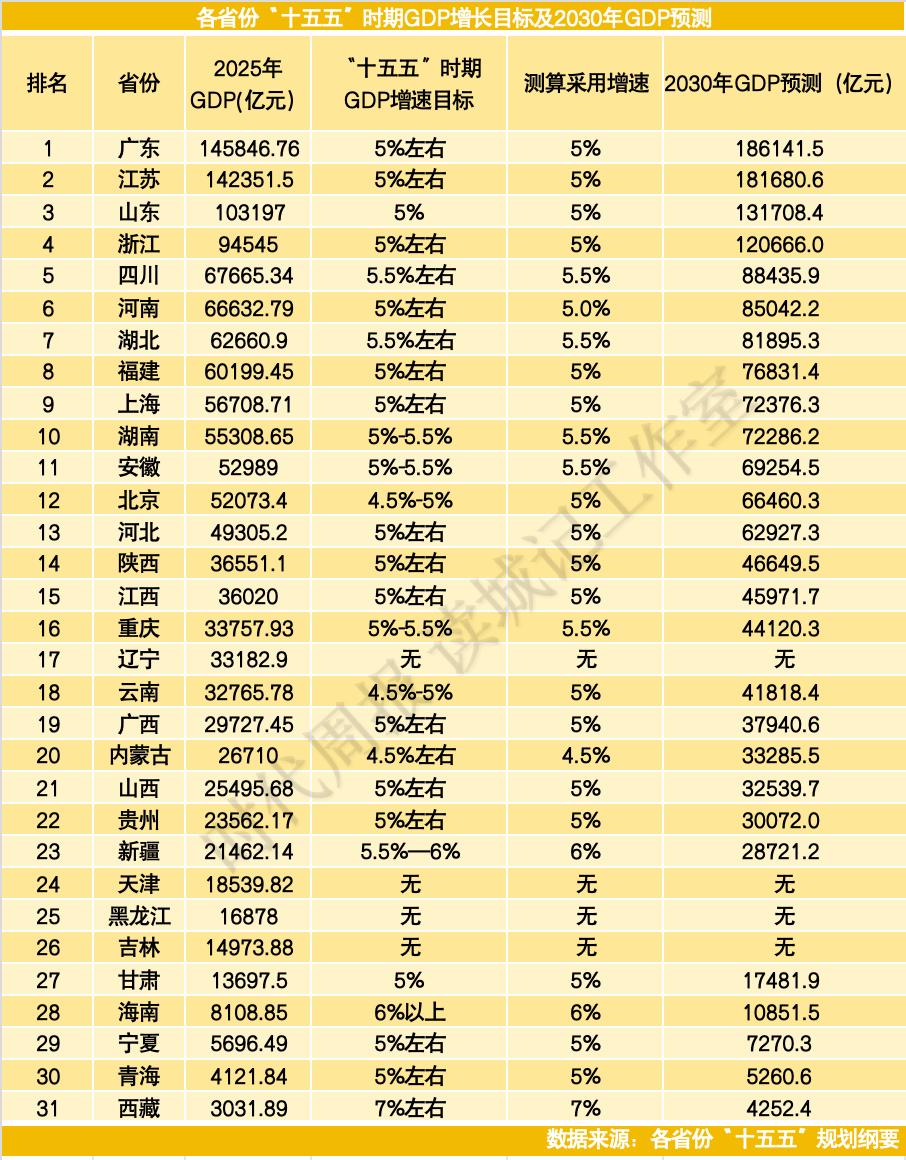
If a simple calculation is made based on the planning goals of each region, by the end of the 14th Five-Year Plan, the economic aggregates of a number of provinces will reach a new level. Guangdong, Jiangsu, and Shandong will still remain in the top three positions in the country.
Among them, Guangdong's GDP is expected to increase from 14.58 trillion yuan in 2025 to around 18.6 trillion yuan, with the newly added economic aggregate in five years possibly exceeding 4 trillion yuan. Jiangsu's GDP will also exceed 18 trillion yuan, and Shandong's GDP will exceed 13 trillion yuan.
GDP of Guangdong and Jiangsu May Exceed 18 Trillion Yuan
Competition among provincial economies has always been an important window for observing China's regional development pattern.
Judging from the 14th Five-Year Plan goals announced by each province, by 2030, there is expected to be no significant change in the pattern of the provinces with the highest economic aggregates. The large economic provinces will continue to play a leading role.
Calculated according to the growth targets set by each region, at the end of the 14th Five-Year Plan, the top ten provinces in terms of GDP will still mainly consist of Guangdong, Jiangsu, Shandong, Zhejiang, Sichuan, Henan, Hubei, Fujian, Shanghai, and Hunan. The agglomeration effect of the leading provinces will be further highlighted.
As the largest economic province in the country, Guangdong is expected to continue to expand its economic aggregate advantage. In 2025, Guangdong's regional GDP reached 1,458,467.6 billion yuan. Calculated at an average annual growth rate of around 5% during the 14th Five-Year Plan period, by 2030, Guangdong's GDP is expected to reach around 18.6 trillion yuan, with the newly added economic aggregate in five years exceeding 4 trillion yuan.
Another province whose GDP will exceed 18 trillion yuan is Jiangsu. In 2025, Jiangsu's regional GDP reached 1,423,515 billion yuan. Calculated at an average annual growth rate of around 5% during the 14th Five-Year Plan period, by 2030, Jiangsu's GDP is also expected to exceed 18 trillion yuan.
As a major manufacturing province, Jiangsu has a leading advanced manufacturing cluster and a complete industrial supporting system in the country. In recent years, Jiangsu has continuously promoted the upgrading of traditional industries and the development of strategic emerging industries, forming strong competitive advantages in fields such as high-end equipment, new-generation information technology, and new energy, providing strong support for sustained economic growth.
In 2025, Shandong, ranked third, became the first northern province to enter the 10-trillion-yuan economic aggregate echelon. Zhejiang ranked fourth in the country with 945.45 billion yuan. Sichuan (676.65 billion yuan), Henan (666.33 billion yuan), Hubei (626.61 billion yuan), and Fujian (601.99 billion yuan) were in the range of 6 trillion to 7 trillion yuan, while Shanghai (567.09 billion yuan) and Hunan (553.09 billion yuan) were in the range of 5 trillion to 6 trillion yuan.
Calculated according to the 14th Five-Year Plan GDP target growth rates of these provinces, by 2030, Shandong's GDP will exceed 13 trillion yuan, Zhejiang's will exceed 12 trillion yuan, the GDP of Sichuan, Henan, and Hubei will exceed 8 trillion yuan, and the GDP of Fujian, Shanghai, and Hunan will exceed 7 trillion yuan. In terms of economic aggregate and growth potential, the southeastern coastal and central regions will still be important engines for China's future economic growth.
From the 14th Five-Year Plan outlines of these provinces, the common keywords for the growth of economic powerhouses are technological innovation and industrial upgrading.
Shandong focuses on cultivating emerging industries such as high-end equipment, new energy, and new materials. Zhejiang makes efforts in artificial intelligence and the digital economy. Shanghai focuses on three leading industries: integrated circuits, biomedicine, and artificial intelligence, and continues to develop high-end service industries. Provinces such as Sichuan, Hubei, and Henan are also accelerating the layout of advanced manufacturing and future industries.
As the traditional growth drivers are gradually transformed, emerging industries are becoming an important engine to support the continued expansion and upgrading of large economic provinces.
Tibet Sets a 7% Growth Target
While the leading provinces are consolidating their leading advantages, a number of middle-ranking provinces are accelerating their pursuit and are expected to achieve a leap in development level during the 14th Five-Year Plan period.
Especially in the central and western regions, a number of provinces have significantly enhanced their growth momentum and are becoming important variables in China's regional economic landscape. Among them, provinces such as Anhui and Chongqing are particularly prominent.
In 2025, Anhui's automobile production reached 3.6865 million vehicles, including 1.7941 million new energy vehicles, both ranking first in the country. Its automobile export volume also ranked first in the country. In terms of cities, Hefei's new energy vehicle production ranked first in the country, outperforming many major automobile industrial cities.
In addition to new energy vehicles, Anhui has also laid out strategic emerging industries such as integrated circuits, new displays, artificial intelligence, and advanced structural materials.
As the provincial capital, Hefei has attracted much attention for its successful cultivation and introduction of major industrial projects on multiple occasions. From BOE to the agglomeration of the new energy vehicle industry chain, and then to the storage chips of Changxin Technology, Hefei has gradually formed a development model of leading industrial upgrading through technological innovation, and has continuously injected new impetus into Anhui's economic growth.
Calculated according to the growth target of 5% to 5.5% put forward in Anhui's 14th Five-Year Plan outline, by 2030, the province's GDP is expected to approach 7 trillion yuan, further narrowing the gap with the provinces ahead.
Similar to Anhui, Chongqing has also shown strong growth resilience in recent years. In 2025, Chongqing's GDP reached 337.5793 billion yuan, exceeding Liaoning's 331.829 billion yuan, rising to the 16th place in the country and becoming the only province with an upward-ranked position last year.
As an important manufacturing base in China, Chongqing is accelerating the transformation of the automobile industry towards new energy and intelligent networking, and at the same time continuously strengthening its advantageous industries such as electronic information and equipment manufacturing. Calculated according to the growth target of 5% to 5.5% during the 14th Five-Year Plan period, by 2030, Chongqing's economic aggregate is expected to exceed 4.4 trillion yuan.
Resource-based provinces are also looking for new growth drivers.
In 2024, Inner Mongolia's GDP reached 263.146 billion yuan, exceeding that of Shanxi. In 2025, Inner Mongolia's GDP increased to 267.1 billion yuan, while Shanxi's was 254.9568 billion yuan, and the gap between the two continued.
For a long time in the past, the economic growth of the two places has been highly dependent on resource industries such as coal. In recent years, with the adjustment of the energy structure and the promotion of industrial transformation, both places have accelerated the cultivation of industries such as new energy, new materials, and modern energy equipment. Among them, Inner Mongolia, relying on its rich wind and solar resources, has vigorously developed the new energy equipment manufacturing and green energy industries. Shanxi has continued to promote the comprehensive reform pilot of the energy revolution, accelerating its efforts to get rid of its single dependence on the traditional coal industry.
Calculated according to their respective planning goals, by 2030, the GDP of both Inner Mongolia and Shanxi is expected to exceed 3 trillion yuan.
Specifically in the western region. In 2025, Xinjiang's GDP grew by 5.5%, Gansu's by 5.8%, and Tibet's by 7.0%, all higher than the national average. Behind this are both the relatively low base of the economic aggregate and the close relationship with the investment in major projects and industrial layout in recent years.
For example, Xinjiang, Gansu, and Tibet have continuously promoted the construction of new energy bases such as wind and solar power, and major projects such as the hydropower project in the lower reaches of the Yarlung Zangbo River have been launched and implemented. The construction of infrastructure such as railways and highways in the western region has continued to speed up, providing strong support for local economic growth.
Therefore, in the 14th Five-Year Plan outline, Tibet has set its average annual GDP growth target at around 7%, Xinjiang at 5.5% to 6%, and Gansu, Ningxia, and Qinghai at around 5%, all showing strong development expectations.
In addition, Hainan has also set a relatively high growth target of around 6%. With the accelerated promotion of the closed-loop operation of the Hainan Free Trade Port, the advantages of institutional opening-up are expected to be further released, and new development opportunities will emerge in fields such as modern service industries, high-tech industries, and tourism consumption.
This article is from the WeChat official account “Time Weekly” (ID: timeweekly). Author: Li Hang. Republished by 36Kr with permission.