The super IPO is coming. SpaceX is going all in.
SpaceX has officially submitted an IPO application and plans to list on the NASDAQ under the ticker symbol "SPCX," with a target valuation of $1.75 trillion, which is expected to break the global record for the largest IPO.
$1.75 trillion. What does this figure mean? It took Apple over forty years to reach this level, while SpaceX has achieved it in just 24 years.
Its IPO fundraising target is $75 billion, far exceeding the record set by Saudi Aramco in 2019.
The list of lead underwriters includes Goldman Sachs, Morgan Stanley, JPMorgan Chase, Bank of America, and Citigroup, an impressive lineup rarely seen in recent years.
However, the basis for all these valuations hinges on the success of the Starship.
This is both absurd and real.
The smartest minds on Wall Street have calculated a trillion - dollar valuation using complex financial models, and the world's top investment banks are ready to sell this story to the market. The verification of this story lies in whether the 33 Raptor engines can operate normally simultaneously at temperatures of thousands of degrees, whether the first - stage rocket can land smoothly back on the launch pad after separation, and whether the heat shields can withstand re - entry into the atmosphere without being burned through.
The capital market has never witnessed such a scenario before: for the largest IPO in human history, the final test of its pricing logic will take place on the launch pad.
At this moment, the laws of physics have become the biggest short - seller on the planet.
01 When the Valuation Model Starts to Self - Prove
Why is SpaceX's $1.75 trillion valuation so closely tied to the Starship?
There is an extremely ingenious loop design here, making the valuation seem both the cause and the result.
George Soros proposed the concept of "reflexivity," which means that the market pricing itself can in turn change the fundamentals of the priced object. When the stock price rises, the company can raise funds at a lower cost. The funds raised are used to expand the business, and the business expansion in turn validates the rise in the stock price.
Soros used this theory to explain many extreme market conditions in financial history. From the bubble of bank stocks to the rise of Internet companies, we can see the shadow of this self - reinforcement.
SpaceX's IPO has pushed this loop to an unprecedented scale.
Its operating logic is as follows: the company goes public at an extremely high valuation - the current target is $1.75 trillion. This valuation allows it to raise $75 billion from the public market, far exceeding any previous IPO in history.
After receiving this money, it will be largely invested in three directions: the research, development, and manufacturing of the Starship, the expansion of AI computing power infrastructure, and the deployment of the next - generation Starlink satellites.
These investments are described in the prospectus as "strategic investments towards a total addressable market of $28.5 trillion."
The market, seeing these investments and the grand narrative of the TAM, believes that the company has broad prospects, and the stock price continues to rise.
As the stock price rises, the company is able to make larger capital expenditure plans or refinance at a lower cost in the future.
Do you see this structure clearly? The money raised from the high valuation is used to do things that make the high valuation seem reasonable, like a circular argument. We are doing a big thing because we are worth so much; we are worth so much because we are doing a big thing.
As long as the loop continues, all the elements inside are mutually reinforcing, and it is difficult to find the "errors" in it from the financial statements or traditional valuation models.
Because traditional valuation models look at historical data and existing assets, while this loop itself is constantly creating new "historical data" and "assets."
The data center that was still on the drawing board last year has been built this year and has become a fixed asset on the balance sheet.
The Starlink business, which was still in the red last year, has started to contribute positive cash flow this year.
The progress at each node adds new evidence to this loop.
However, this structure also has a natural vulnerability.
It transfers almost all the verification pressure to a specific physical assumption: the cost of orbital insertion must undergo a fundamental, order - of - magnitude reduction.
Why is this assumption unavoidable? The reason is that the cost structure of the entire business story is based on this premise. Without the ability to enter orbit at a low cost, the deployment of the next - generation V3 satellites would be a pipe dream.
If the Starship cannot achieve reusable and high - frequency launch rhythms, SpaceX will have to continue using the Falcon 9 to launch satellites one by one, and the cost will be completely out of control. Although Starlink is currently a cash cow, its ARPU has been continuously declining, from $99 in 2023 to $66 in the first quarter of 2026.
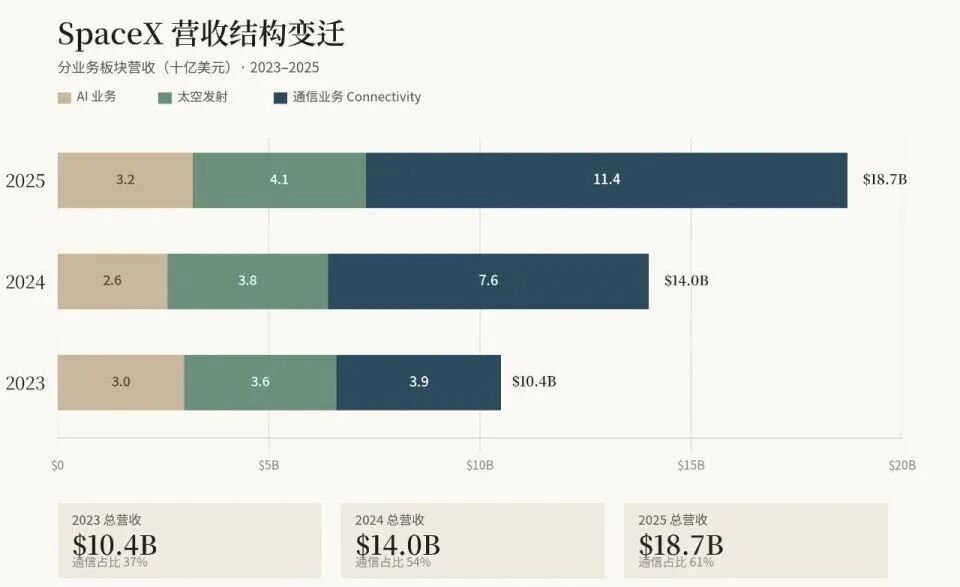
The user base is expanding, but the revenue contributed by each user is shrinking.
If the satellite deployment cost cannot be reduced, the profit margin will be quickly squeezed by these two factors.
Similarly, without the ability to enter orbit at a low cost, the "orbital AI computing power" highly touted in the prospectus is just a concept.
Currently, there is no vehicle on Earth that can complete this task at a commercially reasonable cost.
The Starship is designed to be able to do this, but it has not yet proven itself.
The AI segment, which accounts for the largest part of the $28.5 trillion TAM, is as high as $26.5 trillion. That is to say, the most grand part of the entire valuation narrative depicts something that has not yet been verified in the physical world.
Whether this thing can be verified depends on a rocket that has not yet completed a fully successful flight.
Let's take a look at the other weak links in this loop.
Upon closer examination of the terms of the transactions listed as the pillars of AI revenue in the prospectus, it can be found that their stability is far from what it seems on the surface.
The cloud computing power leasing agreement with Anthropic is $1.25 billion per month until May 2029, but the terms also state that either party can terminate the agreement with 90 days' notice.
90 days, a three - month buffer period.
If Anthropic finds a cheaper computing power solution or its technology roadmap no longer requires such a large - scale centralized training, it can legally stop making payments after 90 days.
Discounting a 90 - day revocable contract in the DCF model over a five - year period is financial engineering, not fundamental analysis.
In addition, in the acquisition of Cursor, the consideration of $60 billion is all paid in SpaceX's Class A shares.
Cursor is an AI programming tool company that has not yet generated large - scale revenue.
SpaceX is essentially using its "currency" with a $1.75 trillion valuation to acquire a target that still needs to burn money to verify its business model. This transaction may potentially tap into a huge market, but in essence, it is a valuation arbitrage, that is, using high - priced stocks to exchange for a highly uncertain future.
If Cursor ultimately fails to succeed, this $60 billion will be an expensive tuition fee.
So, you can see that every connection in this loop is exerting pressure in the same direction.
The profit margin of Starlink depends on the reduction of orbital insertion costs.
The physical foundation of AI depends on the reduction of orbital insertion costs.
The largest figure in the TAM depends on the reduction of orbital insertion costs.
And the only thing that can achieve the reduction of orbital insertion costs is the Starship.
This is why, in the entire trillion - dollar narrative of SpaceX, the Starship is not just one of many growth engines.
It is the factory that determines whether all the engines can be built.
It is the prerequisite for the existence of the entire valuation model.
02 Why Have Almost All the Predictions in the History of Spaceflight Fallen Short?
The capital market has a recurring problem when pricing technological breakthroughs: it always pays for gradual changes as if they were sudden leaps.
In 1970, when NASA promoted the Space Shuttle program to Congress and the public, it promised to reduce the cost of orbital insertion to about $100 per pound.
At that time, the Apollo program had cost an astronomical amount of money, and the public's enthusiasm for the space race was waning. NASA needed a new story to maintain its budget.
The Space Shuttle was portrayed as a revolutionary vehicle. Because it was reusable and could operate like a regular airline, it was supposed to make space travel as common as taking a plane.
What was the actual result? Over the entire operation cycle of the Space Shuttle, the average cost per launch exceeded $1 billion, and the cost per pound of orbital insertion exceeded $10,000.
The gap between the promise and the reality was two full orders of magnitude.
The Space Shuttle did achieve some engineering feats, such as the maintenance of the Hubble Space Telescope and the construction of the International Space Station. However, as a commercial solution to "reduce the cost of orbital insertion," it was a complete failure.
After its retirement, the United States had to rely on Russia's Soyuz spacecraft to send astronauts to the International Space Station for a while.
This is not an isolated case. In the late 1990s, Iridium proposed an exciting plan at the time: to launch 66 low - orbit satellites to form a global communication network. This meant that you could make a phone call in the depths of the Sahara Desert, on the Antarctic ice sheet, or in the middle of the Pacific Ocean.
Motorola was the technical backer of this project, and Wall Street gave it a very high valuation.
In 1998, the Iridium system was officially put into operation, and the company's market value once approached $47 billion.
Unfortunately, Iridium filed for bankruptcy protection in 1999 and was eventually sold for $25 million, less than one - thousandth of its peak valuation.
The reason for the failure was not that the technology was not up to par - 66 satellites were indeed launched, and the system could indeed make phone calls.
The problem was that the construction speed of ground fiber - optic networks and mobile communication base stations far exceeded everyone's expectations.
When you can make a phone call on the streets of New York at a much lower cost, who would buy a satellite phone that costs thousands of dollars and charges by the minute? The cost structure of the space - based system was completely defeated by the evolution speed of the ground - based system.
These two pieces of history point to the same lesson: in the space industry, almost all the so - called technological breakthroughs that claim to "completely change everything" have seriously underestimated the complexity of engineering and the time cycle of commercialization.
Those who made the promises may not have deliberately exaggerated. They were just infected by the charm of the technology and ignored how far the road was from "feasible in the laboratory" to "commercially operational."
Now it's SpaceX's turn.
It seems different from NASA and Iridium.
It is not a traditional space agency driven by government funding, nor is it a PPT company with no satellites.
It has proven that reusable rockets are commercially viable with the Falcon 9. The recovery of the first - stage rocket of the Falcon 9 has reduced the cost of orbital insertion to about $2,700 per kilogram.
Compared with the Space Shuttle's cost of over $50,000 per kilogram, this is an order - of - magnitude reduction.
This is real data, not a prediction.
However, the Starship promises to reduce the cost by another one or two orders of magnitude on this basis.
That is, the cost of orbital insertion per kilogram should drop from $2,700 to $200 or even lower. If this goal is achieved, the cost structure of space travel will really be close to that of container shipping - it's still not cheap, but it's no longer an astronomical figure.
By then, the large - scale deployment of Starlink V3 satellites, the construction of orbital AI data centers, and even the infrastructure construction for Mars colonization proposed by Elon Musk will become economically viable for discussion.
This is the so - called "singularity." Once a certain cost line is crossed, previously impossible business models suddenly become possible. The capital market is essentially paying in advance for this singularity by pricing SpaceX's IPO at $1.75 trillion.
However, the paradox lies in the pace. The cost reduction of the Falcon 9 was an evolutionary process. From its first flight in 2010 to the first successful recovery of the first - stage rocket in 2015, to the realization of reusability in 2017, and to the current maximum of 34 reuses of a single first - stage rocket - this progress took more than a decade.
It took more than a decade of iteration, countless trials and errors, and engineering improvements to achieve the current price of $2,700 per kilogram.
What is the capital market doing?
At the moment of IPO pricing, it has discounted the cost reduction that the Starship still needs several years to prove into today's valuation all at once.
The market expects the Starship to be fully priced in the time of an IPO roadshow, while the Falcon 9 took more than a decade to achieve the same progress.
The uncertainty in this time difference is the biggest source of inflation in the $1.75 trillion valuation.
There is also a problem that most people overlook.
Even if the Starship successfully enters orbit and is recovered, the actual cost depends on the reuse rhythm.
The fastest turnaround record of the Falcon 9 is currently 21 days.
This means that the same rocket can only fly one or two times a month.
The inspection, refurbishment, and component replacement between each flight are all costs.
The design goal of the Starship is "hour - level reuse" - after landing, it can be refueled, the system can be checked, and it can take off again immediately. However, to achieve this goal, the heat shields must hardly need to be replaced, the 33 Raptor engines must withstand repeated ignitions without major overhauls, and the ground facilities of the launch pad must withstand high - frequency impacts and remain intact.
If any of these requirements cannot be met, the reuse rhythm will drop from "several times a day" to "once a week" or even "once a month."
As the reuse rhythm drops, the fixed cost per launch will increase.
The cost reduction curve will change from exponential to linear.
Currently, almost all the valuation models are based on the assumption of exponential cost reduction. The risks and opportunities hidden in this gray area may suddenly emerge in a quarterly earnings report in the future and become the trigger for the market to re - price.
03 Elon Musk: The Biggest Asset and Risk
In addition, according to the prospectus, Musk's shareholding ratio in SpaceX is about 42%. However, because he holds 93.6% of the Class B shares (each with 10 voting rights), he actually controls 85.1% of the total voting rights. After the IPO, this ratio will be slightly diluted, but it will still exceed 50%.
What does this mean? The appointment and removal of board members, major merger and acquisition decisions, capital expenditure directions, and compensation plans - all matters that require shareholder approval are decided by Musk alone. The combined voting power of all other shareholders is not even enough to veto a decision.
The maintenance cost of this governance structure is also surprisingly low. The prospectus reveals that Musk's cash compensation from SpaceX in 2025 was $54,080. For someone in charge of a company valued at $1.75 trillion, this is almost zero compensation.
Of course, no one would think that Musk is just an employee.
His real rewards are written in two incentive plans. One requires SpaceX to build a permanent colony of one million residents on Mars and reach a market value of $7.5 trillion; the other requires the construction of a "non - Earth data center" and a market value of $6.6 trillion. After meeting the conditions, he will receive a total of more than 1.3 billion Class B shares.
A $54,08