Insta360: Redefine cost-effectiveness
Author | Zhang Fan
Stick to Being a Latecomer
Recently, Insta360 released its first annual report after entering the capital market. In 2025, the company achieved an operating revenue of 9.741 billion yuan, a significant year - on - year increase of 74.76%, setting the highest revenue record since its establishment. However, during the same period, due to high expenses in R & D, sales, etc., the company's net profit attributable to the parent company was only 929 million yuan, a year - on - year decrease of 6.62%.
Facing such a financial report with "substantial revenue growth but profit decline", the company held its first investor communication meeting after listing to address the concerns of the capital market.
According to the 2025 annual report, during the reporting period, the revenue of the company's imaging business increased by 78%, mainly due to a significant increase in sales volume. In 2025, the sales volume reached 3.93 million units, a year - on - year increase of 76%. On the other hand, the average product price remained relatively stable at about 2,169 yuan, a year - on - year increase of 1%.
Judging from the ASP trend, the company's products as a whole showed a downward trend, dropping from 2,391.45 yuan per unit in 2022 to 2,147 yuan in 2024 for two consecutive years, but stabilizing in 2025. In the current fierce market competition environment, the main reason for the price stabilization is the boost from the company's active expansion of high - unit - price customers in the B - end market.
Despite the controversy, it is undeniable that even in the face of fierce price competition, the imaging industry remains a sub - industry with high gross profit in the consumer electronics field. According to the 2025 financial report, Insta360's gross profit margin was as high as 48.82%, comparable to that of Ecovacs. However, compared with the gross profit margins of about 20% of mobile phone manufacturers such as Xiaomi and Transsion, Insta360's gross profit margin is about 28 percentage points higher.
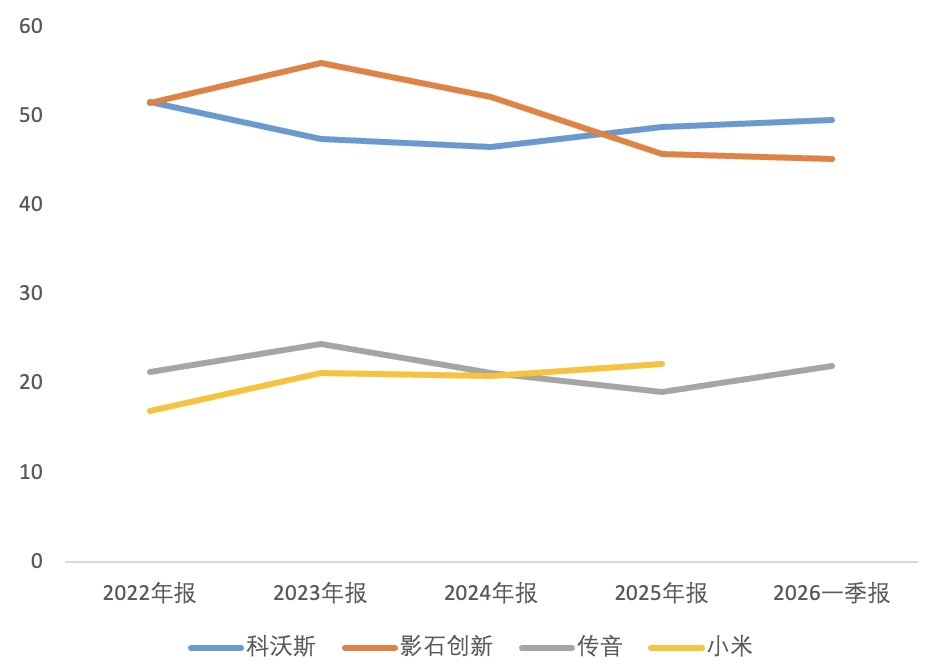
Figure: Gross profit margins of various consumer electronics companies; Source: wind
As the saying goes, "Success comes from high gross profit, and anxiety also comes from high gross profit." Whether the high gross profit margin can be sustained has undoubtedly become the biggest concern of the capital market for Insta360 at present. After all, from the perspective of capital logic, consumer electronics manufacturers share the same supply chain. As a pioneer in the panoramic imaging field, whether the excess profits accumulated by Insta360 through its first - mover advantage and scale effect will follow the development path of new - energy vehicles in the past and be quickly diluted by latecomers has become an issue at hand.
In fact, in recent years, with the slowdown of the growth rate of the consumer electronics industry, various players have been actively exploring new growth curves. Facing the temptation of high gross profit, many peer companies have begun to cross - border test each other. For example, DJI has started to enter Ecovacs' sweeping robot business, and DJI has also stepped up the competition in the panoramic camera market, while mobile phone manufacturers such as OPPO have also targeted DJI's gimbal camera market.
Facing the fierce competition, different manufacturers have chosen different survival paths. For Ecovacs, which mainly focuses on sweeping robots, although its gross profit margin in 2025 was as high as 48.82%, its R & D expense ratio was only 5.15%, while its sales expense ratio was as high as 31.19%. This means that for every 100 yuan of revenue from selling a sweeping robot, Ecovacs can earn 48 yuan in gross profit, but 31 yuan of this 48 yuan is used for advertising and other marketing expenses. From this point of view, Ecovacs' high gross profit depends on the brand effect established by high - volume marketing investment, but the continuously high marketing expenses have also diluted the net profit level. Finally, its net profit margin in 2025 was only 9%.
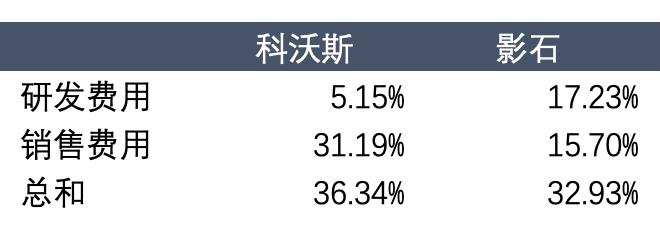
Figure: R & D expense ratio and sales expense ratio of Ecovacs and Insta360; Source: wind
In contrast, Insta360's marketing expense ratio is only half of Ecovacs', but its R & D expense ratio is as high as 17%, more than three times that of Ecovacs. This shows that compared with Ecovacs, Insta360 is more inclined to build its own moat through the technological and product gaps brought about by R & D.
At the financial report communication meeting, Liu Jingkang, the founder of Insta360, also admitted that increasing R & D investment may not be what financial investors want to see, and it also put short - term pressure on the first - quarter performance. However, this is an investment that the company must make in the face of competition to build its long - term value.
In terms of how to balance the risks and returns of R & D, Insta360 basically adopts the "Second Mover" strategy. Under this strategy, Insta360 will not be the first to develop a brand - new product category. Instead, after seeing the prototype of a product in a certain category, it will evaluate the possibility of launching a similar product to reduce the risk of R & D investment.
Compared with the "First Mover", Insta360 is better at redefining "quality - price ratio" by overtaking latecomers. Although the company's product pricing is not low, Insta360 does not "sell a 60 - point product at an 80 - point price", but rather "sells a 150 - point product at a 100 - point price".
For example, Insta360's microphone products are a natural extension of its imaging business, and the business logic risk is controllable. At the same time, Insta360 has achieved stronger product strength than its competitors through a longer sound - collection distance and longer battery life.
Does Insta360 Have an "Apple Dream"?
In the path of building long - term competitiveness, many shadows of Apple's past growth can be seen in Insta360:
1. Self - developed customized chips to strengthen the core hardware barrier and enhance product competitiveness
In addition to the iterative innovation of terminal products, Insta360 has also focused its efforts on the most core chips in the imaging industry. Currently, the company has independently customized and developed three chips. Due to the characteristics of large data computing volume and complex image processing in the imaging business, there are extremely high requirements for the computing power and adaptability of chips. Through customized chips, Insta360 has achieved a deep coupling of hardware and algorithms, which can better fit the usage scenarios of its own products and accurately release hardware performance.
This strategy is exactly the same as Apple's development path in the past. Although Apple adopts a light - asset outsourcing model, it always keeps chip design in its own hands, relying on the chip advantage to widen the hardware gap and build a moat that is difficult for competitors to replicate.
2. Increase investment in software services such as AI to explore long - term growth space
Not limited to self - developed chips, Insta360, like Apple in the past, has also targeted the software service business with high stickiness and high certainty in seeking its own moat. Facing the computing power bottleneck on the terminal side, Insta360 has launched a cloud - based AI image processing service. For example, it allows AI to learn from various well - known camera works to improve the AI's ability to process video files uploaded by users, making video processing more professional; at the same time, it strengthens the camera's follow - up shooting ability through AI technology and provides a series of software supporting services such as cloud data storage.
Insta360 believes that due to the high computing power requirements of imaging, the future industry may rely on AI algorithms far more than on hardware itself.
This has been clearly verified in Apple. After the sales volume of the iPhone reached the ceiling, software services have become Apple's new business pillar. Currently, the revenue of software services accounts for nearly 28% of the total revenue, and it has become Apple's stable second growth curve. Moreover, since the software business usually has the characteristics of high frequency, high gross profit, and strong cash flow, it is regarded by the market as a high - quality "cash cow" business and is also given a higher valuation multiple.
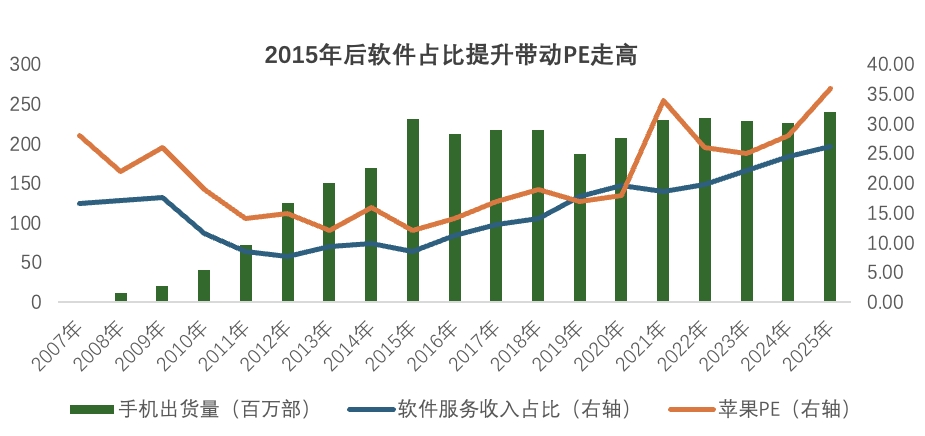
Figure: The increase in the software proportion drives the PE to rise after 2015; Source: wind
Currently, Insta360's increased investment in the AI image software ecosystem is precisely targeting this long - term development dividend. In the future, as the proportion of the software business increases, Insta360 is expected to get rid of the performance constraints of the single hardware sales cycle and complete the strategic transformation from a hardware manufacturer to an ecological platform of "hardware terminal + AI image service".
Relying on the user base accumulated by hardware products as a high - frequency "traffic entrance", and then using high - value - added software services to raise the performance ceiling and deeply leverage the profit space. This strategic transformation replicating the "Apple path" can not only effectively smooth the impact of industry cyclical fluctuations on Insta360's performance, but also is expected to subvert the market's traditional hardware positioning of Insta360 and drive the systematic valuation reshaping of its asset value.
*Disclaimer:
The content of this article only represents the author's views.
The market is risky, and investment should be cautious. In any case, the information in this article or the opinions expressed do not constitute investment advice to anyone. Before making an investment decision, if necessary, investors must consult professionals and make decisions carefully. We have no intention to provide underwriting services or any services that require specific qualifications or licenses for the trading parties.